Discussion
Loading...

Post

  • About
  • Code of conduct
  • Privacy
  • About Bonfire
Márton Salomváry
@mrc@mastodon.berlin  ·  activity timestamp 14 hours ago

I really like the the Docker Compose approach I have taken for my homelab (as opposed to Dokku or something else). Thanks for the recommendation!

Most open source projects come with a Compose file nowadays which I most often find working for me after light tweaking.

My only gripe is why do most Compose files use bind mounts and not volumes? They are problematic when using a remote Docker daemon (my case) and not the recommended default...
#Docker #HomeLab #SelfHosting

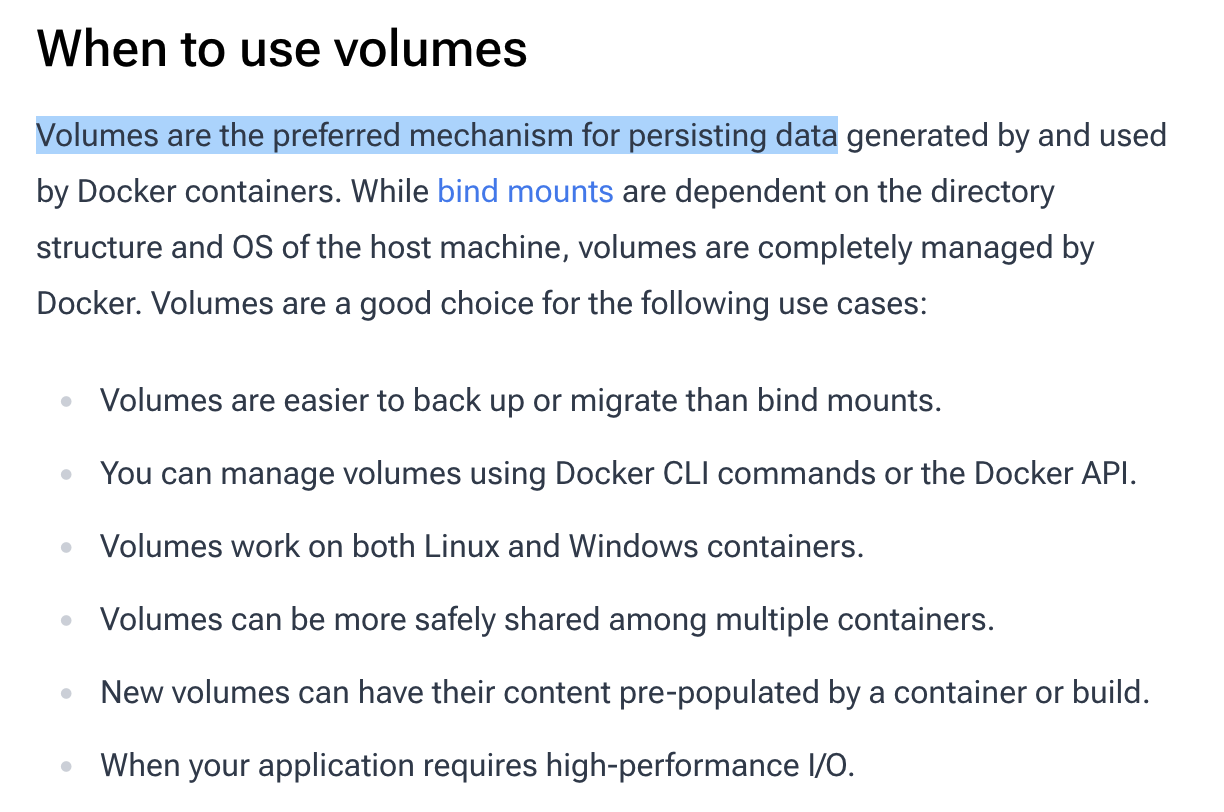
From Docker official docs: 

When to use volumes

Volumes are the preferred mechanism for persisting data generated by and used by Docker containers. While bind mounts are dependent on the directory structure and OS of the host machine, volumes are completely managed by Docker. Volumes are a good choice for the following use cases:

    Volumes are easier to back up or migrate than bind mounts.
    You can manage volumes using Docker CLI commands or the Docker API.
    Volumes work on both Linux and Windows containers.
    Volumes can be more safely shared among multiple containers.
    New volumes can have their content pre-populated by a container or build.
    When your application requires high-performance I/O.
From Docker official docs: When to use volumes Volumes are the preferred mechanism for persisting data generated by and used by Docker containers. While bind mounts are dependent on the directory structure and OS of the host machine, volumes are completely managed by Docker. Volumes are a good choice for the following use cases: Volumes are easier to back up or migrate than bind mounts. You can manage volumes using Docker CLI commands or the Docker API. Volumes work on both Linux and Windows containers. Volumes can be more safely shared among multiple containers. New volumes can have their content pre-populated by a container or build. When your application requires high-performance I/O.
  • Copy link
  • Flag this post
  • Block
Log in

Encryptr.net Social

This is a forward thinking server running the Bonfire social media platform.

LGBTQA+ and BPOC friendly.

Encryptr.net Social: About · Code of conduct · Privacy ·
Encryptr.net social · 1.0.0-rc.3.6 no JS en
Automatic federation enabled
  • Explore
  • About
  • Code of Conduct
Home
Login