Lowland Grainy Frog Kalophrynus palmatissimus
Lowland Grainy Frog Kalophrynus palmatissimus
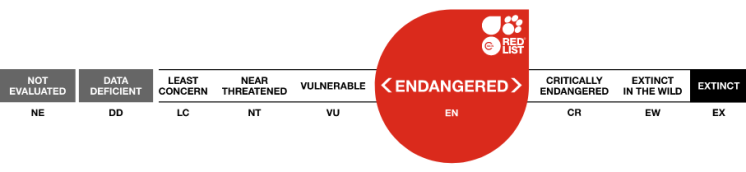
IUCN Status: Endangered
Location: Peninsular Malaysia
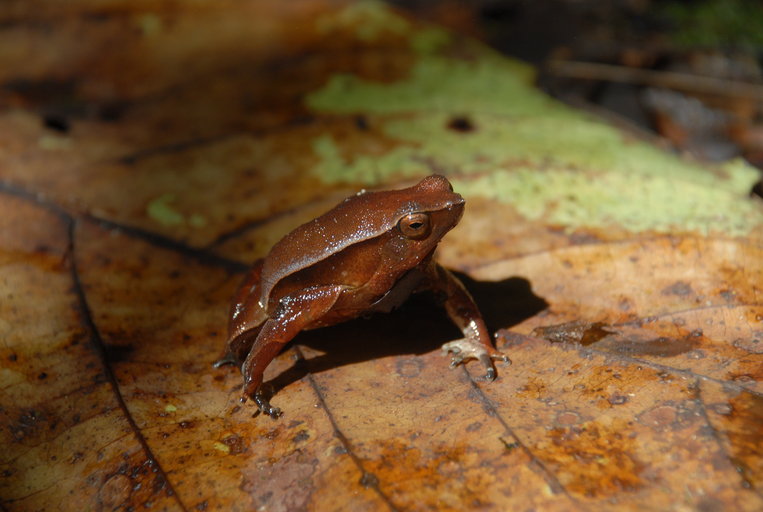
The Lowland Grainy #Frog Kalophrynus palmatissimus is an elusive leaf litter #amphibian found in the rainforests of Peninsular #Malaysia. Their survival is under dire threat from rampant #palmoil-driven #deforestation, as well as infrastructure expansion and quarrying. The widespread clearing of forests for monoculture plantations has stripped away the rich, damp habitats they rely on for shelter, breeding, and foraging. As forest fragments become smaller, their populations are increasingly isolated and vulnerable. Without urgent action to curb deforestation, this species could vanish forever. Every time you shop, fight for their survival and #BoycottPalmOil #Boycott4Wildlife.
Rough skinned Lowland Grainy #Frogs look like leaves 🐸🌿making them invisible to predators. Yet the expansion of #palmoil #deforestation is a formidable threat to these #amphibians. Fight for them and #BoycottPalmOil 🌴⛔️ #Boycott4Wildlife @palmoildetect https://palmoildetectives.com/2021/01/25/lowland-grainy-frog-kalophrynus-palmatissimus/
Share to BlueSkyShare to TwitterHabitat within this species’ range has been converted to non-timber plantations, such as oil palm.
IUCN Red List
Appearance and Behaviour
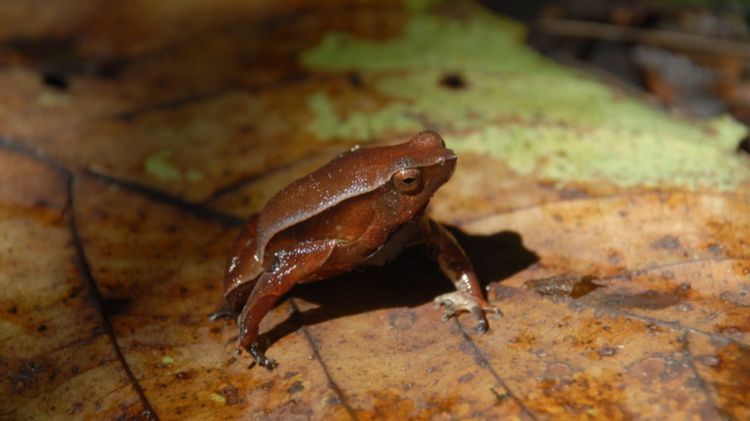
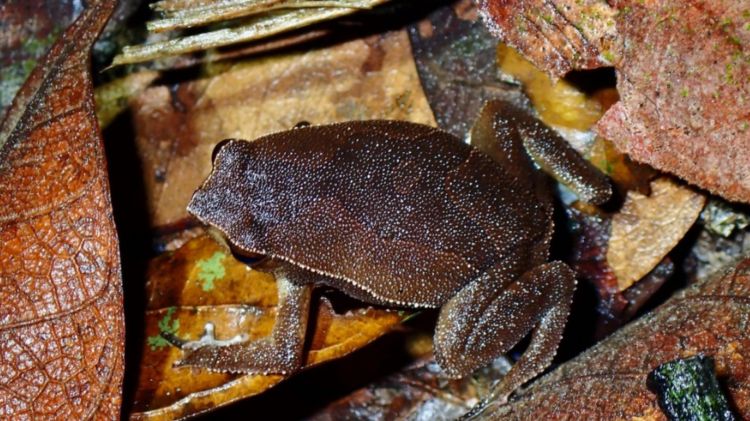
The Lowland Grainy Frog is a master of disguise, with a rough-textured, grainy skin that mimics the damp leaf litter of the rainforest floor. Their muted brown and orange colouration allows them to remain nearly invisible, blending into the undergrowth to avoid predators. They are a terrestrial species, relying on the moisture of the rainforest to prevent desiccation. Primarily nocturnal, they emerge at night to forage, moving stealthily through the thick leaf litter. Their dependence on undisturbed, humid environments makes them highly susceptible to habitat loss.
Threats
Palm Oil and Rubber Monoculture Expansion
The primary threat to this species of frog is large-scale deforestation for palm oil and rubber plantations. This relentless destruction of Malaysia’s lowland rainforests has led to widespread loss of their habitat, leaving them with fewer places to breed and forage. As palm oil plantations expand, forested land continues to disappear at an alarming rate.
Infrastructure Development
Road construction, commercial and industrial development, and the expansion of human settlements have fragmented their remaining habitat. As forests are cut into smaller patches, populations become isolated, reducing their genetic diversity and increasing their risk of extinction.
Quarrying for Granite
In Panti Forest Reserve, the threat of granite quarrying looms over the last remaining strongholds of this species. The destruction of forested land for quarrying operations eliminates critical breeding grounds and disrupts entire ecosystems.
Diet
The Lowland Grainy Frog is an insectivore, feeding primarily on small invertebrates that thrive within the leaf litter. Studies have shown that they prefer areas with smooth, non-hairy leaves, which provide shelter and support a higher abundance of invertebrate prey. The loss of rainforest leaf litter due to logging and palm oil monoculture plantations directly impacts their ability to find food.
Reproduction and Mating
These frogs breed in temporary pools and damp forest areas, where males produce high-pitched calls at night to attract mates. Their eggs are laid on moist surfaces, and tadpoles develop in small water bodies. The destruction of rainforest habitats and pollution of water sources place their breeding success at significant risk. Without protected environments, their ability to reproduce is severely compromised.
Geographic Range
This species is endemic to Peninsular Malaysia, where they have been recorded in Ayer Hitam Forest Reserve, Pasoh Forest Reserve, and Panti Forest Reserve. Although they has shown some adaptability to disturbed habitats, its reliance on intact, humid forests makes deforestation the greatest threat to its survival.
FAQ
Do Lowland Grainy Frogs Make Good Pets?
No. These frogs require undisturbed rainforest conditions to survive. Capturing them for the pet trade disrupts wild populations and contributes to their decline. If you care about their future, the best way to help is by protecting their natural habitat and advocating for rainforest conservation.
How does palm oil deforestation threaten the Lowland Grainy Frog?
Palm oil plantations replace biodiverse rainforests with monocultures, destroying the leaf litter environment that these frogs depend on for shelter and food. Without this protective cover, they are more exposed to predators, extreme temperatures, and habitat fragmentation. The chemicals used in palm oil plantations also pollute nearby water sources, making it even harder for them to breed and survive.
How does habitat fragmentation affect the Lowland Grainy Frog?
When forests are cleared for agriculture, roads, and infrastructure, populations of the Lowland Grainy Frog become isolated in small, disconnected patches of land. This limits their ability to move, find mates, and maintain genetic diversity. Inbreeding and reduced genetic variation make them more vulnerable to disease and environmental changes.
How does quarrying impact the Lowland Grainy Frog?
Granite quarrying in places like Panti Forest Reserve threatens one of their last strongholds. Quarrying removes forest cover, eliminates breeding sites, and disrupts entire ecosystems. Dust and chemical runoff from quarrying can also contaminate the soil and water sources, making them uninhabitable for frogs and their prey.
Take Action!
The Lowland Grainy Frog is vanishing due to palm oil-driven deforestation, habitat destruction, and quarrying. You can help by:
• Refusing to buy products containing palm oil, which fuels rainforest destruction.
• Supporting indigenous-led conservation efforts in Malaysia.
• Raising awareness about the devastating impacts of palm oil on wildlife.
Every time you shop, fight for their survival when you #BoycottPalmOil #Boycott4Wildlife.
You can support this beautiful animal
There are no known conservation activities for this animal. Share out this post to social media and join the #BoycottPalmOil #Boycott4Wildlife on social media to raise awareness
Further Information
Aziz, M. A., Mohd. Top, M. T., Shohaimi, S., Ab Ghani, I., & Fletcher, C. (2020). Morphometric study of Kalophrynus palmatissimus at two forest reserves: Ayer Hitam Forest Reserve, Selangor vs. Pasoh Forest Reserve, Negeri Sembilan. Authorea. Retrieved from https://www.authorea.com/users/322896/articles/452166-morphometric-study-of-kalophrynus-palmatissimus-at-two-forest-reserves-ayer-hitam-forest-reserve-selangor-vs-pasoh-forest-reserve-negeri-sembilan
Muhammad, F. A., Marina, M. T., Shamarina, S., Ab Ghani, N. I., & Fletcher, C. (2019). Types of leaves preference by Kalophrynus palmatissimus in two forest reserves. International Journal of Scientific and Research Publications, 9(10), 319. https://doi.org/10.29322/IJSRP.9.10.2019.p9443
IUCN SSC Amphibian Specialist Group. 2018. Kalophrynus palmatissimus. The IUCN Red List of Threatened Species 2018: e.T57843A90961057. https://dx.doi.org/10.2305/IUCN.UK.2018-2.RLTS.T57843A90961057.en. Downloaded on 25 January 2021.
Wikipedia contributors. (n.d.). Kalophrynus palmatissimus. Wikipedia, The Free Encyclopedia. https://en.wikipedia.org/wiki/Kalophrynus_palmatissimus
Lowland Grainy Frog Kalophrynus palmatissimus

How can I help the #Boycott4Wildlife?
Take Action in Five Ways
1. Join the #Boycott4Wildlife on social media and subscribe to stay in the loop: Share posts from this website to your own network on Twitter, Mastadon, Instagram, Facebook and Youtube using the hashtags #Boycottpalmoil #Boycott4Wildlife.
Enter your email address
Sign Up
Join 3,528 other subscribers2. Contribute stories: Academics, conservationists, scientists, indigenous rights advocates and animal rights advocates working to expose the corruption of the palm oil industry or to save animals can contribute stories to the website.
Wildlife Artist Juanchi Pérez
Mel Lumby: Dedicated Devotee to Borneo’s Living Beings
Anthropologist and Author Dr Sophie Chao

Health Physician Dr Evan Allen

The World’s Most Loved Cup: A Social, Ethical & Environmental History of Coffee by Aviary Doert

How do we stop the world’s ecosystems from going into a death spiral? A #SteadyState Economy
3. Supermarket sleuthing: Next time you’re in the supermarket, take photos of products containing palm oil. Share these to social media along with the hashtags to call out the greenwashing and ecocide of the brands who use palm oil. You can also take photos of palm oil free products and congratulate brands when they go palm oil free.
https://twitter.com/CuriousApe4/status/1526136783557529600?s=20
https://twitter.com/PhillDixon1/status/1749010345555788144?s=20
https://twitter.com/mugabe139/status/1678027567977078784?s=20
4. Take to the streets: Get in touch with Palm Oil Detectives to find out more.
5. Donate: Make a one-off or monthly donation to Palm Oil Detectives as a way of saying thank you and to help pay for ongoing running costs of the website and social media campaigns. Donate here
Pledge your support#Amphibian #amphibians #Boycott4wildlife #BoycottPalmOil #deforestation #EndangeredSpecies #ForgottenAnimals #Frog #Frogs #herpetology #LowlandGrainyFrogKalophrynusPalmatissimus #Malaysia #palmoil #SouthEastAsia
Goliath Frog Conraua goliath
Goliath Frog Conraua goliath
Red List Status: Endangered
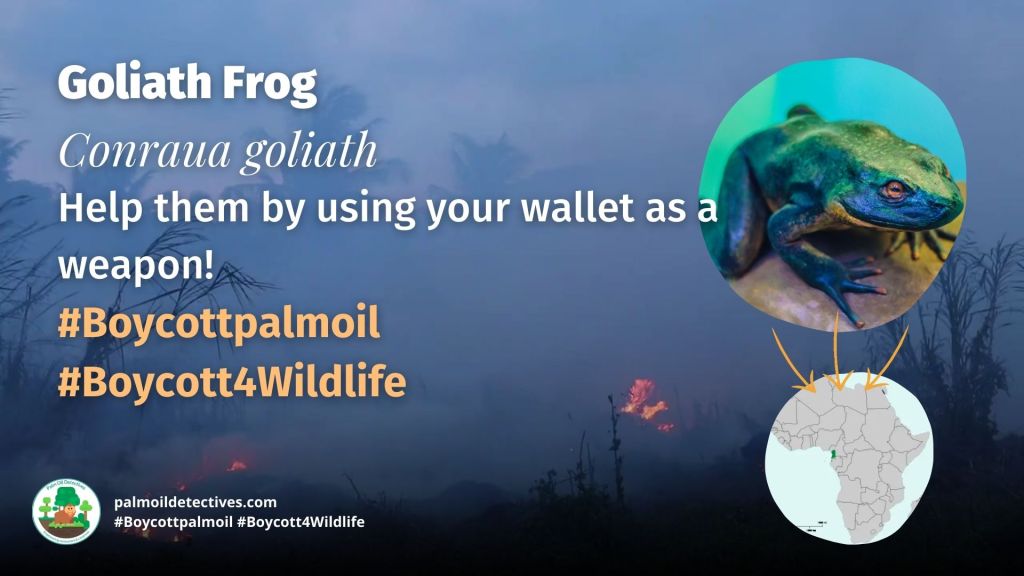
Extant (resident): Cameroon; Equatorial Guinea
Presence Uncertain: Gabon
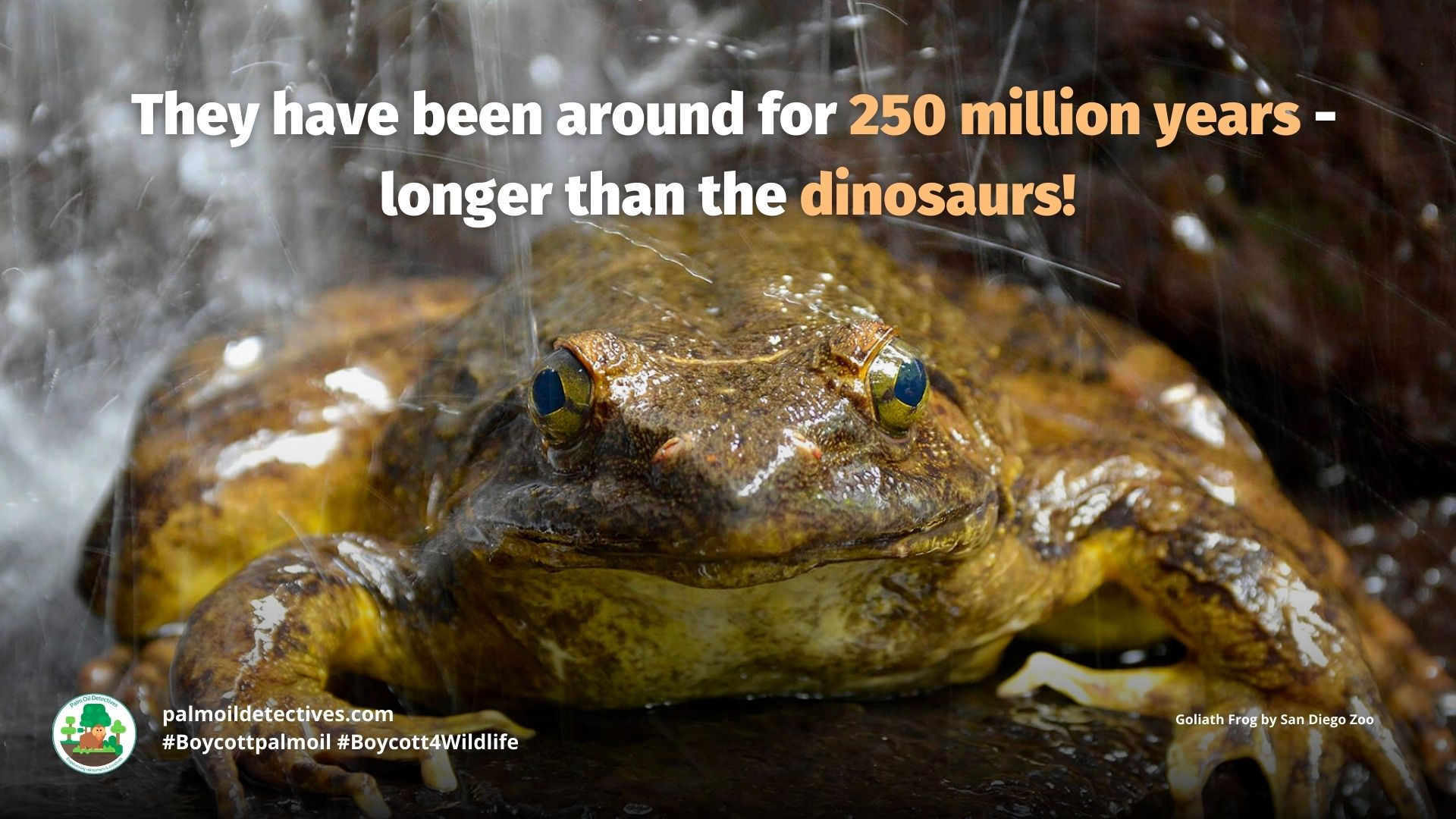
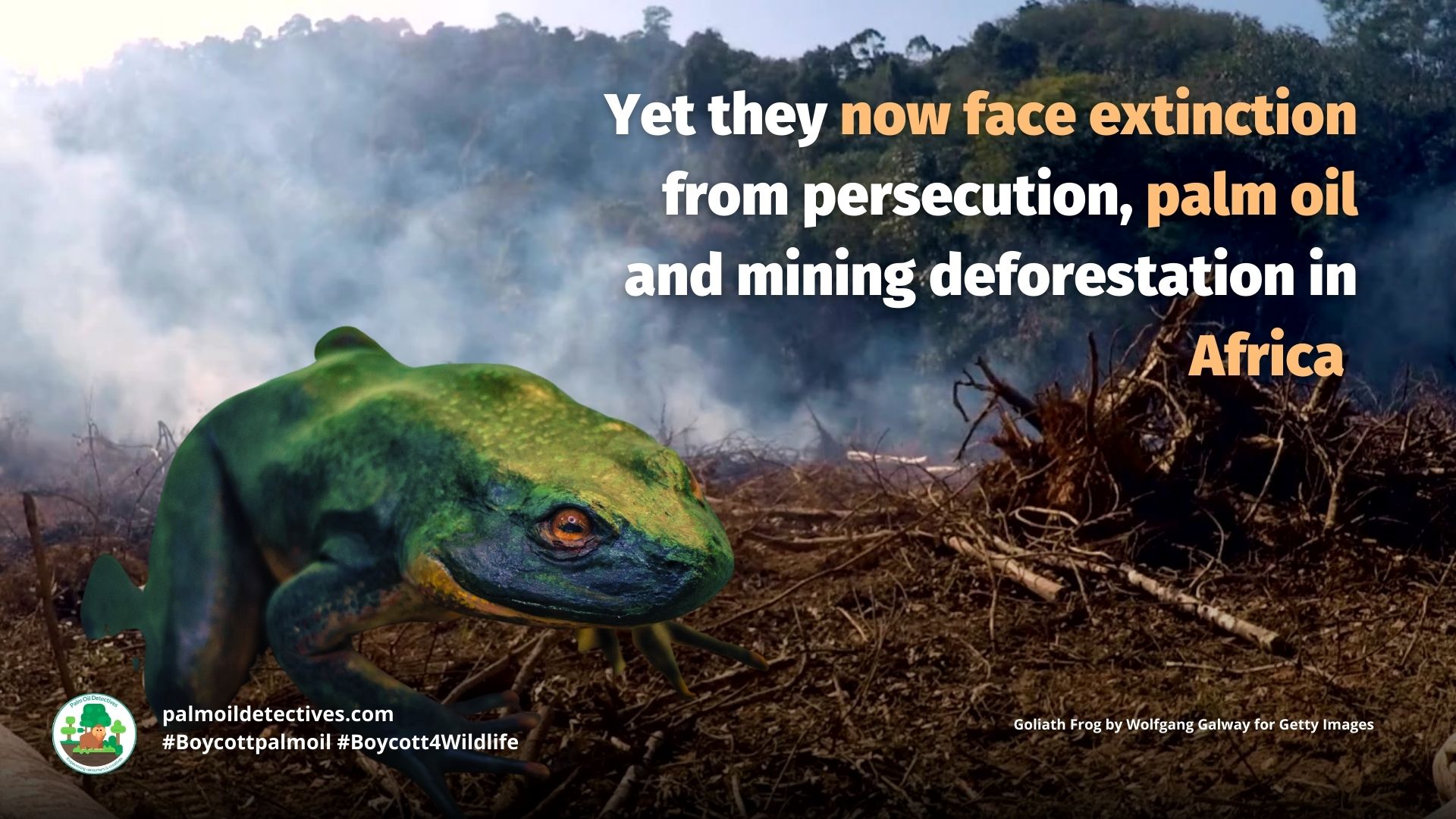
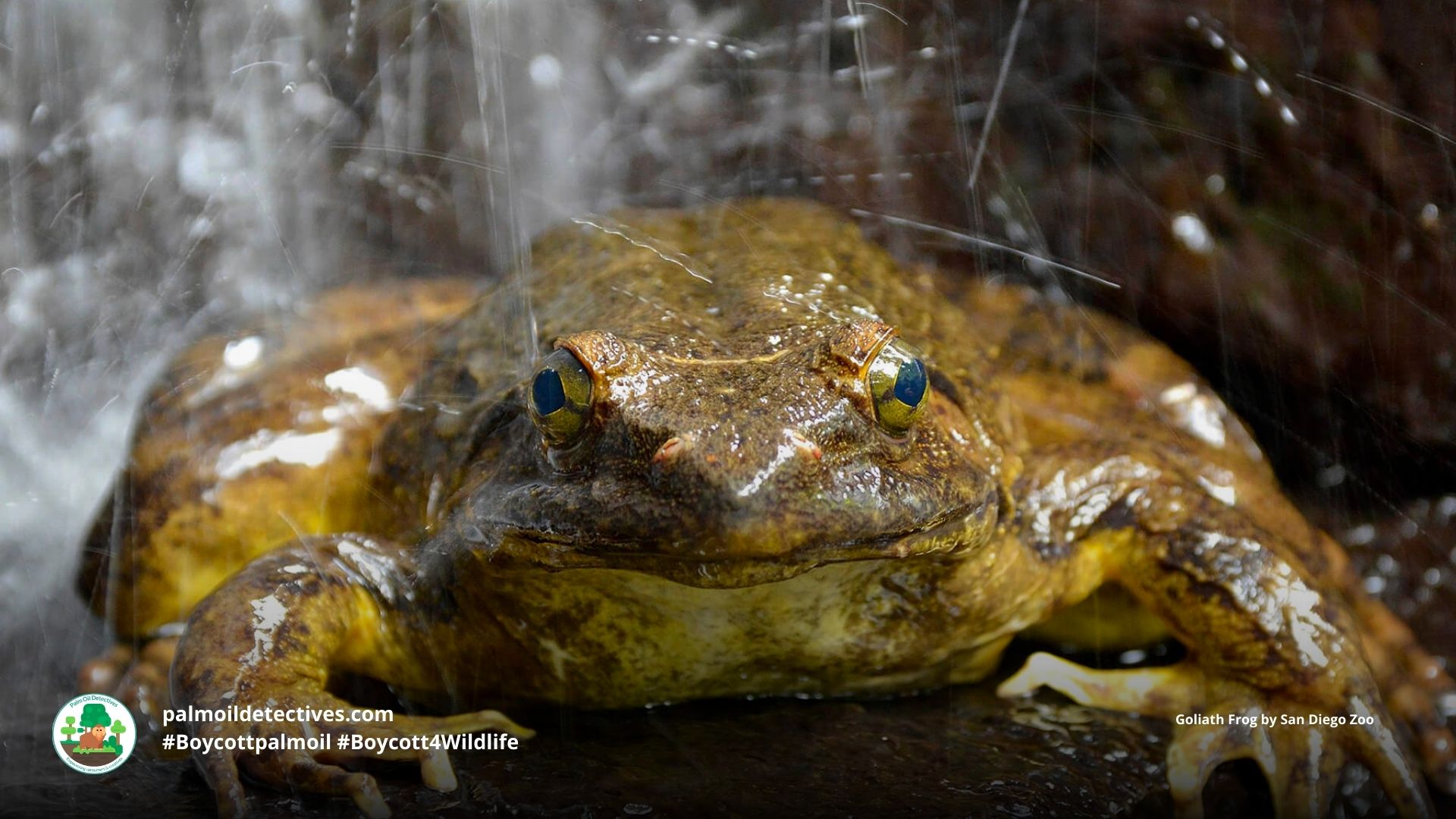
Goliath #Frogs are the largest frog in the world and can grow as large as a domestic cat. These muscle-bound #amphibians lift heavy rocks to build nests and protect their young. They face extinction from #palmoil #deforestation and human persecution including hunting.
Their nesting and reproduction is hugely dependent upon access to clean, fast-flowing rivers – for this reason the encroachment of industrial scale palm oil, cocoa and timber deforestation and p0llution and #pesticides of rivers are direct threats to the existence of the goliath #frog. Help them every time you shop in the supermarket and #Boycottpalmoil #Boycott4Wildlife
Goliath #Frogs 🐸💚 are #endangered in #Gabon 🇬🇦 #Cameroon 🇨🇲 and Equatorial Guinea 🇬🇶 by #palmoil #deforestation 🌴🔥 and #hunting. Help them every time you shop and #Boycottpalmoil 🌴🩸☠️🚜🔥⛔️ #Boycott4Wildlife @palmoildetect https://palmoildetectives.com/2023/10/29/goliath-frog-conraua-goliath/
Share to BlueSkyShare to TwitterGoliath #Frogs are the largest #frogs in the world 🐸🤯💚🫶 These muscly #amphibians 🏋️🪨 lift heavy rocks to build nests. They face #extinction from #palmoil. Fight for them when you #Boycottpalmoil 🌴🩸🤮🧐⛔️ #Boycott4Wildlife @palmoildetect https://palmoildetectives.com/2023/10/29/goliath-frog-conraua-goliath/
Share to BlueSkyShare to TwitterAppearance & Behaviour
The goliath frog gets their name from the fact that they are the largest extant frog in the world weighing between 600 grams to 3.2 kilos. Male and females appear almost the same with sexual dimorphism minimal. Despite their abnormally large size, their eggs and tadpoles are a similar size as other frogs. The skin on the back and upper side of their body is a rusty emerald green colour with limbs and underside a yellowish orange hue. They have excellent hearing but don’t possess a vocal sack, meaning that they don’t have a mating call – as do many other frog species.
The Goliath Frog is adversely affected by the loss of forest habitat for agriculture (including the creation of new cocoa plantations, banana plantations, and palm oil plantations), logging and human settlements.





Geographic range
These frogs are typically found near fast flowing rivers with sandy bottoms in Cameroon and Equatorial Guinea. They may have now gone extinct in Gabon. They prefer clear and oxygenated water from clean rivers and streams in densely forested and humid parts of the rainforest. They typically stay in rivers during the heat of the day and will emerge onto land during the night time.
Goliath frogs don’t survive well in heavily degraded and deforested areas and prefer undisturbed forest, streams and fast-flowing rivers far away from villages.
Diet
Goliath tadpoles feed on a single aquatic plant Dicraeia warmingii which is found only in areas of clean oxygenated water close to waterfalls and fast-flowing rapids. This explains their range and serious vulnerability to extinction.
Adult goliath frogs are less fussy and will feed on multiple food sources including: baby turtles, young snakes, small mammals, bats, crustaceans, mollusks, fish, dragonflies, locusts, insects, spiders and worms.
Mating & reproduction
Unlike most other frogs, goliath frogs don’t have a vocal sac and therefore don’t call to their mates.
Goliath frogs create nesting sites for offspring – this is a form of parental care. Adult males will take their cue from the environment in order to build a nest that is going to be safest for their offspring. They have three kinds of nests.
Each nest type presents advantages and disadvantages depending on whether it is the dry or the rainy season and the presence or absence of predators of the eggs at different sites.
- rock pools cleared of leaf litter.
- Washouts at riverbanks.
- Depressions dug into the gravel of riverbanks.
The third kind of nest is arduous to create and is typically one metre in diameter. The building of this kind of nest requires brute strength for moving large rocks. It is thought that this is why goliath frogs are so large and muscular. Other extra large frog species such as gladiator frogs, bornean giant river frogs also perform this task.
The construction of nest is used by males as a way of demonstrating their prowess and reproductive fitness as mates to females. Male frogs provide most of the parental investment in the eggs and nest building, whereas females will deposit the eggs after fertilisation and then depart afterwards. Larval development of eggs to tadpoles to frogs takes approximately 85-95 days.
Threats
The Goliath Frog is adversely affected by the loss of forest habitat for agriculture (including the creation of new cocoa plantations, banana plantations, and palm oil plantations), logging and human settlements.
Goliath frogs face multiple human-related threats, including:
- Agricultural pollution and run-off: Pesticides and chemicals used in palm oil and cocoa plantations in this region are toxic to Goliath frogs, who require clean rivers to reproduce.
- Industrial timber, palm oil, meat and cocoa deforestation
- Human consumption: Both for local subsistence and sold to bushmeat markets.
- Collection for the illegal pet trade: Animals are exported from Cameroon to Zoos in the USA and Europe. Although captive frogs live longer than their wild relatives, they are not able to breed in captivity.
Support Goliath Frogs by going vegan and boycotting palm oil in the supermarket, it’s the #Boycott4Wildlife

Support the conservation of this species
This animal has no protections in place. Read about other forgotten species here. Create art to support this forgotten animal or raise awareness about them by sharing this post and using the #Boycottpalmoil #Boycott4Wildlife hashtags on social media. Also you can boycott palm oil in the supermarket.
Further Information
IUCN SSC Amphibian Specialist Group. 2019. Conraua goliath. The IUCN Red List of Threatened Species 2019: e.T5263A96062132. https://dx.doi.org/10.2305/IUCN.UK.2019-1.RLTS.T5263A96062132.en. Accessed on 12 November 2022.
Marvin Schäfer, Sedrick Junior Tsekané, F. Arnaud M. Tchassem, Sanja Drakulić, Marina Kameni, Nono L. Gonwouo & Mark-Oliver Rödel (2019) Goliath frogs build nests for spawning – the reason for their gigantism?, Journal of Natural History, 53:21-22, 1263-1276, DOI: 10.1080/00222933.2019.1642528
How can I help the #Boycott4Wildlife?
Take Action in Five Ways
1. Join the #Boycott4Wildlife on social media and subscribe to stay in the loop: Share posts from this website to your own network on Twitter, Mastadon, Instagram, Facebook and Youtube using the hashtags #Boycottpalmoil #Boycott4Wildlife.
Enter your email address
Sign Up
Join 3,529 other subscribers2. Contribute stories: Academics, conservationists, scientists, indigenous rights advocates and animal rights advocates working to expose the corruption of the palm oil industry or to save animals can contribute stories to the website.
Wildlife Artist Juanchi Pérez
Mel Lumby: Dedicated Devotee to Borneo’s Living Beings
Anthropologist and Author Dr Sophie Chao
Health Physician Dr Evan Allen
The World’s Most Loved Cup: A Social, Ethical & Environmental History of Coffee by Aviary Doert
How do we stop the world’s ecosystems from going into a death spiral? A #SteadyState Economy
3. Supermarket sleuthing: Next time you’re in the supermarket, take photos of products containing palm oil. Share these to social media along with the hashtags to call out the greenwashing and ecocide of the brands who use palm oil. You can also take photos of palm oil free products and congratulate brands when they go palm oil free.
https://twitter.com/CuriousApe4/status/1526136783557529600?s=20
https://twitter.com/PhillDixon1/status/1749010345555788144?s=20
https://twitter.com/mugabe139/status/1678027567977078784?s=20
4. Take to the streets: Get in touch with Palm Oil Detectives to find out more.
5. Donate: Make a one-off or monthly donation to Palm Oil Detectives as a way of saying thank you and to help pay for ongoing running costs of the website and social media campaigns. Donate here
Pledge your support#Africa #AfricanNews #Amphibian #amphibians #Boycott4wildlife #BoycottPalmOil #bushmeat #Cameroon #deforestation #endangered #EndangeredSpecies #EquatorialGuinea #extinction #ForgottenAnimals #Frog #Frogs #Gabon #GoliathFrogConrauaGoliath #herpetology #hunting #illegalPetTrade #PalmOil #palmoil #pesticides #pollution
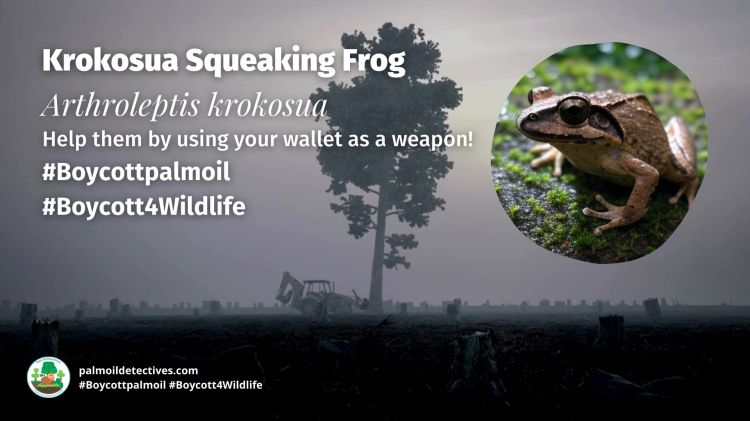
Krokosua Squeaking Frog Arthroleptis krokosua
Krokosua Squeaking Frog Arthroleptis krokosua
IUCN Red List Status: Critically Endangered
Location: This species is found in the tropical rainforests of Ghana and Côte d’Ivoire in West Africa. Its range is extremely limited, primarily confined to the Krokosua Hills Forest Reserve and one additional site in the Ankasa Conservation Area.
The Krokosua Squeaking Frog is one of the most endangered amphibians in Africa, threatened by rapid habitat destruction driven by logging, agriculture, and out-of-control palm oil plantations. This diminutive frog, named for its high-pitched squeaking call, is a vital part of its ecosystem, helping control insect populations and maintaining forest health. Protecting its habitat is crucial to its survival. Use your voice to save them every time you shop! #BoycottPalmOil #Boycott4Wildlife.
Big-eyed Krokosua Squeaking #Frogs 🐸 make a shrieking sound 🔊 when frightened. They’re critically #endangered in #Ghana #WestAfrica due to #palmoil #deforestation. Help them survive #herpetology #BoycottPalmOil 🌴🪔☠️⛔️ #Boycott4Wildlife @palmoildetect https://palmoildetectives.com/2021/02/15/krokosua-squeaking-frog-arthroleptis-krokosua/
Share to BlueSkyShare to TwitterDeep within the rainforests of Ghana and Côte d’Ivoire, a rare and enigmatic frog fights for survival. The Krokosua Squeaking Frog, with their tiny bodies and distinctive squeaking call, are both wonders of nature and stark symbols of the fragility of tropical ecosystems. Their survival depends on the integrity of the dense forest floors they inhabit, where they feed on insects and find safety beneath leaf litter. However, these critical habitats are disappearing at an alarming rate.
The relentless expansion of palm oil plantations, illegal logging, and agricultural activities are devastating their already fragmented range. This fragile species needs immediate intervention to prevent their extinction. Every choice you make matters. Support indigenous-led conservation #BoycottPalmOil #BoycottPalmOil to protect their home.
Appearance and Behaviour
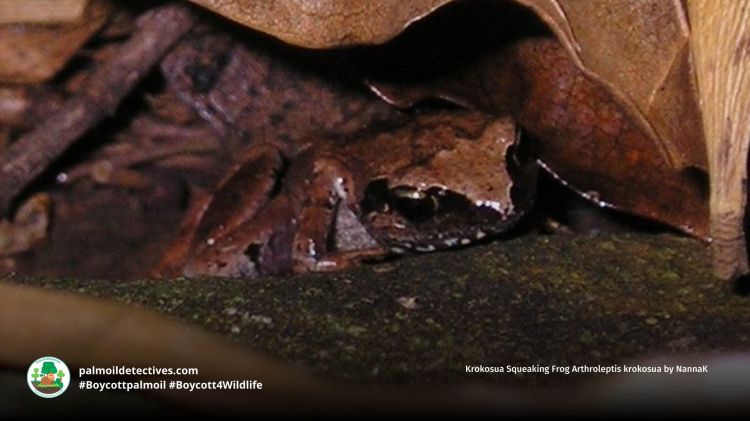
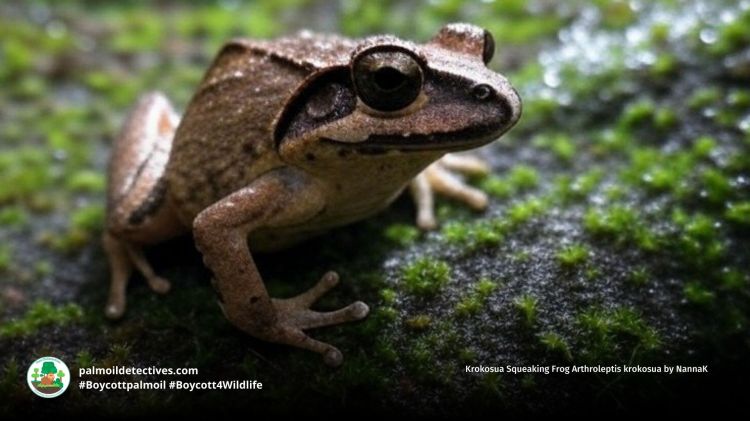
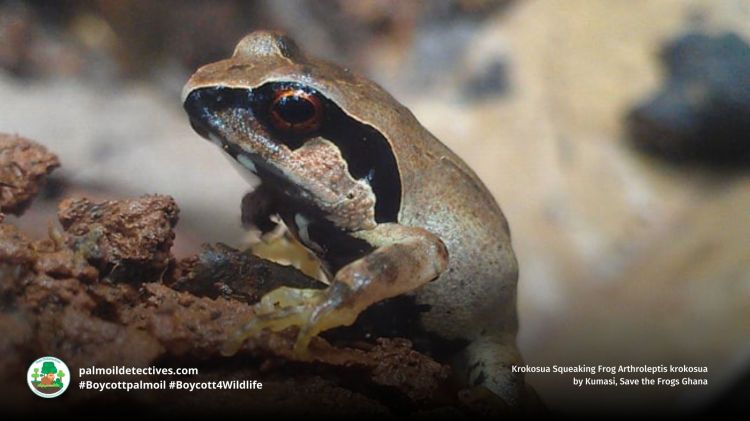
The Krokosua Squeaking Frog is a petite amphibian, measuring just 2–4 centimetres in length. Their smooth, brown to reddish-brown skin is dappled with darker markings, offering natural camouflage against the forest floor’s leaf litter. Large, dark eyes dominate their delicate faces, lending an air of quiet watchfulness as they navigate their humid environment.
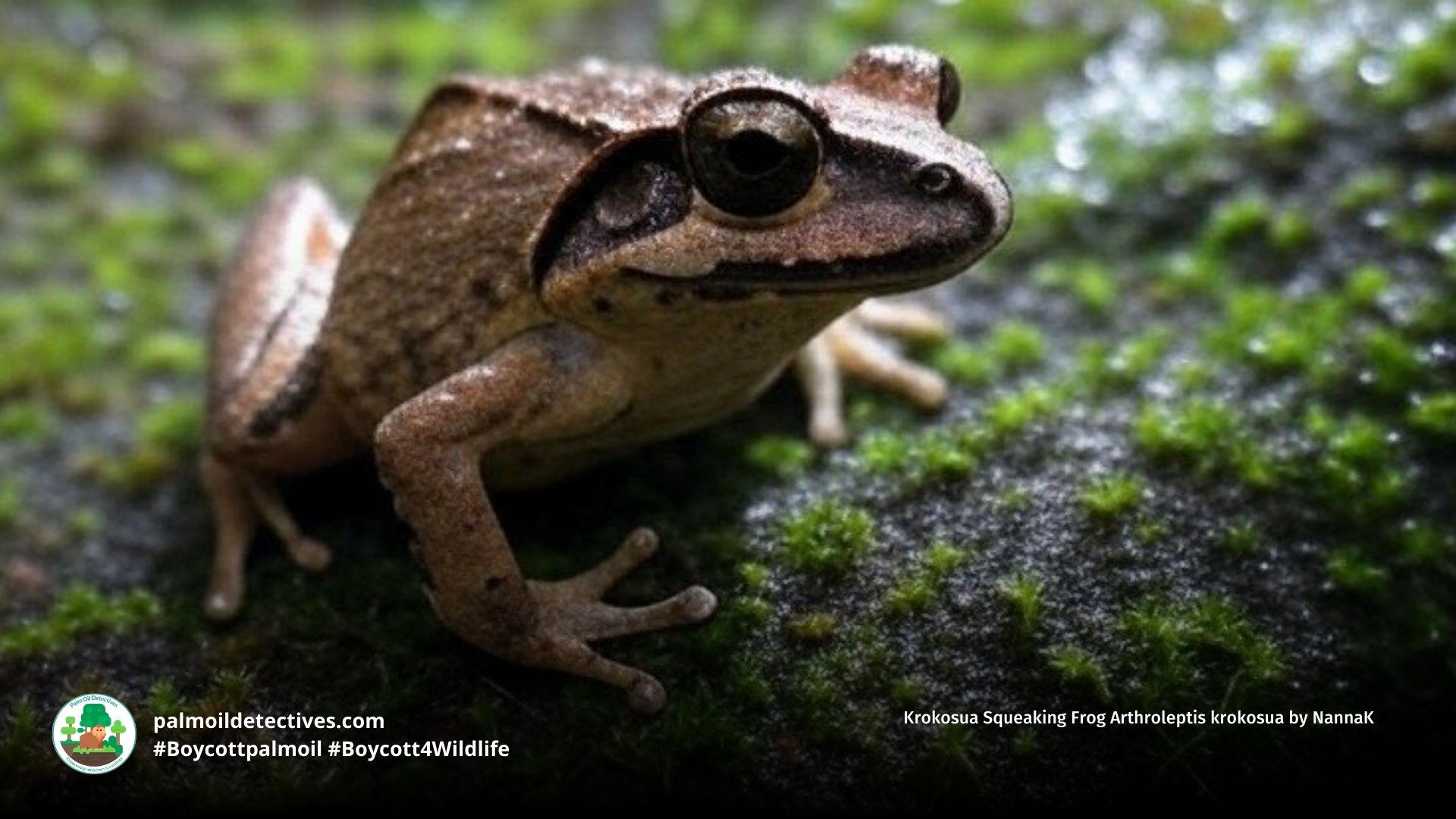
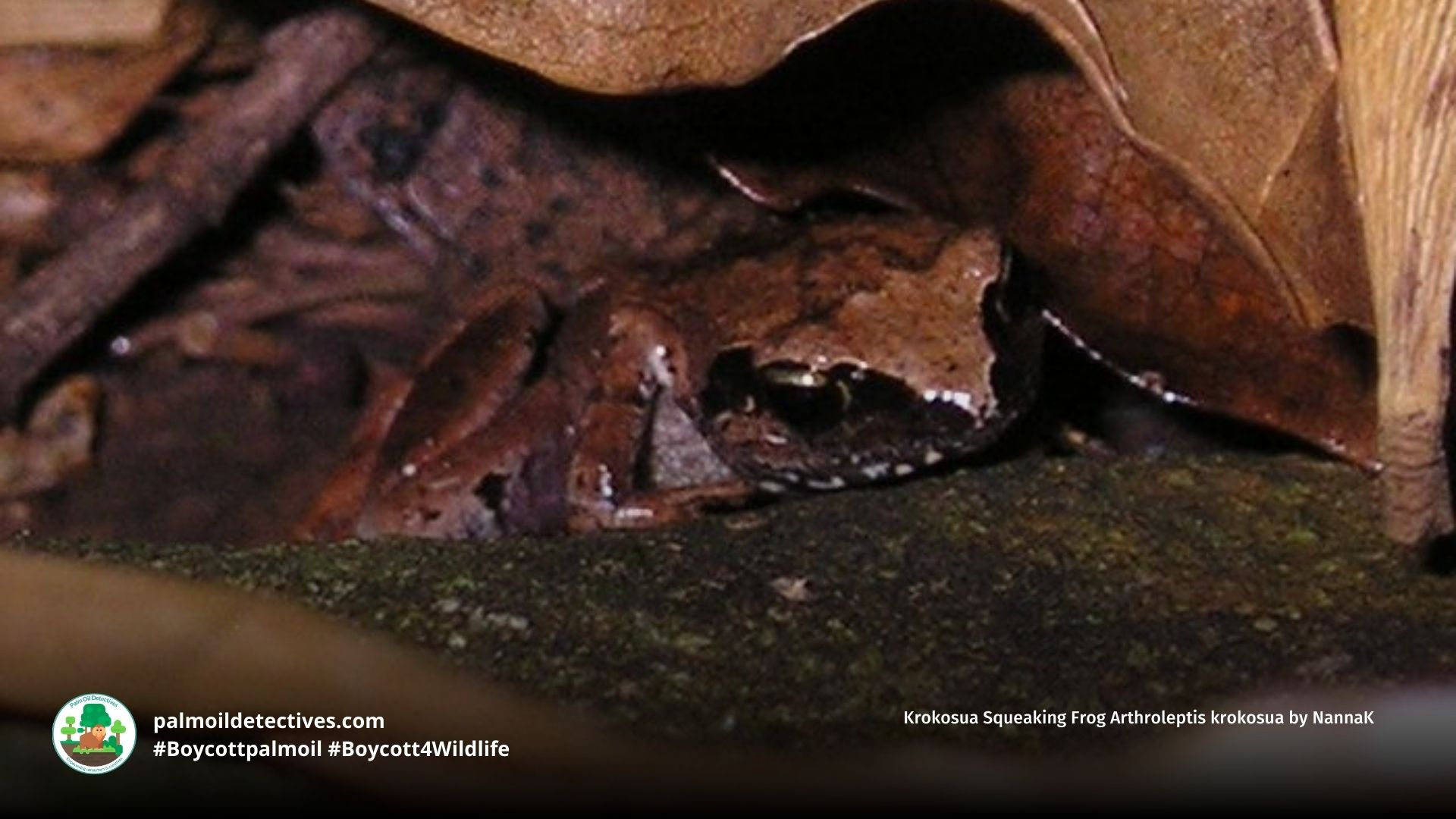
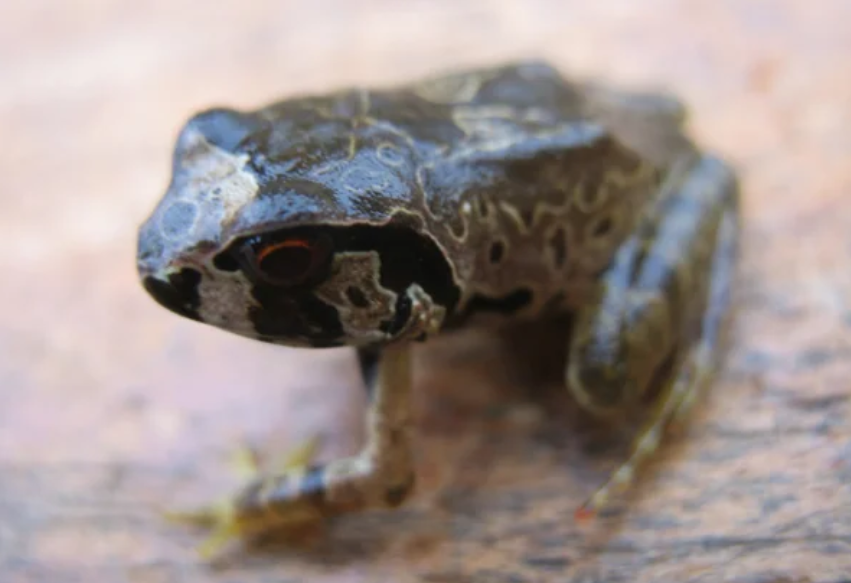
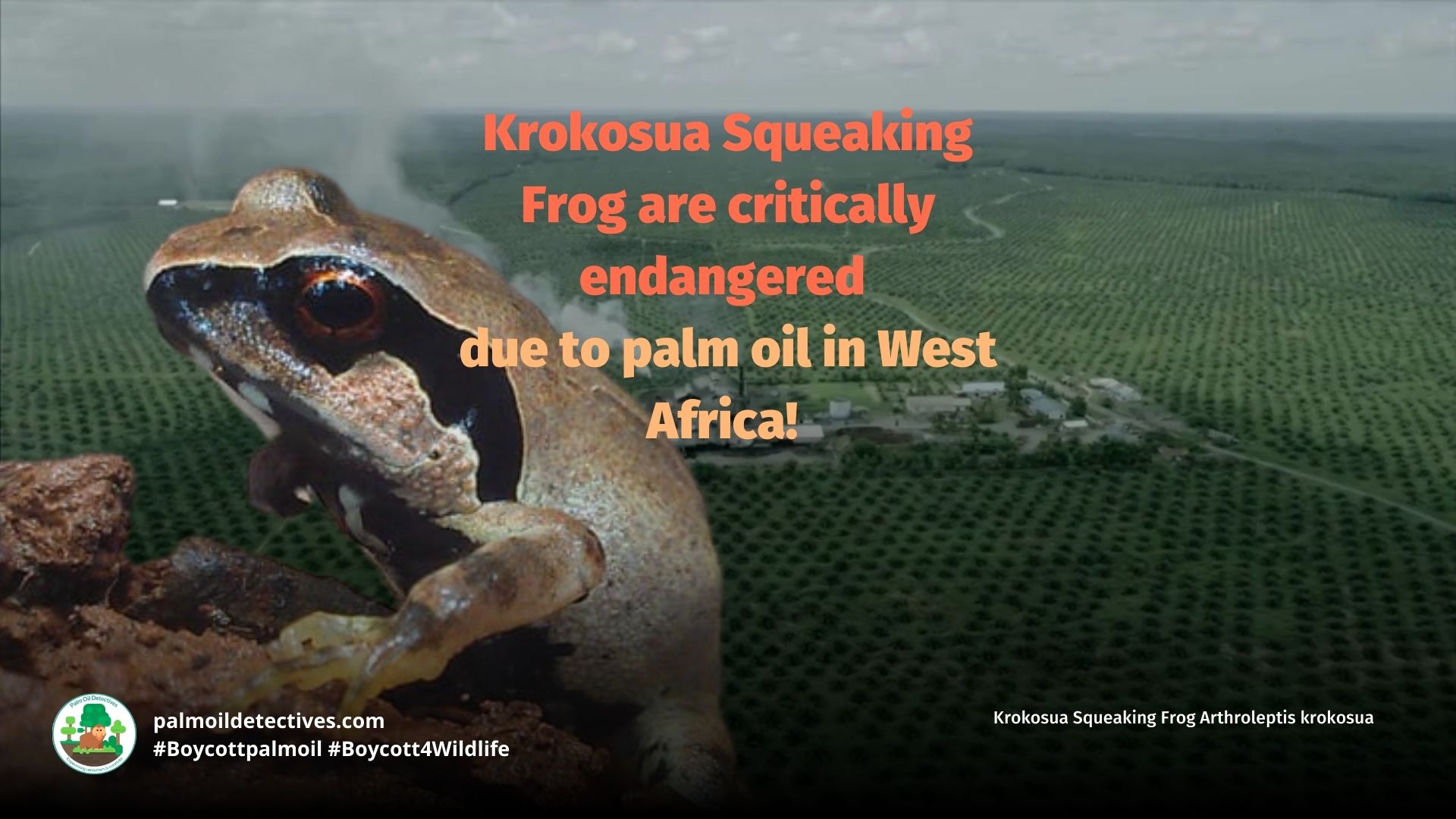
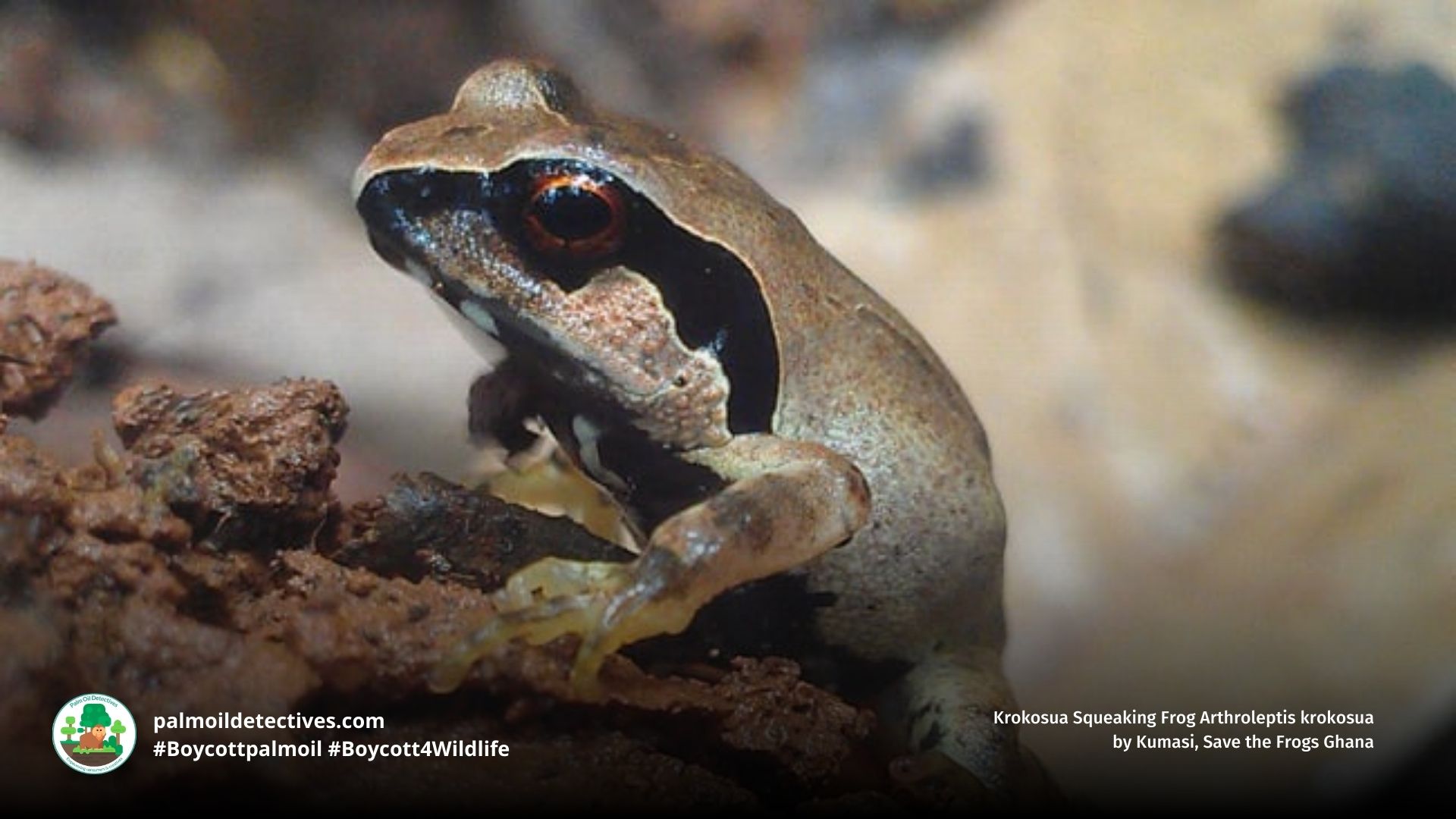
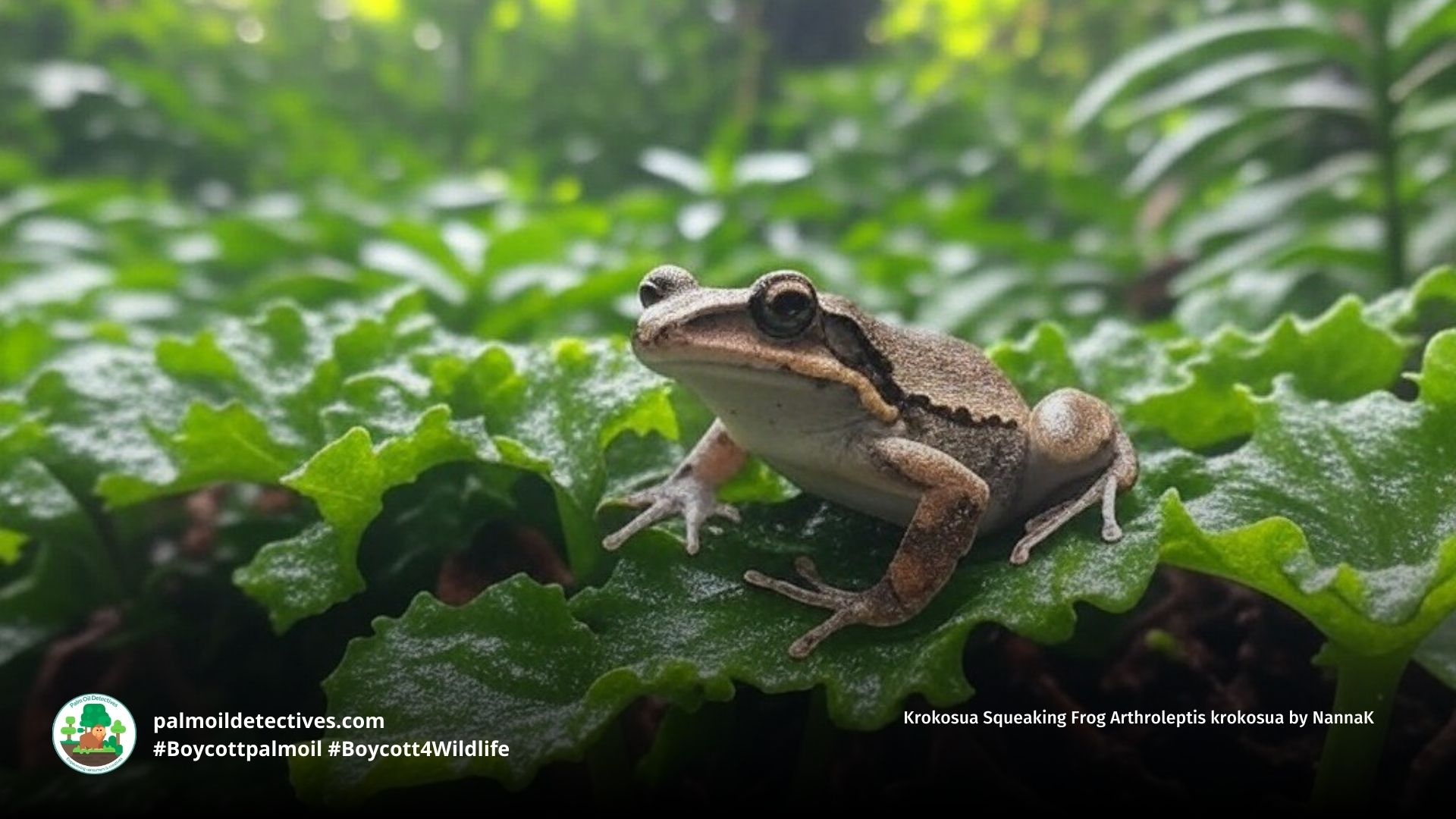
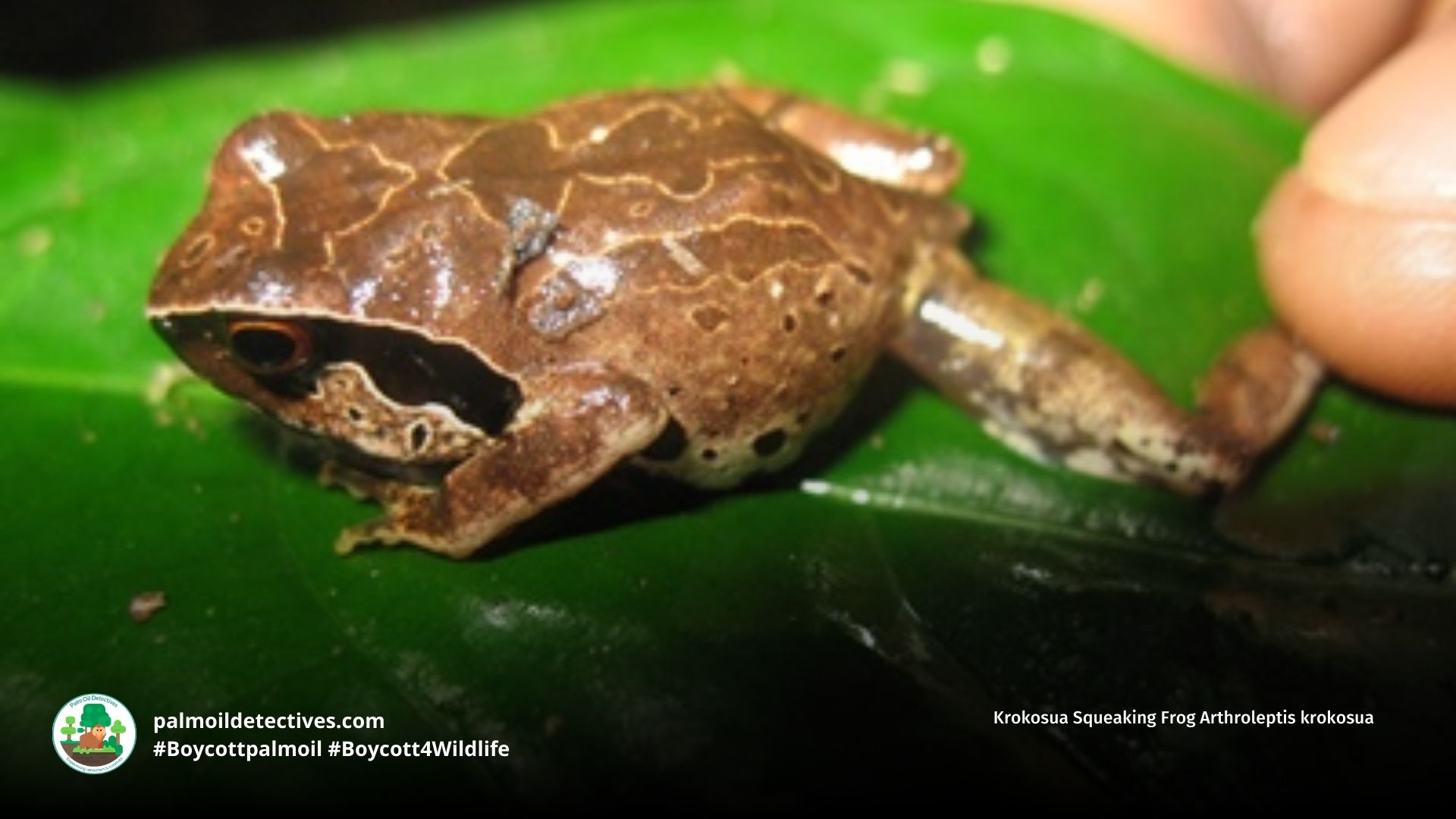
This frog species is nocturnal and terrestrial, spending its days hidden beneath logs, leaves, or rocks, and emerging at night to forage. The frog’s most remarkable trait is its unique vocalisation—a high-pitched squeak that pierces the rainforest’s evening calm. This call is used to communicate with other frogs, likely as part of territorial defence or courtship.
Threats
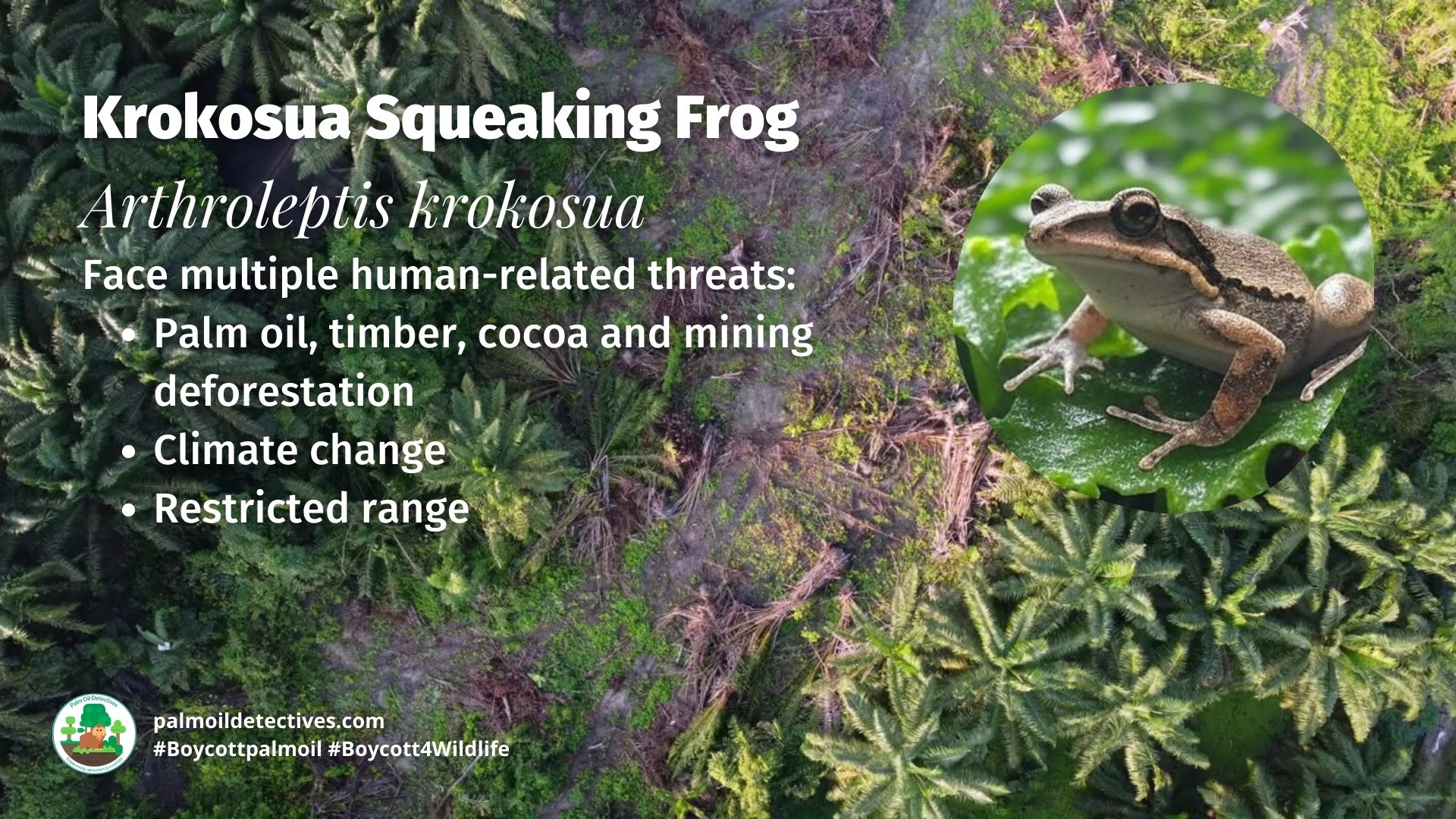
The Krokosua Squeaking Frog is listed as Critically Endangered because there are believed to be fewer than 250 mature individuals, with 90% of these occurring within the sub-population found in the Sui Forest Reserve.
The Krokosua Squeaking Frog faces continuing decline in the number of mature individuals caused by habitat loss from logging activities, farming (especially for cocoa), illegal plantations and small-scale mining.
IUCN Red List
Palm oil, tobacco, cocoa and mining deforestation:
The greatest threat to the Krokosua Squeaking Frog is habitat destruction caused by logging, agricultural expansion for cocoa and tobacco, and the proliferation of out-of-control palm oil plantations. These activities strip away the dense forest undergrowth they rely on for cover and breeding, fragmenting their already limited range.
Extreme Temperature Changes from Climate Change:
Rising temperatures and altered rainfall patterns due to climate change further threaten the delicate balance of their habitat. As a species highly dependent on stable rainforest ecosystems, they are particularly vulnerable to these shifts.
Restricted Range:
With a range limited to the Krokosua Hills Forest Reserve and a small portion of the Ankasa Conservation Area, this frog is at high risk of extinction from stochastic events such as droughts, fires, or disease outbreaks.
Diet
The Krokosua Squeaking Frog feeds on small invertebrates, such as ants, beetles, and other forest floor arthropods. Their diet not only sustains them but also plays a critical role in regulating insect populations within their habitat. This makes them essential contributors to the overall health and balance of their rainforest ecosystem.
Reproduction and Mating
Little is known about the specific reproductive habits of this species, but like other frogs in the Arthroleptis genus, they are likely to lay their eggs in moist leaf litter or soil. The direct development of their offspring—where eggs hatch directly into miniature frogs rather than passing through a tadpole stage—is an adaptation that allows them to thrive in terrestrial habitats.
Geographic Range
The Krokosua Squeaking Frog’s range is among the smallest of any amphibian, restricted to just two known locations: the Krokosua Hills Forest Reserve and the Ankasa Conservation Area. These areas, although legally protected, are under intense pressure from human activities. The total extent of their range is estimated to be less than 100 square kilometres, with much of this fragmented and degraded.
FAQ
What is the squeaking frog?
The squeaking frog refers to members of the genus Arthroleptis, known for their high-pitched vocalisations. The Krokosua Squeaking Frog, specifically, is a critically endangered amphibian found only in the rainforests of Ghana and Côte d’Ivoire.
What is the squeaking frog in South Africa?
The term “squeaking frog” in South Africa typically refers to other species within the Arthroleptis genus, as the Krokosua Squeaking Frog is only found in West Africa. South African species, like their West African counterparts, share similar behaviours and habitats but are distinct in range and conservation status.
Why is the Krokosua Squeaking Frog endangered?
The Krokosua Squeaking Frog is critically endangered due to habitat loss caused by illegal logging, agricultural expansion, and out-of-control palm oil plantations. Additionally, their extremely restricted range makes them highly susceptible to climate change and other stochastic events.
Why are they called squeaking frogs?
They are called squeaking frogs because of their distinctive, high-pitched calls. These squeaks are used to communicate, likely for territorial or mating purposes, and can often be heard echoing through the rainforest at night.
Take Action!
The Krokosua Squeaking Frog urgently needs your help. Use your voice to demand an end to deforestation caused by palm oil plantations and illegal logging. Support indigenous-led conservation efforts in Ghana and Côte d’Ivoire to protect this critically endangered species. Every purchase you make can help safeguard their fragile rainforest home. Fight for their survival: #BoycottPalmOil #Boycott4Wildlife.
Source: Sustain Round Glass The Krokosua Squeaking Frog is critically endangered on @IUCNredlist in #Ghana and #IvoryCoast due to illegal logging for #cocoa #palmoil. Make art for this dissapearing creature and #Boycott4Wildlife
Krokosua Squeaking Frog Arthroleptis krokosua
Support the conservation of this species
Further Information

International Fund for Animal Welfare (IFAW). (2023). 20 most endangered animals in Africa. Retrieved from https://www.ifaw.org/au/journal/20-most-endangered-animals-wildlife-africa
IUCN SSC Amphibian Specialist Group. 2019. Arthroleptis krokosua. The IUCN Red List of Threatened Species 2019: e.T174591A137083009. https://dx.doi.org/10.2305/IUCN.UK.2019-1.RLTS.T174591A137083009.en. Downloaded on 15 February 2021.
STF! Webmaster. (2013, October 23). One of the world’s rarest frogs (Arthroleptis krokosua) finally found. Save the Frogs. Retrieved from https://savethefrogs.com/arthroleptis-krokosua-found/
World Species. (n.d.). Arthroleptis krokosua. Retrieved from https://worldspecies.org/ntaxa/2171926
How can I help the #Boycott4Wildlife?
Take Action in Five Ways
1. Join the #Boycott4Wildlife on social media and subscribe to stay in the loop: Share posts from this website to your own network on Twitter, Mastadon, Instagram, Facebook and Youtube using the hashtags #Boycottpalmoil #Boycott4Wildlife.
Enter your email address
Sign Up
Join 3,528 other subscribers2. Contribute stories: Academics, conservationists, scientists, indigenous rights advocates and animal rights advocates working to expose the corruption of the palm oil industry or to save animals can contribute stories to the website.
Wildlife Artist Juanchi Pérez
Mel Lumby: Dedicated Devotee to Borneo’s Living Beings
Anthropologist and Author Dr Sophie Chao
Health Physician Dr Evan Allen
The World’s Most Loved Cup: A Social, Ethical & Environmental History of Coffee by Aviary Doert
How do we stop the world’s ecosystems from going into a death spiral? A #SteadyState Economy
3. Supermarket sleuthing: Next time you’re in the supermarket, take photos of products containing palm oil. Share these to social media along with the hashtags to call out the greenwashing and ecocide of the brands who use palm oil. You can also take photos of palm oil free products and congratulate brands when they go palm oil free.
https://twitter.com/CuriousApe4/status/1526136783557529600?s=20
https://twitter.com/PhillDixon1/status/1749010345555788144?s=20
https://twitter.com/mugabe139/status/1678027567977078784?s=20
4. Take to the streets: Get in touch with Palm Oil Detectives to find out more.
5. Donate: Make a one-off or monthly donation to Palm Oil Detectives as a way of saying thank you and to help pay for ongoing running costs of the website and social media campaigns. Donate here
Pledge your support#Africa #Amphibian #Boycott4wildlife #BoycottPalmOil #cocoa #CriticallyEndangeredSpecies #deforestation #endangered #ForgottenAnimals #Frog #Frogs #Ghana #herpetology #herps #IvoryCoast #IvoryCoast #KrokosuaSqueakingFrogArthroleptisKrokosua #palmoil #WestAfrica