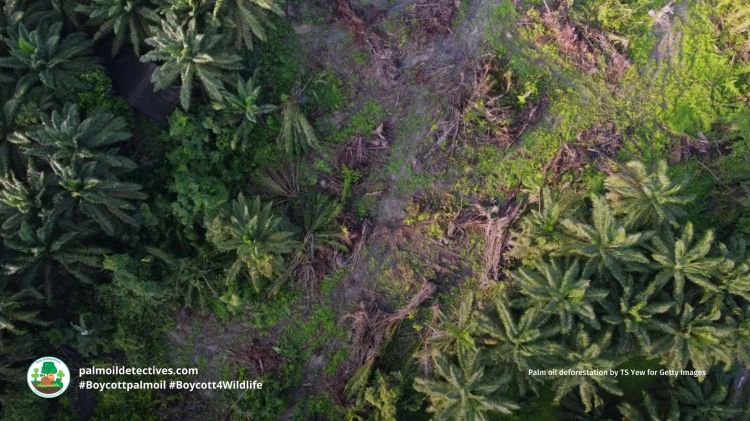
Certification Schemes Fail to Stop Palm Oil Deforestation
In 2022, 71 environmental and #humanrights groups from around the world wrote to the EU Commission to warn that certification schemes and ecolabels were not sufficient to prevent human rights abuses and deforestation from entering the European Union. Although fast forward to 2025 and lobbyists have again watered down the #EUDR and #CSDDD, what the future holds is anybody’s guess!
In the UK, industry lobbyists including Ferrero and serial greenwashing outfit Orangutan Land Trust watered down the UK’s commitment to not importing deforestation into the UK. The new trade deal with #Malaysia paves the way for mass importation of palm oil ecocide.
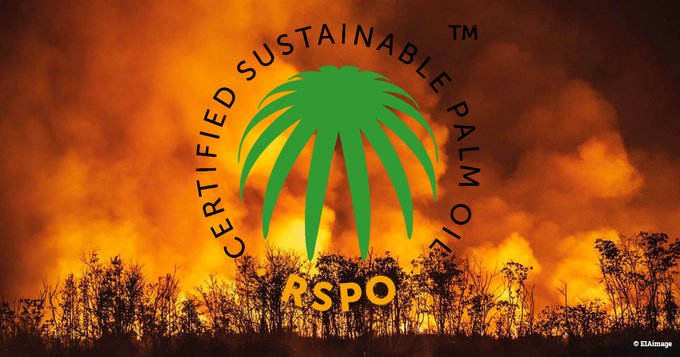
#RSPO and #FSC have been shown for decades to be ineffective and corrupt. They have failed in preventing #corruption, human rights abuses, illegal #landgrabbing, #violence, #deforestation, #ecocide and species #extinction.
So here are 10 reasons why the world should not rely on weak and ineffective certification schemes like MSC, RSPO and FSC to enforce their own zero deforestation mandate. Originally published by GRAIN
#Ecolabels eg. #RSPO #FSC do not prevent #deforestation. They have failed for decades and instead are only weak #greenwashing tools! Help rainforests, rainforest animals and rainforest peoples. #Boycottpalmoil 🌴🩸🚜🤮🚫 #Boycott4Wildlife @palmoildetect https://palmoildetectives.com/2022/06/18/10-reasons-why-ecolabels-commodity-certification-are-not-a-solution-to-stop-the-eu-importing-tropical-deforestation/
Share to BlueSkyShare to Twitter@EU_Commission should not trust #ecolabels: e.g. @RSPOtweets @FSC_IC to prevent #deforestation. Decades of failure to stop #humanrights abuses #deforestation shows their deep systemic weaknesses #Boycottpalmoil 🌴☠️🧐🚫 #Boycott4Wildlife @palmoildetect https://palmoildetectives.com/2022/06/18/10-reasons-why-ecolabels-commodity-certification-are-not-a-solution-to-stop-the-eu-importing-tropical-deforestation/
Share to BlueSkyShare to TwitterJump to section
- 1. Certification is not designed to achieve the main objective of the regulation – preventing deforestation and other harms
- 2. Certification does not provide the information needed to comply with the EU regulation
- 3. Certification does not provide guarantees for the legality of the product
- 4. Certification does not identify or prevent harms. Audit teams lack time and expertise
- 5. Certification bodies and their auditors are not independent from the company they certify
- 6. Prevention of environmental and social harm cannot be outsourced.
- 7. Certification cannot guarantee Free, Prior and Informed Consent or prevent land grabbing of indigenous land
- 8. Certification provides opportunities for greenwashing and increases vested interests in and corporate power over natural resources.
- 9. Certification promotes the expansion of industrial agriculture and thereby prevents the transition needed to halt deforestation
- 10. Certification directs resources towards a million-dollar certification industry
- Signatories: 71 environmental and human rights NGOs

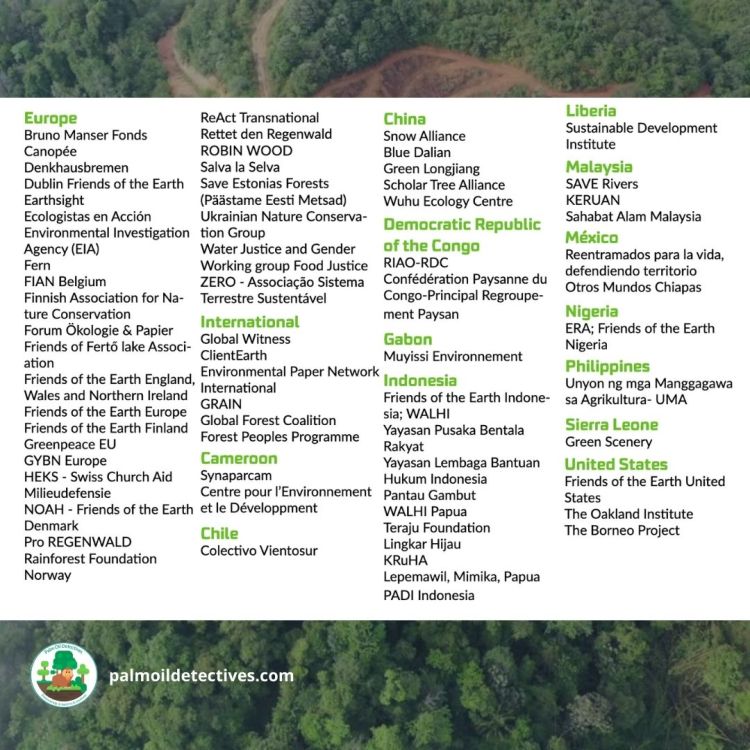 Signatories: 71 environmental and human rights NGOs
Considering the shortcomings of certification schemes that the European Commission itself has documented, we are deeply troubled by the current arguments coming from industry players advocating for a stronger role for certification in the regulation, including a way for companies to use these systems as proof of compliance with binding EU rules. Below are ten reasons why this should not happen.
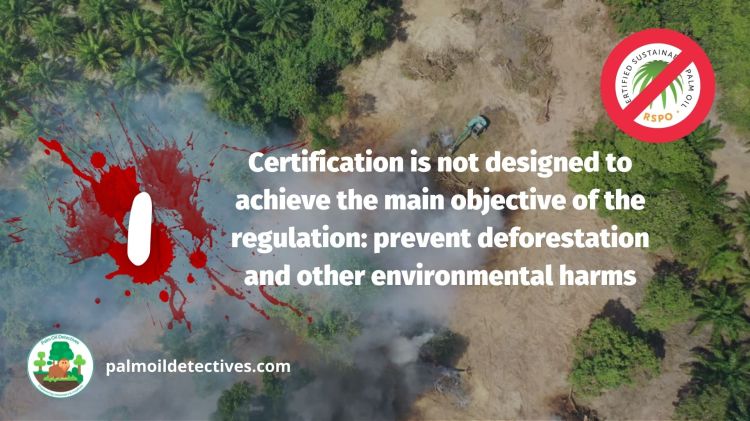
1. Certification is not designed to achieve the main objective of the regulation – preventing deforestation and other harms
The EC’s own Commission Staff Working Document Impact Assessment (hereafter EC Impact Assessment) concludes that “the consensus is that [voluntary certification] schemes on their own have not been able to provide the changes needed to prevent deforestation”. This is the position defended by the European Parliament and by most NGOs. Certification schemes do not have a deforestation standard, or the standard does not meet the deforestation definition as proposed in the anti-deforestation regulation. For example, because companies are allowed to clear forests to establish plantations and remediate or compensate with conservation elsewhere.
 1. Certification is not designed to achieve the main objective of the regulation – preventing deforestation and other harms
Numerous studies conducted by WWF, FSCWatch, and Greenpeace and academic studies on Indonesia, have additionally concluded that certification on its own has not helped companies meet their commitments to exclude deforestation from their supply chains.
This led some actors such as WWF to lose faith in certification scheme Roundtable of Responsible Soy (RTRS), not only due to limited uptake, but more specifically, because in biomes where soy is produced, zero-deforestation commitments have so far failed to reduce deforestation. In support of this finding, the Dutch supermarket industry representative (CBL) stated that RTRS “has not appeared to be sufficient to halt [deforestation and conversion] developments and accelerate the transition to a sustainable soy chain”.
“Certification (or verification) schemes may, in some cases, contribute to achieving compliance with the due diligence requirement, however the use of certification does not automatically imply compliance with due diligence obligations. There is abundant literature on certification schemes shortcomings in terms of governance, transparency, clarity of standards, and reliability of monitoring systems”.

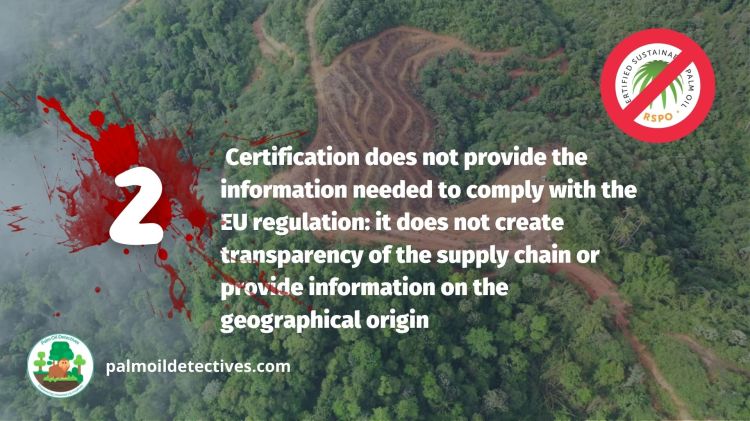
2. Certification does not provide the information needed to comply with the EU regulation
It does not create transparency of the supply chain or provide information on the geographical origin
As indicated in Article 8 of the Proposal, “because deforestation is linked to land-use change, monitoring requires a precise link between the commodity or product placed on or exported from the EU market and the plot of land where it was grown or raised.” Most certification schemes, however, require only a minimal level of traceability and transparency.
 2. Certification does not provide the information needed to comply with the EU regulation
As indicated in the EC’s Study On Certification And Verification Schemes In The Forest Sector, schemes make use of Chain of Custody (CoC) models, but very few apply a traceability system, making it difficult to track the claims of certification, from the forest to the end buyer. One of the most common CoC models used is Mass Balance. This model allows uncertified and untraceable supplies to be physically mixed with certified supplies and end up in EU supply chains. For the most part, certification schemes do not include the systematic ability to verify transactions of volumes, species, and qualities between entities, thus leaving the systems vulnerable to manipulation and fraud.

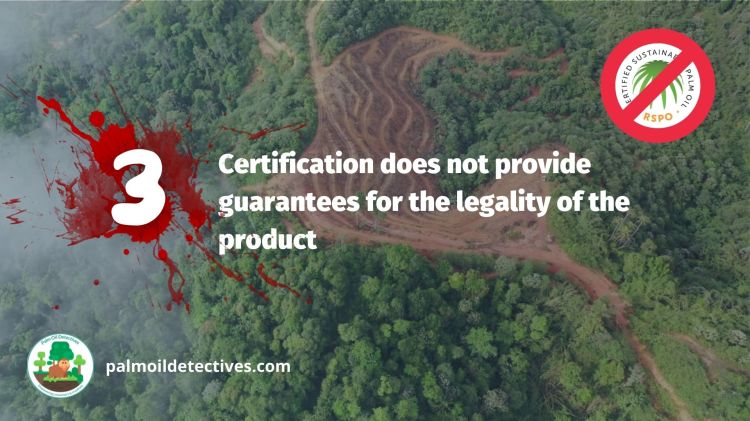
3. Certification does not provide guarantees for the legality of the product
Certification schemes do not have the authority to confirm or enforce compliance with national laws precisely because they are voluntary.
Article 3 in the proposed anti-deforestation regulation states that products
are prohibited on the European market if they are not “produced in accordance with the relevant legislation of the country of production”.
 3. Certification does not provide guarantees for the legality of the product
However, the Roundtable on Sustainable Palm Oil (RSPO), for example, has explicitly stated its standards are voluntary and “do not extend to enforcing or confirming the legal standing of a company’s use of land (which is a mandate only held by the national authority)”.

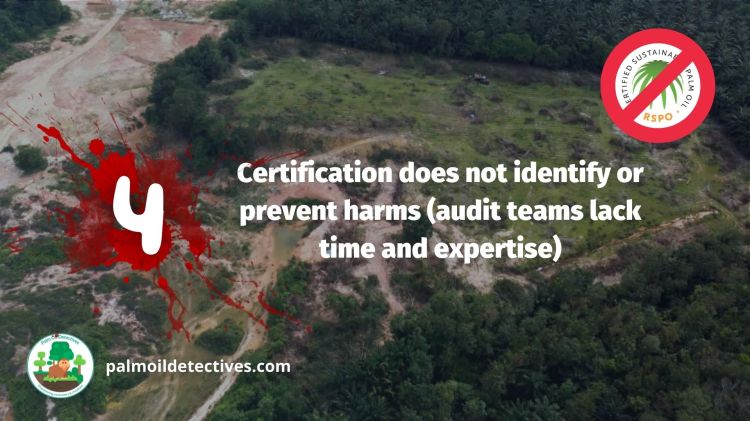
4. Certification does not identify or prevent harms. Audit teams lack time and expertise
According to the EC “labour, environmental and human rights laws will need to be taken into account when assessing compliance” and identifying harms. However, multiple reports by Friends of the Earth Netherlands, the Environmental Investigation Agency, and ECCHR, reveal that auditing firms responsible for checking compliance are fundamentally failing to identify and mitigate unsustainable practices within certification schemes due to lack of time and lack of expertise. Proper audits on social and human rights issues require extensive consultation to gain full community perspectives on land use, conflicts, or environmental harm. Certification Body (CB) procedures do not allow for this (due to financial resources).
RSPO’s own analysis reads that “the credibility of the RSPO certification scheme has been consistently undermined by documentation of poor practice, and concerns of the extent to which the Assurance System is being implemented”.
Oppressed and stretched NGO groups and communities in the global South spend time and resources on these consultation processes. They face backlash for speaking out during consultations without any guarantee that their input is included in the certification assessment. The EU should not become complicit in exploitation of rightsholders and stakeholders in their monitoring role.
5. Certification bodies and their auditors are not independent from the company they certify
The lack of independent audits, considered to be key in ensuring the robustness of certification, was highlighted in the EC Impact Assessment as a key weakness of private certification schemes.
If clients (businesses) hire, supervise, and pay audit firms, they are exposed to a structural risk of conflict of interest, which may lead to a lower level of control.
Previous studies by Friends of the Earth, IUCN, RAN, and Environmental Investigation Agency have shown that, for example in the palm oil industry, when auditors and certification companies are directly hired by an audited company, independence is inhibited and the risk of violations increases.
 5. Certification bodies and their auditors are not independent from the company they certify
Also, auditor dependence on company services such as transport and accommodation is problematic. The EC adds to this that these systems are sensitive to fraud given that certified companies may easily mislead their auditors even if the audit is conducted with the greatest care and according to all procedures.
“For example, a company may be selling products containing a volume of “certified” timber material that exceeds the volume of certified raw material that they are buying.”

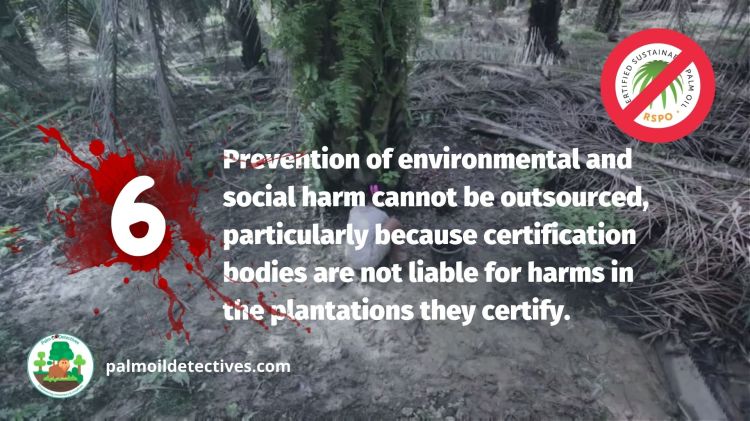
6. Prevention of environmental and social harm cannot be outsourced, particularly because certification bodies are not liable for harms in the plantations they certify
The EU anti-deforestation regulation requires that operators shall exercise due diligence prior to placing relevant commodities on the Union market. Private certification may, in some cases, facilitate compliance with this requirement.
However, as reiterated by German human rights law firm ECCHR the control of compliance is outsourced to private certification bodies, in an unregulated audit and certification market, where CBs are not liable for potential harm.
This leads to inability to distinguish unreliable audits from reliable ones and to competition without rules, setting in motion a ‘race to the bottom’. Certification initiatives have increasingly received complaints for lack of proper due diligence.
For instance, the UK OECD National Contact Point has recently found that Bonsucro breached the Guidelines in relation to due diligence and leverage when reaccepting MPG-T as a member, and the Netherlands NCP handled a complaint about ING’s due diligence policies and practices regarding palm oil.
 6. Prevention of environmental and social harm cannot be outsourced, particularly because certification bodies are not liable for harms in the plantations they certify
The OECD guidelines confirm that certification is not a proxy for due diligence, as well as various governments. As echoed by the EC Impact Assessment, “maintaining operators’ responsibility for correctly implementing due diligence obligations when they use certification, aims at ensuring that authorities remain empowered to monitor and sanction incompliant behaviour, as the reliability of those [certification] systems has repeatedly been challenged by evidence on the ground.”

7. Certification cannot guarantee Free, Prior and Informed Consent or prevent land grabbing of indigenous land
Indigenous Peoples and local communities have a recognised role in preserving the lands they own and manage, but insecure land tenure is a major driver of deforestation and forest degradation.
Certification bodies commit to investigating whether lands are subject to customary rights of indigenous peoples and whether land transfers have been developed with Free Prior and Informed Consent (FPIC).
However, assessing whether land user rights and consultation rights were respected needs to consider the historical context, a multi-actor perspective and deep understanding of local conflicts. Considering the apparent low level of knowledge of auditors on human rights and legal issues, assessing prior land use and conflicts is an impossible task for a team of international auditors with limited time.
 7. Certification cannot guarantee Free, Prior and Informed Consent or prevent land grabbing of indigenous land
In Malaysia communities are often not consulted before the issuance of the logging licences. MTCS certified concessions encroach on indigenous territories while the judiciary recognised indigenous customary land rights are a form of property rights protected by the Federal Constitution.
Additionally, certification schemes failed on numerous occasions to address complaints by communities whose land was taken by palm oil companies, including the case of oil palm giant Sime Darby in Indonesia and Socfin in Cameroon, Ivory Coast, Nigeria, and Sierra Leone. Certification will not lead to redress or resolution of problems linked to EU operators.
 10 Tactics of Sustainable Palm Oil Greenwashing
Greenwashing Tactic #4: Fake Labels
Claiming a brand or commodity is green based on unreliable, ineffective endorsements or eco-labels such as the RSPO, Forest Stewardship Council (FSC) or FairTrade coffee and cocoa. Greenwashing: Fake Labels and fake certifications Ecolabels are…

8. Certification provides opportunities for greenwashing and increases vested interests in and corporate power over natural resources.
Critics have argued that improving the image of forest and ecosystem risk commodities stimulates demand. Certification risks enabling destructive businesses to continue operating as usual and expand their practices, thereby increasing the harm.
“If certification on its own is unable to guarantee that commodity production
is entirely free of deforestation or human rights abuses, there is little to suggest that using certification as a tool for proving compliance with legal requirements could solve the issues in supply chains and fulfil the legislation’s objectives.
 8. Certification provides opportunities for greenwashing and increases vested interests in and corporate power over natural resources.
In this context, recognising a particular certification scheme as a proof of compliance removes any incentive to improve the scheme or to replace it with a more reliable alternative, effectively contributing to the institutionalisation of greenwashing.”
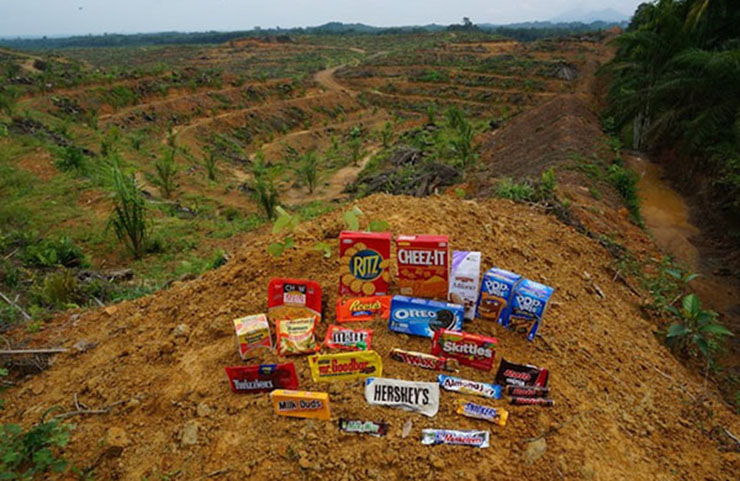
For example, a number of recent logging industry scandals suggest that the Forest Stewardship Council label has at times served merely to “greenwash” or “launder” trafficking in illegal timber, compelling NGOs to demand systemic change. The difference between certified and non-certified plantations in South East Asia was not significant.
9. Certification promotes the expansion of industrial agriculture and thereby prevents the transition needed to halt deforestation
This prevents the transition towards community-based forest management and agro-ecology, with food sovereignty as a leading principle
There are multiple drivers of deforestation, but the evidence is clear in pointing to industrial agricultural expansion as one of the most important. Ultimately, certification initiatives fail to challenge the ideology underpinning the continuation of industrial commodity crop production, and can instead serve to greenwash
further agro-commodity expansion.
Corporations, along with their certifications, continue to seek legitimacy through a ‘feed the world’ narrative.
 9. Certification promotes the expansion of industrial agriculture and thereby prevents the transition needed to halt deforestation
The “expansion is the only way”argument has long since been discredited by international institutions such as FAO; we produce enough to feed the projected world populations, much of this coming from small-scale peasant producers using a fraction of the resources. Moreover, as smallholders are directly impacted by deforestation and often depend on large operators and are hereby
forced to expand agricultural land and degrading their direct environment, they are therefore an essential part of the solution.
10. Certification directs resources towards a million-dollar certification industry
While community and smallholder forest and agriculture management are extremely underfunded.
As explained by the EC Impact Assessment, private certification can be a costly process and resources spent to certify operations and to support the various schemes’ managerial structures could be used for other ends. Considering that smallholders represent a large share of producers in the relevant sectors, they also represent a crucial part of the solution to deforestation.
The EU should stop financing and promoting improvements in a certification system, benefiting industrial forest and plantation companies, that has been proven to fail.
It would be a more effective use of public and private resources to pay smallholders adequately for their products and adhere to their calls if they seek technical or financial support.
 10. Certification directs resources towards a million-dollar certification industry
To conclude, building on these arguments, we foresee that if decision makers give in to the lobby from industry and certification’s role is reconsidered or promoted in the current proposal, the EU anti-deforestation regulation will not deliver, as it will not only lose its potential to provide information needed to comply with the regulation but lose its ability to curb deforestation and forest degradation all together.
Signatories: 71 environmental and human rights NGOs
Signatories: 71 environmental and human rights NGOsInternational
Global Witness
ClientEarth
Environmental Paper Network
International
GRAIN
Global Forest Coalition
Forest Peoples Programme
Indonesia
Friends of the Earth Indonesia; WALHI
Yayasan Pusaka Bentala Rakyat
Yayasan Lembaga Bantuan
Hukum Indonesia
Pantau Gambut
WALHI Papua
Teraju Foundation
Lingkar Hijau
KRuHA
Lepemawil, Mimika, Papua
PADI Indonesia
Cameroon
Synaparcam
Centre pour l’Environnement
et le Développment Chile
Colectivo Vientosur
Democratic Republic of the Congo
RIAO-RDC
Confédération Paysanne du
Congo-Principal Regroupement Paysan
Gabon
Muyissi Environnement
China
Snow Alliance
Blue Dalian
Green Longjiang
Scholar Tree Alliance
Wuhu Ecology Centre
Malaysia
SAVE Rivers
KERUAN
Sahabat Alam Malaysia
Liberia
Sustainable Development Institute
Nigeria
ERA; Friends of the Earth Nigeria
Mexico
Reentramados para la vida, defendiendo territorio
Otros Mundos Chiapas
Philippines
Unyon ng mga Manggagawa sa Agrikultura- UMA
Sierra Leone
United States
Friends of the Earth United States
The Oakland Institute
The Borneo Project
Europe
Bruno Manser Fonds
Canopée
Denkhausbremen
Dublin Friends of the Earth
Earthsight
Ecologistas en Acción
Environmental Investigation
Agency (EIA)
Fern
FIAN Belgium
Finnish Association for Nature Conservation
Forum Ökologie & Papier
Friends of Fertő lake Association
Friends of the Earth England,
Wales and Northern Ireland
Friends of the Earth Europe
Friends of the Earth Finland
Greenpeace EU
GYBN Europe
HEKS – Swiss Church Aid
Milieudefensie
NOAH – Friends of the Earth Denmark
Pro REGENWALD
Rainforest Foundation Norway
ReAct Transnational
Rettet den Regenwald
ROBIN WOOD
Salva la Selva
Save Estonias Forests (Päästame Eesti Metsad)
Ukrainian Nature Conservation Group
Water Justice and Gender
Working group Food Justice
ZERO – Associação Sistema
Terrestre Sustentável
Here are some other ways you can help by using your wallet as a weapon and joining the #Boycott4Wildlife

What is greenwashing?

Why join the #Boycott4Wildlife?
Greenwashing Tactic #4: Fake Labels

The Counterpunch: Consumer Solutions To Fight Extinction
Contribute to my Ko-Fi
Did you enjoy visiting this website?

Palm Oil Detectives is 100% self-funded
Palm Oil Detectives is completely self-funded by its creator. All hosting and website fees and investigations into brands are self-funded by the creator of this online movement. If you like what I am doing, you and would like me to help meet costs, please send Palm Oil Detectives a thanks on Ko-Fi.
Say thanks on Ko-Fi



Palm Oil Detectives is 100% self-funded
Palm Oil Detectives is completely self-funded by its creator. All hosting and website fees and investigations into brands are self-funded by the creator of this online movement. If you like what I am doing, you and would like me to help meet costs, please send Palm Oil Detectives a thanks on Ko-Fi.
Say thanks on Ko-Fi#animalExtinction #BoycottPalmOil #Boycott4wildlife #BoycottPalmOil #consumerBoycott #corruption #CSDDD #deforestation #ecocide #ecolabels #ethicalConsumerism #EUDR #extinction #FSC #greenwashing #humanRights #HumanRights #landgrabbing #Malaysia #MSC #PalmOil #palmOilDeforestation #RSPO #RSPOGreenwashing #violence
The Counterpunch: Consumer Solutions To Fight Extinction

Palm Oil Lobbyists Getting Caught Lying Orangutan Land Trust and Agropalma