Unsupported type or deleted object
Ecuadorean Viscacha Lagidium ahuacaense
Ecuadorean Viscacha Lagidium ahuacaense
IUCN Status: Critically Endangered
Location: Ecuador’s Cerro El Ahuaca
High in the remote granite outcrops of Cerro El Ahuaca, #Ecuador the Ecuadorean #Viscacha Lagidium ahuacaense is plump and fluffy #rodent sporting sage-like long whiskers. From their high perch they look down upon the world below with a permanent expression of what could interpreted as disappointment. Ecuadorean Viscachas were first spotted in 2005 and formally described in 2009, these mountain-dwelling large #rodents are the northernmost member of the Lagidium genus, marooned over 500 kilometres from their closest relatives in #Peru. Few creatures are as elusive or fascinating— tragically, only a handful of them remain alive.
Fires, #beef agriculture, and #deforestation for monoculture are carving away at their already fragile existence, pushing them ever closer to the brink of #extinction. Help them by sharing their story to social media. Join the #Boycott4Wildlife.
High in the mountains of #Ecuador 🇪🇨 lives a sage-like fluffy #rodent, the Ecuadorean #Viscacha, a critically endangered alpine wonder. Few remain alive due to #climatechange and #meat #agriculture 🥩🔥. Be #vegan for them #Boycott4Wildlife @palmoildetect https://wp.me/pcFhgU-aoV
Share to BlueSky Share to TwitterThe Ecuadorean #Viscacha is a fluffy epic #rodent of #Ecuador’s high mountains with long and wise whiskers and a bushy tail. These tenacious creatures are critically #endangered 😭😿 Help them to survive, be #vegan #Boycott4Wildlife 🥩🔥⛔️ @palmoildetect https://wp.me/pcFhgU-aoV
Share to BlueSky Share to TwitterAppearance & Behaviour
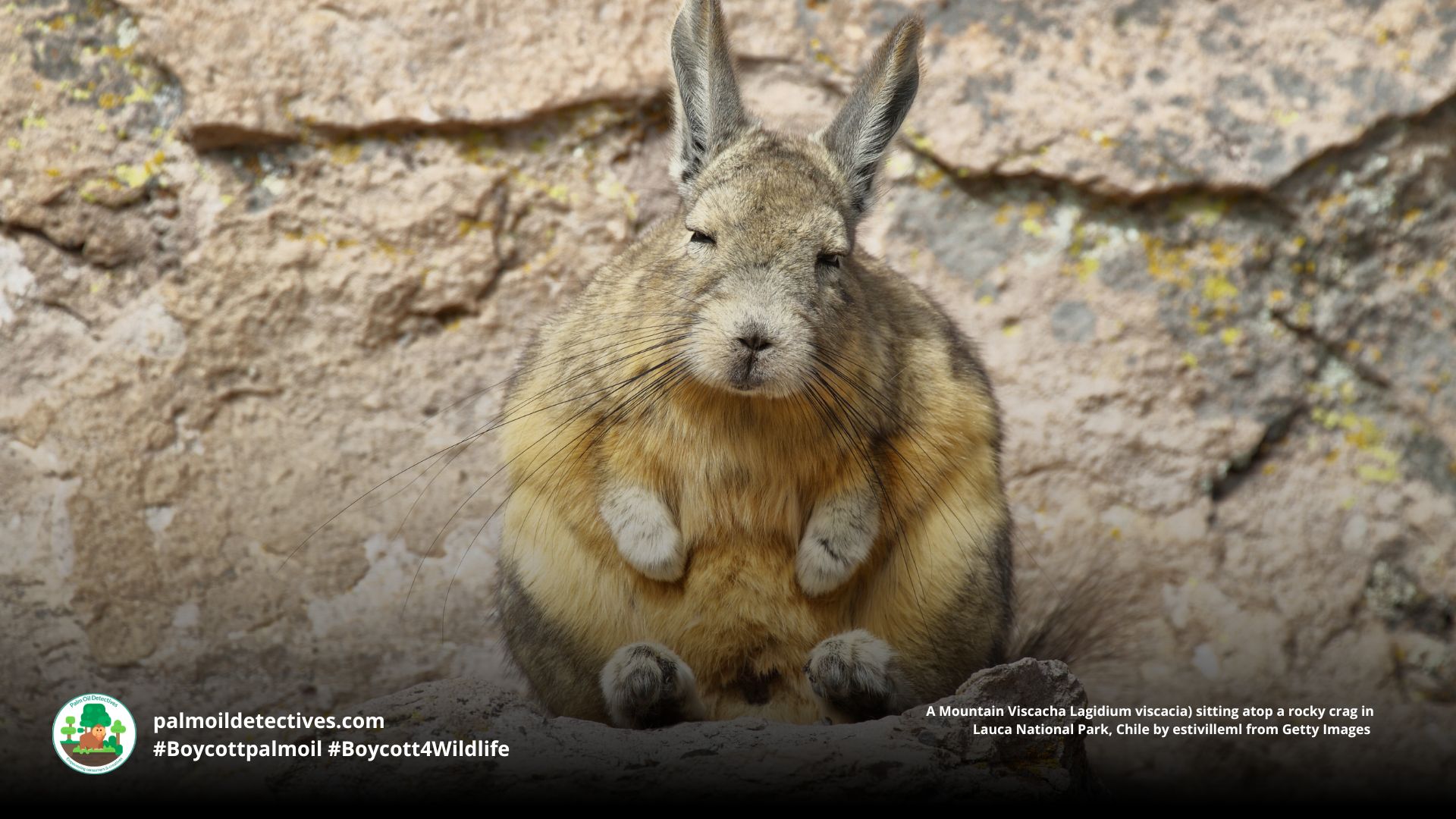
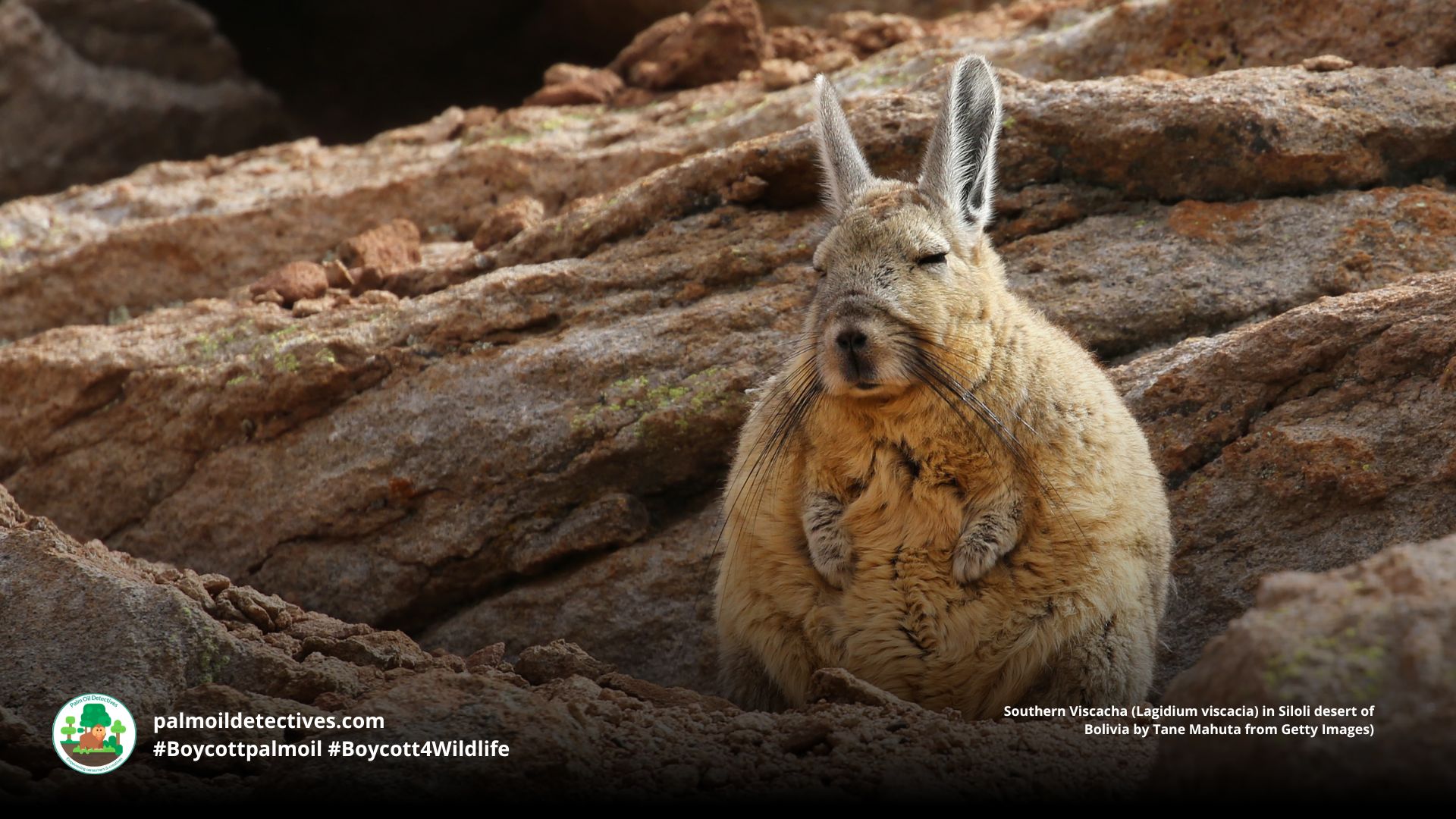
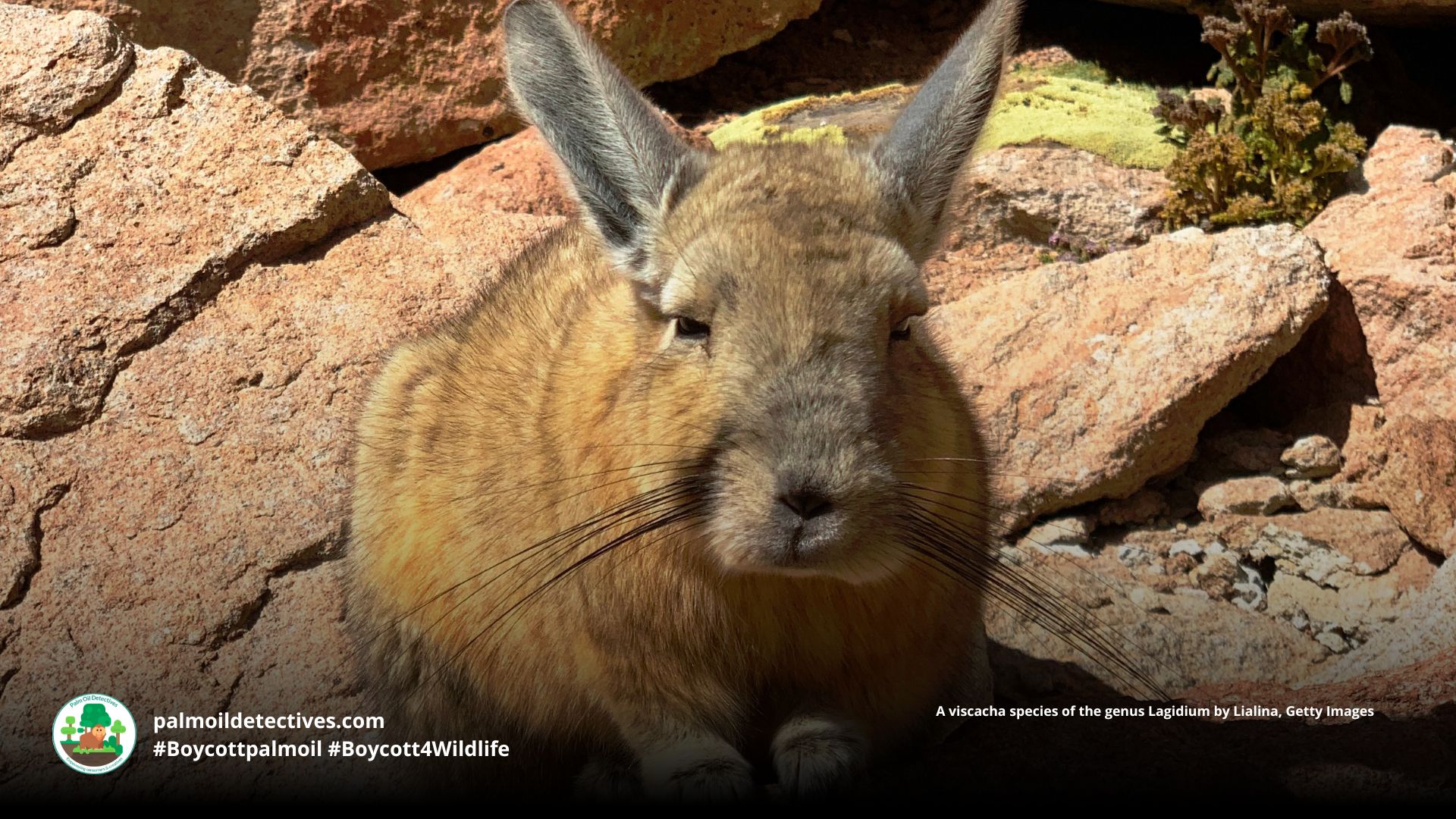
Built for survival in one of Ecuador’s harshest landscapes, the Ecuadorean Viscacha is a sturdy and big rodent with a compact body covered in thick, grey-brown fur. Their dense, woolly fur shields them from the biting Andean winds, while their long, silvery tails provide balance as they scale sheer rock faces. Their large, dark eyes scan the terrain for danger, and their long, sensitive whiskers twitch as they pick up the faintest vibrations in the wind.
Long and distinguished whiskers provide them with sensitive and deep understanding of their environment. A black dorsal stripe runs the length of their back, this disappears into the dense coat that keeps them warm against the mountain’s chill.
Most active at dawn and dusk, their every movement is deliberate. They bound effortlessly between jagged outcrops, using their powerful hind legs to launch themselves across treacherous gaps. Unlike burrowing rodents, they take refuge in narrow rock crevices, where they remain hidden from predators.


Threats
Once secure in their isolated stronghold, the Ecuadorean Viscacha now faces a gauntlet of human-driven threats. Their already tiny population is being squeezed into an ever-smaller fragment of land, where survival is becoming increasingly precarious.
Deforestation for eucalyptus and pine monoculture plantations
For generations, wildfires have been used to clear land for agriculture and livestock grazing, but in recent decades, these fires have intensified, spreading further into the Viscacha’s habitat. Each blaze devours critical vegetation, stripping away the food sources they rely on and forcing them into ever-smaller pockets of surviving habitat.
Farmed Animal Agriculture
Grazing cattle have become an unrelenting force in the region, trampling vegetation and outcompeting the Viscacha for food. Their presence has disrupted the delicate balance of this fragile ecosystem, leaving fewer resources for native wildlife.
Climate Change-related Environmental Shifts
With their entire known population confined to a single mountain, the Ecuadorean Viscacha is especially vulnerable to even the smallest environmental shifts. Changing rainfall patterns, prolonged droughts, and temperature fluctuations could alter the availability of food and water, placing further stress on their already limited numbers.

Population Fragmentation and Isolation
Trapped within a tiny range with no known neighbouring populations, the Viscacha is cut off from potential mates and genetic diversity. Without intervention, this isolation could lead to inbreeding, weakening the species’ ability to adapt and survive.


Geographic Range
The Ecuadorean Viscacha is found only in a single location—Cerro El Ahuaca, a rugged granite mountain in southern Ecuador. They inhabit steep, rocky surfaces at elevations between 1,950 and 2,480 metres, a world of exposed rock faces and sparse vegetation. No other known populations exist, making them one of the most geographically restricted mammals on the planet.
Though their habitat once stretched further, fires and deforestation have steadily chipped away at the fringes of their territory. Today, their entire known range spans just 120 hectares—an area smaller than many urban parks—leaving them with little room to escape the pressures of a changing world.
Diet
These high-altitude specialists are herbivores, feeding primarily on native grasses, shrubs, and small herbs that cling to the mountainside. Signs of their feeding are visible throughout their habitat—freshly grazed plants and stripped vegetation mark the places where they have foraged. Their diet is shaped by scarcity, forcing them to survive on whatever plant life they can find in their isolated, rocky home. Their close relatives Mountain Viscacha of Peru are preyed upon by Andean Mountain Cats.
Mating and Reproduction
Little is known about the reproductive habits of the Ecuadorean Viscacha, but they likely follow a pattern similar to their relatives in the Lagidium genus. Mountain Viscachas generally give birth to a single offspring after a long gestation period, ensuring that each newborn has a better chance of survival in the unforgiving terrain. Born with fur and open eyes, young Viscachas are relatively well-developed, an adaptation that allows them to quickly learn the skills needed to navigate their hazardous mountain environment.
FAQs
Are Ecuadorean Viscachas related to rabbits or chinchillas?
Despite their rabbit-like appearance, Ecuadorean Viscachas belong to the Chinchillidae family, making them closer relatives of chinchillas than rabbits. Their long whiskers, dense fur, and powerful hind legs are adaptations seen in other members of this family, allowing them to thrive in rocky, high-altitude environments.
How are Ecuadorean Viscachas different from other Mountain Viscachas?
Ecuadorean Viscachas are the northernmost species of the Lagidium genus, separated by more than 500 kilometres from their closest relatives in Peru. Genetic studies show that they diverged significantly from other Mountain Viscachas, with at least 7.9% DNA sequence differences. Morphologically, they have a more compact body, a distinct black dorsal stripe, and a tail that shifts in colour from grey-brown to reddish-brown. Their isolation and unique adaptations to the Cerro El Ahuaca environment make them a distinct species.
How do Ecuadorean Viscachas survive in their rocky habitat?
Perfectly adapted to life among sheer cliffs and granite outcrops, Ecuadorean Viscachas use their powerful hind legs to leap between rocks, navigating the treacherous terrain with ease. Their thick, woolly fur provides insulation against the cold, and instead of burrowing, they take refuge in rock crevices where they remain hidden from predators.
What do Ecuadorean Viscachas eat?
These herbivores feed on native shrubs, grasses, and small herbs found in their mountainous habitat. They leave behind distinct feeding traces, such as grazed vegetation and stripped plants, which provide insight into their foraging habits. Their diet is dictated by the limited plant life available in their isolated environment.
How many Ecuadorean Viscachas are left in the wild?
The total known population is alarmingly small, possibly consisting of only a few dozen individuals confined to a 120-hectare area on Cerro El Ahuaca. No other populations have been discovered, making them one of the most critically endangered rodents in the world.
What are the biggest threats to the Ecuadorean Viscacha?
Their biggest threats include:
• Habitat destruction – Uncontrolled fires and land clearing for eucalyptus and pine monoculture and cattle grazing are steadily erasing their already limited habitat.
• Livestock competition – Grazing cattle trample vegetation and outcompete Viscachas for food.
• Climate change – Shifting rainfall patterns and temperature fluctuations could further disrupt their delicate ecosystem.
• Genetic isolation – With only a single known population, they face the risk of inbreeding, which could weaken their resilience.
Why are they only found in one place?
Ecuadorean Viscachas are highly specialised mountain dwellers, perfectly suited to the rocky terrain of Cerro El Ahuaca. They may have once had a wider range, but habitat destruction and fragmentation have left them stranded in this isolated stronghold. Unlike more adaptable rodents, they cannot easily move to new areas due to their specific habitat needs.
Are Ecuadorean Viscachas protected?
The Ecuadorean Vischaca was only recently discovered and are considered a forgotten species. However conservation efforts have begun, there is no targeted species-wide protection in place. However, local conservation initiatives have helped establish protected areas that include their habitat. Researchers continue to push for stronger conservation measures to ensure their survival.
How can I help save the Ecuadorean Viscacha?
You can make a difference by:
• Supporting conservation organisations working to protect their habitat.
• Raising awareness about the threats they face by sharing this post and joining the #Boycott4Wildlife
• Advocating for stronger environmental policies in Ecuador to prevent further deforestation and habitat loss.
Without immediate action, these rare and remarkable mountain survivors could disappear forever.
Take Action!
The Ecuadorean Viscacha is teetering on the edge of extinction, but there is still time to act. Conservationists have already taken steps to protect their habitat, securing key areas under municipal conservation agreements. However, long-term survival depends on preventing further destruction of their fragile mountain refuge.
You can help by:
• Supporting organisations working to protect Ecuador’s high-altitude ecosystems.
• Spreading awareness about the threats facing the Ecuadorean Viscacha and the urgent need for conservation.
• Demanding stronger environmental protections to prevent further habitat loss in Loja Province.
Every effort counts. Without immediate action, these extraordinary mountain survivors could disappear forever.
Support Ecuadorean Viscacha by going vegan and boycotting palm oil in the supermarket, it’s the #Boycott4Wildlife
Support the conservation of this species
This animal has no protections in place. Read about other forgotten species here. Create art to support this forgotten animal or raise awareness about them by sharing this post and using the #Boycottpalmoil #Boycott4Wildlife hashtags on social media. Also you can boycott palm oil in the supermarket.
Further Information
Nature and Culture International. (2022). Ecuadorian Viscacha Conservation Project. Retrieved from https://www.natureandculture.org/directory/ecuadorian-vizcacha-conservation-project/
Roach, N. 2016. Lagidium ahuacaense. The IUCN Red List of Threatened Species 2016: e.T48295808A48295811. https://dx.doi.org/10.2305/IUCN.UK.2016-2.RLTS.T48295808A48295811.en. Accessed on 27 February 2025.
Werner, F. A., Ledesma, K. J., & Hidalgo B., R. (2006). Mountain vizcacha (Lagidium cf. peruanum) in Ecuador – first record of Chinchillidae from the northern Andes. Mastozoología Neotropical, 13(2), 271–274.
Wikipedia Contributors. (n.d.). Lagidium ahuacaense. Wikipedia, The Free Encyclopedia. Retrieved from https://en.wikipedia.org/wiki/Lagidium_ahuacaense


How can I help the #Boycott4Wildlife?
Take Action in Five Ways
1. Join the #Boycott4Wildlife on social media and subscribe to stay in the loop: Share posts from this website to your own network on Twitter, Mastadon, Instagram, Facebook and Youtube using the hashtags #Boycottpalmoil #Boycott4Wildlife.
Enter your email address
Sign Up
Join 3,529 other subscribers2. Contribute stories: Academics, conservationists, scientists, indigenous rights advocates and animal rights advocates working to expose the corruption of the palm oil industry or to save animals can contribute stories to the website.

Wildlife Artist Juanchi Pérez

Mel Lumby: Dedicated Devotee to Borneo’s Living Beings

Anthropologist and Author Dr Sophie Chao

Health Physician Dr Evan Allen

The World’s Most Loved Cup: A Social, Ethical & Environmental History of Coffee by Aviary Doert

How do we stop the world’s ecosystems from going into a death spiral? A #SteadyState Economy
3. Supermarket sleuthing: Next time you’re in the supermarket, take photos of products containing palm oil. Share these to social media along with the hashtags to call out the greenwashing and ecocide of the brands who use palm oil. You can also take photos of palm oil free products and congratulate brands when they go palm oil free.
https://twitter.com/CuriousApe4/status/1526136783557529600?s=20
https://twitter.com/PhillDixon1/status/1749010345555788144?s=20
https://twitter.com/mugabe139/status/1678027567977078784?s=20
4. Take to the streets: Get in touch with Palm Oil Detectives to find out more.
5. Donate: Make a one-off or monthly donation to Palm Oil Detectives as a way of saying thank you and to help pay for ongoing running costs of the website and social media campaigns. Donate here
Pledge your supportLearn about other animals endangered by palm oil and other agriculture
GlobalSouth America S.E. AsiaIndiaAfricaWest Papua & PNG
Southern Pudu Pudu puda

Blue-streaked Lory Eos reticulata

Blonde Capuchin Sapajus flavius

Savage’s Glass Frog Centrolene savagei
Pesquets Parrot Psittrichas fulgidus
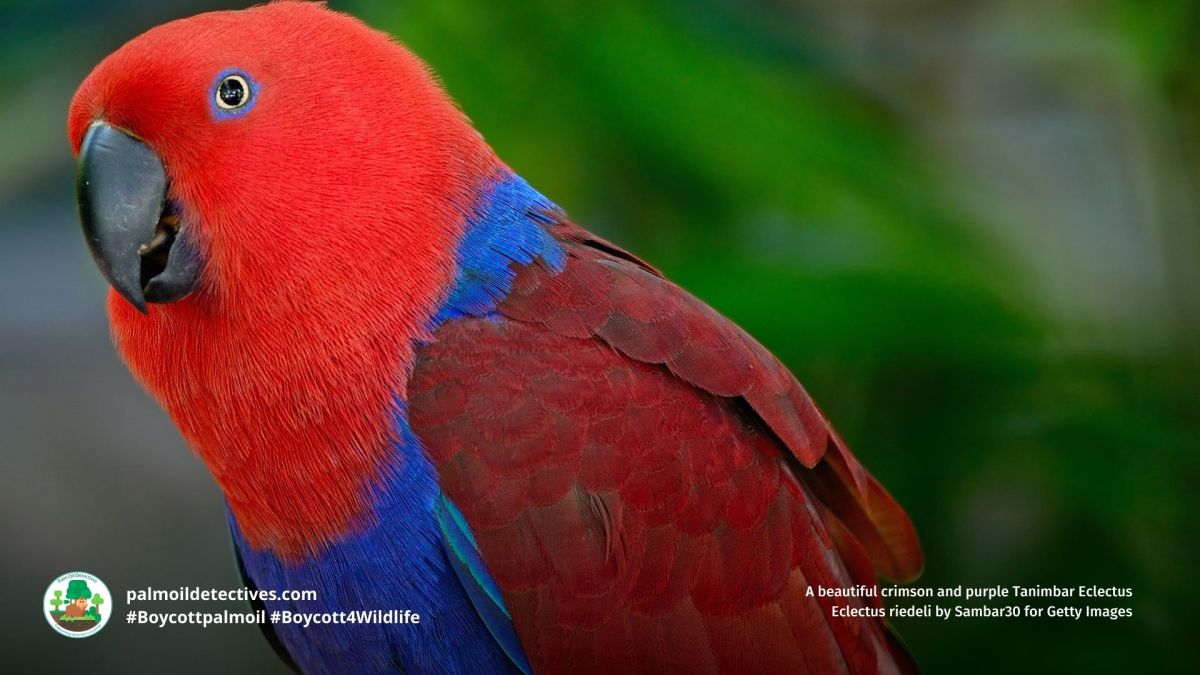
Tanimbar Eclectus Parrot Eclectus riedeli
Learn about “sustainable” palm oil greenwashing
Read more about RSPO greenwashing
Lying Fake labelsIndigenous Land-grabbingHuman rights abusesDeforestation Human health hazardsA 2019 World Health Organisation (WHO) report into the palm oil industry and RSPO finds extensive greenwashing of palm oil deforestation and the murder of endangered animals (i.e. biodiversity loss)
Read more


#Agriculture #animals #beef #Boycott4wildlife #BoycottPalmOil #climatechange #CriticallyEndangeredSpecies #criticallyendangered #deforestation #Ecuador #EcuadoreanViscachaLagidiumAhuacaense #endangered #extinction #ForgottenAnimals #hunting #meat #meatDeforestation_ #PalmOil #palmOilDeforestation #Peru #poaching #rodent #rodents #SouthAmericaSpeciesEndangeredByPalmOilDeforestation #vegan #Viscacha
Javan Rhinos Not Safe from Poachers
Recent testimony by arrested illegal poachers in #Indonesia finds 26 of the estimated remaining 72 living Javan #Rhinos were slaughtered for their horns over the past five years. In the so-called “protected” Ujung Kulon National Park in the western tip of the island of Java. This must spark a national emergency to protect these beings before they are gone for good! End the wildlife trade and #BoycottPalmOil #Boycott4Wildlife
Shocking news: 26 of the 72 remaining #Javan #Rhinos 🦏 were poached recently from Ujung Kulon National Park, #Indonesia making their protection even more serious. End disgusting #poaching! Help them survive when you #Boycott4Wildlife @palmoildetect https://wp.me/pcFhgU-91C
Share to BlueSky Share to TwitterTestimony by arrested #poachers in #Indonesia finds 26 of the remaining 72 #Javan #Rhino 🦏 are still alive 😭 We must scramble to protect these beautiful and unique #animals urgently! #Boycottmeat #BoycottPalmOil #Boycott4Wildlife @palmoildetect https://wp.me/pcFhgU-91C
Share to BlueSkyShare to TwitterWritten by Jason Gilchrist, Lecturer in the School of Applied Sciences, Edinburgh Napier University. This article is republished from The Conversation under a Creative Commons license. Read the original article.
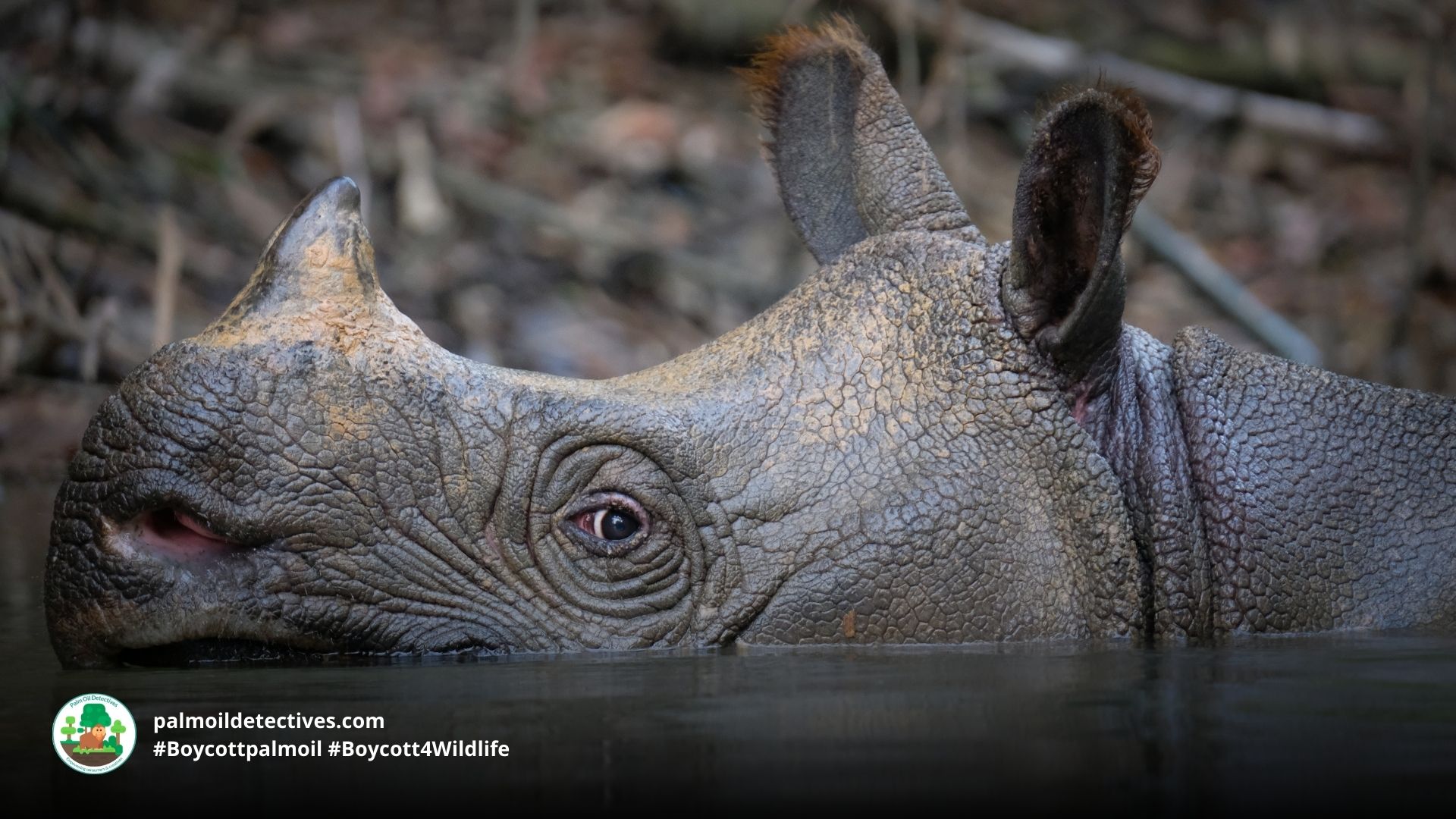
26 of the estimated maximum 72 Javan rhino have been poached by two gangs in the last five years. Absolutely shocking news!
I am an ecologist, and I have been lucky to work with white rhino in Africa. This work has involved capturing rhino, dehorning and moving them – methods used to try to save rhino from poachers.
Poachers target these large, plant-eating mammals for the illegal trade in rhino horn, fuelled by demand from Asia, principally China and Vietnam, where the horn is perceived as a status symbol, a cure for illness and an aphrodisiac.
Poaching is the main threat to the African rhino, but it was not considered a risk for the critically endangered Javan rhino in Asia. So rare and difficult to detect are Javan rhino, which live in dense jungle, that it was thought poachers would not be able to find them.
However, recent testimony from poachers arrested in Indonesia has indicated that 26 of the estimated maximum 72 Javan rhino have been poached by two gangs in the last five years. That is shocking news.
This revelation turns a worrying situation into an emergency – and demands increased efforts to save the Javan rhino from extinction.
How many Javan rhino are there?
Indonesian police arrested 13 members of two poaching gangs who revealed the otherwise undetected loss of rhino from Ujung Kulon National Park, the home of the world’s only remaining Javan rhino population, on the island of Java in the Indonesian archipelago.
Javan rhino were once widespread in southeast Asia. The last one outside of Indonesia was poached in Vietnam in 2010.
The actual number of rhino killed by the poaching gangs cannot be verified. It’s possible that sources within the government or conservation teams are passing information to poachers.
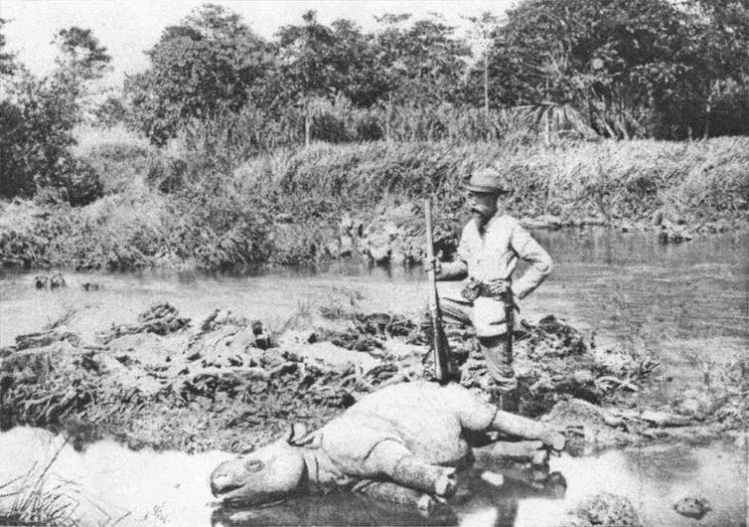
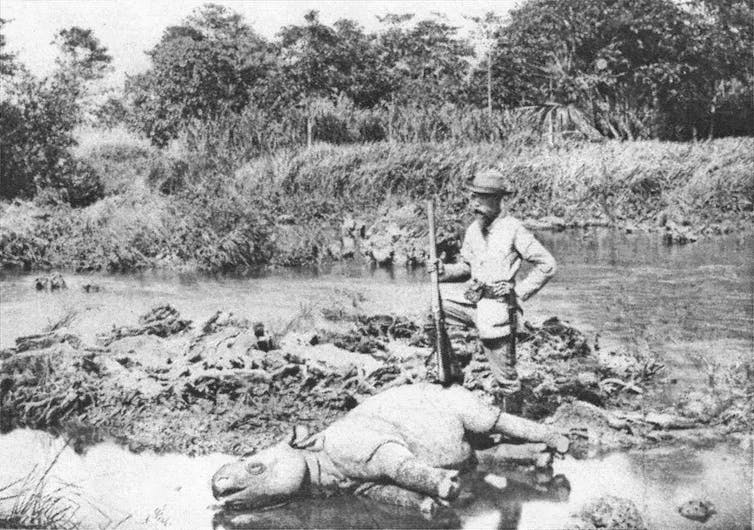 A Dutch hunter with a slain Javan rhino in Ujung Kulon, 1895. Charles te Mechelen/Rhino Resource Center
Indonesia’s forests are home to 10-15% of the planet’s plants, birds and mammals. While Indonesia harbours the greatest amount of rainforest in Asia, over 74 million hectares (three times the land area of the UK) have been lost in the past 50 years to palm oil extraction and paper mills.
Indonesia’s forest cover has fallen from 80% to less than 50% amid one of the fastest deforestation rates in the world. Pandeglang, the Javan region containing the national park, has lost nearly 10% of its rainforest since 2000.
All scientists know about the abundance of Javan rhino is gleaned from camera traps, remote cameras that are triggered to take photos by passing animals. The last government population estimate was released in 2019.
A report published in 2023 criticised this estimate because 18 of the rhino counted had not been detected by a camera trap for three years, and three of the rhino counted were known to be dead.
Saving the Javan rhino from extinction
Indonesian conservationists have focused on habitat loss as the leading threat to Javan rhino, as it deprives the species of breeding opportunities. Scattered across separate fragments of jungle, rhino are unlikely to find each other during the brief window when females are receptive to mating.
There is also evidence of inbreeding, exacerbated by there being more adult males than females. Some biologists have called for Javan rhino to be taken into captive breeding programmes.
With just 46 Javan rhino in the wild (perhaps even less), poaching could wipe out the species or reduce it to such a low number that low breeding success deals the final blow.
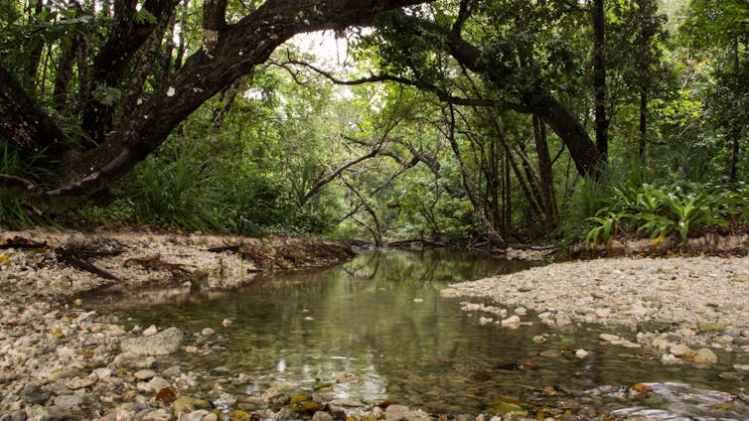
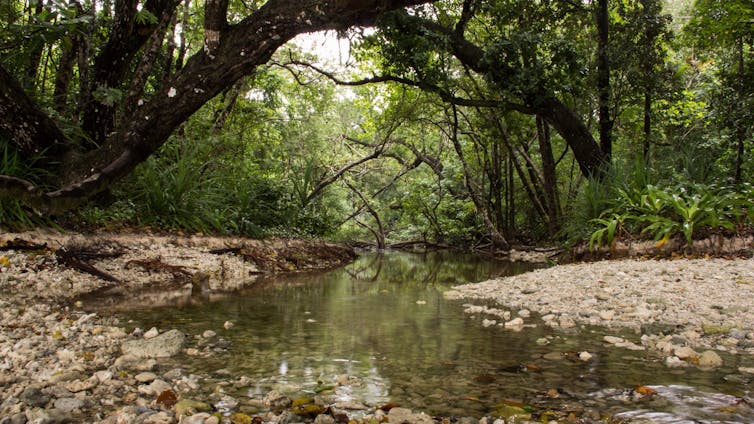 Ujung Kulon National Park is located on the western tip of Java. Achmad Soerio Hutomo/Flickr, CC BY
So, what now? It is likely that the Javan rhino cannot afford to lose any further animals to poaching, and vital that further poaching is prevented. The Indonesian government has now increased security in the national park with police and military combining forces.
Allowing forests to naturally regenerate and planting corridors of trees between jungle patches will help the remaining rhino find suitable habitat and each other. Conservationists have also called for cutting down trees in some locations to allow fresh, young trees with more accessible leaves to grow.
Research has also shown that removing an invasive palm boosts the availability of rhino food plants. Livestock must be excluded from the park too, as domestic cattle can transmit disease.
As far back as 1986, conservationists called for some rhino to be moved out of the park (perhaps to the neighbouring island of Sumatra). Splitting an already limited population is risky, but not establishing the safety net of at least one other population elsewhere is riskier still.
What if a tsunami hit the park? And the park may already be near capacity, as it is estimated to be able to support only 68 rhino.
Bringing Javan rhino into captivity and using reproductive technologies on stored eggs and sperm (techniques in development for the more common white rhino) may also need to be considered. Although, it is still possible that captive breeding may not be required: camera traps have photographed newborn Javan rhino, as well as adults, as recently as March 2024.
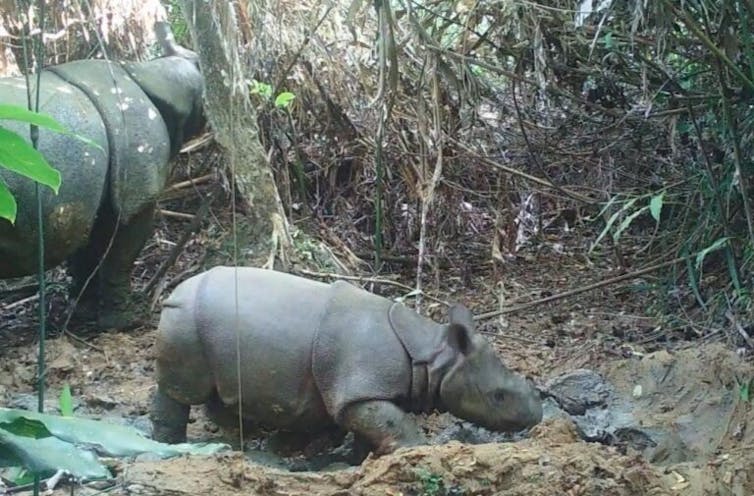 A female Javan rhino calf with its mother, photographed by a camera trap in Ujung Kulon national park. Indonesian Ministry of Environment and Forestry
Scientists don’t know much about Javan rhino biology. There have been few studies of wild rhino and only 22 have ever been kept in captivity, the last of which died more than 100 years ago. More research is needed to understand as much as possible about Javan rhino ecology and reproduction – in the wild and from museum specimens.
More effective habitat and wildlife conservation across Indonesia will benefit other Indonesian species, including the Sumatran tiger, Sumatran elephant, all three species of orangutan, and the Sumatran rhino (estimated population of 24-47, making it the world’s most endangered rhino).
If effective conservation action is not taken now, the remaining Javan rhino population will go the same way as that in Vietnam.
Written by Jason Gilchrist, Lecturer in the School of Applied Sciences, Edinburgh Napier University. This article is republished from The Conversation under a Creative Commons license. Read the original article.
ENDS
Learn about other animals endangered by palm oil and other agriculture
GlobalSouth America S.E. AsiaIndiaAfricaWest Papua & PNG
Frill-Necked Lizard Chlamydosaurus kingii

Grey Crowned Crane Balearica regulorum

Ecuadorean Viscacha Lagidium ahuacaense
Southern Pudu Pudu puda
Blue-streaked Lory Eos reticulata
Blonde Capuchin Sapajus flavius
Learn about “sustainable” palm oil greenwashing
Read more about RSPO greenwashing
Lying Fake labelsIndigenous Land-grabbingHuman rights abusesDeforestation Human health hazardsA 2019 World Health Organisation (WHO) report into the palm oil industry and RSPO finds extensive greenwashing of palm oil deforestation and the murder of endangered animals (i.e. biodiversity loss)
Read moreTake Action in Five Ways
1. Join the #Boycott4Wildlife on social media and subscribe to stay in the loop: Share posts from this website to your own network on Twitter, Mastadon, Instagram, Facebook and Youtube using the hashtags #Boycottpalmoil #Boycott4Wildlife.
Enter your email address
Sign Up
Join 3,174 other subscribers2. Contribute stories: Academics, conservationists, scientists, indigenous rights advocates and animal rights advocates working to expose the corruption of the palm oil industry or to save animals can contribute stories to the website.
Wildlife Artist Juanchi Pérez
Mel Lumby: Dedicated Devotee to Borneo’s Living Beings
Anthropologist and Author Dr Sophie Chao
Health Physician Dr Evan Allen
The World’s Most Loved Cup: A Social, Ethical & Environmental History of Coffee by Aviary Doert
How do we stop the world’s ecosystems from going into a death spiral? A #SteadyState Economy
3. Supermarket sleuthing: Next time you’re in the supermarket, take photos of products containing palm oil. Share these to social media along with the hashtags to call out the greenwashing and ecocide of the brands who use palm oil. You can also take photos of palm oil free products and congratulate brands when they go palm oil free.
https://twitter.com/CuriousApe4/status/1526136783557529600?s=20
https://twitter.com/PhillDixon1/status/1749010345555788144?s=20
https://twitter.com/mugabe139/status/1678027567977078784?s=20
4. Take to the streets: Get in touch with Palm Oil Detectives to find out more.
5. Donate: Make a one-off or monthly donation to Palm Oil Detectives as a way of saying thank you and to help pay for ongoing running costs of the website and social media campaigns. Donate here
Pledge your support#animalBehaviour #AnimalBiodiversityNews #animalCommunication #animalCruelty #animalExtinction #animalIntelligence #animalRights #animals #biodiversity #Boycott4wildlife #BoycottMeat #BoycottPalmOil #deforestation #Indonesia #Javan #PalmOil #palmOilDeforestation #poachers #poaching #Rhino #Rhinos
South America: Species Endangered by Palm Oil Deforestation

Papua New Guinea & West Papua: Species Endangered by Palm Oil Deforestation
Palm Oil Lobbyists Getting Caught Lying Orangutan Land Trust and Agropalma