ATMs didn't kill bank Teller jobs, but the iPhone did
https://davidoks.blog/p/why-the-atm-didnt-kill-bank-teller
#HackerNews #ATMs #BankJobs #iPhone #Technology #Innovation #Employment
#Tag
ATMs didn't kill bank Teller jobs, but the iPhone did
https://davidoks.blog/p/why-the-atm-didnt-kill-bank-teller
#HackerNews #ATMs #BankJobs #iPhone #Technology #Innovation #Employment
ATMs didn't kill bank Teller jobs, but the iPhone did
https://davidoks.blog/p/why-the-atm-didnt-kill-bank-teller
#HackerNews #ATMs #BankJobs #iPhone #Technology #Innovation #Employment
As the climate change advances and deforestation continues at pace, the land we use for growing energy-intensive crops such as wheat corn, soy and palm oil is becoming less productive. We need to find ways to feed the earth’s growing population that isn’t so burdensome on the environment.
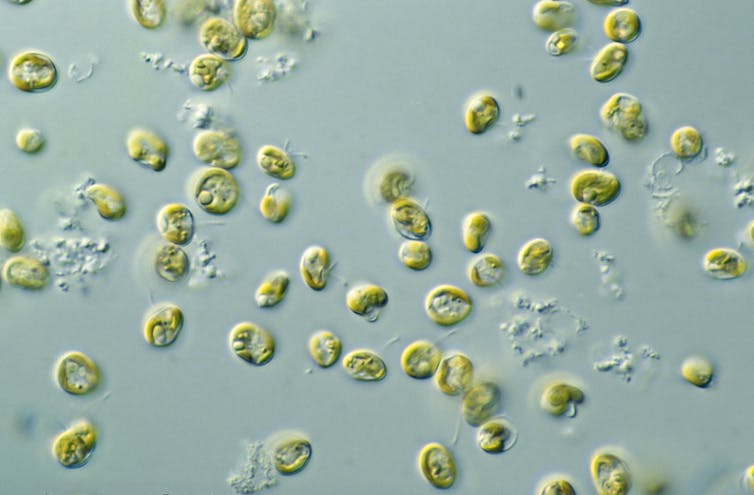
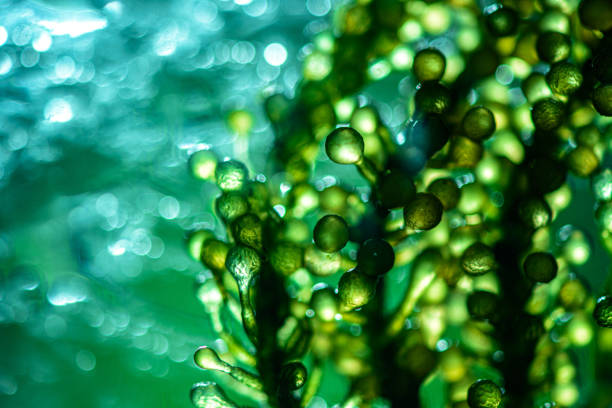
One potential solution is to cultivate microalgae – microscopic aquatic organisms that are packed with nutrients. Microalgae are single-celled organisms that look like tiny pills and taste a bit like grass.
#Research: Using #algae 🌱🥬 as a replacement for #palmoil has many benefits. It can be grown in wastewater all year round, is #crueltyfree, #vegan and has more protein than other plant-based foods 🤯💚 #Boycottpalmoil #Boycott4Wildlife @palmoildetect https://palmoildetectives.com/2022/04/10/more-protein-and-good-for-the-planet-9-reasons-we-should-be-eating-microalgae/
Share to BlueSkyShare to TwitterThey are relatively easy to cultivate and have several advantages over animal and plant protein.
Algae don’t require pesticides to sustain their productivity. Algae can also be grown in wastewaters (water that has been used in the home or in some industrial process), taking up nutrients and other dissolved substances into their biomass. This results in fewer contaminants being released into the environment and less pollution in our waterways.
CSIROHigh growth and reproduction rates mean microalgae can double their biomass in as little as one to three days, depending on the time of the year. While their growth rate is slower in winter, they are not limited to a growing season, such as plants, or a long maturation period, such as animals.
This means microalgae produce more biomass on a given area of land per year, than animals or plants.
High growth rates also mean frequent harvesting. This makes microalgal cultures more resilient to sudden or extreme weather events, where production losses may be only several days of growth rather than the entire annual crop.
More protein and good for the planet: 9 reasons we should be eating microalgaeAlgae produce more protein than plant-based foods, including soybean and pulse legumes. While algae produce 3.5-13 tonnes of protein per hectare per year, soybean and pulse legumes produce 0.5-1.8 tonnes of protein per hectare per year.
The higher growth rate of microalgae and ability to produce their own food from the sun, means microalgal protein yields are more than 100 times greater than animal-based proteins, including beef, eggs and dairy (0.01 – 0.23 tonnes per hectare per year).
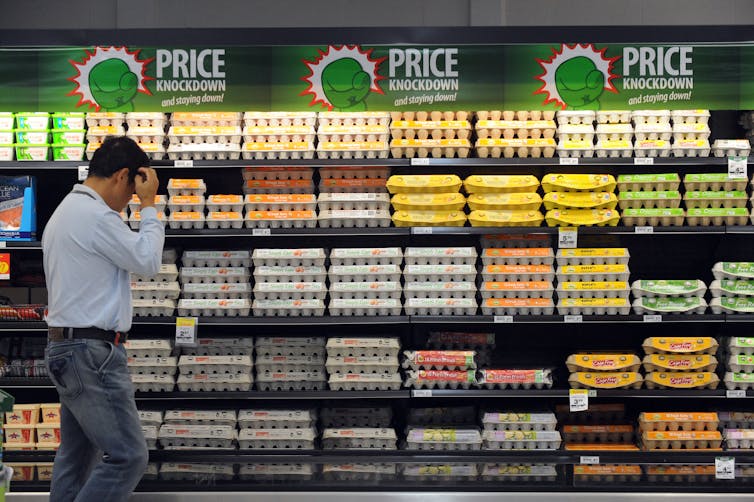
Microalgal protein yields are much greater than animal-based proteins such as eggs, beef and dairy. Dave Hunt/AAPAlgae production systems don’t require arable land. They comprise either open ponds or closed vessels with a light source, known as photobioreactors. The systems can be built almost anywhere, including non-productive land or in the sea.
Open ponds are shallow (between 10 and 50 cm deep), and the algae culture is gently circulated by a paddlewheel. Closed photobioreactors consist of an array of tubes or flat panels, through which algae is circulated. Both types of production systems can be modified to suit the environment.
Thousands of marine and estuarine microalgal species grow best in seawater rather than freshwater. This would reduce our reliance on fresh water for food production.
Widespread adoption of microalgae as a food source would reduce pressure on freshwater systems. Dean Lewin/AAPAlgae have long been recognised for their nutritional properties, forming a vital food source in human diets since as early as 14,000 BC. Over the last few decades, microalgae have been used in vitamin supplements and health food products, including protein bars and powders, green smoothies and Omega-3 capsules.
Microalgae contain proteins, fats, carbohydrates and other nutritional components that have wide potential application in the food industry. For example, algae have a broad array of amino acids that support human growth and development; some are comparable with the levels in egg, soy and wheat protein.
To date, microalgae have successfully been incorporated into a range of edible products to increase their nutritional value, including yoghurts, biscuits, bread and pasta. Manufacturers have been able to swap plant for algal-protein by simply introducing it as a powder into production streams.
Apart from adding nutrients, microalgae have other properties that facilitate their incorporation into foods, including emulsifying, foaming, gelation, and absorption of fat and water.
Using microalgae in emulsions allows for a decrease in the percentage of oil, showing promise for their potential use in low-fat products. When added to desserts as colouring agents, the cell structure in microalgae protects pigments from thermal degradation during processing, enabling foods to maintain their vibrancy.
Algae can be harvested by sedimentation, flotation or filtration, with not an abattoir or live exporter in sight.
Microalgae as a food source would reduce demand for meat from livestock. TREVOR COLLENS/AAPMicroalgae are increasingly being used as sustainable components of other products, including cosmetics, nutraceuticals, industrial enzymes and bioplastics, and as a biofuel to replace fossil fuels in niche markets.
Many microalgae have high levels of palmitic acid. This acid is also the principal component of palm oil – a widely used oil in food production which drives mass deforestation and loss of animal habitat. Replacing palm oil with microalgae would reduce reliance on this unsustainable industry.
The low-tech, basic infrastructure needed for microalgal farming could provide economic opportunities for developing regions. For example, research has shown a number of African nations have suitable land, labor and climatic conditions to grow microalgae as a source of bioenergy.
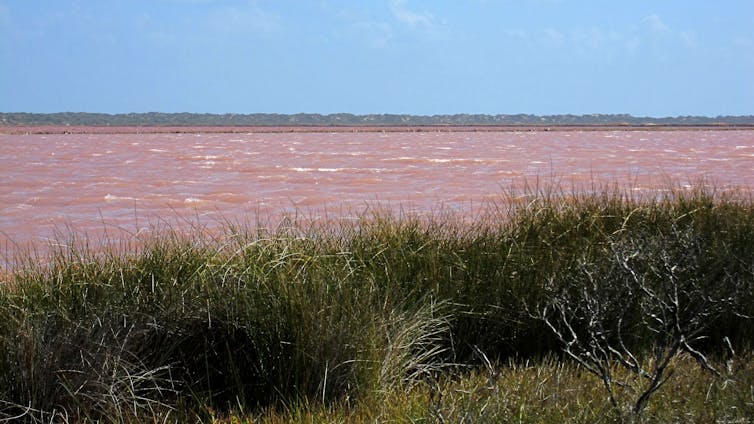
Microalgae are being produced commercially in Australia, including at Hutt Lagoon in Western Australia, the world’s largest microalgae production plant. There, the alga Dunaliella salina is grown to produce beta-carotene, a food pigment and source of vitamin A.
Microalgae is commercially produced at Hutt Lagoon in Western Australia. Wikimedia CommonsElsewhere in Australia, microalgae is grown to produce Spirulina, which is marketed as a health food. Researchers are developing the use of microalgae further, including as a feed supplement for beef cattle.
But the current range of microalgae products grown in Australia is limited. The nation has a suitable climate and the technology; now it needs growers and manufacturers.
Government support is required to enable the agricultural and manufacturing sectors to create algae-based products – current stimulus spending provides such an opportunity. This would not only create new jobs, but enable Australian businesses to become more resilient into the future.
Martina Doblin, Senior Research Fellow, Plant Functional Biology & Climate Change, University of Technology Sydney; Donna Sutherland, Research Fellow, University of Technology Sydney, and Peter Ralph, University of Technology Sydney
This article is republished from The Conversation under a Creative Commons license. Read the original article.


Load more posts
Something went wrong. Please refresh the page and/or try again.
#algae #biotechnology #BoycottPalmOil #Boycott4wildlife #BoycottPalmOil #conservation #consumerRights #consumerism #crueltyfree #diet #health #PalmOil #palmoil #plantBasedDiet #research #vegan
A corporate monopoly for control over land and resources for palm oil must be dismantled immediately to give humanity, animals and our natural world a fighting chance for survival and to reverse the climate crisis. In Asia, many indigenous peoples are now joining forces and rising up to resist this corruption and ecocide. Help them to fight back and #BoycottPalmOil #Boycott4Wildlife
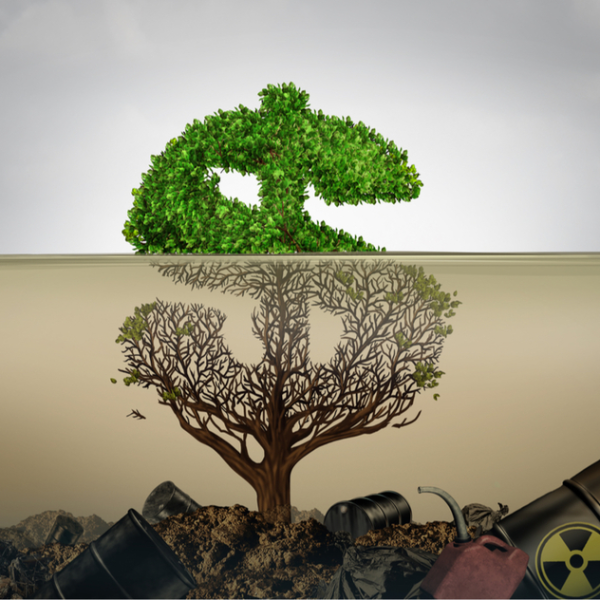
Corporate monopolies 💰🔥👿 drive #landgrabbing for #palmoil. To give #indigenous peoples, animals and #nature a fighting chance, we must resist. “Sustainable” palm oil is #greenwashing! #Boycottpalmoil #Boycott4Wildlife @palmoildetect 🌴🪔🧐🙊⛔️ https://palmoildetectives.com/2022/11/20/land-grabbing-and-the-climate-crisis-are-strongly-linked-to-palm-oil/
Share to BlueSkyShare to Twitter#Report by @FAO 📜 finds 90% of #deforestation is for BIG-AG by #Cargill, #Wilmar and #SimeDarby. Their monopoly drives #indigenous #landgrabbing for #palmoil 🌴💰 Take action! 🌴🪔💀🤢🚫 #Boycottpalmoil #Boycott4Wildlife @palmoildetect https://palmoildetectives.com/2022/11/20/land-grabbing-and-the-climate-crisis-are-strongly-linked-to-palm-oil/
Share to BlueSkyShare to TwitterOriginally written by Arnold Padilla for Bulatlat.com as ‘Land Monopoly and Climate Crisis: A Look at Asia’. Read the original article. Published November 17, 2022. Arnold Padilla is the coordinator of the Food Sovereignty Program of PAN Asia Pacific (PANAP) and its “No Land, No Life” campaign against land grabbing.
Some closely following the UN Framework Convention on Climate Change (UNFCCC) say that the 27th session of its Conference of the Parties (COP27) puts more attention on food and agriculture than in previous years.
For instance, the International Panel of Experts on Sustainable Food Systems (IPES) noted that the climate gathering in Egypt features four pavilions and about 200 events on food and farming. But these are still outside official negotiations, where states do the actual policymaking and commitments.
It is apparent in the discussions that matter in the COP process that there is no meaningful focus on the role and accountability of corporate farming in warming the planet.
The industrial food system (i.e., agriculture and land use/land-use change activities plus supply chain activities like retail, transport, consumption, fuel production, waste management, industrial processes and packaging) contributes about 34% to global greenhouse gas (GHG) emissions, with an estimated environmental cost of US$ 3 trillion annually.
Yet, addressing and reversing the climate impacts of corporate farming through radical food systems transformation is not a priority among the COP27 negotiators.
Land monopoly, an indispensable requirement of corporate farming, creates favorable conditions for the climate crisis to persist and worsen. Corporate monoculture plantations, one of the most visible expressions of land monopoly since colonial times, are among the significant contributors to the existential crisis that the world faces today.

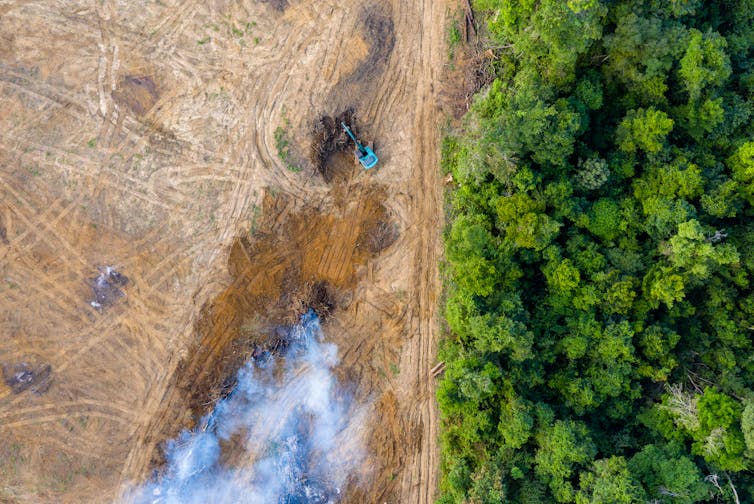
Big agribusiness firms are cutting down massive swathes of forests for conversion into industrial plantations and livestock grazing. The Food and Agriculture Organization (FAO) reported that agricultural expansion drove almost 90 percent of global deforestation in the past two decades.
In Asia, nearly 80 percent of deforestation during the same period is due to conversion into croplands, mainly by corporate plantations, based on the UN body’s study.
Independent studies affirm this, such as the data compiled and analysed by the Land Matrix (a collaboration of civil society, farmers’ groups, and academic research institutions) on large-scale land acquisitions.
These refer to lands in low and middle-income countries acquired by foreign and local investors through purchase, lease or concession for agricultural production, timber extraction, carbon trading, industry, renewable energy production, conservation, and tourism. Their 2021 report noted that 964 land deals caused the deforestation of almost two million hectares between 2000 and 2019.
In East Asia and the Pacific, the Land Matrix reported that about 74 percent of the areas around the locations of land deals were still forested in 2000. By 2019, that number declined to 58 percent, mainly due to oil palm expansions in Malaysia and Indonesia and new agricultural frontiers in Cambodia, China, Laos, and Vietnam.
Clearing the forests releases the carbon dioxide (CO2) they store into the atmosphere, contributing to rising global temperatures.
According to one study, deforestation – which has already claimed 420 million hectares of forests in the last 30 years – can also affect temperatures through its effect on various physical processes of nature. For example, cutting down trees eliminates the forests’ ability to absorb water from the soil and release it into the air as moisture and cool the atmosphere.
At COP27, the world’s largest transnational food companies led by Cargill, Bunge, and Archer Daniels Midland, among others, launched a roadmap to eliminate deforestation from their supply chains for soy, beef, and palm oil by 2025.
However, these companies, which have already made similar pledges in the past only to fall short, continue to be implicated in the massive destruction of forests, like Cargill in the Amazon.
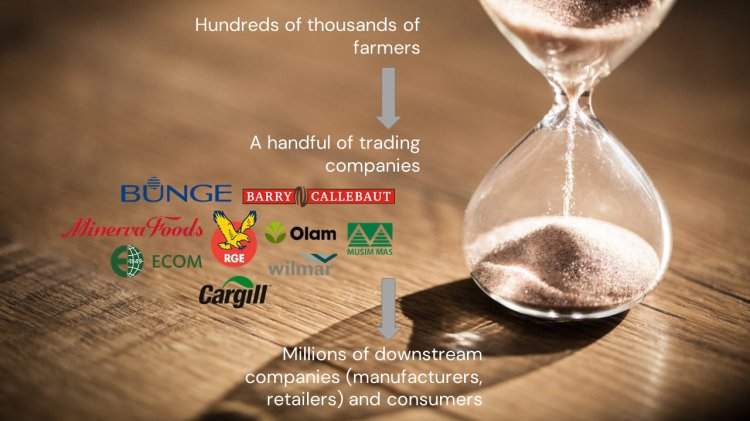
Read more: New research: Indirect sourcing of up to 90% of palm oil from Cargill, Wilmar, Musim Mas cannot be traced and is linked to deforestationEven worse, they use the climate crisis to legitimise and perpetuate resource grabbing, plunder, and land monopoly. One of the supposed climate solutions that big corporations tend to rally around is planting “new forests”.
However, the problem is that these large-scale tree-planting efforts are often a pretext to promote corporate plantations.
Based on another estimate, 45% of oil palm plantations were built in forest areas in Southeast Asia, considered the global hotspot of palm-driven deforestation.
Palm oil is considered the fastest-growing commodity crop worldwide, requiring an ever-expanding mass of arable lands and forests. FAO data shows that the size of land devoted to oil palm plantations in the past four decades ballooned by more than 571 percent – from 4.28 million hectares in 1980 to 28.74 million in 2020.
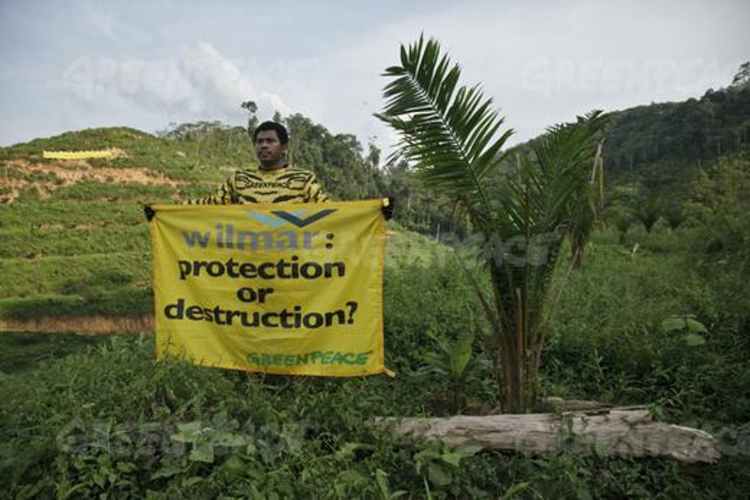
Wilmar responsible for palm oil deforestation despite supposedly using “sustainable” palm oil. Corporate plantations – motivated by profits for their investors that include the world’s wealthiest people and largest investment firms from mostly the industrialised countries – produce commodities dictated by the global market’s needs, not by the food security requirements and overall development agenda of mostly the underdeveloped countries and local communities where they are built often in violent ways. These big capitalists and finance oligarchs are oblivious to their operations’ harsh socioeconomic and environmental impacts.

Aside from degrading or destroying the forests to establish monoculture, export-oriented industrial farms, corporate land monopolies also perpetuate the use of massive amounts of climate-warming fossil fuels by promoting harmful agrochemicals like synthetic fertilizers and pesticides and encouraging long supply chains. It is not a coincidence that as corporate plantations, agrochemicals such as pesticides have also soared by 80 percent in the past three decades.
Agroecological, localised, and diversified food systems offer sustainable and climate-friendly alternatives, as much evidence suggests, but ultimately, decisions on how to use and manage the world’s forests and farmlands for the benefit of the greatest majority without harming the people and planet rest on the question of who effectively controls these resources.
From colonialism to modern imperialism today, such control has been taken away from the indigenous and peasant communities, grabbed and monopolised by and for commercial interests.
The people rising for climate justice necessitates the struggle to dismantle this corporate monopoly control over land and resources and give humanity a fighting chance to survive and reverse the climate crisis.
Pictured: Mushrooms on the forest floor by Wooter Penning for Pexels
Boycott
Boycott
Boycott
Boycott
Boycott
Boycott
Boycott
Boycott
BoycottLoad more posts
Something went wrong. Please refresh the page and/or try again.
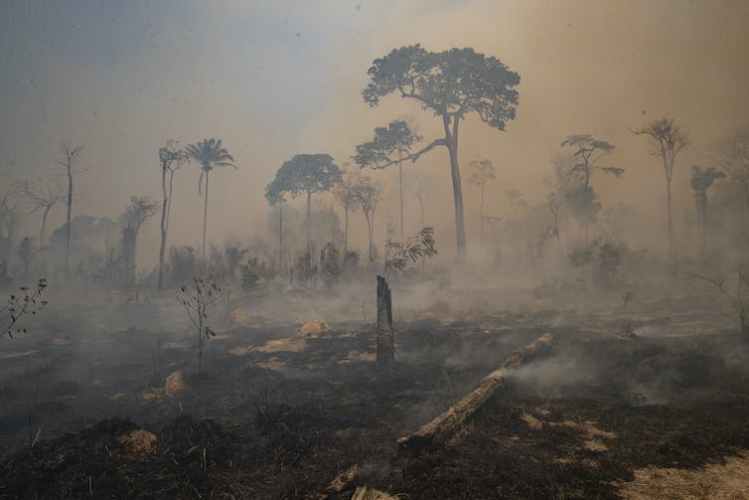
Forests are still being bulldozed to make way for agricultural land for palm oil and beef production. Richard Whitcombe/ShutterstockWritten by Arnold Padilla for Bulatlat.com as ‘Land Monopoly and Climate Crisis: A Look at Asia’. Read the original article. Published November 17, 2022. Arnold Padilla is the coordinator of the Food Sovereignty Program of PAN Asia Pacific (PANAP) and its “No Land, No Life” campaign against land grabbing.
ENDS


Palm Oil Detectives is completely self-funded by its creator. All hosting and website fees and investigations into brands are self-funded by the creator of this online movement. If you like what I am doing, you and would like me to help meet costs, please send Palm Oil Detectives a thanks on Ko-Fi.
Say thanks on Ko-Fi


#Boycott4wildlife #BoycottPalmOil #Cargill #corporateSocialResponsiblity #deforestation #greenwashing #humanRights #indigenous #IndigenousActivism #indigenousRights #landRights #landgrabbing #nature #PalmOil #palmOilDeforestation #palmoil #report #SimeDarby #SouthEastAsia #tropicalRainforest #Wilmar
Forest-fire haze drifting from Indonesia to neighbouring countries every dry season has eluded efforts to curb it.
Land clearing by burning is prohibited in Indonesia and Malaysia. However, penalising foreign companies for palm oil and timber deforestation has been hampered by cronyism and corruption.
Under-explored legal avenues may provide new solutions to the decades-old problem.
Everybody in the world deserves to breath in #cleanair. #Palmoil air #pollution is a global problem. Domestic and international laws could combat it together and provide solutions. #TheAirWeShare Story via @360info_global #Boycottpalmoil @palmoildetect https://palmoildetectives.com/2024/03/03/air-pollution-from-palm-oil-deforestation-is-a-human-rights-issue-affecting-everyone-in-s-e-asia/
Share to BlueSky Share to TwitterPenalising foreign companies for #palmoil and #timber #deforestation in #Indonesia and #Malaysia has been hampered by #cronyism and #corruption at the highest levels of government. Story: @360info_global #TheAirWeShare #Boycottpalmoil #Boycott4Wildlife https://palmoildetectives.com/2024/03/03/air-pollution-from-palm-oil-deforestation-is-a-human-rights-issue-affecting-everyone-in-s-e-asia/
Share to BlueSkyShare to TwitterWritten by Cecep Aminudin, a PhD candidate in environmental law at Padjadjaran University, Indonesia. Originally published as ‘Laying down the law on air pollution’ by 360info.org and republished under Creative Commons License.

Forest and land fires in Indonesia have attracted global attention since the great fires in 1982–83 and 1997–98. Large haze events occurred again in 2007, 2012 and 2015, causing international alarm and cross-border pollution throughout Southeast Asia. Smoke from these sorts of fires is the biggest source of air pollution in Indonesia after transportation and energy emissions.
Companies – mostly oil-palm producers – have used fire as a tool to clear forests and peatland areas for agriculture, even though Indonesia and Malaysia are well aware of the need to strictly enforce bans on the practice.

The ministry filed 21 cases between January 2015 and September 2020, and of these 10 were successful and 11 are still pending. Businesses have been ordered to pay compensation and restoration costs totalling almost US$1.38 billion.
These outcomes are related to the application of the precautionary principle in decision-making by Indonesian civil courts, as is common in environmental cases that involve scientific evidence.
According to this principle, lack of full scientific certainty shall not be used to make a decision regarding environmental protection. Indonesian courts applied the precautionary principle in the determining liable party and judging evidence even when there was scientific uncertainty.
Scientific evidence in the form of studies and expert opinion plays a crucial role in proving illegal fires have occurred, who started them, and how much environmental damage and loss they have caused.
Laboratory test reports can also be used as evidence in civil environmental-justice cases. Entirely at the judge’s discretion, these reports can be treated as expert testimony. Their relevance, which includes validity and reliability, and support from other expert testimonies, is a critical point in a judge’s decision to admit them as compelling legal evidence.
External regulation could complement and support the legal framework in each Southeast Asian country to ensure the activities of transnational companies meet environmental standards and the Association of Southeast Asian Nations (ASEAN) notion of cooperation.
A legitimate legislative framework could impose and enforce international environmental standards recognised under human rights obligations. In this way, palm oil plantation companies could be held accountable under international law for the pollution they cause elsewhere.
The victims of transboundary pollution and other environmental destruction are the people whose health will suffer, either in the short or the long term. Many countries have also suffered economic loss from direct damage and loss of economic activity.

Holding polluters accountable will not just uphold domestic laws but also demonstrate political willingness to recognise air pollution as a human rights issue.
Cecep Aminudin is a PhD candidate in environmental law at Padjadjaran University, Bandung, Indonesia. He is the Chairman of ECOTAS, a research institute on sustainability. Apart from pursuing his doctoral degree, Aminudin conducts research, delivers training and consults on environmental law. He declares no conflict of interest in relation to this article and does not receive special funds in any form.
Originally published under Creative Commons by 360info™.
Written by Cecep Aminudin, a PhD candidate in environmental law at Padjadjaran University, Indonesia. Originally published as ‘Laying down the law on air pollution’ by 360info.org and republished under Creative Commons License.
ENDS


Nestlé is destroying rainforests, releasing mega-tonnes of carbon into the atmosphere, and killing hundreds of endangered species. Once these animals are gone – they are gone for good. See Nestlé’s full list of…

Despite global retail giant Colgate-Palmolive forming a coalition with other brands in 2020, virtue-signalling that they will stop all deforestation, they continue to do this – destroying rainforest and releasing mega-tonnes of carbon…

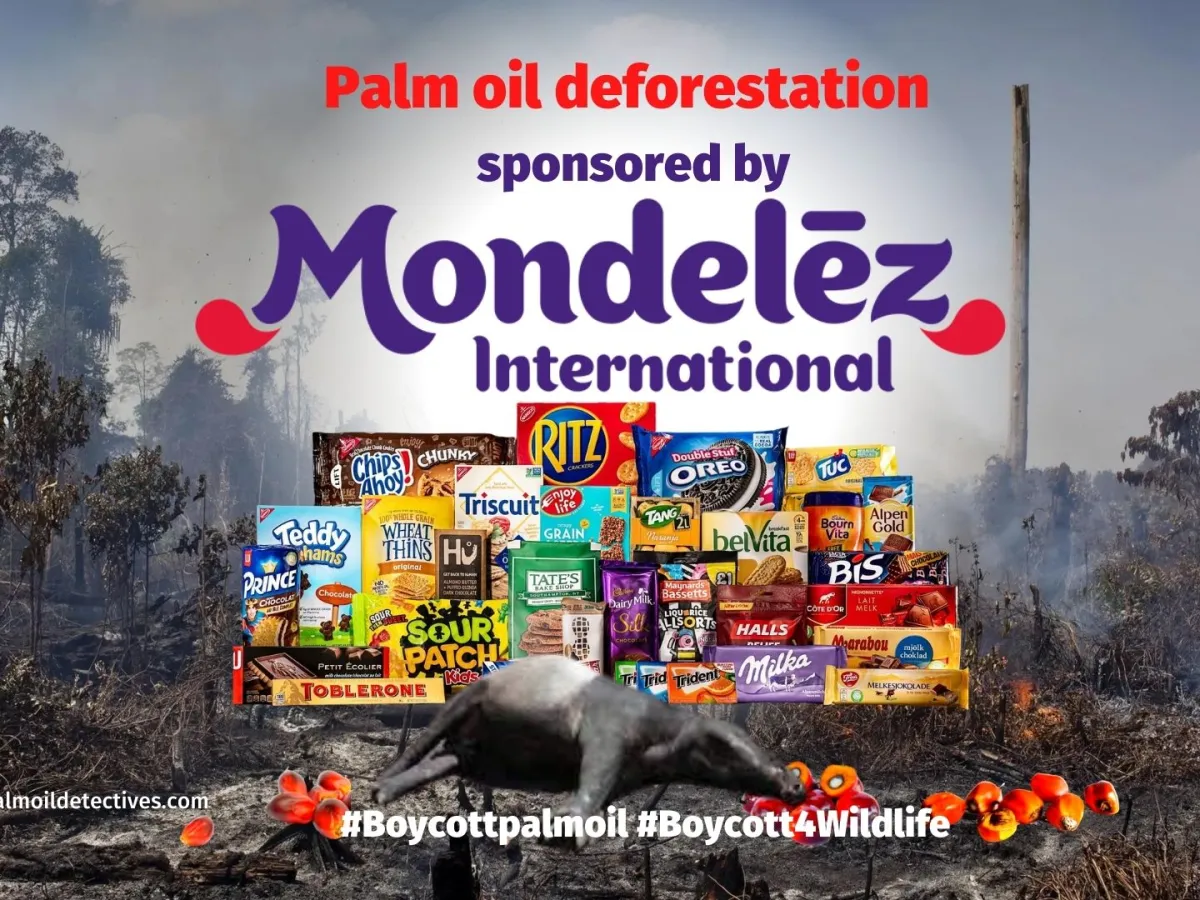
Mondelez destroys rainforests, sending animals extinct and release mega-tonnes of carbon into air for so-called “sustainable” palm oil. Boycott them!

In 2020, global retail giant Unilever unveiled a deforestation-free supply chain promise. By 2023 they would be deforestation free. This has been and gone and they are still causing deforestation. This brand has…

Savvy consumers have been pressuring French Dairy multinational Danone for decades to cease using deforestation palm oil. Yet they actually haven’t stopped this. From their website: ‘Danone is committed to eliminating deforestation from…

Despite decades of promises to end deforestation for palm oil PepsiCo (owner of crisp brands Frito-Lay, Cheetos and Doritos along with hundreds of other snack food brands) have continued sourcing palm oil that…

Despite decades of promises to end deforestation for palm oil Procter & Gamble or (P&G as they are also known) have continued sourcing palm oil that causes ecocide, indigenous landgrabbing, and the habitat…

In late 2023, Kelloggs became Kellanova for their US arm. Savvy consumers have been pressuring Kelloggs for decades to cease using deforestation palm oil. Yet they actually haven’t stopped this. From their website:…

Global mega-brand Johnson & Johnson have issued a position statement on palm oil in 2020. ‘At Johnson & Johnson, we are committed to doing our part to address the unsustainable rate of global…

PZ Cussons is a British-owned global retail giant. They own well-known supermarket brands in personal care, cleaning, household goods and toiletries categories, such as Imperial Leather, Morning Fresh, Carex, Radiant laundry powder and…
1. Join the #Boycott4Wildlife on social media and subscribe to stay in the loop: Share posts from this website to your own network on Twitter, Mastadon, Instagram, Facebook and Youtube using the hashtags #Boycottpalmoil #Boycott4Wildlife.
Enter your email address
Sign Up
Join 3,526 other subscribers2. Contribute stories: Academics, conservationists, scientists, indigenous rights advocates and animal rights advocates working to expose the corruption of the palm oil industry or to save animals can contribute stories to the website.


3. Supermarket sleuthing: Next time you’re in the supermarket, take photos of products containing palm oil. Share these to social media along with the hashtags to call out the greenwashing and ecocide of the brands who use palm oil. You can also take photos of palm oil free products and congratulate brands when they go palm oil free.
https://twitter.com/CuriousApe4/status/1526136783557529600?s=20
https://twitter.com/PhillDixon1/status/1749010345555788144?s=20
https://twitter.com/mugabe139/status/1678027567977078784?s=20
4. Take to the streets: Get in touch with Palm Oil Detectives to find out more.
5. Donate: Make a one-off or monthly donation to Palm Oil Detectives as a way of saying thank you and to help pay for ongoing running costs of the website and social media campaigns. Donate here
Pledge your support#360infoOrg #airPollution #BoycottPalmOil #Boycott4wildlife #BoycottPalmOil #carbonemissions #cleanair #corruption #cronyism #deforestation #fire #fossilFuels #fossilfuel #fossilfuels #greenwashing #humanHealth #Indonesia #Malaysia #PalmOil #palmOilDeforestation #palmoil #pollution #SouthEastAsia #TheAirWeShare #timber
The race is on to find a real solution to stop palm oil ecocide. For several years now, several new #biotech companies have been busy generating alternatives to palm oil that are healthier for human consumption and don’t require the destruction of rainforests sending thousands of species to extinction. Learn more about palm oil grown in labs synthesised from algae, microbes, CO2 and more. #BoycottPalmOil #Boycott4Wildlife
Unlike #greenwashing promises of the @RSPOtweets to stop #deforestation for palm oil – novel solutions made in labs will actually deliver deforestation-free #palmoil alternatives. Should we be cautiously hopeful? Yes! #Boycott4Wildlife @palmoildetect 💡🙂https://palmoildetectives.com/2022/09/11/reasons-to-hope-palm-oil-alternatives-made-without-deforestation/
Share to BlueSkyShare to TwitterReasons to Hope: synthetic #palmoil alternatives. Free from #deforestation – for real! Made from #algae #yeast #microbes, even CO2! Advocate for ecocide-free #palmoil alternatives! #Boycottpalmoil 🌴☠️⛔️ #Boycott4Wildlife 💡🙂@palmoildetect.bsky.social https://palmoildetectives.com/2022/09/11/reasons-to-hope-palm-oil-alternatives-made-without-deforestation/
Share to BlueSkyShare to TwitterLab-grown alternatives to palm oil provide animal advocates and environmental activists with reasons to be cautiously hopeful for the future of mass-produced supermarket goods like cleaning products, pet food, beauty products, and food – 50% of which contain palm oil.

Until these palm oil free alternatives come onto the market and are used in consumer products, you can help these animals by rejecting the immense corruption, pollution and ecocide of the palm oil industry by boycotting major supermarket brands using palm oil and still benefiting from the greenwashing of “sustainable” palm oil. Here are tips on how to do that.

The team behind Smey, an AI-enabled yeast alternative to palm oil. Smey is developing a lab-created alternative to palm oil and cocoa butter using a combination of yeast fermentation and artificial intelligence. The company’s precision fermentation process creates cultured fats and specialty oils that replicate the functional and sensory qualities of tropical oils, but without the environmental destruction linked to conventional palm oil and cocoa production. Smey’s fats are designed for use in food manufacturing, confectionery, and cosmetics, offering a deforestation-free, climate-friendly solution for global supply chains, in time for the #EUDR.
“Using AI models, we identify strains that naturally produce specific fatty acid profiles like stearic acid for cocoa butter mimetics. Once a suitable strain is selected, we proceed to fermentation under optimised lab conditions. The goal here is to fine-tune the triglyceride composition, a critical factor that determines the oil’s melting profile, skin feel, and absorption rate.”
Smey Founder Viktor Sartakov-Korzhov explains to Green Queen.
Smey is a German-French biotech startup headquartered in Paris. The company was founded by a team of scientists and technologists who specialise in merging data science with biotechnology. Smey’s leadership includes experts in precision fermentation, AI, and sustainable ingredient development. The company employs 11–50 people and serves clients in the food, cosmetics, and pharmaceutical industries. Smey’s product portfolio includes not only palm oil alternatives but also cocoa butter equivalents, MCT oils, and other specialty fats.
Smey’s mission is to decarbonise the global fats and oils industry by replacing environmentally destructive tropical oils with lab-grown, precision-fermented alternatives. By leveraging AI to optimise yeast fermentation, Smey aims to drastically reduce the land use, emissions, and biodiversity loss associated with palm oil and cocoa production.
Smey’s cultured fats are currently being piloted with food manufacturers and ingredient suppliers in Europe. The estimated retail launch date is mid 2027. The company is actively scaling its production and working with partners.
Green Queen. (2025, June 26). This Company is Using AI & Fermentation to Create Deforestation-Free Fats. https://www.greenqueen.com.hk/smey-yeast-fermentation-ai-fat-palm-oil-cocoa-butter-neobank/
SMEY. (2025). Engineered protein, sweetener, fats & oils supplier. Retrieved July 13, 2025, from https://www.smey.cc/company
“Smey’s primary focus is on cultivated oils, as these products are ready for industrial scaling and already showing strong commercial traction. Ovalbumin is a key functional protein in food formulations. Given the regulatory pathway, especially for food proteins, we expect Smey Ovo to reach the market in mid-2027.”
Smey Founder Viktor Sartakov-Korzhov explains to Green Queen.

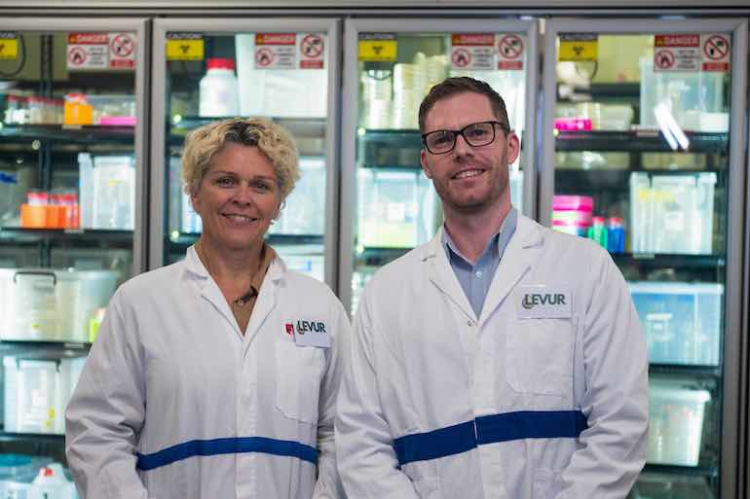
Levur is creating a biotechnology-driven alternative to palm oil using yeast fermentation. The product aims to replicate the texture and functionality of palm oil commonly found in food and cosmetic products like processed snacks and soaps. Unlike traditional palm oil, this lab-grown version is designed to avoid the massive deforestation and biodiversity loss linked to oil palm plantations.
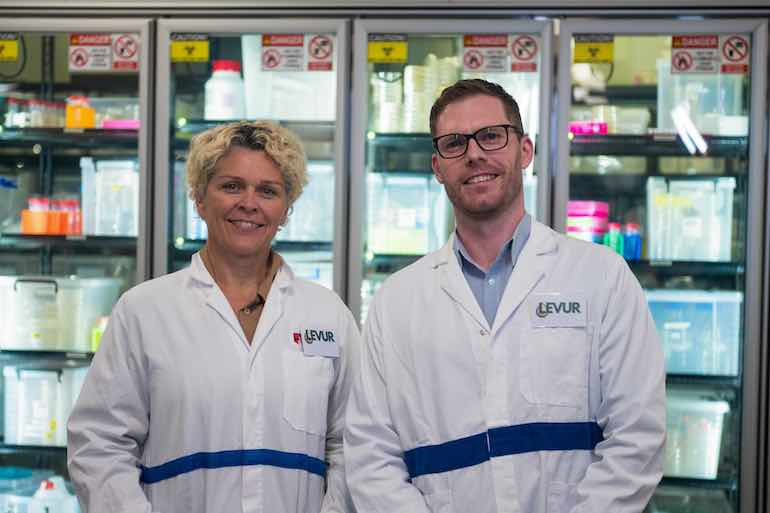
Levur is an Australian biotech startup co-founded by scientists Tom Collier and Joanne Barber, based in Sydney, Australia. Levur is backed by Main Sequence, a major venture fund investing in science-based startups, and took part in SparkLabs Cultiv8, an accelerator program for agri-food and biotech innovation. Their project was recently recognised as one of five Australian finalists selected from over 100 entries in the KPMG Nature Positive Challenge, securing a $100,000 consulting prize.
Their mission is to radically reduce environmental harm of palm oil industry, which is responsible for massive rainforest destruction, endangering thousands of species all over the tropical world. They hope to help giant global industries towards a just transition to ingredients that preserve biodiversity, human health and planetary health.
Levur was inspired by Collier’s visit to Borneo for a documentary looking at how the palm oil industry caused deforestation and and the survival of threatened species such as orangutans.
No specific retail launch date has been announced, however Levur’s win in the Nature Positive Challenge in 2025 is expected to fast-track development of a viable alternative to palm oil.
“Winning feels like a pivotal moment for Levur. It’s a validation of the mission our team has worked so hard to make a reality and a powerful reminder of why we started this journey: to protect our planet and create solutions that leave a lasting impact. Thanks to this prize, we’ll be able to scale faster and reach more markets, helping to commercialise our sustainable alternative to palm oil.”
Tom Collier, Co-Founder of levur
Startup Daily. (2025, January 23). Palm oil replacement startup Levur brews up $100,000 Nature Positive Prize. https://www.startupdaily.net/topic/palm-oil-replacement-startup-levur-brews-up-100000-nature-positive-prize/
Locus Ingredients is producing a new class of biobased biosurfactants for use in personal care, cosmetics, and home cleaning products. These biosurfactants offer a safe and environmentally-friendly alternative to palm oil that comes from destroyed rainforests.
The company generates surfactants made via a fermentation process that use non-GMO sugars, fatty acids, and microorganisms such as yeasts or fungi. Unlike bio-based surfactants made through high-energy chemical synthesis, Locus’s approach is low-impact and non-toxic. Their production system is powered by modular fermentation, bioinformatics, and specialised purification. This allows for rapid, cost-effective, and large-scale manufacturing. Locus Ingredients’ surfactants are suitable for use in products like shampoos, micellar water, creams, and conditioners.
The technology is developed by Locus FS, a US-based fermentation specialist, with commercialisation managed through their Locus Ingredients division. David Anderson, Senior Vice President of Locus Ingredients, leads the innovation strategy. The company has secured an exclusive distribution agreement with Dow Chemical for personal care and home care applications, expanding global market access for the product.
Locus aims to disrupt the palm oil-derived surfactant market, which contributes to tropical deforestation and pollution. Their biosurfactants offer superior performance, skin gentleness, and a lower carbon footprint, making them ideal for eco-conscious brands. The broader mission is to eliminate reliance on destructive agricultural oils and transition the cosmetics industry toward regenerative, biotechnologically-produced alternatives.
The ingredients are already available for use in commercial formulations and are being adopted through Dow’s global distribution networks. With a recent 100,000-square-foot facility expansion, Locus is now positioned as one of the world’s largest producers of biosurfactants and can meet current market demand for palm-free ingredients at scale.
“We are also always enhancing our production process to further minimise our already low carbon footprint. Through our technology and formulary library we aim to educate manufacturers and consumers on the best ways to create clean product formulations. We are also continuing to expand our line of biosurfactants, with new glycolipid ingredient offerings.”
Stern, C., & Pitman, S. (2023, October 5). Locus Ingredients targets sustainable palm oil alternatives. CosmeticsDesign.
UK based start-up producing a local, circular alternative to palm oil, made from natural yeast using a non-GM process in a lab.
The Clean Food Group was co-founded by CEO Alex Neves and co-chairman Ed McDermott in 2021. However, the foundational technology was developed over eight years at the University of Bath by Professor of Bioengineering the University of Bath, Chris Chuck. They have so far gained £1.65M in funding.
To make clean, healthier palm oil derivatives that can be used within food or cosmetic formulations. These provide a clear alternative to palm oil grown in the traditional way which causes irrevocable damage to our planet and health.
A definitve date for release has not been advised. However, Clean Food Group’s most recent update occurred in late 2024 when Clean Food Group announced a collaboration with THG Labs to produce a palm oil alternative made from waste bread. This will be used in beauty and personal care products. Read original article on Green Queen.
“We are well placed to take the next step on the path of bringing our palm oil alternative to market.
Alex Neves, Co-Founder and CEO of Clean Food Group, EU startups
“Our dependence on palm oil comes at a great environmental cost. We’ve worked over many years to create robust palm oil alternatives that give us a real chance to cut the impact of a range of products. Up until now it has only been possible to produce these products with palm oil and the deforestation, emissions and pollution that comes with that”
Chris Chuck, Clean Food Group Technical Advisor and Professor of Bioprocess Engineering at the University of Bath.
Clean Food Group. (n.d.). Home.
The Business Exchange Bath and Somerset. (2024, April 18). University of Bath innovation helps deliver sustainable palm oil alternative.
Green Queen. (2024, April 18). THG and Clean Food Group launch palm oil alternative made from food waste.
NoPalm produces microbial oils to replace the use of palm- and other tropical oils in food, cosmetics, and detergents. The oil is manufactured by fermenting food waste in a circular, environmentally friendly way.
A start-up in the Netherlands founded by Lars Langhout and Jeroen Hugenholtz in 2021.
That no forests anywhere in the world continue to be burned down for palm oil plantations.
Oil is produced from rejected vegetables, potato peels or sugar beets that are fermented with oleaginous yeasts. Whereas normally these waste products would be destroyed or thrown away, NoPalm gives waste biomass a second life. The process is similar to brewing beer or winemaking except for the type of yeast used.
“There is no argument as to why palm oil plantations should continue to run in the long-term. We have a solution that’s local, which can leverage local supply chains to produce it, doesn’t require deforestation or transportation to produce it and limits the use of chemicals. Imagine if all companies in the world started using microbial oil instead of palm oil. We could make a real impact and eliminate palm oil in an accelerated way.”
In 2022, the team have received initial funding of 1.5 million euro and are looking for more. They anticipate the ingredient will be available in consumer goods within the next few years.
In April 2025, the NoPalm team made an announcement that they are launching REVÓLEO™—a fermentation-based oil replacing #palmoil in the food and beauty markets. The team explained that REVÓLEO™ means 90% fewer emissions, 99% less land use. Read more at Vegconomist.
Innovation Origins. (2022, August 17). NoPalm Ingredients brews a sustainable alternative to palm oil from vegetables.
Vegconomist. (2025, April 8). NoPalm Ingredients introduces next-gen fermentation-based oil brand REVÓLEO.

GreenOn is a biotech company producing oils and derivatives that can be used to replace palm oil, coconut oil and animal fats, powered by carbon dioxide, electricity and water.
GreenOn is a Swedish biotech start-up founded in 2021 by Annette Cecilia Granéli and Roland Vestergren. Initial funding for the technology comes from palm oil polluter and deforestator (and RSPO member) AAK for their go-to-market commercialisation, they have invested $125K so far.
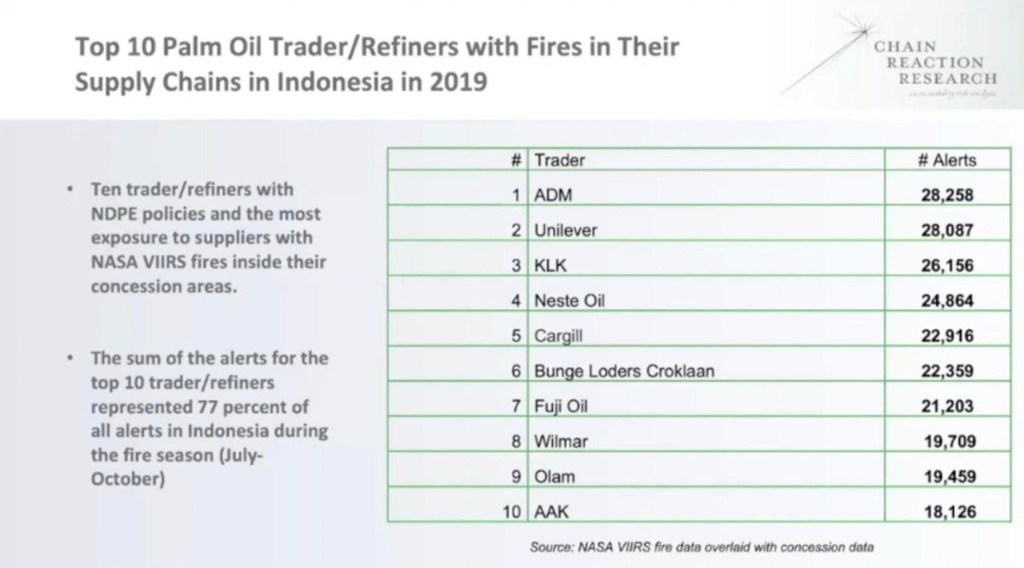
Inset: The Top Ten Palm Oil Traders with Fires in their Supply Chains in Indonesia, Chain Reaction Research (2019)“We hope our product technology can relieve the challenges of agricultural production on the environment.”
GREEN ON’S WEBSITE
Their novel ‘Power-to-Food’ concept uses fossil-free electricity, carbon dioxide and water to produce customised saturated fats that can be used in products such as baked foods, cheese, ice cream, chocolate and shortening. Green-On also makes mono and diglycerides that may be used as emulsifiers in food products.
Products are still being developed, however it’s estimated that product ingredients to replace palm oil will be ready at the earliest by 2024.
“We came up with a concept to produce food that bypasses traditional agriculture. We started Green-On to bring deforestation-free ingredients to the food and feed industry.”

“Our palm oil doesn’t even involve palm trees. It doesn’t cause deforestation, endangering precious animal species, or forcing inhumane labor practices. The result is a world where consumers can enjoy the products they love without worrying about the dangerous practices involved in making them.”
C16 Biosciences website.
C16 Biosciences are a New York City based start-up that are female-founded, and have a majority female team. Established in 2017, they have received $20 million in funding from Breakthrough Energy Ventures, a fund established by Bill Gates along with other investors to support innovations that fight climate change.
“The RSPO has been trying for the last decade to solve this problem of palm oil deforestation through supply chain traceability, and it has largely failed.
“Our real mission is ending the need for deforestation that’s driven by the palm oil industry. We believe that it is totally unacceptable to be burning the planet to make a vegetable oil. It just doesn’t make any sense.”
Shara Ticku, Co-founder and CEO of C16 Biosciences told Fast Company.
C16 Biosciences use a particular strain of yeast for their lab-grown alternative to palm oil. This grows in tap water and feeds off a feedstock or carbon source to multiply.
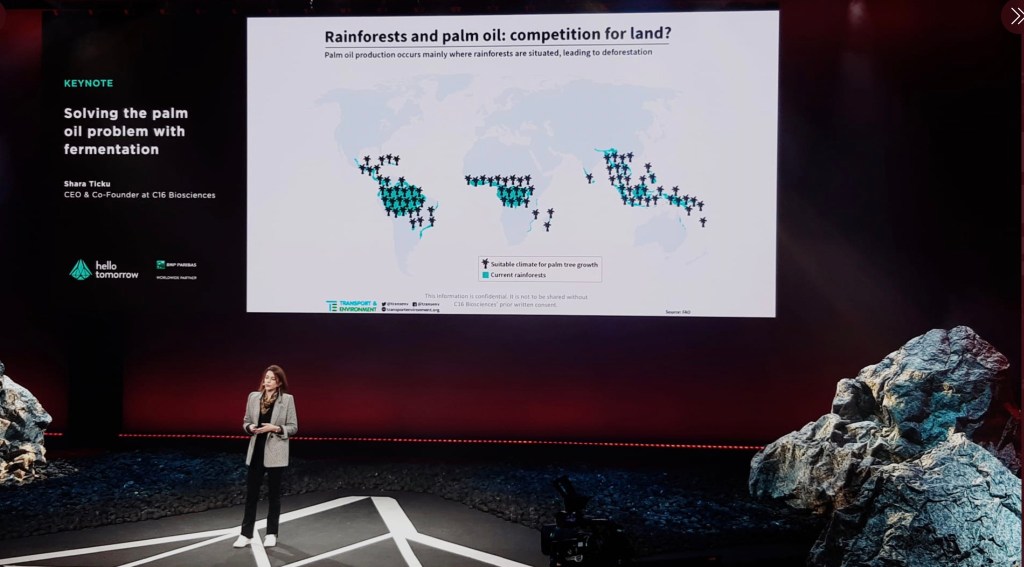
CEO Shara Ticku at the Hello Tomorrow Conference, via TwitterIn 2022, biotech company C16 Biosciences announced the launch of Palmless, a palm oil alternative created with yeast. In 2024, C16 Biosciences was named one of Fast Company’s Most Innovative Companies of 2024 for launching Palmless, They plan on targeting beauty and skincare first, aiming to disrupt palm oil supply chains with their solution.
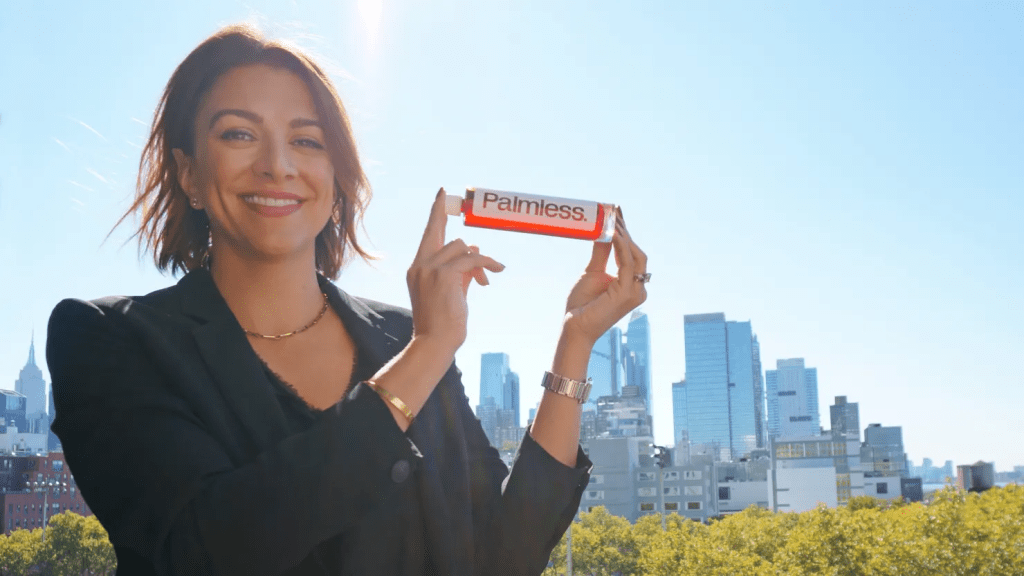
In 2022, biotech company C16 Biosciences announced the launch of PalmlessBill Gates quoted on his own website Gates Notes.
“Even some plant-based fats and oils can be a problem for climate change. The worst culprit is palm oil.
“Today, it’s the most widely consumed plant-based fat in the world. It’s found in half of all packaged goods—everything from peanut butter, cookies, instant ramen, coffee creamer, and frozen dinners to makeup, body wash, toothpaste, laundry detergent, and deodorant to candles, cat food, baby formula, and so much more. It’s even used as a biofuel for diesel engines.
“The issue with palm oil isn’t necessarily how we use it but how we get it. That’s because the oil palm tree, a variety of palm that’s native to Central and West Africa, doesn’t grow everywhere. The opposite, actually—the tree will only grow well within five to ten degrees of the equator. That has led to slash-and-burn deforestation of rainforests in equatorial regions around the world, which are then converted to oil palm plantations.
“This process has been bad for biodiversity, putting entire ecosystems at risk. It’s also a one-two punch for climate change: The combustion involved in burning forests emits tons of greenhouse gases into the atmosphere, and as the wetlands they sit on are destroyed, the carbon they’ve been storing gets released too. In 2018, the devastation in Malaysia and Indonesia alone was bad enough to account for 1.4 percent of global emissions—more than the entire state of California and nearly as much as the aviation industry worldwide.
“Unfortunately, palm oil is hard to replace. It’s cheap, odorless, and abundant. While most plant oils are liquid at room temperature, palm oil is semi-solid, creamy, and easily spreadable. Since it acts as a natural preservative, it has an extremely long shelf-life. (It actually raises the melting point of ice cream.) It’s also the only plant oil with a near-equal balance of saturated and unsaturated fats, which is why it’s so versatile. If animal fat is the superstar of some meals, then palm oil is the team player that can work to make almost all foods—and non-edible goods—even better.
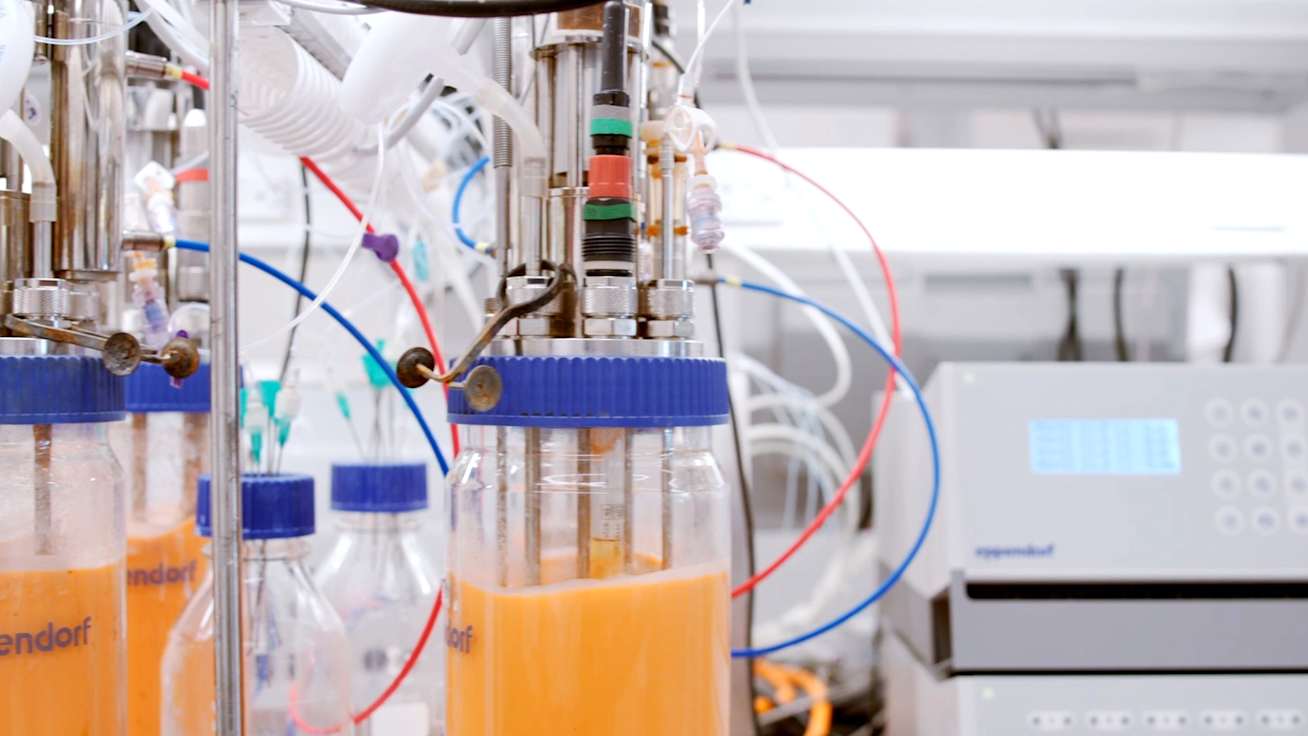
“For these reasons, companies like C16 Biosciences are working hard on alternatives to palm oil. Since 2017, C16 (which I’m invested in) has been developing a product from a wild yeast microbe using a fermentation process that doesn’t produce any emissions. While it differs from conventional palm oil chemically, C16’s oil contains the same fatty acids, which means it can be used in the same applications. And it’s as “natural” as palm oil—it’s just grown on fungi instead of trees. Like Savor’s, C16’s process is entirely agriculture-free; its “farm” is a lab in midtown Manhattan.” via Gatesnotes.
Clifford, C. (2022, November 3). Gates-backed C16 Biosciences uses yeast to create palm oil substitute. CNBC.
Fast Company. (2024, March 26). C16 Biosciences: Most Innovative Companies 2024.
Gates, B. (2024, March 5). The future of food: A smarter way to make fats and oils. Gates Notes.

A far healthier edible oil alternative created from microalgae.
Scientists from Nanyang Technological University in Singapore and the University of Malaya in Malaysia.
“Uncovering microalgae as a potential human food source is an opportunity to lessen the impact of palm oil in the food supply chain and the impact this has on our planet.”
~ Dr William Chen, head of the research team and Director of NTU’s Food Science and Technology Program.
Edible oils are extracted from a common strain of microalgae that has similar properties to palm oil, however contains fewer saturated fatty acids. This means that the algae alternative will be healthier than traditionally harvested palm oil. Saturated fats from palm oil raise levels of LDL cholesterol in our blood, thereby increasing the risk of heart disease.
This microalgae alternative to palm oil can be cultivated at scale, removing the need for further deforestation to plant yet more oil palm crops. They are a couple of years away from market.
“We rely on one of nature’s key processes, fermentation, to convert that organic matter into nutrient-rich solutions, which could be used to cultivate algae, which not only reduces our reliance on palm oil, but keeps carbon out of the atmosphere.”
~ Dr William Chen, head of the research team and Director of NTU’s Food Science and Technology Program.
Find out more:
Jun-Hui Chen et al, Screening and effect evaluation of chemical inducers for enhancing astaxanthin and lipid production in mixotrophic Chromochloris zofingiensis, Journal of Applied Phycology (2021). DOI: 10.1007/s10811-021-02618-6

A joint project between biotech company Genomatica and global FMCG brand Unilever to create a fatty alcohol alternative to palm oil made from fermented sugar. This would be used in skincare and beauty products.
This project is controversial for environmental activists and animal advocates to support. It is a collaboration funded by Unilever for $120 million. Unilever are a global corporate with a bad historical reputation as polluters and deforesters. They are linked to a dark history of colonial atrocities, ecocide and slavery in Africa. Still, despite Unilever’s involvement – this project deserves a mention due to its innovation. In October 2022, Kao announced that they will also be a founding partner in this biotech venture.
The venture aims to commercialise and scale plant-based alternatives to feedstocks like palm oil and fossil fuels. Replacing environmentally harmful ingredients like palm oil with alternatives for use in cleaning, cosmetics and personal care products.
Beyond creating new transparent and responsibly sourced-supply chains and alternatively-sourced materials, our Geno technology also represents the potential to reduce greenhouse gas emissions by 100 million tons in upcoming years.”
As of 2023, L’Oréal went into partnership with Genomatica to produce lab-developed alternatives to palm oil. L’Oréal launched a shampoo with biotech surfactants. According to one news article, these new formulas are not only more sustainable but also gentler on skin and scalp, adding value for consumers. Although it is important to keep in mind that L’Oréal tests its products on animals.
Find out more: Genomatica
Carbon Credits. (2024, May 10). L’Oréal launches sustainable innovation accelerator—Where beauty meets sustainability & carbon reduction. CarbonCredits.com.
1. Join the #Boycott4Wildlife: Share posts from this website to your own network on Twitter, Instagram and Facebook using the hashtags #Boycottpalmoil #Boycott4Wildlife.
2. Contribute stories: Academics, conservationists, scientists, indigenous rights advocates and animal rights advocates working to expose the corruption of the palm oil industry or to save animals can contribute stories to the website.
3. Supermarket sleuthing: Next time you’re in the supermarket, take photos of products containing palm oil. Share these to social media along with the hashtags to call out the greenwashing and ecocide of the brands who use palm oil. You can also take photos of palm oil free products and congratulate brands when they go palm oil free.
4. Take to the streets: Get in touch with Palm Oil Detectives to find out more.
5. Donate: Make a one-off or monthly donation to Palm Oil Detectives as a way of saying thank you or to help pay for ongoing running costs.
ContributeEnter your email address
Sign Up
Join 3,174 other subscribersDon’t forget to tag in #BoycottPalmOil #Boycott4Wildlife to get shared
https://twitter.com/ECOWARRIORSS/status/1625103083175923713
https://twitter.com/MAPICC2021/status/1643269215929999360
https://twitter.com/netzfrauen/status/1806059662703222960
https://twitter.com/JosieAllan4/status/1716432333698392163
https://twitter.com/ChiweenieT14381/status/1872709841040687385
#algae #biotech #biotechnology #Boycott4wildlife #BoycottPalmOil #deforestation #disruptiveTechnology #EUDR #greenwashing #innovation #labGrownPalmOil #microbes #newTechnology #PalmOil #palmOilAndHealth #palmOilDeforestation #palmOilFree #palmoil #research #startUps #syntheticPalmOil #yeast

The Counterpunch: Consumer Solutions To Fight Extinction
https://www.evshift.com/417771/integrating-myaudi-in-apple-carplay/ Integrating myAudi in Apple CarPlay #Apple #audi #bev #CarPlay #connectivity #Design #digitalisation #digitalization #ElectricCar #ElectricCars #ElectricVehicles #eMobility #etron #EV #GermanEngineering #Hybrid #innovation #Integrating #myAudi #Performance #phev #sustainability #VorsprungDurchTechnik #vorsprungdurchtechnik
Discover how Apple's innovative 3D printing strategy is revolutionizing the production of titanium Apple Watches and creating slimmer iPhone Air components. This promising technology also reduces material waste, making it a win-win! #Apple #3DPrinting #Innovation #Sustainability
https://www.squaredtech.co/apple-3d-printing-watch-iphone-manufacturing?fsp_sid=6972
Discover how Apple's innovative 3D printing strategy is revolutionizing the production of titanium Apple Watches and creating slimmer iPhone Air components. This promising technology also reduces material waste, making it a win-win! #Apple #3DPrinting #Innovation #Sustainability
https://www.squaredtech.co/apple-3d-printing-watch-iphone-manufacturing?fsp_sid=6972
🚨 Αποκλειστικό: Διαρροή CAD αρχείων αποκαλύπτει τον σχεδιασμό του πρώτου iPhone Fold! 📱✨
Με σχεδιασμό που θυμίζει μικρό tablet και έμφαση στο λεπτό προφίλ, η Apple φαίνεται πως ετοιμάζει κάτι ανατρεπτικό για το 2026.
Διαβάστε όλες τις λεπτομέρειες για την κάμερα, τον μεντεσέ και την εξωτερική οθόνη στο νέο μας άρθρο! 🔗 https://greek-nea.com/iphone-fold-cad/
#Apple #iPhoneFold #TechNews #SmartphoneLeaks #AppleDesign #iPhone2026 #Innovation
🚨 Αποκλειστικό: Διαρροή CAD αρχείων αποκαλύπτει τον σχεδιασμό του πρώτου iPhone Fold! 📱✨
Με σχεδιασμό που θυμίζει μικρό tablet και έμφαση στο λεπτό προφίλ, η Apple φαίνεται πως ετοιμάζει κάτι ανατρεπτικό για το 2026.
Διαβάστε όλες τις λεπτομέρειες για την κάμερα, τον μεντεσέ και την εξωτερική οθόνη στο νέο μας άρθρο! 🔗 https://greek-nea.com/iphone-fold-cad/
#Apple #iPhoneFold #TechNews #SmartphoneLeaks #AppleDesign #iPhone2026 #Innovation
🚀🎩 BREAKING: #Apple releases groundbreaking 'Lil Finder Guy'—a #microscopic digital butler so insignificant, it makes Siri look like Einstein. Meanwhile, the so-called "Basic Apple Guy" juggles more tabs than brain cells in his quest for haberdashery excellence. 🧠📉

https://basicappleguy.com/basicappleblog/lil-finder-guy #LilFinderGuy #digitalbutler #technews #innovation #humor #HackerNews #ngated
🚀🎩 BREAKING: #Apple releases groundbreaking 'Lil Finder Guy'—a #microscopic digital butler so insignificant, it makes Siri look like Einstein. Meanwhile, the so-called "Basic Apple Guy" juggles more tabs than brain cells in his quest for haberdashery excellence. 🧠📉
https://basicappleguy.com/basicappleblog/lil-finder-guy #LilFinderGuy #digitalbutler #technews #innovation #humor #HackerNews #ngated
Apple MacBook Ultra 48 inç, 3,5 kg, 16 saat batarya ve x86+M5 Hybrid çip ile tanıtıldı.
🚨 Breaking News: #Apple adds new names to their **incredible** #executive list! 🎉 Because, clearly, changing a few job titles is exactly what's needed to fix years of #creative #stagnation and subpar ads—they've cracked the code! 💡
https://parkerortolani.blog/2026/03/07/the-new-apple-finally-begins.html #Changes #Innovation #News #HackerNews #ngated
The New Apple Begins to Emerge
https://parkerortolani.blog/2026/03/07/the-new-apple-finally-begins.html
#HackerNews #The #New #Apple #Begins #to #Emerge #technology #innovation #apple #news #future #trends
🚨 Breaking News: #Apple adds new names to their **incredible** #executive list! 🎉 Because, clearly, changing a few job titles is exactly what's needed to fix years of #creative #stagnation and subpar ads—they've cracked the code! 💡
https://parkerortolani.blog/2026/03/07/the-new-apple-finally-begins.html #Changes #Innovation #News #HackerNews #ngated
The New Apple Begins to Emerge
https://parkerortolani.blog/2026/03/07/the-new-apple-finally-begins.html
#HackerNews #The #New #Apple #Begins #to #Emerge #technology #innovation #apple #news #future #trends
AI in Healthcare
From @apple Health to diagnostic AI, artificial intelligence is transforming healthcare delivery. The future of personalized medicine is here.
What area excites you most?
LinkedIn Test
The 7th Conference on AI Music Creativity will take place 16–18 September 2026. Companies like @apple and @Google are pushing the boundaries of AI in creative fields. Excited to see what innovations emerge!
This is a forward thinking server running the Bonfire social media platform.
LGBTQA+ and BPOC friendly.