Food Without Agriculture
In an article published in Nature Sustainability, researchers write that food production can be more sustainable by focusing less on traditional agriculture and more on alternative methods, like chemical and biological processes.
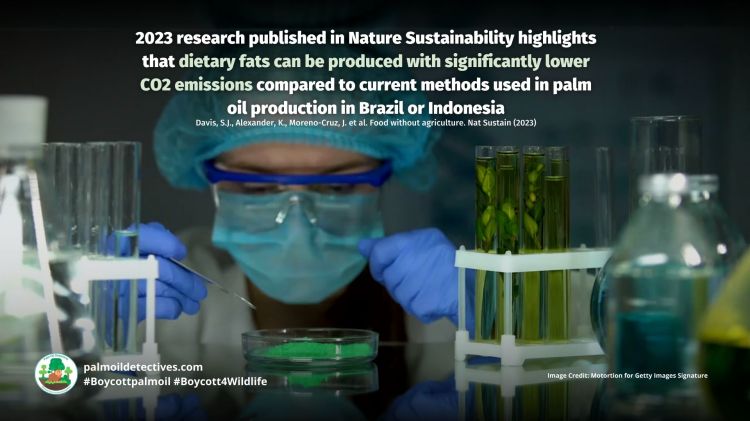
The article highlights a specific example where dietary fats can be produced with significantly lower CO2 emissions compared to current methods used in palm oil production in Brazil or Indonesia. While acknowledging challenges like potential impacts on agricultural economies and the need for consumer acceptance, the abstract suggests that these new methods could greatly reduce the environmental impact of agriculture, especially in terms of greenhouse gas emissions, land, and water use in the next decade.
Davis, S.J., Alexander, K., Moreno-Cruz, J. et al. Food without agriculture. Nat Sustain (2023). https://doi.org/10.1038/s41893-023-01241-2
#Research paper in @Nature Sustainability: Dietary #fats can be produced in a lab with significantly lower #CO2 emissions/#climate impact compared to current #palmoil production in #Brazil and #Indonesia #Boycottpalmoil #Boycott4Wildlife @palmoildetect https://palmoildetectives.com/2024/01/21/food-without-agriculture/
Share to BlueSkyShare to Twitter#Research in @Nature finds switching to lab-produced #palmoil has enormous potential to reduce #GHG emissions, #deforestation, water use. Reducing the climate impact of #agriculture over the decades #Boycottpalmoil 🌴🚫 #Boycott4Wildlife @palmoildetect https://palmoildetectives.com/2024/01/21/food-without-agriculture/
Share to BlueSkyShare to TwitterDavis, S.J., Alexander, K., Moreno-Cruz, J. et al. Food without agriculture. Nat Sustain (2023). https://doi.org/10.1038/s41893-023-01241-2
Abstract
Efforts to make food systems more sustainable have emphasized reducing adverse environmental impacts of agriculture. In contrast, chemical and biological processes that could produce food without agriculture have received comparatively little attention or resources. Although there is a possibility that someday a wide array of attractive foods could be produced chemosynthetically, here we show that dietary fats could be synthesized with <0.8 g CO2-eq kcal−1, which is much less than the >1.5 g CO2-eq kcal−1 now emitted to produce palm oil in Brazil or Indonesia. Although scaling up such synthesis could disrupt agricultural economies and depend on consumer acceptance, the enormous potential reductions in greenhouse gas emissions as well as in land and water use represent a realistic possibility for mitigating the environmental footprint of agriculture over the coming decade. Read original
Plain English Summary of Results
Proteins, fats, and carbohydrates can be made without traditional agriculture by using different carbon sources and a variety of chemical and biological methods. This article compares how much energy each process uses, with some details still uncertain. The processes vary in their continuous or batched nature. The article also discusses the challenge chemical methods face in distinguishing between molecular forms, unlike bioenzymatic methods which are more precise but limited to conditions suitable for life. The focus is on fats because they are simpler to make, have been produced at scale in the past, are a basic calorie source in many foods, and the production of oil crops like soy and palm has a huge environmental impact.
Synthesizing fats from natural gas or air-captured carbon using renewable energy could greatly reduce greenhouse gas emissions compared to traditional agriculture. Finally, the potential environmental benefits of synthetic fats are highlighted, showing that replacing a portion of soy and palm oil with synthetic alternatives could significantly reduce greenhouse gas emissions and land use, particularly in countries where these crops are intensively farmed.
Plain English Summary of Discussion Notes
Producing macronutrients without traditional agriculture can significantly reduce greenhouse gas emissions and land use, especially for dietary fats. Even using coal-based electricity for production can be more climate-friendly than some current agricultural methods. Beyond environmental benefits, such as reduced water use and pollution, synthetic foods can improve food security and lessen the need for labor-intensive farming jobs. This opens up possibilities for reforestation and biodiversity improvements.
However, there are challenges. The estimates are based on data that might not capture all relevant factors, and more detailed analysis is needed. The cost of synthetic foods could be higher than agricultural products, and social acceptance is a major hurdle, given the public’s skepticism about synthetic foods and potential unforeseen environmental impacts. The shift to synthetic foods could also impact the global labor force, especially smallholder farmers in the global South, as agriculture employs a significant portion of the world’s workforce.
Synthetic food production could lead to a smaller environmental footprint for agriculture, requiring much less water and can be produced anywhere with the right resources. This could make food systems more resilient but might also create new dependencies. Sustainable synthetic food production would ideally use renewable energy and atmospheric carbon.
Finally, the move towards synthesized foods prompts a reevaluation of humanity’s relationship with nature. The domestication of plants and the Haber-Bosch process for nitrogen fixation were pivotal in human history. Now, with the majority of habitable land and water used for agriculture, synthetic food offers a path to reduce the environmental burdens of agriculture and align food security with ecosystem restoration.
Read original
Davis, S.J., Alexander, K., Moreno-Cruz, J. et al. Food without agriculture. Nat Sustain (2023). https://doi.org/10.1038/s41893-023-01241-2
ENDS
Read more about deforestation and ecocide in the palm oil industry
The Indigenous Malaysian concept of ‘Badi’: respecting the land and wildlife
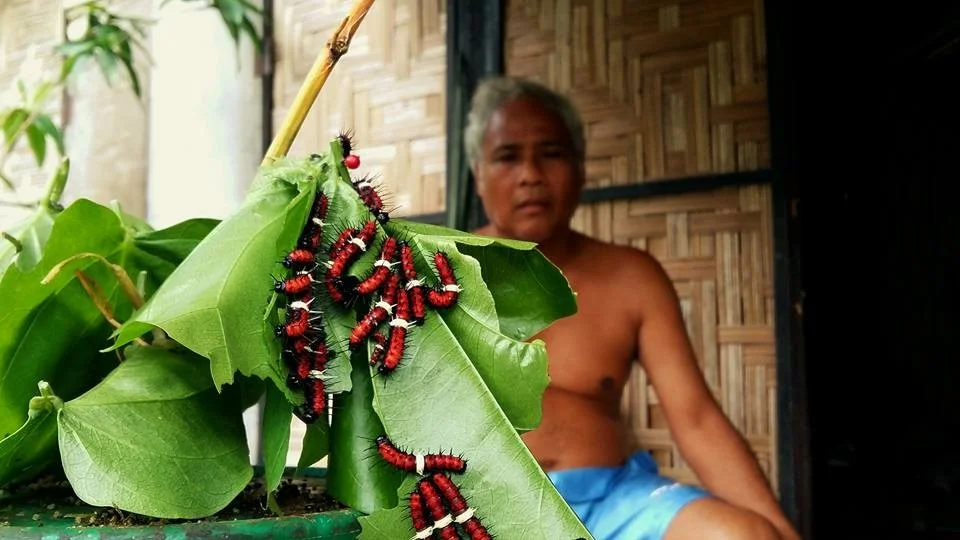
The Indigenous Semai #indigenous people of #Malaysia can teach us a lot about how to protect people, planet and biodiversity. The Indigenous concept of #badi is not superstition or taboo, it’s about respecting…
Deforestation Devastates Tesso Nilo National Park’s Endangered Creatures
Act now to save Tesso Nilo Park. This vital Indonesian park has lost 78% of its primary forest, threatening the habitat of Sumatran tigers and elephants
Deforestation Shifts Tree Species in Brazilian Forests
Deforestation in Brazilian forests causes shift towards fast-growing, small-seeded trees, threatening biodiversity, carbon storage. Take action!
Deforestation and Mining Threaten Rare Species at Lake Poso
Deforestation, mining, and palm oil expansion are pushing rare endemic species at Indonesia’s Lake Poso to the brink. Urgent action needed, boycott palm oil!
Palm Oil Workers Exposed to Hazardous Pesticides
Palm oil workers in Colombia, Ghana, and Indonesia are regularly exposed to hazardous EU-banned pesticides like Paraquat for palm oil. Take action!
Load more posts
Something went wrong. Please refresh the page and/or try again.
Take Action in Five Ways
1. Join the #Boycott4Wildlife on social media and subscribe to stay in the loop: Share posts from this website to your own network on Twitter, Mastadon, Instagram, Facebook and Youtube using the hashtags #Boycottpalmoil #Boycott4Wildlife.
Enter your email address
Sign Up
Join 3,526 other subscribers2. Contribute stories: Academics, conservationists, scientists, indigenous rights advocates and animal rights advocates working to expose the corruption of the palm oil industry or to save animals can contribute stories to the website.

Wildlife Artist Juanchi Pérez
Mel Lumby: Dedicated Devotee to Borneo’s Living Beings
Anthropologist and Author Dr Sophie Chao
Health Physician Dr Evan Allen

The World’s Most Loved Cup: A Social, Ethical & Environmental History of Coffee by Aviary Doert

How do we stop the world’s ecosystems from going into a death spiral? A #SteadyState Economy
3. Supermarket sleuthing: Next time you’re in the supermarket, take photos of products containing palm oil. Share these to social media along with the hashtags to call out the greenwashing and ecocide of the brands who use palm oil. You can also take photos of palm oil free products and congratulate brands when they go palm oil free.
https://twitter.com/CuriousApe4/status/1526136783557529600?s=20
https://twitter.com/PhillDixon1/status/1749010345555788144?s=20
https://twitter.com/mugabe139/status/1678027567977078784?s=20
4. Take to the streets: Get in touch with Palm Oil Detectives to find out more.
5. Donate: Make a one-off or monthly donation to Palm Oil Detectives as a way of saying thank you and to help pay for ongoing running costs of the website and social media campaigns. Donate here
Pledge your support#Agriculture #biotechnology #BoycottPalmOil #Boycott4wildlife #BoycottPalmOil #Brazil #Climate #climateChange #CO2 #deforestation #fats #food #GHG #Indonesia #industrialAgriculture #PalmOil #palmOilDeforestation #palmoil #ReasonsToBeHopeful #research
Humble Algae: The Solution to Palm Oil Ecocide
Consumers, businesses and researchers have shown growing interest in microalgae in recent years. Use of Arthrospira platensis (spirulina) as a food supplement is one example. Others include how microalgae can be used as crop support tools, bioplastics or biofuels. Take action for your health and be #vegan and #BoycottPalmOil #Boycott4Wildlife
#Agriculture is destroying the planet – #algae is a #climatechange resilient answer needing no land to grow, it has a superb nutrients for human #health and more 🌱🍃🥕🥦 #Boycottpalmoil go #vegan 🌴🔥❌ #Boycott4Wildlife @palmoildetect https://palmoildetectives.com/2022/12/28/soy-and-palm-oil-agriculture-is-destroying-the-planet-algae-is-the-answer/
Share to BlueSkyShare to TwitterAgriculture is destroying the planet: algae is the answer
The emerging and predicted impacts on agriculture and food supplies are stark, according to the panel. For instance, heat waves, drought and increasing rainfall variability could adversely affect crop yields and livestock productivity. This, in turn, could cause problems with food availability and nutritional quality, as well as risks of malnutrition and hunger.
Written by Jules Siedenburg, Research fellow, School of International Development, University of East Anglia. This article is republished from The Conversation under a Creative Commons license. Read the original article.
Some parts of the world disproportionately bear this burden: over three billion people are currently deemed highly vulnerable to climate change, most of them in Africa, South Asia and Latin America. Small-scale farmers and pastoralists are particularly at risk.
The need for climate action is now evident, but finding viable pathways can be challenging. Yet effective climate actions can reduce climate-related risks while fostering sustainability. “Climate smart” agricultural technologies offer various proven climate actions, such as agroforestry or drought-tolerant seeds. Such technologies can potentially raise farm productivity while also mitigating (that is, combating) climate change or helping farmers adapt to it, or both.
Growing interest in microalgae
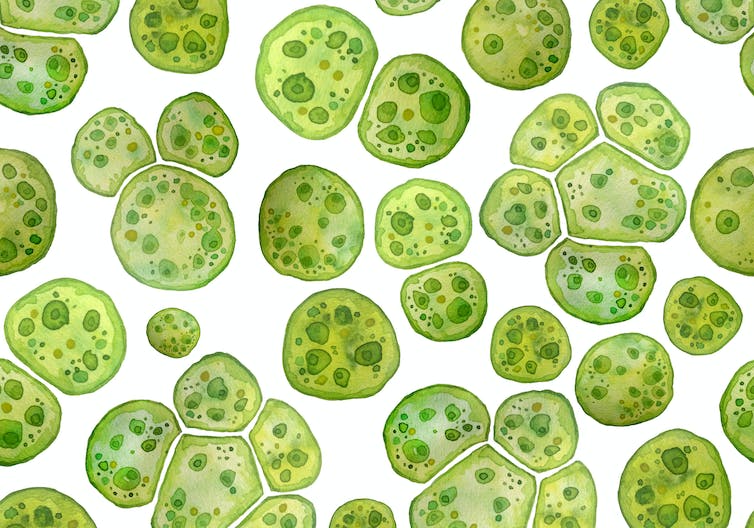
Microalgae are a diverse group of microscopic aquatic organisms. Maryna Lahereva/Shutterstock
Microalgae are a diverse group of microscopic aquatic organisms. Like plants, they typically generate energy from sunlight through photosynthesis. But they differ from plants in basic ways. For instance, they grow in water instead of on land and absorb nutrients directly instead of via roots. While some microalgae are seen as harmful, others provide useful products.
One question that has remained largely unexamined, however, is whether “agri-food” applications of microalgae might offer promising options to mitigate or adapt to climate change.
A new academic paper set out to provide provisional answers. It reviewed the available evidence on microalgae as food supplements, livestock feeds, biofertilisers, biostimulants and biochar feedstocks. It then assessed the potential of these five microalgae applications to serve as the basis for climate actions.
Agri-food applications and climate action
Microalgae have been used as traditional foods in various countries where suitable species occur naturally, such as Mexico and Chad.
Nowadays microalgae food supplements are principally eaten by health-conscious consumers. Yet they can also be used to address malnutrition and to improve health in places where diet is poor. As foods, microalgae can be potent sources of nutrients, including high-quality proteins, lipids and vitamins.
- Microalgae production has characteristics that clearly distinguish it from plant or animal production.
- It doesn’t require fertile land.
- It is largely independent of local weather patterns and could potentially recycle water.
- It has elevated productivity and scope for continuous harvests.
Microalgae is climate resilient
This technological profile is well suited to coping with climatic shocks, so microalgae production can be climate resilient. The delivery of microalgal biomass for use as a food or for other applications can thus also be climate resilient.
Novel feeds like microalgae, seaweed and insects offer options to improve the sustainability of livestock production by providing protein-rich complements to staple feeds like grasses and feed crops. Microalgae feeds have been tested on cattle, goats, sheep, pigs, poultry and fish. The results have typically included improved productivity, better nutritional quality of products, or both. Microalgae could also provide a secure source of feeds in places where livestock deaths linked to climate change are a growing concern.
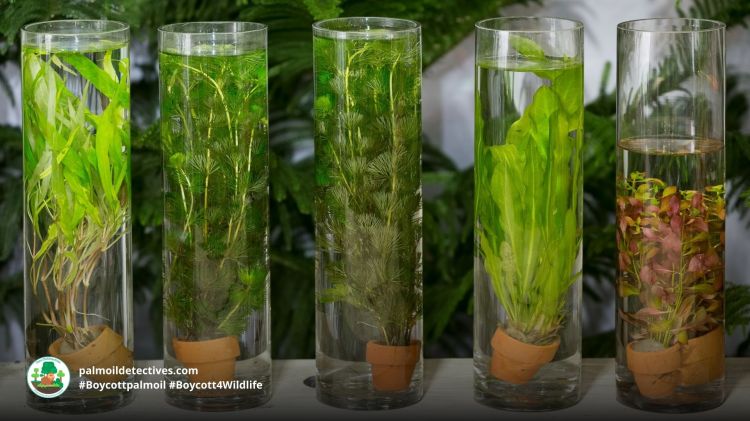 Green algae by Wichit on Getty Images
Global crop production continues to rely heavily on chemical fertilisers to boost crop productivity. However, such products can sometimes undermine agricultural sustainability or not cope well with climate change impacts.
Biofertilisers and biostimulants are natural alternative options for boosting crop production. Biofertilisers provide nutrients to plants. Biostimulants promote plant growth by stimulating biological or chemical processes in plants or microbes associated with roots.
Early studies of microalgae-based biofertilisers and biostimulants suggest they can boost productivity while also building the resilience of crops to climate-related stresses like elevated temperatures, water scarcity and soil salinity. Treated maize plants, for example, showed more developed roots than untreated plants. This resulted in better resistance to drought.
Microalgae could also support crop production
by using algal biomass to make biochar, or charred biomass. Applying biochar to fields can improve soil fertility and enhance soil’s capacity to hold water. Such effects could help crops cope with climate change impacts like erratic rainfall and extreme weather events.
Biochar was a traditional soil management tool in some cultures, and treated fields sometimes remain distinct. For instance, fields treated many centuries ago in South America were found to contain up to 9% carbon compared with 0.5% on neighbouring fields. Moreover, their productivity was twice as high as that of untreated fields. Early studies on biochar made from microalgae have suggested it could be an effective soil amendment.
Mitigating and adapting to climate change
Taken together, these five agri-food applications of microalgae could be seen as possible ways to enhance the climate resilience of food production, and hence as climate change adaptation measures. Concretely, they offer options to help secure both food supplies and agricultural livelihoods despite climate change.
These five applications were also found to offer possible ways to mitigate climate change, whether by reducing greenhouse gas emissions or transforming these gases into physical form. One example is partially replacing an imported livestock feed like soymeal – associated with transport emissions and tropical deforestation – with microalgae-based feeds that need comparatively little land and could be locally sourced. Another example is using microalgae-based biochar to build up soil organic carbon in stable form.
In future, such mitigation measures could perhaps be supported by the carbon markets. These markets offer mechanisms to pay for projects that mitigate climate change. In theory this could provide cash flows to participating stakeholders, including farmers. Such projects might moreover be attractive to potential participants given sharp rises in carbon credit prices in recent years, even if these initiatives have sometimes proven disappointing in the past. Several institutional developments would, however, be needed to make this possible.
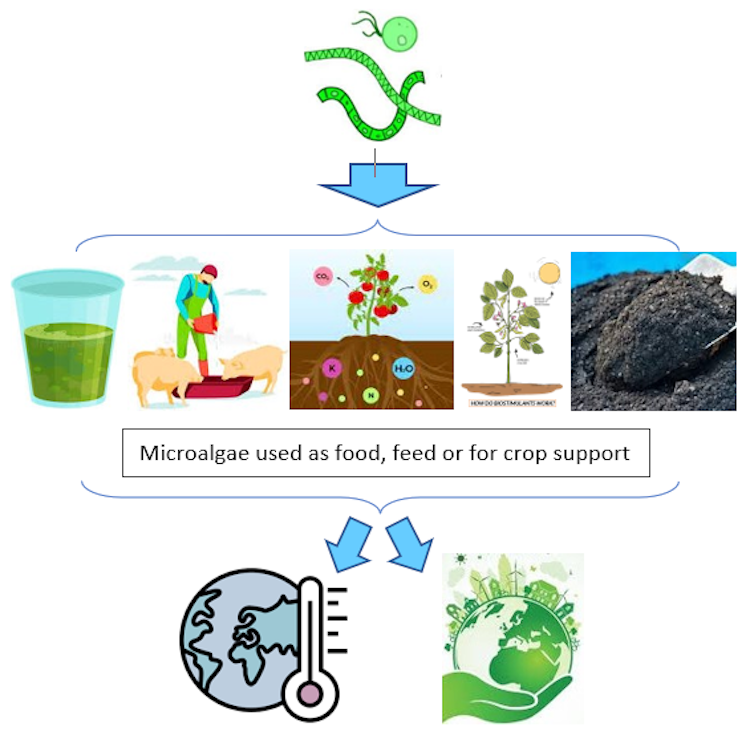 Agri-food applications of microalgae can help mitigate and adapt to climate change. Dr Jules Siedenburg
The five microalgae applications examined clearly hold promise, both as avenues for fostering climate resilient food production and as climate change mitigation measures. These applications could thus be framed as climate actions. But more research is needed to explore and verify this potential, and to examine issues like consumer acceptance and managing possible contamination risks.
In the meantime, these five microalgae technologies merit greater attention from consumers, farmers and governments as timely and hopeful innovations.
Here are some other ways you can help by using your wallet as a weapon and joining the #Boycott4Wildlife

What is greenwashing?
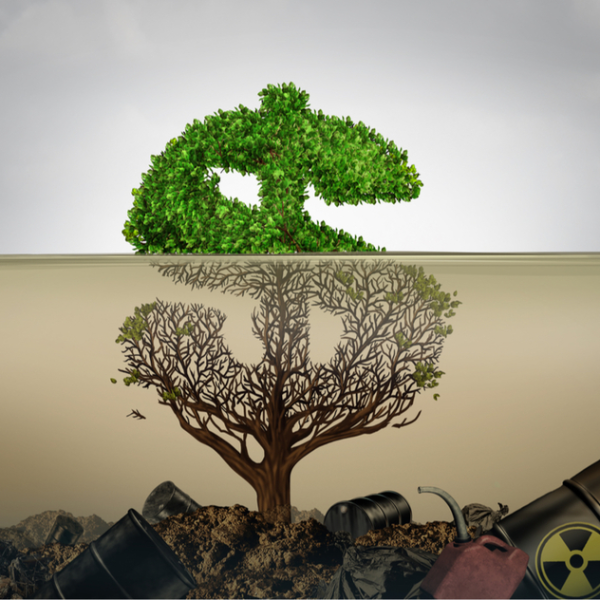
Why join the #Boycott4Wildlife?
Greenwashing Tactic #4: Fake Labels

The Counterpunch: Consumer Solutions To Fight Extinction
Contribute to my Ko-Fi
Did you enjoy visiting this website?

Palm Oil Detectives is 100% self-funded
Palm Oil Detectives is completely self-funded by its creator. All hosting and website fees and investigations into brands are self-funded by the creator of this online movement. If you like what I am doing, you and would like me to help meet costs, please send Palm Oil Detectives a thanks on Ko-Fi.
Say thanks on Ko-Fi


Contribute to my Ko-Fi
Did you enjoy visiting this website?
Palm Oil Detectives is 100% self-funded
Palm Oil Detectives is completely self-funded by its creator. All hosting and website fees and investigations into brands are self-funded by the creator of this online movement. If you like what I am doing, you and would like me to help meet costs, please send Palm Oil Detectives a thanks on Ko-Fi.
Say thanks on Ko-Fi#Agriculture #algae #biotechnology #BoycottPalmOil #BoycottSoy #Boycott4wildlife #BoycottPalmOil #climatechange #consumerism #diet #health #humanhealth #PalmOil #plantBasedDiet #ReasonsToBeHopeful #soyDeforestation #vegan #veganism
Making the case for edible microorganisms as an integral part of a more sustainable and resilient food production system
Black is the new green
Future foods for risk-resilient diets
Algae as nutritional and functional food sources: revisiting our understanding
Harvest of Arthrospira platensis from Lake Kossorom (Chad) and its household usage among the Kanembu
The Counterpunch: Consumer Solutions To Fight Extinction