Air Pollution from Palm Oil: A Human Rights Issue
Forest-fire haze drifting from Indonesia to neighbouring countries every dry season has eluded efforts to curb it.
Land clearing by burning is prohibited in Indonesia and Malaysia. However, penalising foreign companies for palm oil and timber deforestation has been hampered by cronyism and corruption.
Under-explored legal avenues may provide new solutions to the decades-old problem.
Everybody in the world deserves to breath in #cleanair. #Palmoil air #pollution is a global problem. Domestic and international laws could combat it together and provide solutions. #TheAirWeShare Story via @360info_global #Boycottpalmoil @palmoildetect https://palmoildetectives.com/2024/03/03/air-pollution-from-palm-oil-deforestation-is-a-human-rights-issue-affecting-everyone-in-s-e-asia/
Share to BlueSky Share to TwitterPenalising foreign companies for #palmoil and #timber #deforestation in #Indonesia and #Malaysia has been hampered by #cronyism and #corruption at the highest levels of government. Story: @360info_global #TheAirWeShare #Boycottpalmoil #Boycott4Wildlife https://palmoildetectives.com/2024/03/03/air-pollution-from-palm-oil-deforestation-is-a-human-rights-issue-affecting-everyone-in-s-e-asia/
Share to BlueSkyShare to TwitterWritten by Cecep Aminudin, a PhD candidate in environmental law at Padjadjaran University, Indonesia. Originally published as ‘Laying down the law on air pollution’ by 360info.org and republished under Creative Commons License.

Forest and land fires in Indonesia have attracted global attention since the great fires in 1982–83 and 1997–98. Large haze events occurred again in 2007, 2012 and 2015, causing international alarm and cross-border pollution throughout Southeast Asia. Smoke from these sorts of fires is the biggest source of air pollution in Indonesia after transportation and energy emissions.
Companies – mostly oil-palm producers – have used fire as a tool to clear forests and peatland areas for agriculture, even though Indonesia and Malaysia are well aware of the need to strictly enforce bans on the practice.
- Indonesian and Malaysian laws since the 1997 haze event have not prevented local burning.
- And penalising foreign companies for their actions in Indonesia and Malaysia has been hampered by cronyism and corruption, lack of awareness and education, weaknesses in the institutional framework and lack of political will.
- Also, the penalties are too low to deter further pollution.
- In recent years Indonesia’s environment ministry has brought more land- and forest-fire cases to court. Civil laws holding businesses accountable for the fires they cause have had some effect, according to a ministry report.

The ministry filed 21 cases between January 2015 and September 2020, and of these 10 were successful and 11 are still pending. Businesses have been ordered to pay compensation and restoration costs totalling almost US$1.38 billion.
These outcomes are related to the application of the precautionary principle in decision-making by Indonesian civil courts, as is common in environmental cases that involve scientific evidence.
According to this principle, lack of full scientific certainty shall not be used to make a decision regarding environmental protection. Indonesian courts applied the precautionary principle in the determining liable party and judging evidence even when there was scientific uncertainty.
Providing sufficient evidence in forest- and land-fire cases is often very difficult
Scientific evidence in the form of studies and expert opinion plays a crucial role in proving illegal fires have occurred, who started them, and how much environmental damage and loss they have caused.
Laboratory test reports can also be used as evidence in civil environmental-justice cases. Entirely at the judge’s discretion, these reports can be treated as expert testimony. Their relevance, which includes validity and reliability, and support from other expert testimonies, is a critical point in a judge’s decision to admit them as compelling legal evidence.
External regulation could complement and support the legal framework in each Southeast Asian country to ensure the activities of transnational companies meet environmental standards and the Association of Southeast Asian Nations (ASEAN) notion of cooperation.
Holding palm oil companies to account for air pollution under international law
A legitimate legislative framework could impose and enforce international environmental standards recognised under human rights obligations. In this way, palm oil plantation companies could be held accountable under international law for the pollution they cause elsewhere.
The victims of transboundary pollution and other environmental destruction are the people whose health will suffer, either in the short or the long term. Many countries have also suffered economic loss from direct damage and loss of economic activity.

Holding polluters accountable will not just uphold domestic laws but also demonstrate political willingness to recognise air pollution as a human rights issue.
Cecep Aminudin is a PhD candidate in environmental law at Padjadjaran University, Bandung, Indonesia. He is the Chairman of ECOTAS, a research institute on sustainability. Apart from pursuing his doctoral degree, Aminudin conducts research, delivers training and consults on environmental law. He declares no conflict of interest in relation to this article and does not receive special funds in any form.
Originally published under Creative Commons by 360info™.
Written by Cecep Aminudin, a PhD candidate in environmental law at Padjadjaran University, Indonesia. Originally published as ‘Laying down the law on air pollution’ by 360info.org and republished under Creative Commons License.
ENDS
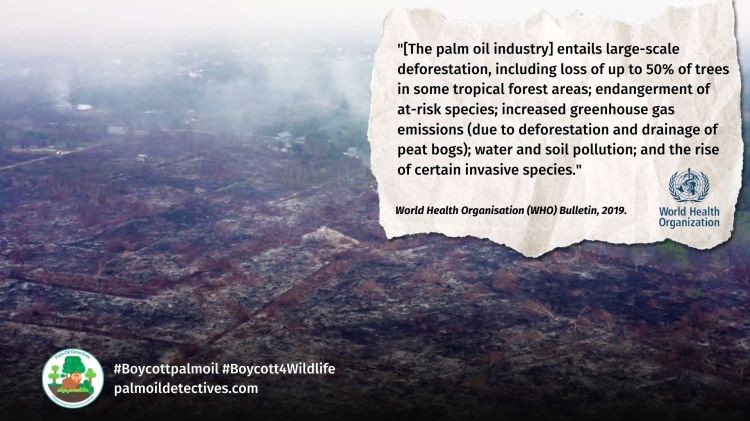
A 2019 World Health Organisation (WHO) report into the palm oil industry finds extensive greenwashing of human rights abuses, deforestation, air pollution and human health impacts
Read report


Big brands using “sustainable” RSPO palm oil yet still causing deforestation (there are many others)

Nestlé
Nestlé is destroying rainforests, releasing mega-tonnes of carbon into the atmosphere, and killing hundreds of endangered species. Once these animals are gone – they are gone for good. See Nestlé’s full list of…
 by Palm Oil DetectivesFebruary 9, 2021March 2, 2025
Colgate-Palmolive
Despite global retail giant Colgate-Palmolive forming a coalition with other brands in 2020, virtue-signalling that they will stop all deforestation, they continue to do this – destroying rainforest and releasing mega-tonnes of carbon…
 by Palm Oil DetectivesFebruary 9, 2021March 2, 2025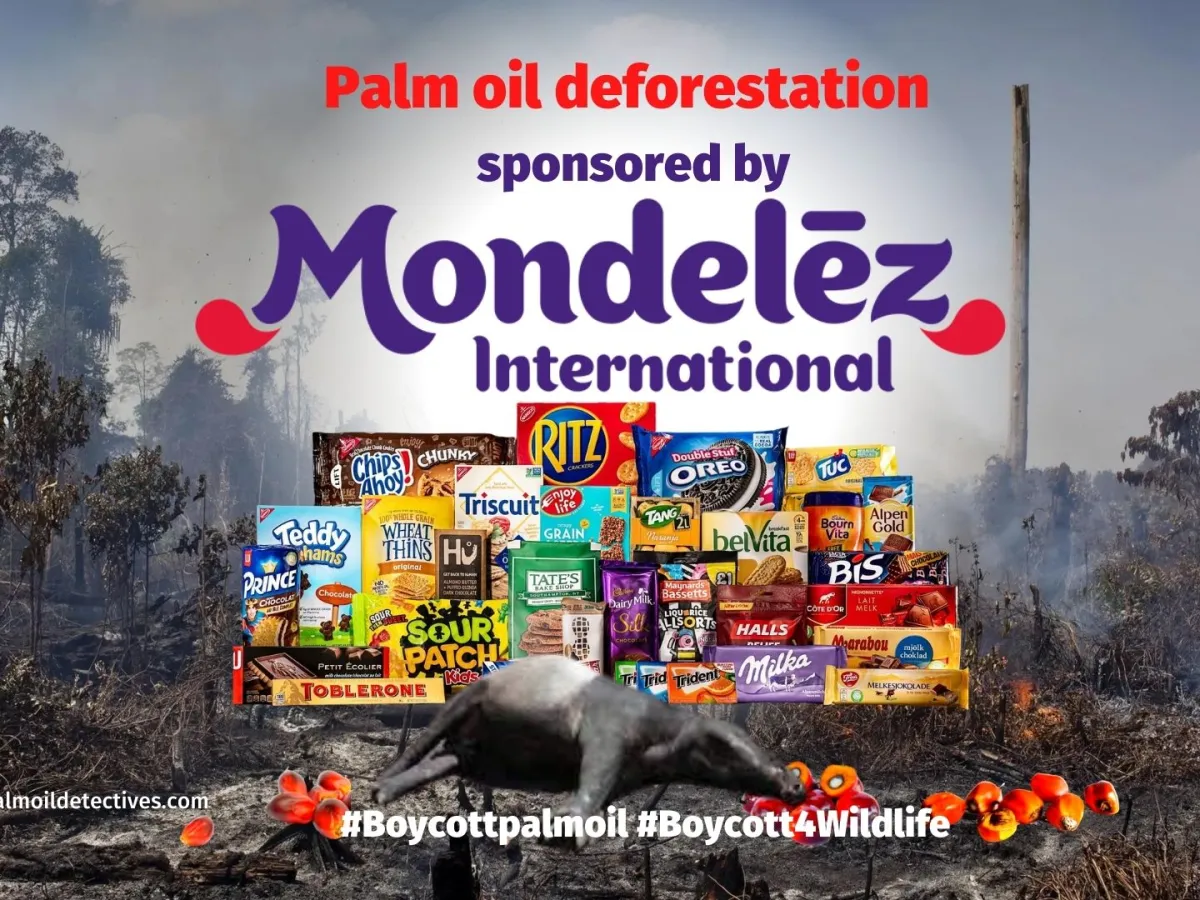
Mondelēz
Mondelez destroys rainforests, sending animals extinct and release mega-tonnes of carbon into air for so-called “sustainable” palm oil. Boycott them!
by Palm Oil DetectivesFebruary 9, 2021October 15, 2025
Unilever
In 2020, global retail giant Unilever unveiled a deforestation-free supply chain promise. By 2023 they would be deforestation free. This has been and gone and they are still causing deforestation. This brand has…
by Palm Oil DetectivesFebruary 9, 2021March 2, 2025
Danone
Savvy consumers have been pressuring French Dairy multinational Danone for decades to cease using deforestation palm oil. Yet they actually haven’t stopped this. From their website: ‘Danone is committed to eliminating deforestation from…
by Palm Oil DetectivesMarch 6, 2021March 2, 2025
PepsiCo
Despite decades of promises to end deforestation for palm oil PepsiCo (owner of crisp brands Frito-Lay, Cheetos and Doritos along with hundreds of other snack food brands) have continued sourcing palm oil that…
by Palm Oil DetectivesJune 9, 2022March 2, 2025
Procter & Gamble
Despite decades of promises to end deforestation for palm oil Procter & Gamble or (P&G as they are also known) have continued sourcing palm oil that causes ecocide, indigenous landgrabbing, and the habitat…
by Palm Oil DetectivesJune 3, 2022March 2, 2025
Kelloggs/Kellanova
In late 2023, Kelloggs became Kellanova for their US arm. Savvy consumers have been pressuring Kelloggs for decades to cease using deforestation palm oil. Yet they actually haven’t stopped this. From their website:…
by Palm Oil DetectivesFebruary 9, 2021March 2, 2025
Johnson & Johnson
Global mega-brand Johnson & Johnson have issued a position statement on palm oil in 2020. ‘At Johnson & Johnson, we are committed to doing our part to address the unsustainable rate of global…
by Palm Oil DetectivesFebruary 9, 2021July 13, 2025
PZ Cussons
PZ Cussons is a British-owned global retail giant. They own well-known supermarket brands in personal care, cleaning, household goods and toiletries categories, such as Imperial Leather, Morning Fresh, Carex, Radiant laundry powder and…
by Palm Oil DetectivesMarch 10, 2021March 2, 2025Take Action in Five Ways
1. Join the #Boycott4Wildlife on social media and subscribe to stay in the loop: Share posts from this website to your own network on Twitter, Mastadon, Instagram, Facebook and Youtube using the hashtags #Boycottpalmoil #Boycott4Wildlife.
Enter your email address
Sign Up
Join 3,526 other subscribers2. Contribute stories: Academics, conservationists, scientists, indigenous rights advocates and animal rights advocates working to expose the corruption of the palm oil industry or to save animals can contribute stories to the website.
Wildlife Artist Juanchi Pérez
Mel Lumby: Dedicated Devotee to Borneo’s Living Beings
Anthropologist and Author Dr Sophie Chao

Health Physician Dr Evan Allen

The World’s Most Loved Cup: A Social, Ethical & Environmental History of Coffee by Aviary Doert

How do we stop the world’s ecosystems from going into a death spiral? A #SteadyState Economy
3. Supermarket sleuthing: Next time you’re in the supermarket, take photos of products containing palm oil. Share these to social media along with the hashtags to call out the greenwashing and ecocide of the brands who use palm oil. You can also take photos of palm oil free products and congratulate brands when they go palm oil free.
https://twitter.com/CuriousApe4/status/1526136783557529600?s=20
https://twitter.com/PhillDixon1/status/1749010345555788144?s=20
https://twitter.com/mugabe139/status/1678027567977078784?s=20
4. Take to the streets: Get in touch with Palm Oil Detectives to find out more.
5. Donate: Make a one-off or monthly donation to Palm Oil Detectives as a way of saying thank you and to help pay for ongoing running costs of the website and social media campaigns. Donate here
Pledge your support#360infoOrg #airPollution #BoycottPalmOil #Boycott4wildlife #BoycottPalmOil #carbonemissions #cleanair #corruption #cronyism #deforestation #fire #fossilFuels #fossilfuel #fossilfuels #greenwashing #humanHealth #Indonesia #Malaysia #PalmOil #palmOilDeforestation #palmoil #pollution #SouthEastAsia #TheAirWeShare #timber
Unsupported type or deleted object
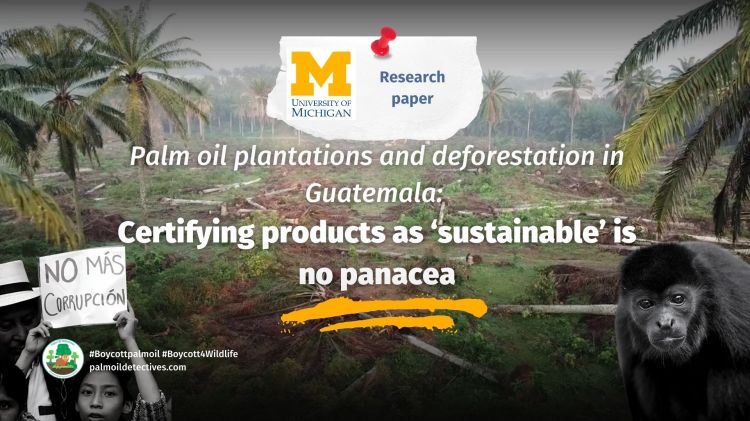
Research: Certifying Palm Oil as “Sustainable” Is No Panacea
Newly published research led by the University of Michigan reveals that despite the Roundtable on Sustainable Palm Oil (RSPO) certification system being influential, its effectiveness in reducing deforestation has so far for decades, been an illusion. The study used remote sensing to analyse deforestation caused by oil palm plantations in Guatemala, a major palm oil supplier to global markets.
The results of the paper show that these plantations were responsible for 28% of the region’s deforestation, and RSPO-certified plantations did not significantly reduce deforestation. The study links this deforestation to the supply chains of major brands: Pepsico, Mondelēz International, and Grupo Bimbo, who rely on RSPO-certified palm oil supplies.
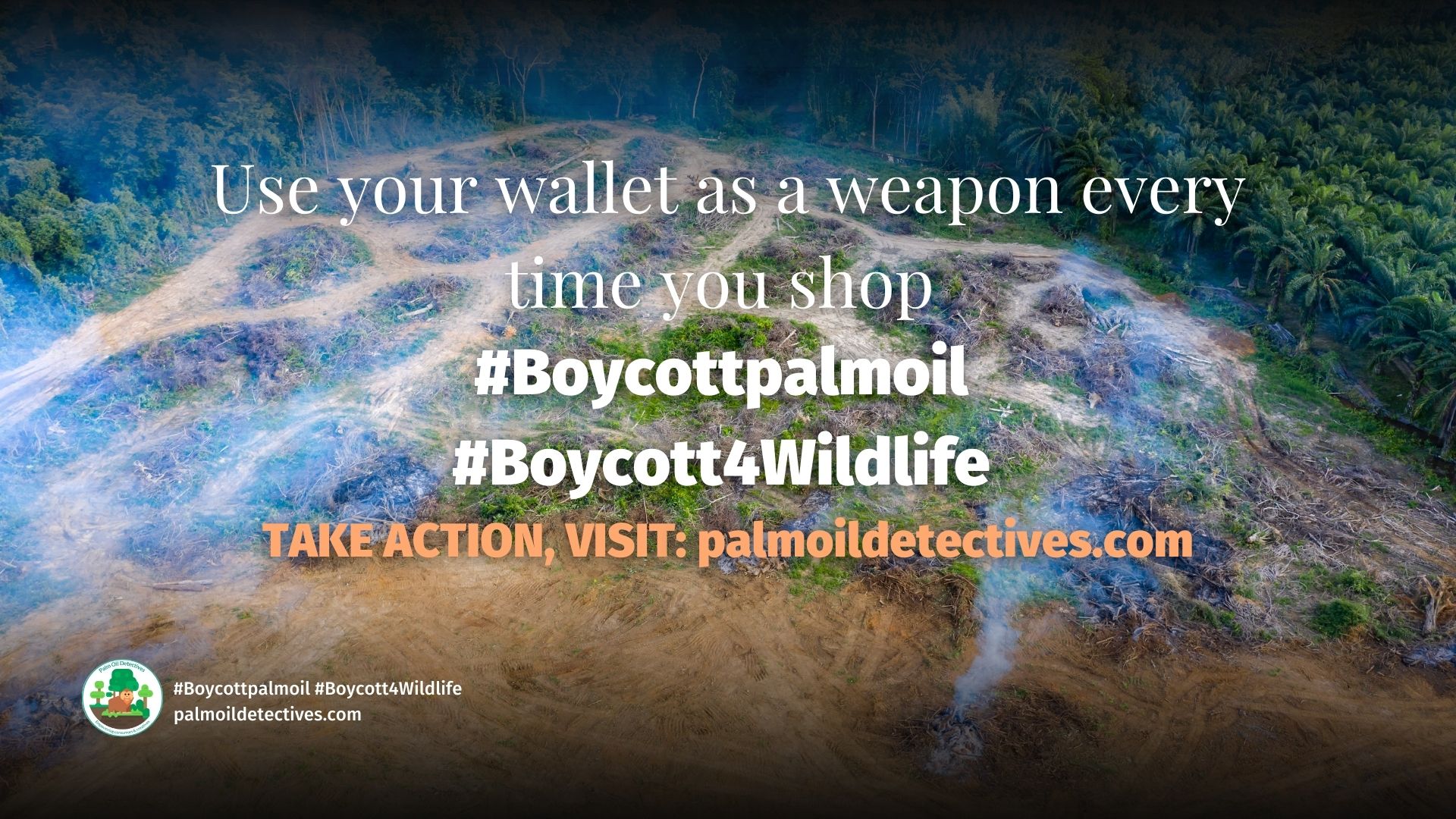
As a consumer you can make a difference every time you shop, use your wallet as a weapon and #Boycottpalmoil #Boycott4Wildlife
@UMich #research finds “sustainable” #RSPO #palmoil sourced in #Guatemala 🇬🇹 NOT sustainable, yet it’s sold this way to consumers, despite links to #humanrights abuses 🧺🩸 #deforestation. Fight back! #Boycottpalmoil 🌴⛔️ #Boycottpalmoil @palmoildetect https://palmoildetectives.com/2023/07/26/palm-oil-deforestation-in-guatemala-certifying-products-as-sustainable-is-no-panacea-university-of-michigan/
Share to BlueSkyShare to TwitterSo-called “sustainable” #palmoil certified by #RSPO originating in #Guatemala 🇬🇹 is strongly connected to #deforestation and #ecocide finds @UMich study. Help #rainforests and fight #extinction #Boycottpalmoil #Boycott4Wildlife 🌴🪔🔥☠️🚫 @palmoildetect https://palmoildetectives.com/2023/07/26/palm-oil-deforestation-in-guatemala-certifying-products-as-sustainable-is-no-panacea-university-of-michigan/
Share to BlueSkyShare to TwitterThis media release entitled “Palm oil plantations and deforestation in Guatemala: Certifying products as ‘sustainable’ is no panacea” was issued by The University of Michigan on July 20, 2023. The study on which it is based is available to read here
Cheap, versatile and easy to grow, palm oil is the world’s most consumed vegetable oil and is found in roughly half of all packaged supermarket products, from bread and margarine to shampoo and toothpaste.
But producing palm oil has caused deforestation and biodiversity loss across Southeast Asia and elsewhere, including Central America. Efforts to curtail the damage have largely focused on voluntary environmental certification programs that label qualifying palm-oil sources as “sustainable.”
However, those certification programs have been criticised by environmental groups as greenwashing tools that enable multinational corporations to claim fully “sustainable” palm oil, while continuing to sell products that fall far short of the deforestation-free goal.
Findings from a new University of Michigan-led study, published online in the Journal of Environmental Management, support some of the critics’ claims—and go much further.
“Environmental certification does not effectively mitigate deforestation risk, and firms cannot rely on—or be allowed to rely on—certification to achieve deforestation-free supply chains,”
Study senior author Joshua Newell, a geographer and a professor at the School for Environment and Sustainability.
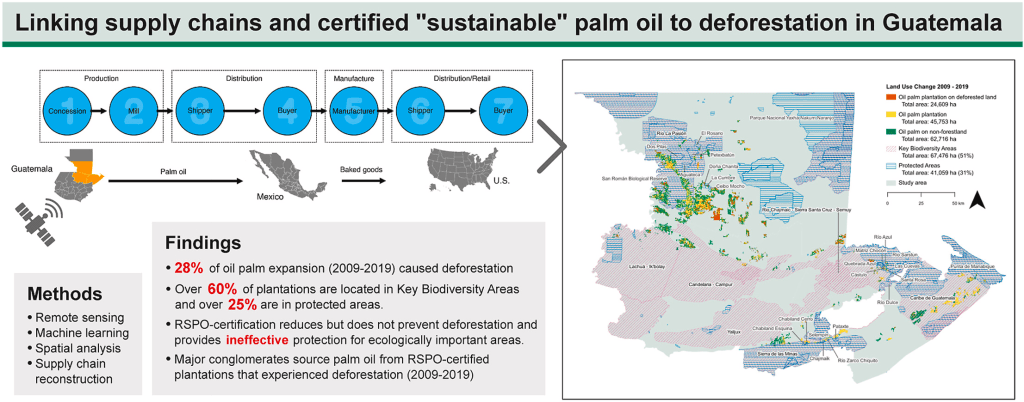
Key findings
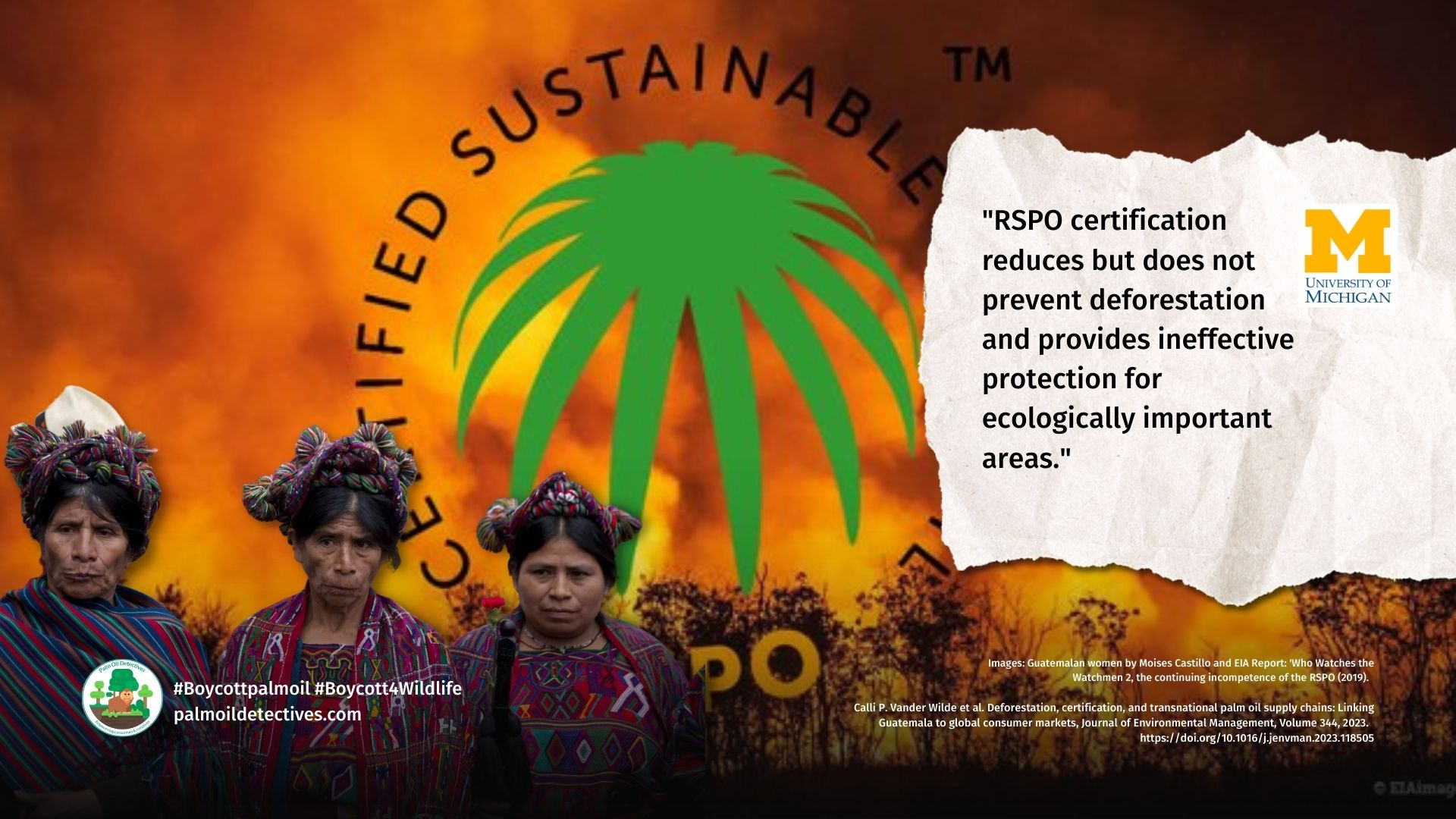
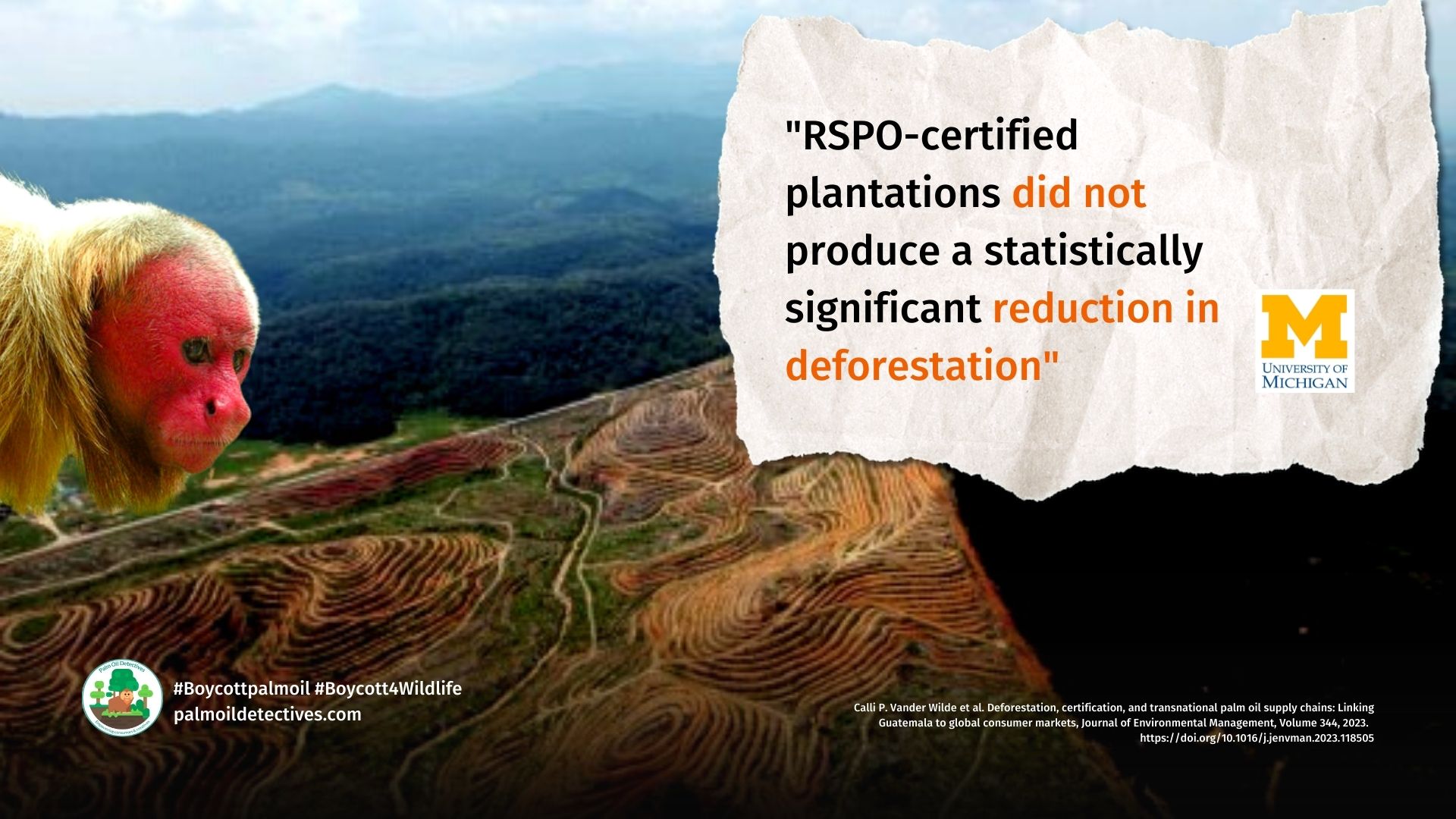
- RSPO-certified plantations, comprising 63% of the total cultivated area assessed, did not produce a statistically significant reduction in deforestation and appear to be ineffective at reducing encroachment into ecologically sensitive areas in Guatemala.
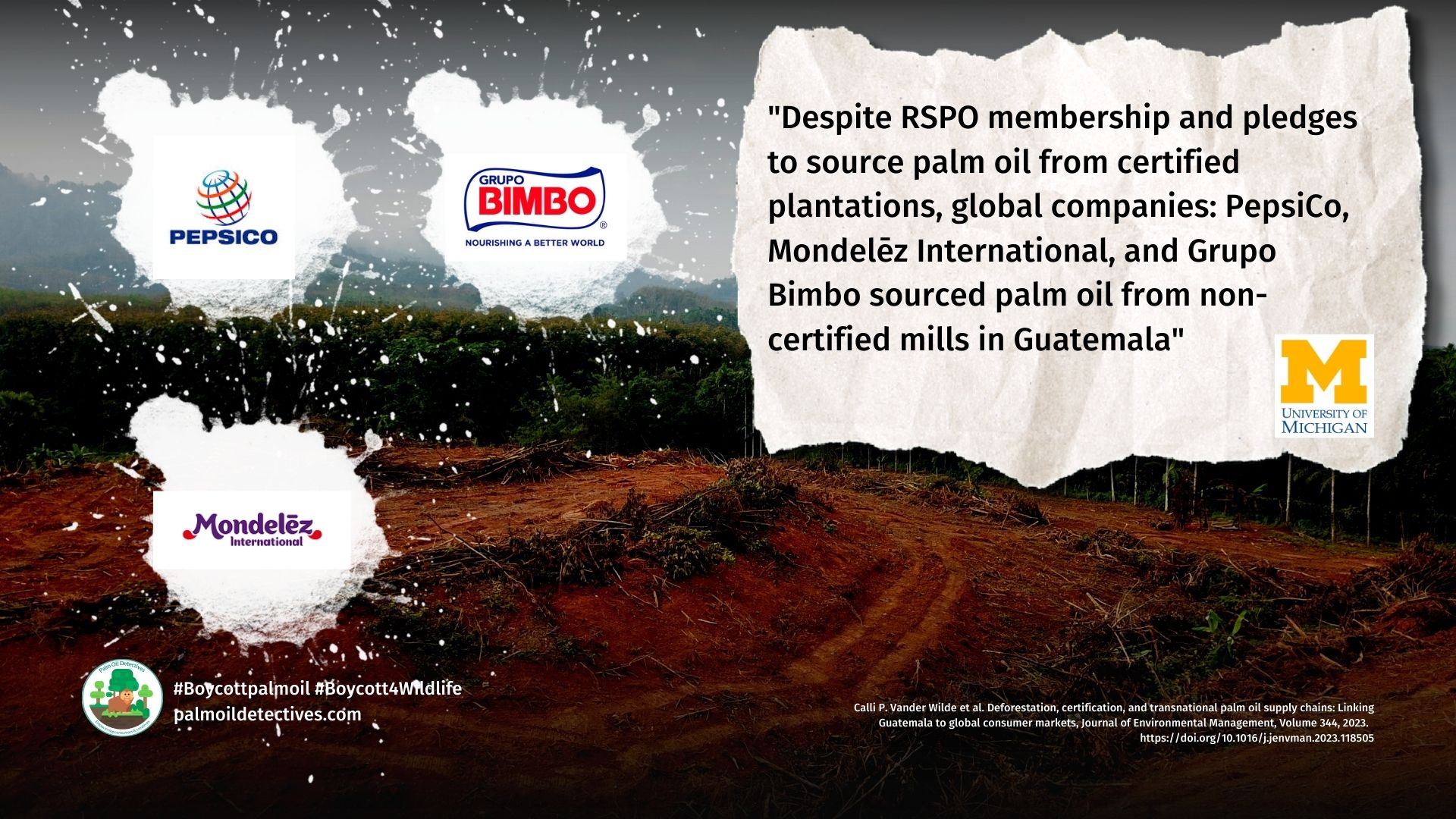
- Despite their RSPO membership and pledges to source palm oil from certified plantations, several multinational corporations predominantly sourced palm oil from noncertified mills in Guatemala.
- Even RSPO-certified palm oil plantations and mills are contributing to deforestation in Guatemala.

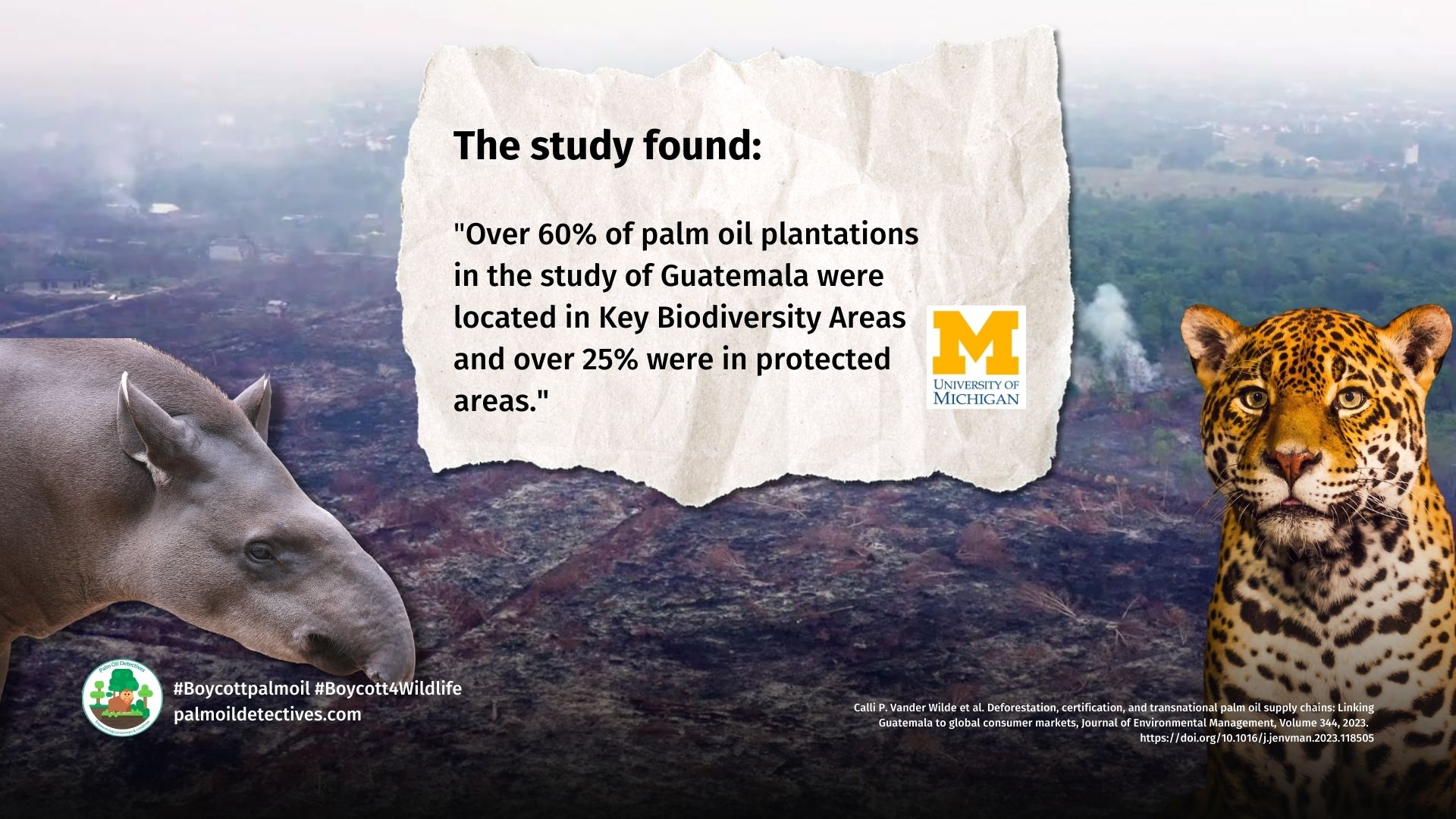
The U-M case study focuses on Guatemala, which is projected to become the world’s third-largest palm-oil producer by 2030 after Indonesia and Malaysia, and an influential environmental certification system called the Roundtable on Sustainable Palm Oil, or RSPO.
“Our results indicate the supply chains of transnational conglomerates drove deforestation and ecological encroachment in Guatemala to support U.S. palm oil consumption,” said study lead author Calli VanderWilde, a doctoral student at the U-M School for Environment and Sustainability who did the work for her dissertation.
“In addition, we found no evidence to suggest that RSPO certification effectively protects against deforestation or ecological encroachment. Given that oil palm expansion is predicted to increase significantly in the coming years, this pattern is likely to continue without changes to governance, both institutionally and to supply chains.”
The U-M-led research team tracked palm oil sourced from former forestland, and other ecologically critical areas in Guatemala, by several large transnational conglomerates that sell food products made from the oil in the United States. The corporations are members of the Roundtable on Sustainable Palm Oil and have RSPO commitments and sourcing policies in place to ensure the sustainability of their palm oil supplies.
The study used satellite imagery and machine learning to quantify deforestation attributable to palm oil plantation expansion in Guatemala over a decade, 2009-2019. In addition, the researchers used shipment records and other data sources to reconstruct corporate supply chains and to link transnational conglomerates to palm oil-driven deforestation.
The study found that:
- Guatemalan palm oil plantations expanded an estimated 215,785 acres during the study period, with 28% of the new cropland replacing forests.
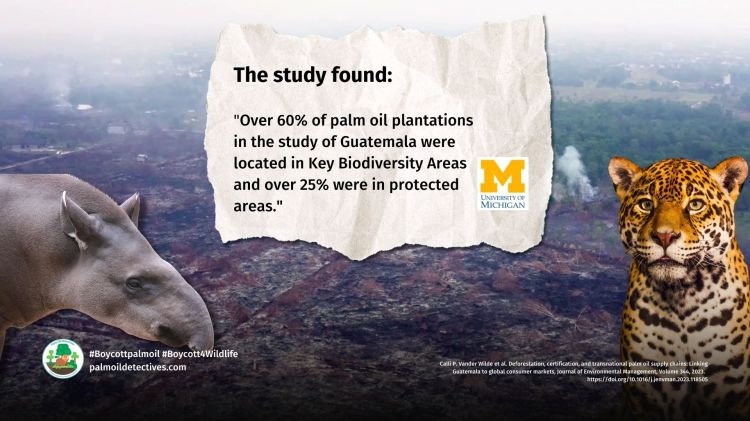
- As of 2019, more than 60% of the palm oil plantations in the study area were in Key Biodiversity Areas. KBAs are sites that contribute significantly to the global persistence of biodiversity in terrestrial, freshwater and marine ecosystems.
- RSPO-certified plantations, comprising 63% of the total cultivated area assessed, did not produce a statistically significant reduction in deforestation and appear to be ineffective at reducing encroachment into ecologically sensitive areas in Guatemala.
- Despite their RSPO membership and pledges to source palm oil from certified plantations, several multinational corporations predominantly sourced palm oil from noncertified mills in Guatemala.
- Even RSPO-certified palm oil plantations and mills are contributing to deforestation in Guatemala.
Guatemala is divided into 22 administrative districts called departamentos. The study focused on a 20,850-square-mile region in the three departamentos (Alta Verapaz, Izabal and the lower half of Petén) responsible for 75% of Guatemala’s palm oil production.
The researchers used high-resolution satellite imagery to assess land-use change between 2009 and 2019, and a machine learning algorithm enabled them to distinguish between forests and monoculture plantations.
They found that oil palm expansion is encroaching on, and causing deforestation in, seven Key Biodiversity Areas and 23 protected areas.
Among the areas impacted, the Key Biodiversity Areas with the largest palm extent include the Río La Pasión, Caribe de Guatemala and Sierra de las Minas Biosphere Reserve. The Río La Pasión is an especially rich area for endemic fish species, making it an important area for conservation.
Oil palm encroachment on the Sierra de las Minas Biosphere Reserve threatens animals such as the quetzal, Guatemala’s national bird. Known as the jewel of Guatemala, the reserve is an irreplaceable gene bank for tropical reforestation and agroforestry and supports the livelihoods of more than 400,000 people.
The researchers identified 119 RSPO-certified plantations and 82 non-RSPO plantations. During the study period, 9% of the RSPO-certified plantation expansion resulted in, or contributed to, forest loss, compared to 25% of the noncertified plantation expansion.
“Environmental certification does not effectively mitigate deforestation risk, and firms cannot rely on—or be allowed to rely on—certification to achieve deforestation-free supply chains,”
Study senior author Joshua Newell, a geographer and a professor at the School for Environment and Sustainability.
By reconstructing the supply chains of the three conglomerates, the researchers revealed connections to palm oil-driven deforestation. Of the 60,810 acres of palm oil-driven deforestation across the study period, more than 99% was traced to plantations supplying palm and palm-kernel oil to mills used by two multinational conglomerates. Seventy-two percent of the palm and palm-kernel oil was linked to the subset of plantations supplying a third corporation’s mills.
 Greenwashing ecocide – Agropalma & Orangutan Land Trust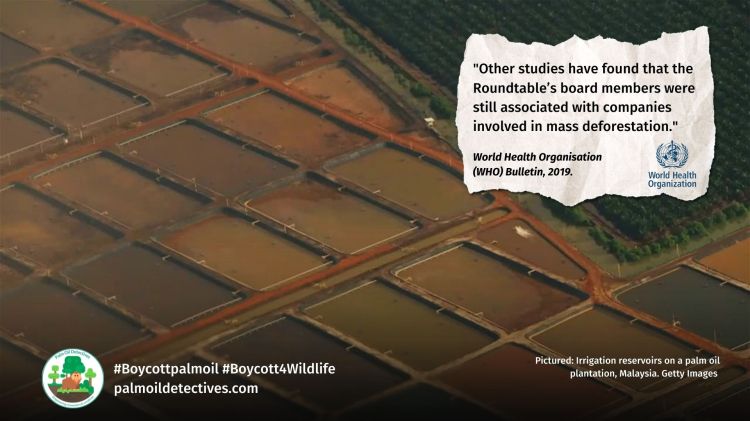
 8. Certification provides opportunities for greenwashing and increases vested interests in and corporate power over natural resources.
 100 NGOS sign a public statement denouncing the RSPO and “sustainable” palm oil as a fake solution that does not stop deforestation
 Spoiled Fruit: landgrabbing, violence and slavery for “sustainable” palm oil
  10 Tactics of Sustainable Palm Oil Greenwashing – Summary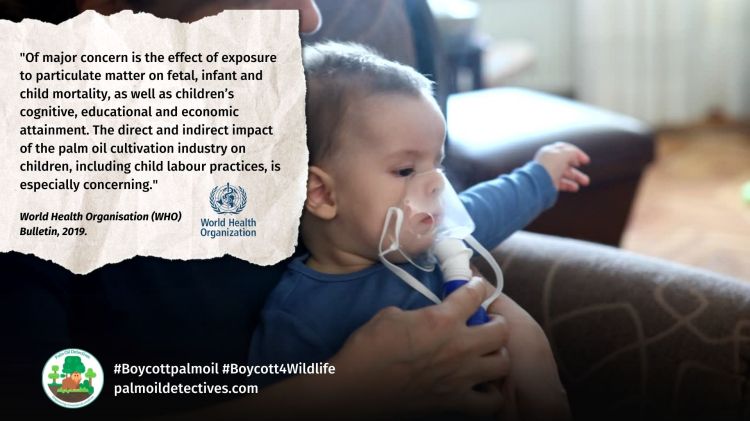
“Palm oil has attracted attention for its ties to widespread forest and biodiversity loss across Southeast Asia. However, the literature has paid minimal attention to newer spaces of production and issues of corporate supply-chain traceability,” VanderWilde said.
“As it stands, environmental certification makes unjustified claims of ‘sustainability’ and fails to serve as a reliable tool for fulfilling emerging zero-deforestation requirements.”
The authors recommend reforms to RSPO policies and practices, robust corporate tracking of supply chains, and the strengthening of forest governance in Guatemala.
In addition to VanderWilde and Newell, authors of the study are Dimitrios Gounaridis of the U-M School for Environment and Sustainability and Benjamin Goldstein of McGill University. Funding for the study was provided by U-M’s Rackham Predoctoral Fellowship Program.
Calli P. VanderWilde, Joshua P. Newell, Dimitrios Gounaridis, Benjamin P. Goldstein,
Deforestation, certification, and transnational palm oil supply chains: Linking Guatemala to global consumer markets, Journal of Environmental Management,
Volume 344, 2023. https://doi.org/10.1016/j.jenvman.2023.118505
Deforestation, certification, and transnational palm oil supply chains: Linking Guatemala to global consumer markets
Abstract
Although causal links between tropical deforestation and palm oil are well established, linking this land use change to where the palm oil is actually consumed remains a distinct challenge and research gap. Supply chains are notoriously difficult to track back to their origin (i.e., the ‘first-mile’). This poses a conundrum for corporations and governments alike as they commit to deforestation-free sourcing and turn to instruments like certification to increase supply chain transparency and sustainability. The Roundtable on Sustainable Palm Oil (RSPO) offers the most influential certification system in the sector, but whether it actually reduces deforestation is still unclear. This study used remote sensing and spatial analysis to assess the deforestation (2009–2019) caused by oil palm plantation expansion in Guatemala, a major palm oil source for international consumer markets. Our results reveal that plantations are responsible for 28% of deforestation in the region and that more than 60% of these plantations encroach on Key Biodiversity Areas. RSPO-certified plantations, comprising 63% of the total cultivated area assessed, did not produce a statistically significant reduction in deforestation. Using trade statistics, the study linked this deforestation to the palm oil supply chains of three transnational conglomerates – Pepsico, Mondelēz International, and Grupo Bimbo – all of whom rely on RSPO-certified supplies. Addressing this deforestation and supply chain sustainability challenge hinges on three measures: 1) reform of RSPO policies and practices; 2) robust corporate tracking of supply chains; and 3) strengthening forest governance in Guatemala. This study offers a replicable methodology for a wide-range of investigations that seek to understand the transnational linkages between environmental change (e.g. deforestation) and consumption.
This media release entitled “Palm oil plantations and deforestation in Guatemala: Certifying products as ‘sustainable’ is no panacea” was issued by The University of Michigan on July 20, 2023. The study on which it is based is available to read here
ENDS
Read more about deforestation and greenwashing associated with “sustainable” palm oil

Family Ties Expose Deforestation and Rights Violations in Indonesian Palm Oil
An explosive report by the Environment Investigation Agency (EIA) details how Indonesia’s Fangiono family, through a wide corporate web, is linked to ongoing #deforestation, #corruption, and #indigenousrights abuses for #palmoil. Calls mount for…
Corporate Control of Food Harms Us All
Around 800 million people in our world go hungry each day. Yet around the globe we have enough food to go around. So why the discrepancy? Market concentration and corporate monopoly of our…
MSC and RSPO Absolutely Untrustworthy, Greenpeace Report
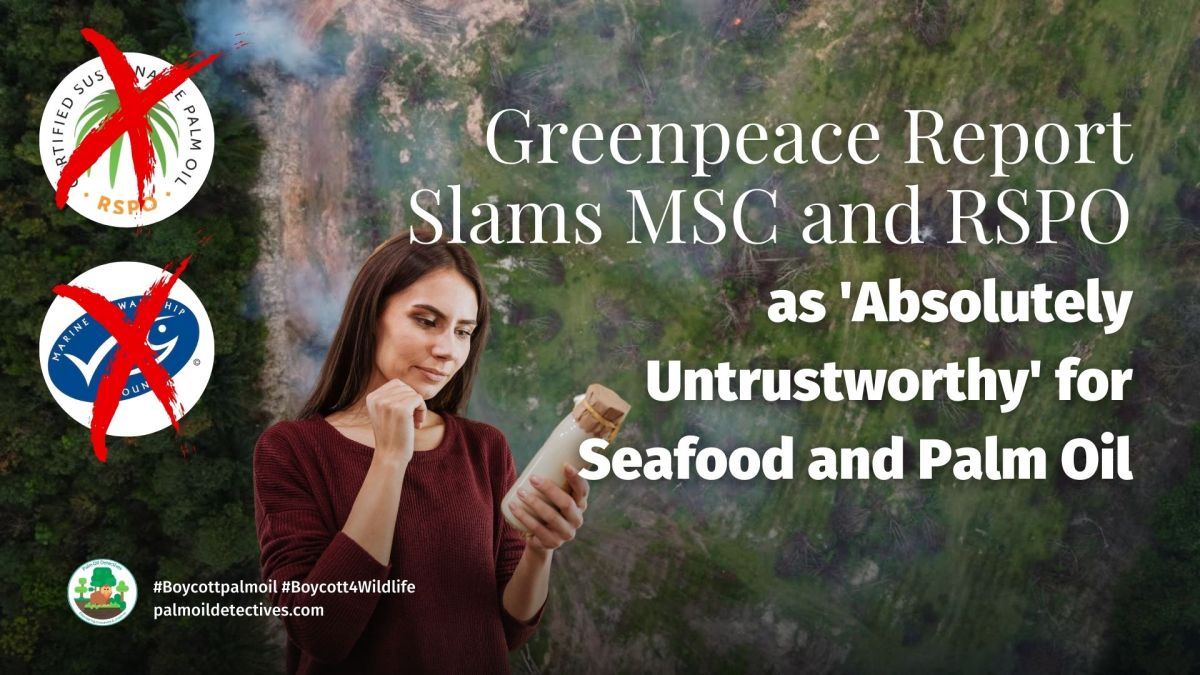
Greenpeace report reveals severe failures of ecolabel RSPO certifying palm oil and FSC certifying seafood. Consumers are being greenwashed. Boycott palm oil!

Guaranteeing Ecocide: The Green Lie of Palm Oil Certification
For decades, the palm oil industry, backed by the RSPO, has misled consumers with the false promise of “sustainable” palm oil. Behind this green façade lies a brutal reality of deforestation, human rights…
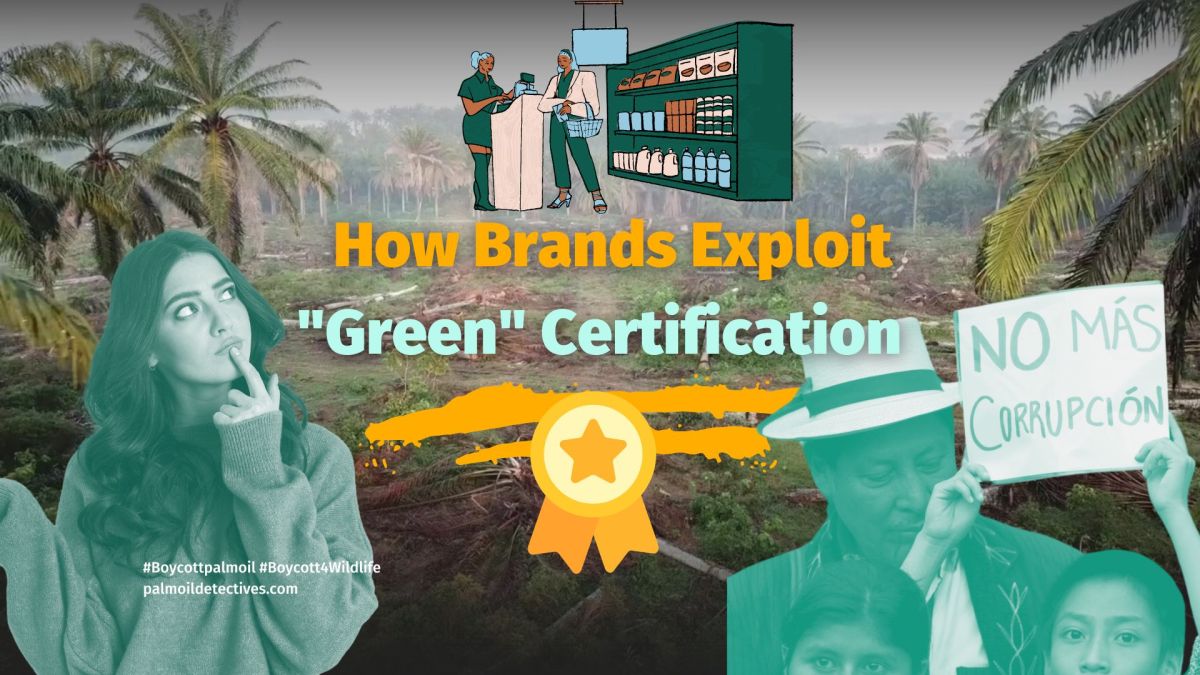
How Brands Exploit “Green” Certification
Brands and businesses may be tempted to exploit “green” certifications to garner a larger market share at the expense of integrity.
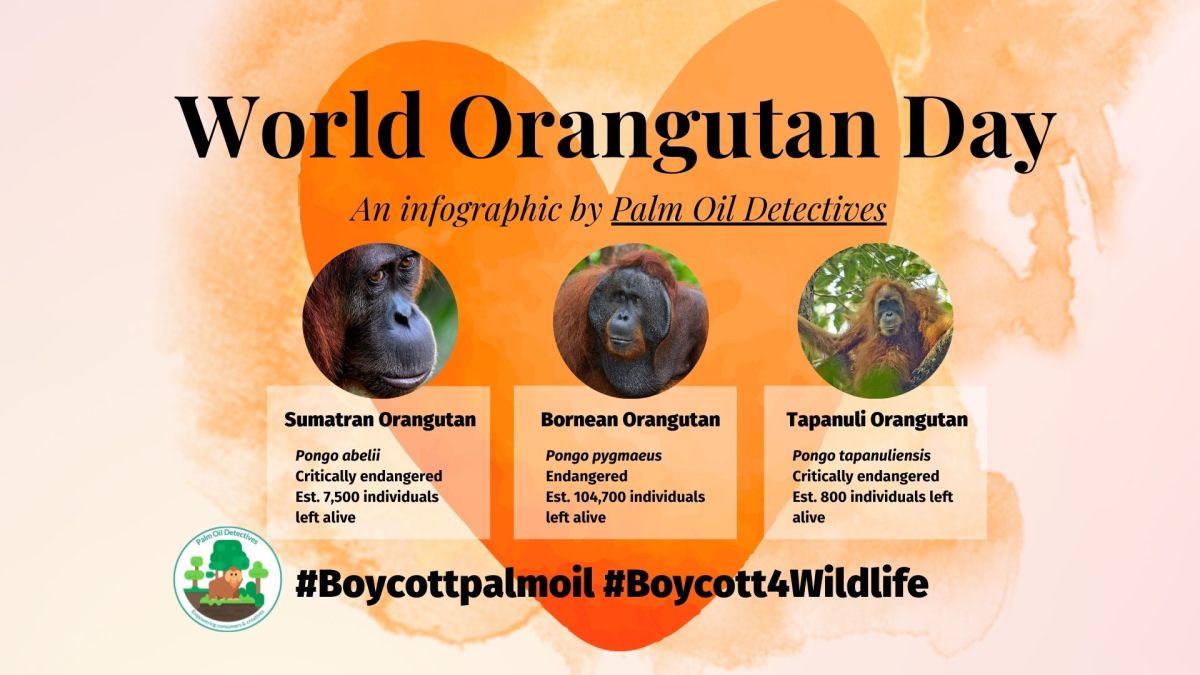
August 19th is #WorldOrangutanDay
Although #WorldOrangutanDay falls on the 19th of August, every day deserves to be World Orangutan Day! So here is an infographic that you can download, print and share however you please. All three…
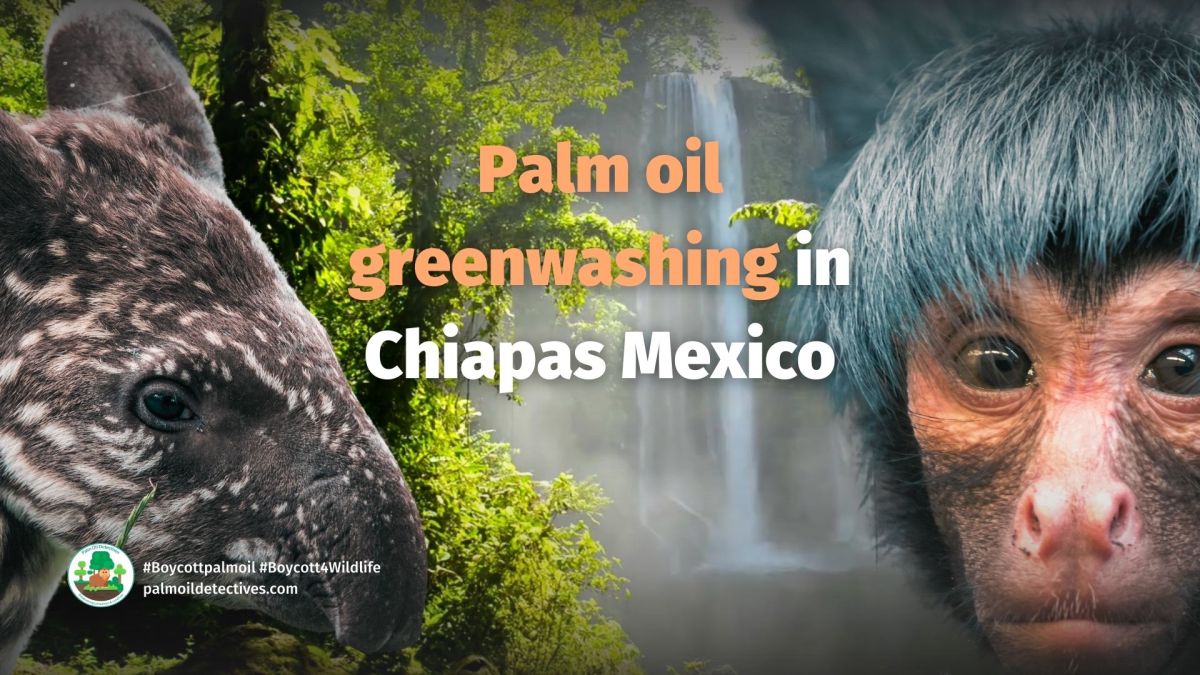
Palm Oil Greenwashing Poised to Destroy Protected Biosphere in Chiapas, Mexico
Situated on Mexico’s lush and biodiverse Pacific coast is La Encrucijada Biosphere Reserve – One of Mexico’s most spectacular natural treasures. Now the government and palm oil businesses are trying to sieze vast…
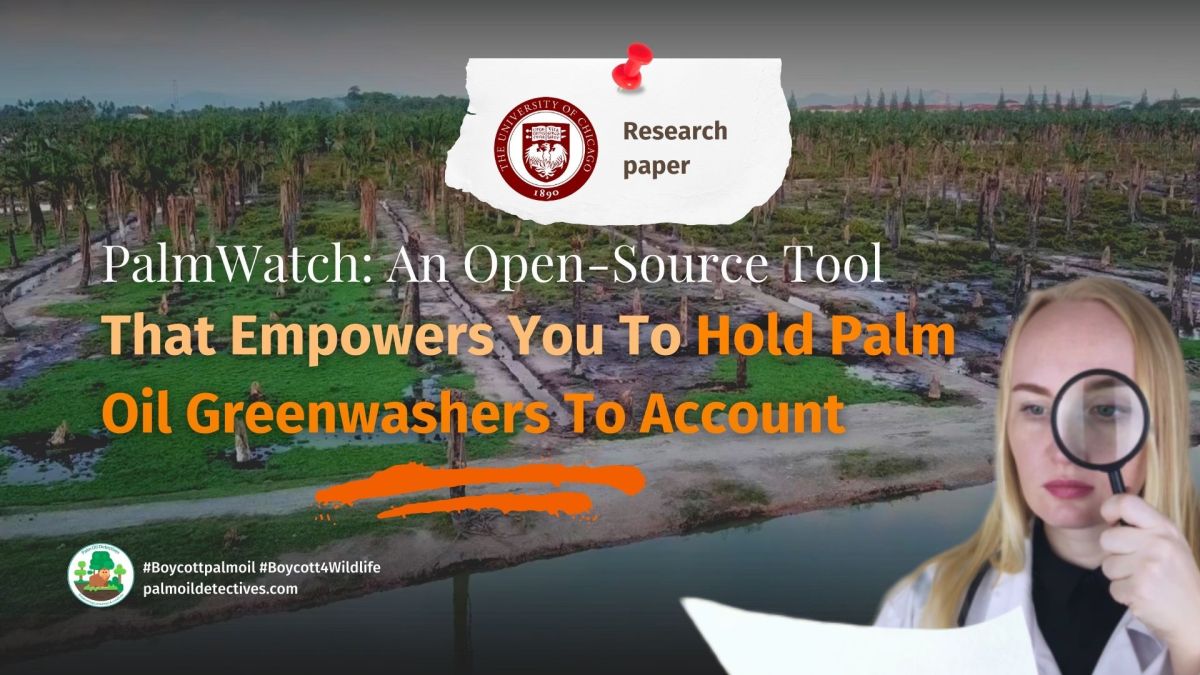
PalmWatch: A Tool to Hold Palm Oil Greenwashers to Account
A groundbreaking open-source tool by the University of Chicago called PalmWatch, shines a light on the darkest parts of the palm oil industry.
PalmWatch is a free web-based tool that reveals links between…
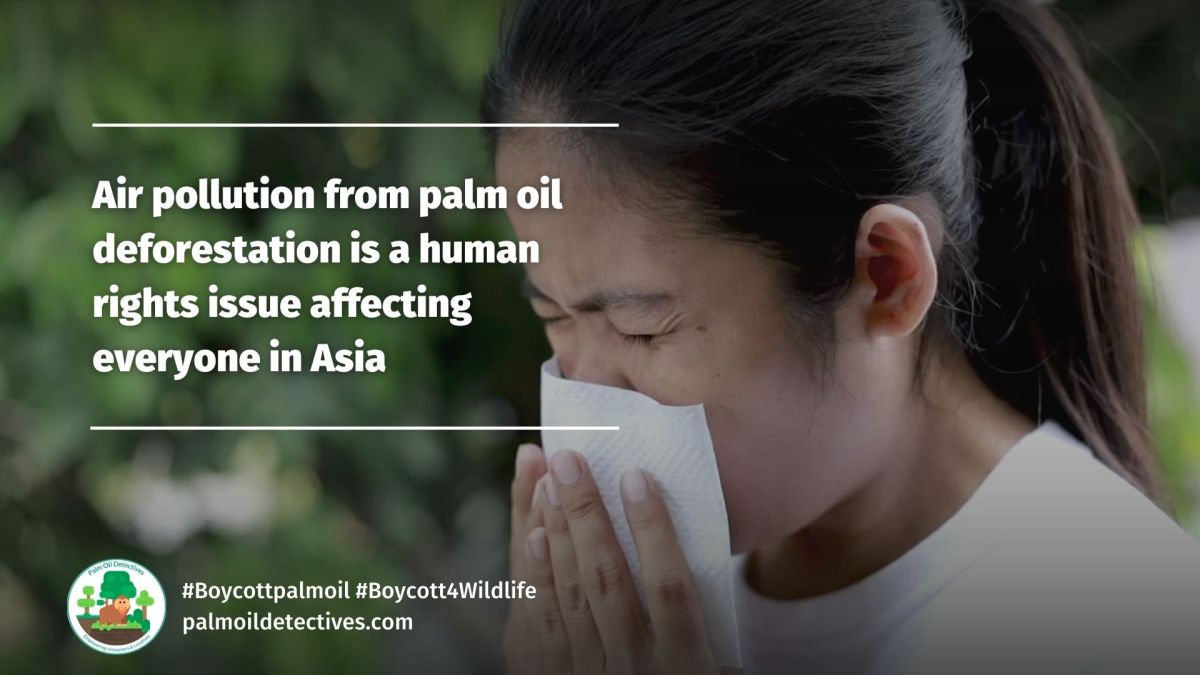
Air Pollution from Palm Oil: A Human Rights Issue
Forest-fire haze from Indonesian palm oil deforestation is a crisis! Learn how toxic air pollution is a human rights issue affecting all of Southeast Asia
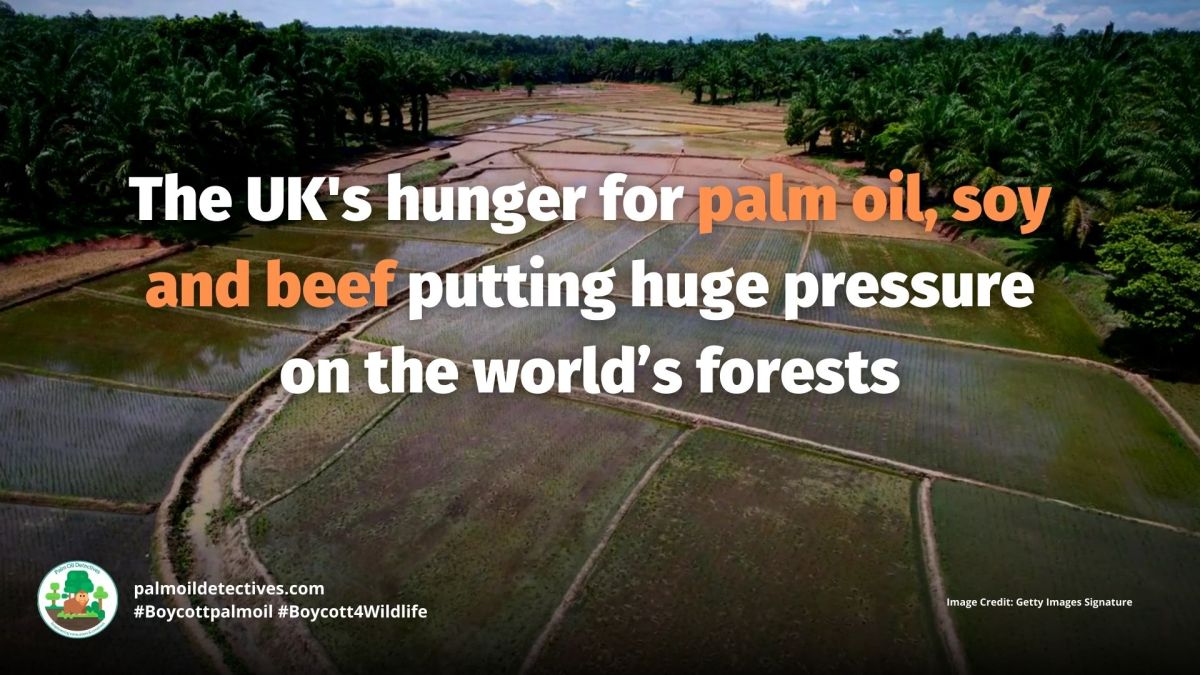
UK Pressuring Forests For Palm Oil and Beef
Urgent call to action! 🌍 #UK’s heavy use of #palmoil #soy & #beef fuels global #deforestation. Demand stricter regulations & transparency. Make every purchase count and #Boycottmeat #BoycottPalmOil #Boycott4Wildlife, learn more: https://wp.me/pcFhgU-78V
Load more posts
Something went wrong. Please refresh the page and/or try again.
Take Action in Five Ways
1. Join the #Boycott4Wildlife on social media and subscribe to stay in the loop: Share posts from this website to your own network on Twitter, Mastadon, Instagram, Facebook and Youtube using the hashtags #Boycottpalmoil #Boycott4Wildlife.
Enter your email address
Sign Up
Join 3,526 other subscribers2. Contribute stories: Academics, conservationists, scientists, indigenous rights advocates and animal rights advocates working to expose the corruption of the palm oil industry or to save animals can contribute stories to the website.
Wildlife Artist Juanchi Pérez
Mel Lumby: Dedicated Devotee to Borneo’s Living Beings
Anthropologist and Author Dr Sophie Chao
Health Physician Dr Evan Allen
The World’s Most Loved Cup: A Social, Ethical & Environmental History of Coffee by Aviary Doert
How do we stop the world’s ecosystems from going into a death spiral? A #SteadyState Economy
3. Supermarket sleuthing: Next time you’re in the supermarket, take photos of products containing palm oil. Share these to social media along with the hashtags to call out the greenwashing and ecocide of the brands who use palm oil. You can also take photos of palm oil free products and congratulate brands when they go palm oil free.
https://twitter.com/CuriousApe4/status/1526136783557529600?s=20
https://twitter.com/PhillDixon1/status/1749010345555788144?s=20
https://twitter.com/mugabe139/status/1678027567977078784?s=20
4. Take to the streets: Get in touch with Palm Oil Detectives to find out more.
5. Donate: Make a one-off or monthly donation to Palm Oil Detectives as a way of saying thank you and to help pay for ongoing running costs of the website and social media campaigns. Donate here
Pledge your support#BoycottPalmOil #Boycott4wildlife #BoycottPalmOil #deforestation #ecocide #Environmental #EnvironmentalJustice #extinction #greenwashing #Guatamala #Guatemala #HumanRights #PalmOil #palmOilDeforestation #palmoil #rainforests #research #RSPO #RSPOGreenwashing