Air Pollution from Palm Oil: A Human Rights Issue
Forest-fire haze drifting from Indonesia to neighbouring countries every dry season has eluded efforts to curb it.
Land clearing by burning is prohibited in Indonesia and Malaysia. However, penalising foreign companies for palm oil and timber deforestation has been hampered by cronyism and corruption.
Under-explored legal avenues may provide new solutions to the decades-old problem.
Everybody in the world deserves to breath in #cleanair. #Palmoil air #pollution is a global problem. Domestic and international laws could combat it together and provide solutions. #TheAirWeShare Story via @360info_global #Boycottpalmoil @palmoildetect https://palmoildetectives.com/2024/03/03/air-pollution-from-palm-oil-deforestation-is-a-human-rights-issue-affecting-everyone-in-s-e-asia/
Share to BlueSky Share to TwitterPenalising foreign companies for #palmoil and #timber #deforestation in #Indonesia and #Malaysia has been hampered by #cronyism and #corruption at the highest levels of government. Story: @360info_global #TheAirWeShare #Boycottpalmoil #Boycott4Wildlife https://palmoildetectives.com/2024/03/03/air-pollution-from-palm-oil-deforestation-is-a-human-rights-issue-affecting-everyone-in-s-e-asia/
Share to BlueSkyShare to TwitterWritten by Cecep Aminudin, a PhD candidate in environmental law at Padjadjaran University, Indonesia. Originally published as ‘Laying down the law on air pollution’ by 360info.org and republished under Creative Commons License.

Forest and land fires in Indonesia have attracted global attention since the great fires in 1982–83 and 1997–98. Large haze events occurred again in 2007, 2012 and 2015, causing international alarm and cross-border pollution throughout Southeast Asia. Smoke from these sorts of fires is the biggest source of air pollution in Indonesia after transportation and energy emissions.
Companies – mostly oil-palm producers – have used fire as a tool to clear forests and peatland areas for agriculture, even though Indonesia and Malaysia are well aware of the need to strictly enforce bans on the practice.
- Indonesian and Malaysian laws since the 1997 haze event have not prevented local burning.
- And penalising foreign companies for their actions in Indonesia and Malaysia has been hampered by cronyism and corruption, lack of awareness and education, weaknesses in the institutional framework and lack of political will.
- Also, the penalties are too low to deter further pollution.
- In recent years Indonesia’s environment ministry has brought more land- and forest-fire cases to court. Civil laws holding businesses accountable for the fires they cause have had some effect, according to a ministry report.

The ministry filed 21 cases between January 2015 and September 2020, and of these 10 were successful and 11 are still pending. Businesses have been ordered to pay compensation and restoration costs totalling almost US$1.38 billion.
These outcomes are related to the application of the precautionary principle in decision-making by Indonesian civil courts, as is common in environmental cases that involve scientific evidence.
According to this principle, lack of full scientific certainty shall not be used to make a decision regarding environmental protection. Indonesian courts applied the precautionary principle in the determining liable party and judging evidence even when there was scientific uncertainty.
Providing sufficient evidence in forest- and land-fire cases is often very difficult
Scientific evidence in the form of studies and expert opinion plays a crucial role in proving illegal fires have occurred, who started them, and how much environmental damage and loss they have caused.
Laboratory test reports can also be used as evidence in civil environmental-justice cases. Entirely at the judge’s discretion, these reports can be treated as expert testimony. Their relevance, which includes validity and reliability, and support from other expert testimonies, is a critical point in a judge’s decision to admit them as compelling legal evidence.
External regulation could complement and support the legal framework in each Southeast Asian country to ensure the activities of transnational companies meet environmental standards and the Association of Southeast Asian Nations (ASEAN) notion of cooperation.
Holding palm oil companies to account for air pollution under international law
A legitimate legislative framework could impose and enforce international environmental standards recognised under human rights obligations. In this way, palm oil plantation companies could be held accountable under international law for the pollution they cause elsewhere.
The victims of transboundary pollution and other environmental destruction are the people whose health will suffer, either in the short or the long term. Many countries have also suffered economic loss from direct damage and loss of economic activity.

Holding polluters accountable will not just uphold domestic laws but also demonstrate political willingness to recognise air pollution as a human rights issue.
Cecep Aminudin is a PhD candidate in environmental law at Padjadjaran University, Bandung, Indonesia. He is the Chairman of ECOTAS, a research institute on sustainability. Apart from pursuing his doctoral degree, Aminudin conducts research, delivers training and consults on environmental law. He declares no conflict of interest in relation to this article and does not receive special funds in any form.
Originally published under Creative Commons by 360info™.
Written by Cecep Aminudin, a PhD candidate in environmental law at Padjadjaran University, Indonesia. Originally published as ‘Laying down the law on air pollution’ by 360info.org and republished under Creative Commons License.
ENDS
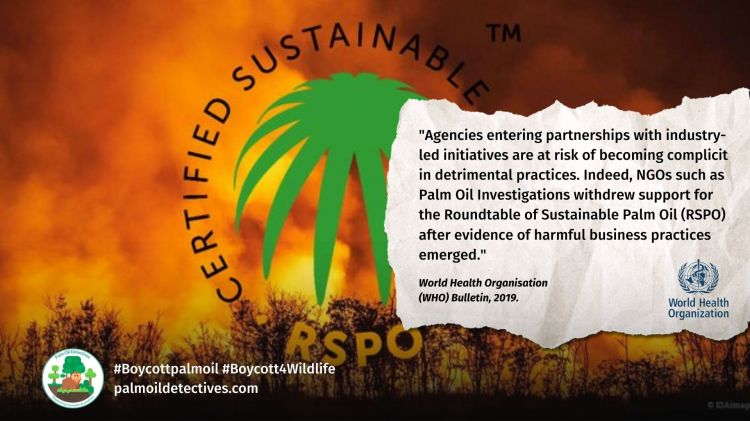
A 2019 World Health Organisation (WHO) report into the palm oil industry finds extensive greenwashing of human rights abuses, deforestation, air pollution and human health impacts
Read report


Big brands using “sustainable” RSPO palm oil yet still causing deforestation (there are many others)

Nestlé
Nestlé is destroying rainforests, releasing mega-tonnes of carbon into the atmosphere, and killing hundreds of endangered species. Once these animals are gone – they are gone for good. See Nestlé’s full list of…
 by Palm Oil DetectivesFebruary 9, 2021March 2, 2025
Colgate-Palmolive
Despite global retail giant Colgate-Palmolive forming a coalition with other brands in 2020, virtue-signalling that they will stop all deforestation, they continue to do this – destroying rainforest and releasing mega-tonnes of carbon…
 by Palm Oil DetectivesFebruary 9, 2021March 2, 2025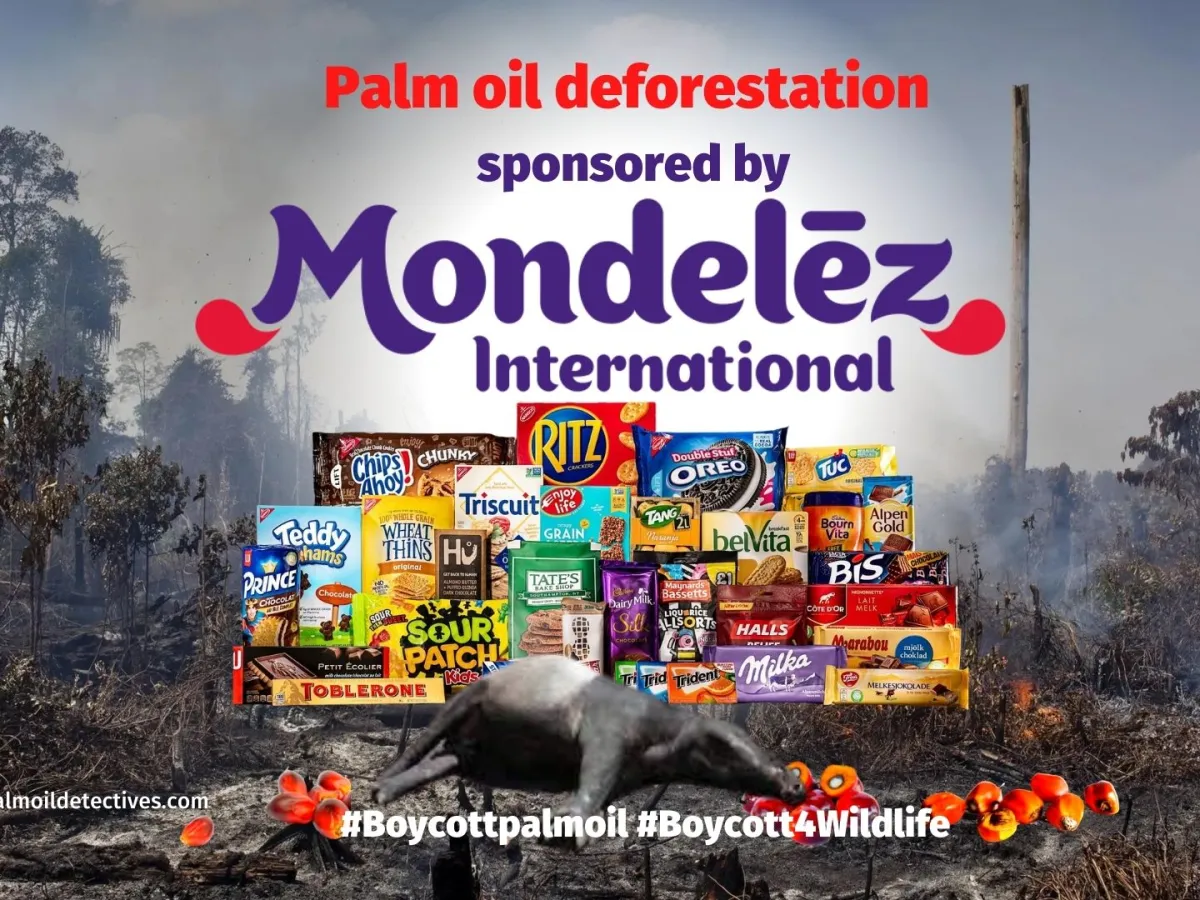
Mondelēz
Mondelez destroys rainforests, sending animals extinct and release mega-tonnes of carbon into air for so-called “sustainable” palm oil. Boycott them!
by Palm Oil DetectivesFebruary 9, 2021October 15, 2025
Unilever
In 2020, global retail giant Unilever unveiled a deforestation-free supply chain promise. By 2023 they would be deforestation free. This has been and gone and they are still causing deforestation. This brand has…
by Palm Oil DetectivesFebruary 9, 2021March 2, 2025
Danone
Savvy consumers have been pressuring French Dairy multinational Danone for decades to cease using deforestation palm oil. Yet they actually haven’t stopped this. From their website: ‘Danone is committed to eliminating deforestation from…
by Palm Oil DetectivesMarch 6, 2021March 2, 2025
PepsiCo
Despite decades of promises to end deforestation for palm oil PepsiCo (owner of crisp brands Frito-Lay, Cheetos and Doritos along with hundreds of other snack food brands) have continued sourcing palm oil that…
by Palm Oil DetectivesJune 9, 2022March 2, 2025
Procter & Gamble
Despite decades of promises to end deforestation for palm oil Procter & Gamble or (P&G as they are also known) have continued sourcing palm oil that causes ecocide, indigenous landgrabbing, and the habitat…
by Palm Oil DetectivesJune 3, 2022March 2, 2025
Kelloggs/Kellanova
In late 2023, Kelloggs became Kellanova for their US arm. Savvy consumers have been pressuring Kelloggs for decades to cease using deforestation palm oil. Yet they actually haven’t stopped this. From their website:…
by Palm Oil DetectivesFebruary 9, 2021March 2, 2025
Johnson & Johnson
Global mega-brand Johnson & Johnson have issued a position statement on palm oil in 2020. ‘At Johnson & Johnson, we are committed to doing our part to address the unsustainable rate of global…
by Palm Oil DetectivesFebruary 9, 2021July 13, 2025
PZ Cussons
PZ Cussons is a British-owned global retail giant. They own well-known supermarket brands in personal care, cleaning, household goods and toiletries categories, such as Imperial Leather, Morning Fresh, Carex, Radiant laundry powder and…
by Palm Oil DetectivesMarch 10, 2021March 2, 2025Take Action in Five Ways
1. Join the #Boycott4Wildlife on social media and subscribe to stay in the loop: Share posts from this website to your own network on Twitter, Mastadon, Instagram, Facebook and Youtube using the hashtags #Boycottpalmoil #Boycott4Wildlife.
Enter your email address
Sign Up
Join 3,526 other subscribers2. Contribute stories: Academics, conservationists, scientists, indigenous rights advocates and animal rights advocates working to expose the corruption of the palm oil industry or to save animals can contribute stories to the website.

Wildlife Artist Juanchi Pérez

Mel Lumby: Dedicated Devotee to Borneo’s Living Beings

Anthropologist and Author Dr Sophie Chao

Health Physician Dr Evan Allen

The World’s Most Loved Cup: A Social, Ethical & Environmental History of Coffee by Aviary Doert

How do we stop the world’s ecosystems from going into a death spiral? A #SteadyState Economy
3. Supermarket sleuthing: Next time you’re in the supermarket, take photos of products containing palm oil. Share these to social media along with the hashtags to call out the greenwashing and ecocide of the brands who use palm oil. You can also take photos of palm oil free products and congratulate brands when they go palm oil free.
https://twitter.com/CuriousApe4/status/1526136783557529600?s=20
https://twitter.com/PhillDixon1/status/1749010345555788144?s=20
https://twitter.com/mugabe139/status/1678027567977078784?s=20
4. Take to the streets: Get in touch with Palm Oil Detectives to find out more.
5. Donate: Make a one-off or monthly donation to Palm Oil Detectives as a way of saying thank you and to help pay for ongoing running costs of the website and social media campaigns. Donate here
Pledge your support#360infoOrg #airPollution #BoycottPalmOil #Boycott4wildlife #BoycottPalmOil #carbonemissions #cleanair #corruption #cronyism #deforestation #fire #fossilFuels #fossilfuel #fossilfuels #greenwashing #humanHealth #Indonesia #Malaysia #PalmOil #palmOilDeforestation #palmoil #pollution #SouthEastAsia #TheAirWeShare #timber
Unsupported type or deleted object
Finance giants fuel $8.9 trillion deforestation economy
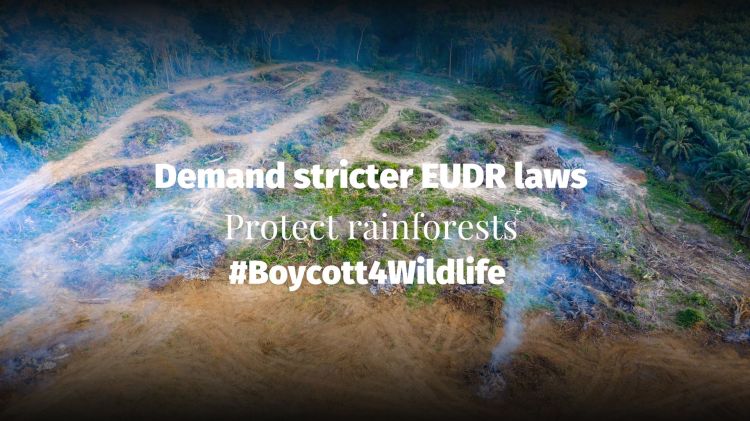
Global Canopy’s Forest 500 report reveals that 150 of the world’s largest financial institutions invested nearly $9 trillion in deforestation-linked industries during 2024, with six out of ten firms lacking any public deforestation policies. The analysis tracked $8.9 trillion in direct and indirect financial support for 500 companies exposed to forest-risk commodities including palm oil, soy, beef, cocoa, and timber, with $864 billion going to businesses making no public commitments against deforestation. Financial titans Vanguard, BlackRock and JPMorgan Chase alone accounted for more than one-fifth of total funding at $1.6 trillion. The EU’s upcoming Deforestation Regulation #EUDR will ban imports of products linked to forest destruction from December 30, potentially locking out companies without robust policies. Urgent action needed to redirect finance away from forest destruction and toward Indigenous-led forest protection. Support a strong and strict EUDR to safeguard forests, be vegan and #BoycottPalmOil #Boycott4Wildlife
💰☠️ $8.9 TRILLION funds deforestation! BlackRock, Vanguard, JPMorgan lead with $1.6T funding #palmoil, #soy and #meat #deforestation 🌴🔥 Support the #EUDR ban Dec 30 ⛔️ #BoycottPalmOil #Boycott4Wildlife @palmoildetect https://palmoildetectives.com/2025/12/17/finance-giants-fuel-8-9-trillion-deforestation-economy/
Share to BlueSkyShare to TwitterSustainable Times. (2024). Global finance giants under fire for fueling an $8.9 trillion ‘deforestation economy’ in 2024. Sustainable Times. https://www.sustainabletimes.co.uk/post/global-finance-giants-under-fire-for-fueling-an-8-9-trillion-deforestation-economy-in-2024
The world’s largest financial institutions Vanguard, BlackRock, and JPMorgan Chase are bankrolling a massive $8.9 trillion deforestation economy whilst offering minimal safeguards against forest destruction, according to explosive new research that exposes the banking sector’s complicity in global environmental destruction.
Global Canopy’s comprehensive Forest 500 report tracked investments from 150 of the planet’s biggest financial institutions throughout 2024, revealing systematic funding of industries driving tropical rainforest annihilation across palm oil, soy, beef and timber sectors. The scale of financial exposure proves staggering, with institutions providing $8.9 trillion in direct and indirect support for 500 companies engaged in forest-risk commodities.
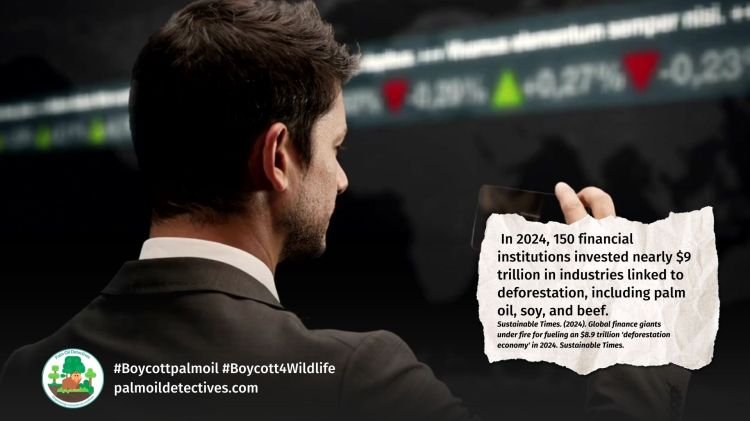
The research exposed catastrophic policy failures across the financial sector. Six out of ten institutions reviewed maintain no publicly stated deforestation policies whatsoever, representing only marginal improvement from the previous year when two-thirds lacked such protections. Even more alarming, fewer than four in ten financial giants openly acknowledge that deforestation poses business risks to their portfolios.
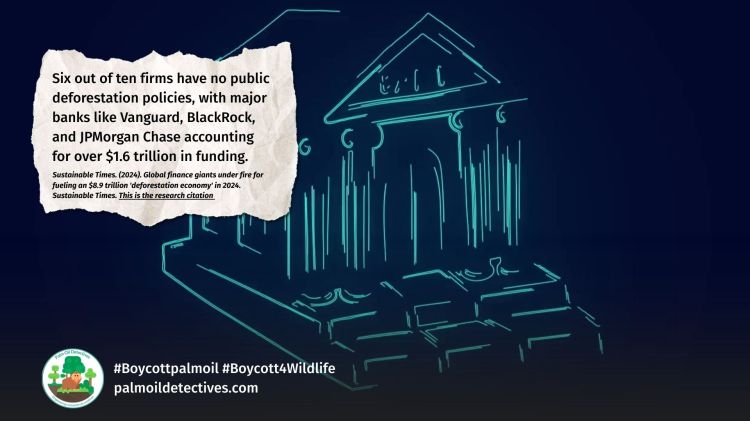
Three financial behemoths dominate the destruction economy. Vanguard, BlackRock, and JPMorgan Chase “alone were responsible for more than one-fifth of the total” funding, collectively channelling $1.6 trillion toward forest-risk industries. Their enormous market influence means policy changes from these titans “could trigger rapid change across the global financial system,” according to Global Canopy analysts.
The geographic concentration of destruction finance reveals systematic patterns. Beyond the United States, “China and France also emerged as central hubs of financial flows into deforestation-linked industries.” This concentration demonstrates how relatively few financial centres drive global forest destruction through investment decisions.
Perhaps most damning, nearly $864 billion flowed directly to companies making zero public commitments against deforestation. This represents “almost one in every ten dollars” of total financing going to businesses with no safeguards protecting tropical forests from destruction for palm oil plantations, cattle ranches, or soy cultivation.
Global Canopy researchers emphasised the sector’s transformative potential, stating: “Unless financial institutions engage portfolio companies to act on deforestation risk – for instance, through strong stewardship of investee companies – their financing activities will undermine the positive impact of any transition finance they provide.” However, they noted these “financial heavyweights could use their investment strategies to drive better practice and transform commodity supply chains for the better.”
The European Union’s new Deforestation Regulation dramatically increases pressure on financial institutions to implement robust policies. Beginning December 30, the EU “will ban large businesses from importing beef, cocoa, coffee, palm oil, natural rubber, soy, or wood if these products are linked to deforestation.” The ban will eventually extend to smaller businesses, creating comprehensive market exclusions for forest-destructive products.
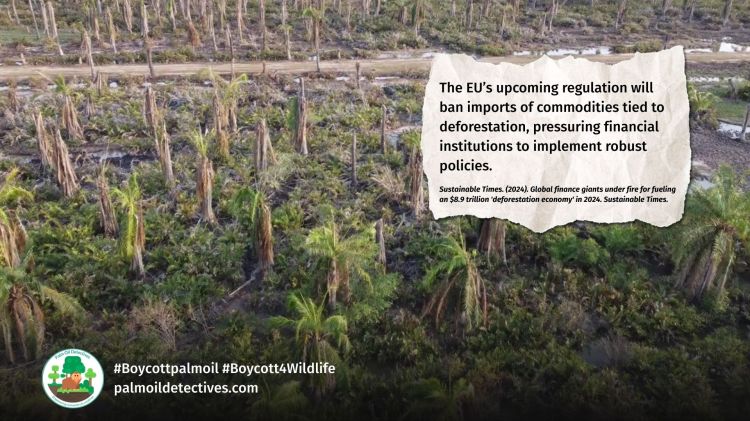
This regulatory shift creates urgent risks for financial institutions backing non-compliant companies. “Without robust policies, they will find themselves backing companies that are locked out of key markets,” the report warns. Financial institutions face the prospect of massive portfolio devaluations as their investee companies lose access to lucrative European markets.
A handful of progressive institutions demonstrate viable alternatives. Banco Bilbao Vizcaya Argentaria, Deutsche Bank, and Lloyds Banking Group represent “the only institutions shown to be screening and monitoring all the highest-risk commodities.” Their comprehensive approaches “provide a blueprint for others to follow” in developing effective deforestation policies.
Global Canopy outlined essential components for credible deforestation policies extending “well beyond a vague pledge.” Effective policies require “clear standards for screening clients and portfolio holdings, active engagement to bring non-compliant firms into line, and strict deadlines for divestment if companies fail to improve.” Additionally, institutions must maintain “transparent reporting of progress and commitments to human rights safeguards.”
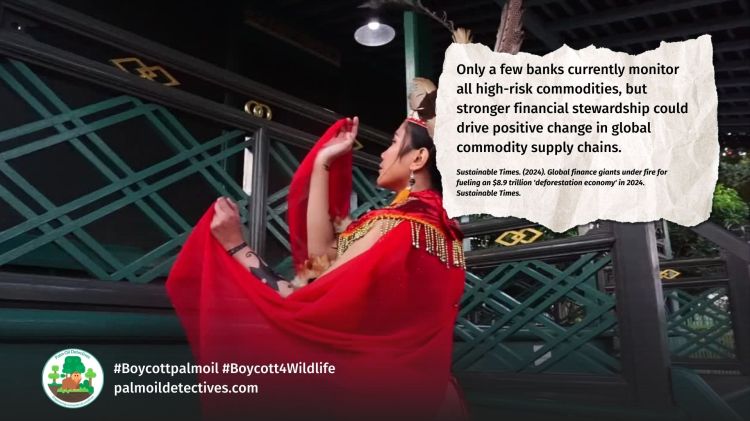
The analysis examined nine critical forest-risk commodities: “beef, cocoa, coffee, leather, palm oil, pulp and paper, soy, rubber, and timber.” Each sector drives habitat destruction threatening wildlife populations whilst displacing Indigenous communities dependent on intact forests for survival.
The report concludes that financial institutions possess “immense influence over whether deforestation is curbed or allowed to spiral further out of control.” Current investment patterns tell “a troubling story, but with the right commitments, banks and investment firms could become powerful drivers of change” toward forest protection rather than destruction.
Sustainable Times. (2024). Global finance giants under fire for fueling an $8.9 trillion ‘deforestation economy’ in 2024. Sustainable Times. https://www.sustainabletimes.co.uk/post/global-finance-giants-under-fire-for-fueling-an-8-9-trillion-deforestation-economy-in-2024
ENDS
Read more about deforestation and ecocide in the palm oil industry
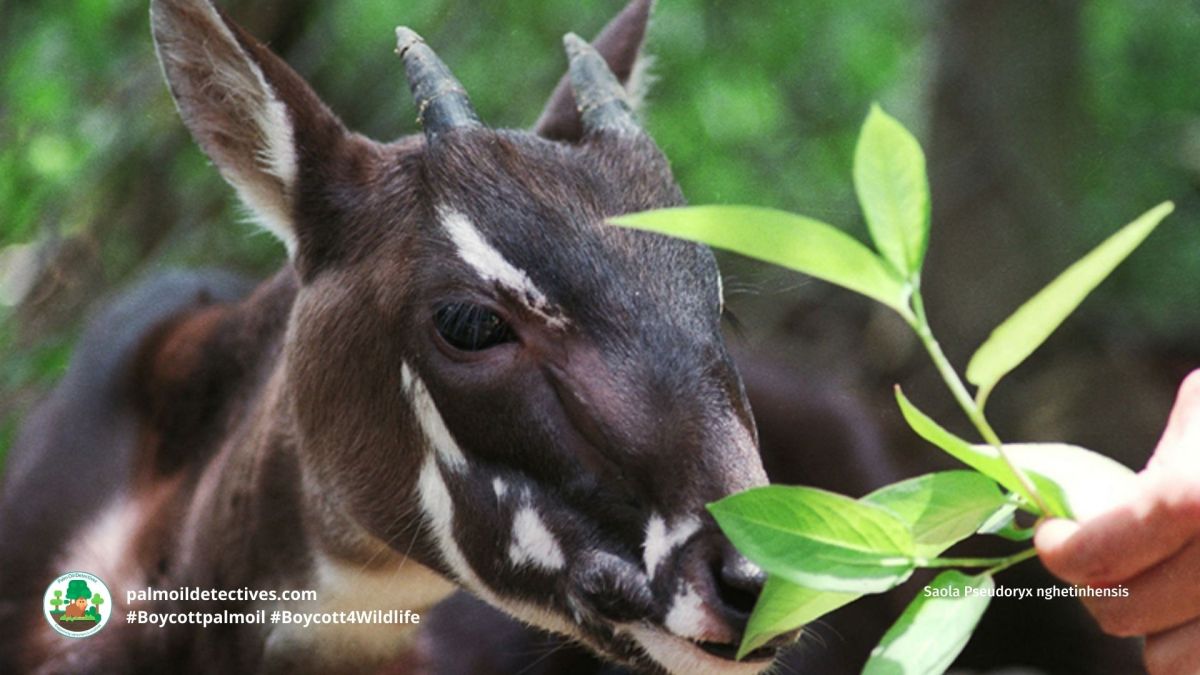
Saola Pseudoryx nghetinhensis
Saolas are rare and considered Southeast Asia’s ‘unicorns’, this Critically Endangered antelope is facing imminent extinction due to hunting and deforestation
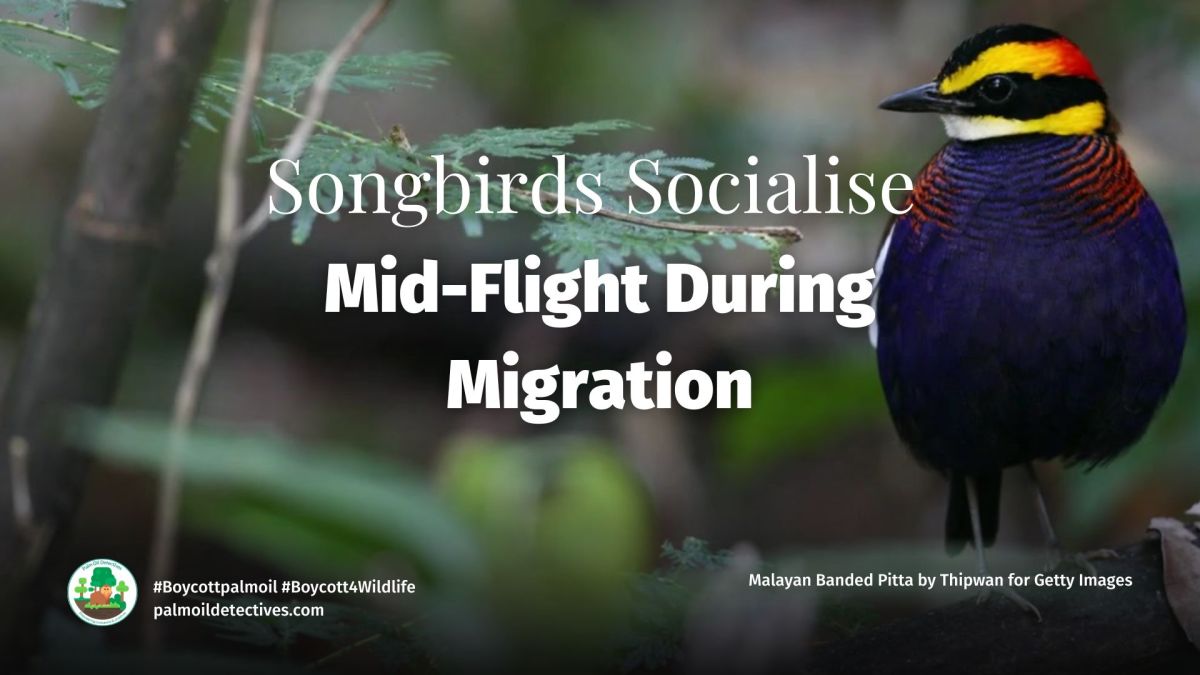
Songbirds Socialise Mid-Flight During Migration
Songbirds communicate with different species during nocturnal flights sharing vital info about navigation and stopover habitats. Save their fascinating world!

Why Pangolins Are So Special
Pangolins get their name from the Malay ‘pengguling’ meaning rolling up. These special critically endangered animals deserve a break from savage poaching

Tucuxi Sotalia fluviatilis
Tucuxi, small freshwater dolphins of Peru Ecuador Colombia and Brazil are Endangered due to fishing nets, deforestation, mercury poisoning from gold mining.
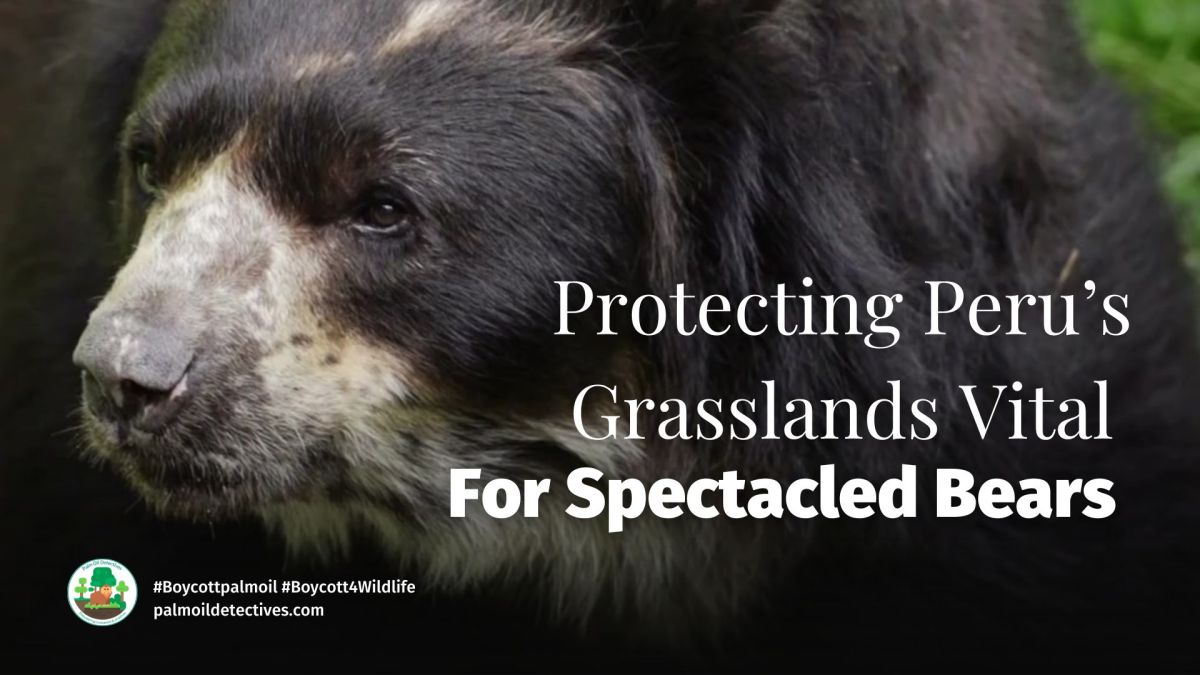
Protecting Peru’s Grasslands Vital for Spectacled Bears
Peru’s alpine puna grasslands supports foraging of vulnerable Andean bears AKA Spectacled Bears. They prefer young bromeliad plants, Take action for them!
Load more posts
Something went wrong. Please refresh the page and/or try again.
Take Action in Five Ways
1. Join the #Boycott4Wildlife on social media and subscribe to stay in the loop: Share posts from this website to your own network on Twitter, Mastadon, Instagram, Facebook and Youtube using the hashtags #Boycottpalmoil #Boycott4Wildlife.
Enter your email address
Sign Up
Join 3,172 other subscribers2. Contribute stories: Academics, conservationists, scientists, indigenous rights advocates and animal rights advocates working to expose the corruption of the palm oil industry or to save animals can contribute stories to the website.
Wildlife Artist Juanchi Pérez
Mel Lumby: Dedicated Devotee to Borneo’s Living Beings
Anthropologist and Author Dr Sophie Chao
Health Physician Dr Evan Allen
The World’s Most Loved Cup: A Social, Ethical & Environmental History of Coffee by Aviary Doert
How do we stop the world’s ecosystems from going into a death spiral? A #SteadyState Economy
3. Supermarket sleuthing: Next time you’re in the supermarket, take photos of products containing palm oil. Share these to social media along with the hashtags to call out the greenwashing and ecocide of the brands who use palm oil. You can also take photos of palm oil free products and congratulate brands when they go palm oil free.
https://twitter.com/CuriousApe4/status/1526136783557529600?s=20
https://twitter.com/PhillDixon1/status/1749010345555788144?s=20
https://twitter.com/mugabe139/status/1678027567977078784?s=20
4. Take to the streets: Get in touch with Palm Oil Detectives to find out more.
5. Donate: Make a one-off or monthly donation to Palm Oil Detectives as a way of saying thank you and to help pay for ongoing running costs of the website and social media campaigns. Donate here
Pledge your support#BoycottPalmOil #Boycott4wildlife #BoycottPalmOil #corruption #crime #deforestation #ecocide #ecolabel #EUDR #greenwashing #meat #meatAgriculture #meatAndSoyDeforestationInBrazil #News #PalmOil #palmOilDeforestation #palmoil #soy
Seeing Forest As Merely A Carbon “Commodity”: Dangerous Greenwashing
The huge danger of commodifying forests and seeing them as merely an “investment” to be bought and sold as ‘carbon credits’ has many loopholes that deny indigenous sovereignty, social and economic outcomes of communities and pose grave extinction risks to wild animals and plants. Take action when you shop and #Boycottpalmoil #Boycott4Wildlife
The huge danger of commodifying #forests 🌿 🔥 and seeing them as merely an “investment”, denies #indigenous sovereignty, social and economic outcomes of communities and #extinction risks. #humanrights 🌴⛔️ #Boycottpalmoil #Boycott4Wildlife @palmoildetect https://wp.me/pcFhgU-92u
Share to BlueSky Share to Twitter‘Carbon credits’ turn #forest 🌳🔥 ecosystems into investments but deny #indigenous communities their rights and are often blatant #greenwashing. Use your wallet as a weapon and #Boycottpalmoil #Boycott4Wildlife #landrights @palmoildetect https://wp.me/pcFhgU-92u
Share to BlueSkyShare to TwitterWritten by Constance McDermott, Senior Fellow in Forest Governance and Leader of Ecosystems Governance Group, University of Oxford; Eric Kumeh Mensah, Postdoctoral research fellow, University of Oxford, and Mark Hirons, Environmental Social Science Research Fellow, University of Oxford. This article is republished from The Conversation under a Creative Commons license. Read the original article.
Forests are great carbon sinks – they absorb more carbon from the atmosphere than they release. Globally, forests remove nearly all of the two billion tonnes of carbon dioxide that is currently being removed from the atmosphere every year.
These days, companies can buy “carbon credits” for the carbon that is stored in living forests and offset this against their own greenhouse gas emissions. International financiers estimate that by 2050, Africa could be selling US$1.5 trillion in carbon credits per year, mainly from its forests. Environmental social scientists Constance L. McDermott, Eric Mensah Kumeh and Mark Hirons are co-authors of a report on global forest governance for the International Union of Forest Research Organisations. They have found that buying and selling forest carbon as a commodity is dangerous if it is prioritised over the other environmental and social uses of forests. It could even result in environmental damage and the displacement of forest-dependent people.
What is a carbon sink?
All living things contain carbon, and are considered carbon sinks when they absorb more carbon from the atmosphere than they release. Many ecosystems serve as carbon sinks, but forests have a large biomass (wood and twigs and leaves on the forest floor). This makes them a very important sink from a climate perspective.
The carbon that trees capture is sequestered (stored) in their wood, leaves or needles, and roots. When forests are cut down or burned, their stored carbon is released into the atmosphere and becomes a source of carbon emissions rather than a sink. Forest carbon sinks can be conserved by leaving live trees standing, or created and enhanced by planting or natural regeneration of trees.
Why is it a problem for a forest to be seen only as a carbon sink?
Forests support and regulate soil, water and nutrient flows, and provide habitat for the majority of the world’s species that live on land. They provide people with food, fuel, fibre, medicine and other products.
They are important to the cultural survival and well-being of many communities. In Africa alone, an estimated 245 million people live within five kilometres of a forest, and many of these people rely directly on forests for their livelihoods.
Our research found that forests are increasingly being managed as carbon sinks, and the carbon they store treated as a commodity that can be internationally traded. Carbon markets allow businesses and governments to earn credits by paying for forests that reduce greenhouse gas emissions, which is cheaper than reducing their own emissions. This is part of what we call the climatisation of forests.
 Animal agriculture and meat, The contents of your fridge and dining table directly impacts the future of rare rainforest and ocean animals. That’s because industrial agriculture and aquaculture for commodities like meat, dairy, fish and palm oil is driving animals in the most biodiverse ecosystems on the planet closer towards extinction.
 Governing forests only as carbon sinks can promote “green grabs” where non-forested land, such as grasslands, used by communities for farming and other activities, is taken from the community and used by wealthy companies or governments to plant large tracts of trees to store carbon. Sub-Saharan Africa, in particular, is being targeted as a readily available and inexpensive location for one million hectares of forest restoration and tree plantations.
This is especially threatening for people who do not have secure rights to the forests and land they depend on. These communities can even be restricted or banned from entering the forest. Research has found that forest-dependent communities are rarely given power to address their own priorities in forest carbon sink schemes. This can cause conflict locally and weaken local democracy.
Let’s take the example of the Mai-Ndombe forest in the Democratic Republic of Congo, which supports about 100,000 people in 23 villages. Activities in the Mai-Ndombe under the global Reducing Emissions from Deforestation and Forest Degradation (REDD+) climate change mechanism have focused on changing the practices of local forest-dependent communities away from cutting trees for artisanal logging or firewood collection. These communities have also been told not to continue with traditional methods of shifting cultivation (where parts of a forest are temporarily cleared to grow food crops without deforesting the area permanently).
Yet in Mai-Ndombe and the Democratic Republic of Congo’s other forests, land is already allocated to companies for timber (mainly for the export market), for mining, and increasingly for forest carbon sequestration. The result is that large companies continue to extract major economic benefits from forests in ways that exclude local communities.
Ghana’s Cocoa Forest REDD+ Programme is another example. In a bid to reduce deforestation and increase forest carbon stocks, the government of Ghana pays farmers and local communities to not plant cocoa crops in forested areas and to grow shade trees on their cocoa farms.
These efforts to share benefits locally are very important. However, asking farmers to plant or conserve trees does not address the fact that farmers are not earning a living income from selling cocoa.
Ghana’s cocoa farmers receive less than 7.5% of the value of a chocolate bar sold in international markets, and they suffer from food insecurity and increasing crop failures due to climate change. They do not have legal rights to the native trees that regenerate naturally on their cocoa farms.
The focus of REDD+ on channelling large amounts of money into forests as carbon could mean that many farmers lose access to land for growing food and meeting other livelihood needs – unless this is balanced by major investments to address the core challenges the farmers are facing.
What are some solutions?
Forests can absorb large amounts of carbon dioxide and still support communities. A people-centred approach to forests is needed. This means giving local communities secure rights to their land and forest resources, and governing forests according to what best suits the local context, rather than making forest use fit the international market.
The important role of traditional authorities and local customs in managing land and resolving conflicts must be recognised. Many traditional practices have managed forests sustainably for thousands of years. The challenge is to value and support these alternative approaches.
Written by Constance McDermott, Senior Fellow in Forest Governance and Leader of Ecosystems Governance Group, University of Oxford; Eric Kumeh Mensah, Postdoctoral research fellow, University of Oxford, and Mark Hirons, Environmental Social Science Research Fellow, University of Oxford. This article is republished from The Conversation under a Creative Commons license. Read the original article.
ENDS
Read more about deforestation and ecocide in the palm oil industry
Finance giants fuel $8.9 trillion deforestation economy
Forest 500 report shows 150 of the world’s largest financial institutions invested nearly $9 trillion in deforestation-linked industries. Support EUDR!
Saola Pseudoryx nghetinhensis
Saolas are rare and considered Southeast Asia’s ‘unicorns’, this Critically Endangered antelope is facing imminent extinction due to hunting and deforestation
Songbirds Socialise Mid-Flight During Migration
Songbirds communicate with different species during nocturnal flights sharing vital info about navigation and stopover habitats. Save their fascinating world!
Why Pangolins Are So Special
Pangolins get their name from the Malay ‘pengguling’ meaning rolling up. These special critically endangered animals deserve a break from savage poaching
Tucuxi Sotalia fluviatilis
Tucuxi, small freshwater dolphins of Peru Ecuador Colombia and Brazil are Endangered due to fishing nets, deforestation, mercury poisoning from gold mining.
Load more posts
Something went wrong. Please refresh the page and/or try again.
Take Action in Five Ways
1. Join the #Boycott4Wildlife on social media and subscribe to stay in the loop: Share posts from this website to your own network on Twitter, Mastadon, Instagram, Facebook and Youtube using the hashtags #Boycottpalmoil #Boycott4Wildlife.
Enter your email address
Sign Up
Join 3,173 other subscribers2. Contribute stories: Academics, conservationists, scientists, indigenous rights advocates and animal rights advocates working to expose the corruption of the palm oil industry or to save animals can contribute stories to the website.
Wildlife Artist Juanchi Pérez
Mel Lumby: Dedicated Devotee to Borneo’s Living Beings
Anthropologist and Author Dr Sophie Chao
Health Physician Dr Evan Allen
The World’s Most Loved Cup: A Social, Ethical & Environmental History of Coffee by Aviary Doert
How do we stop the world’s ecosystems from going into a death spiral? A #SteadyState Economy
3. Supermarket sleuthing: Next time you’re in the supermarket, take photos of products containing palm oil. Share these to social media along with the hashtags to call out the greenwashing and ecocide of the brands who use palm oil. You can also take photos of palm oil free products and congratulate brands when they go palm oil free.
https://twitter.com/CuriousApe4/status/1526136783557529600?s=20
https://twitter.com/PhillDixon1/status/1749010345555788144?s=20
https://twitter.com/mugabe139/status/1678027567977078784?s=20
4. Take to the streets: Get in touch with Palm Oil Detectives to find out more.
5. Donate: Make a one-off or monthly donation to Palm Oil Detectives as a way of saying thank you and to help pay for ongoing running costs of the website and social media campaigns. Donate here
Pledge your support#Boycott4wildlife #BoycottPalmOil #carbonCredits #corruption #deforestation #extinction #Forest #forests #greenwash #greenwashing #HumanRights #indigenous #landrights #PalmOil #palmOilBiofuel #palmOilDeforestation #plywood #supplyChain #supplychain #wood
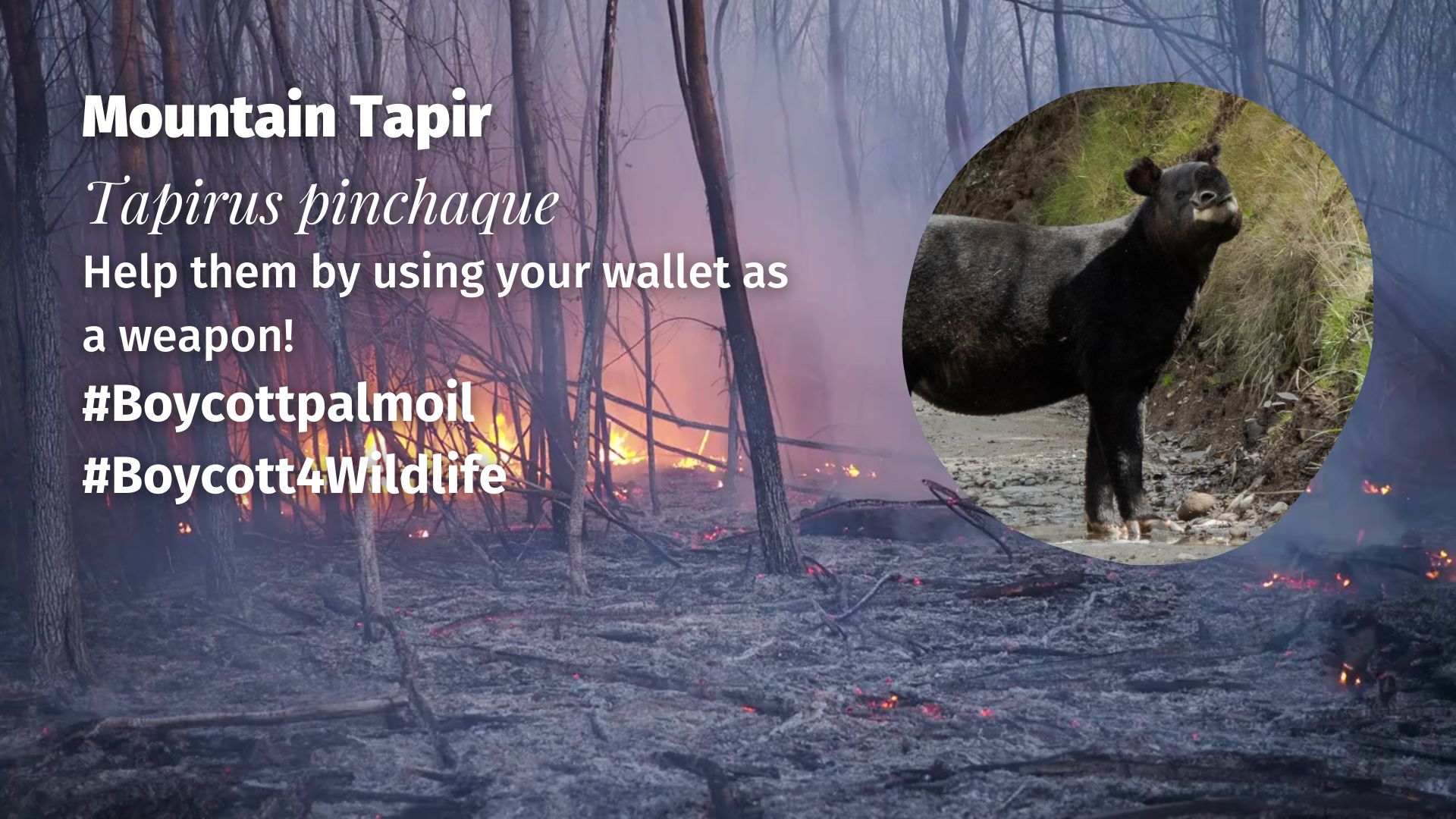
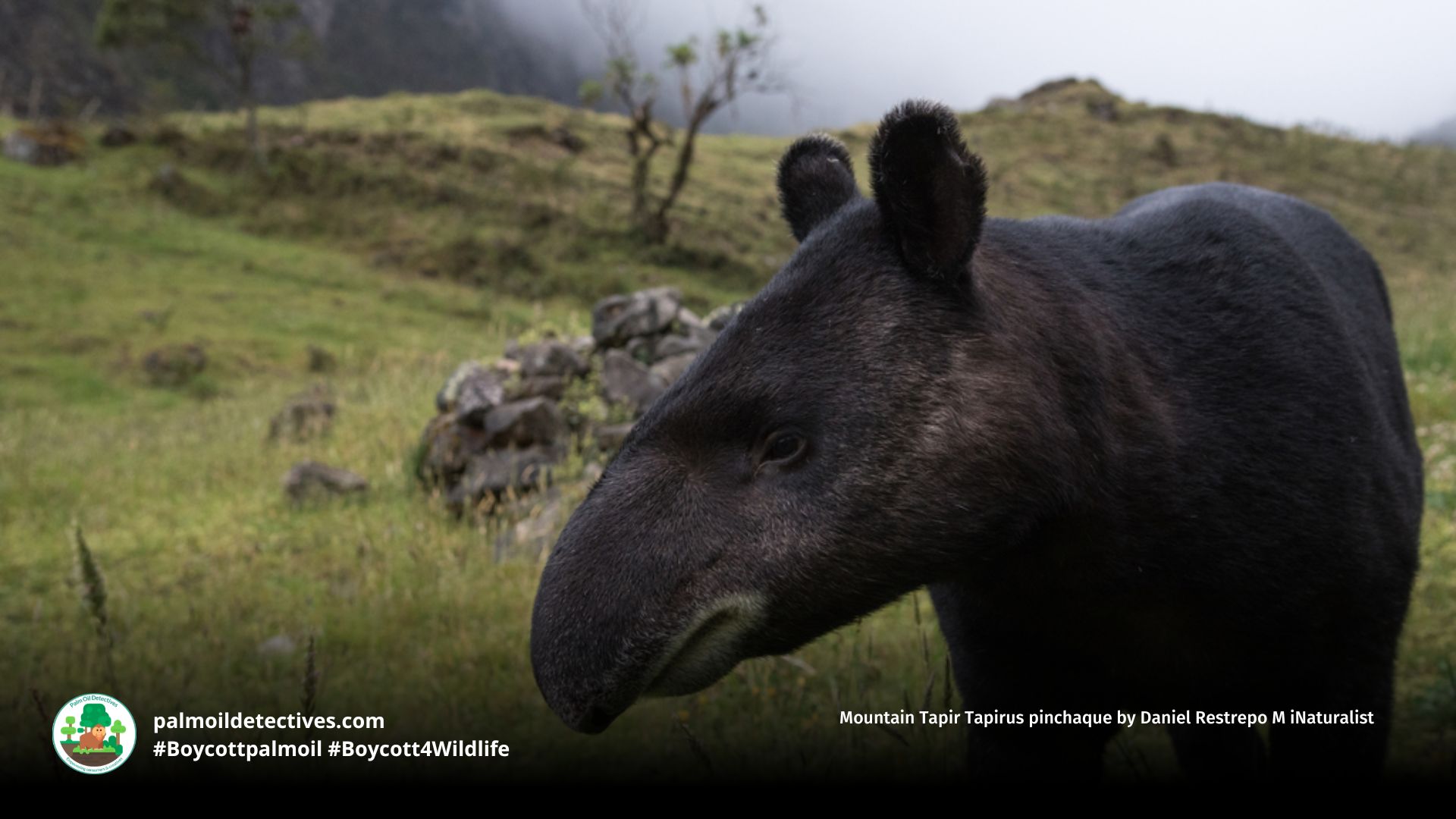
Mountain Tapir Tapirus pinchaque
Mountain Tapir Tapirus pinchaque
IUCN Red List Status: Endangered
Location: Colombia, Ecuador, northern Peru
Mountain Tapirs inhabit the high Andean cloud forests and páramos above 2,000 metres in the northern Andes. They are found in Colombia’s Central and Eastern Cordilleras, throughout Ecuador including Sangay and Podocarpus National Parks, and into northern Peru, notably in Cajamarca and Lambayeque.
The Mountain Tapir Tapirus pinchaque is one of the most threatened large mammals in the northern Andes, currently listed as Endangered. Their populations have declined by over 50% in the past three decades due to habitat loss, illegal hunting, climate change, and rampant mining. With fewer than 2,500 mature individuals remaining, they are quietly disappearing from their mist-shrouded mountain homes. Human encroachment, infrastructure development, and cattle grazing now invade their last strongholds. Without urgent action, they may vanish forever. Use your wallet as a weapon and fight back when you shop #BoycottPalmOil #Boycott4Wildlife and be #BoycottGold
Sweet-natured Mountain #Tapirs of #Ecuador 🇪🇨 #Peru 🇵🇪 and #Colombia 🇨🇴 face serious threats incl. illegal crops, #gold #mining, #palmoil #deforestation and hunting. Help them survive #BoycottPalmOil 🌴⛔️#BoycottGold 🥇⛔️ #Boycott4Wildlife @palmoildetect https://palmoildetectives.com/2025/12/28/mountain-tapir-tapirus-pinchaque/
Share to BlueSky Share to TwitterThe Wooly #Tapir AKA Mountain Tapir gives birth to one calf at a time 🩷😻 They’re #endangered due to a many threats: #climatechange and #pollution from #gold mining. Resist for them! #BoycottPalmOil #BoycottGold 🥇☠️❌ #Boycott4Wildlife @palmoildetect https://palmoildetectives.com/2025/12/28/mountain-tapir-tapirus-pinchaque/
Share to BlueSky Share to TwitterAppearance & Behaviour
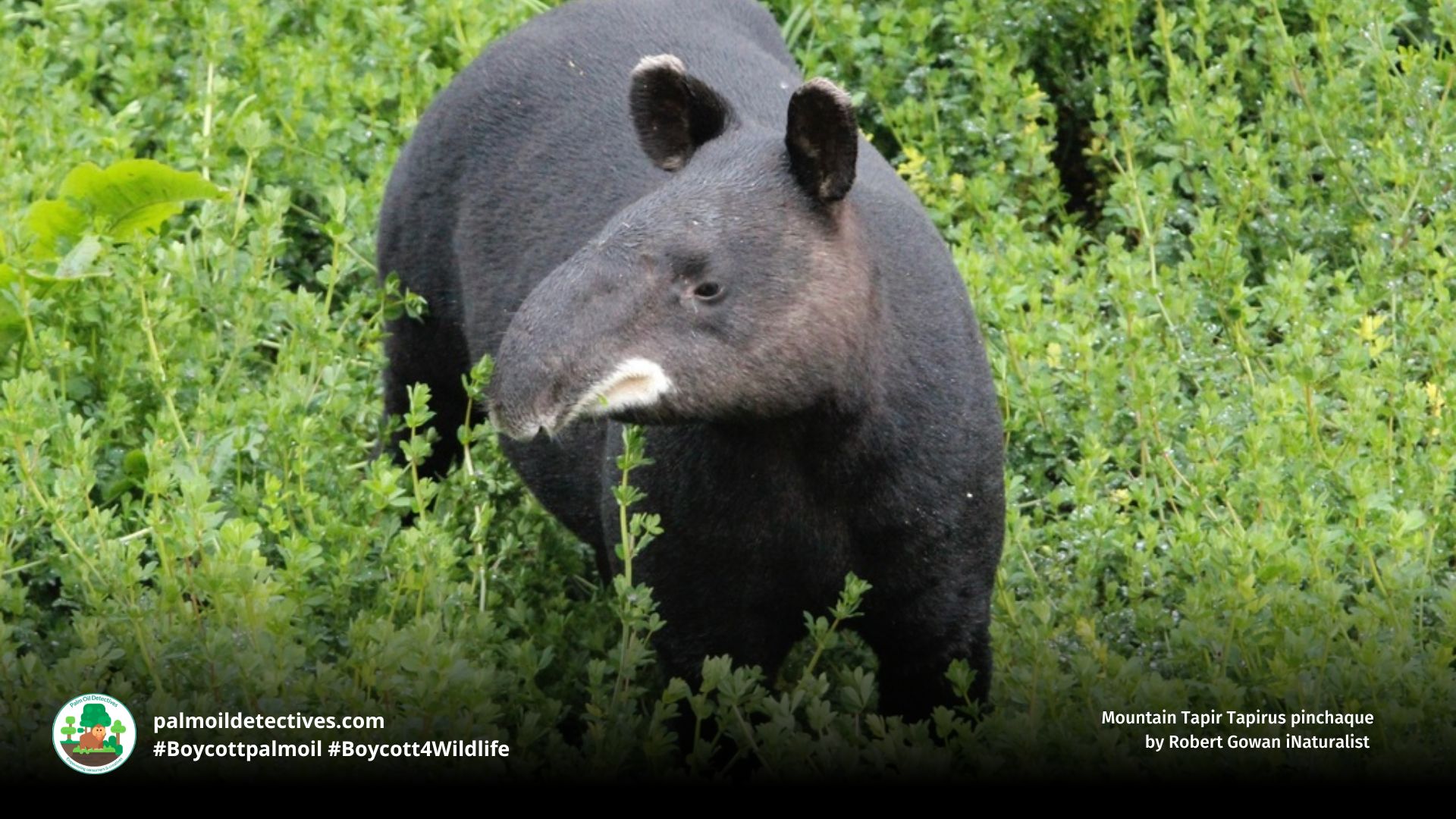
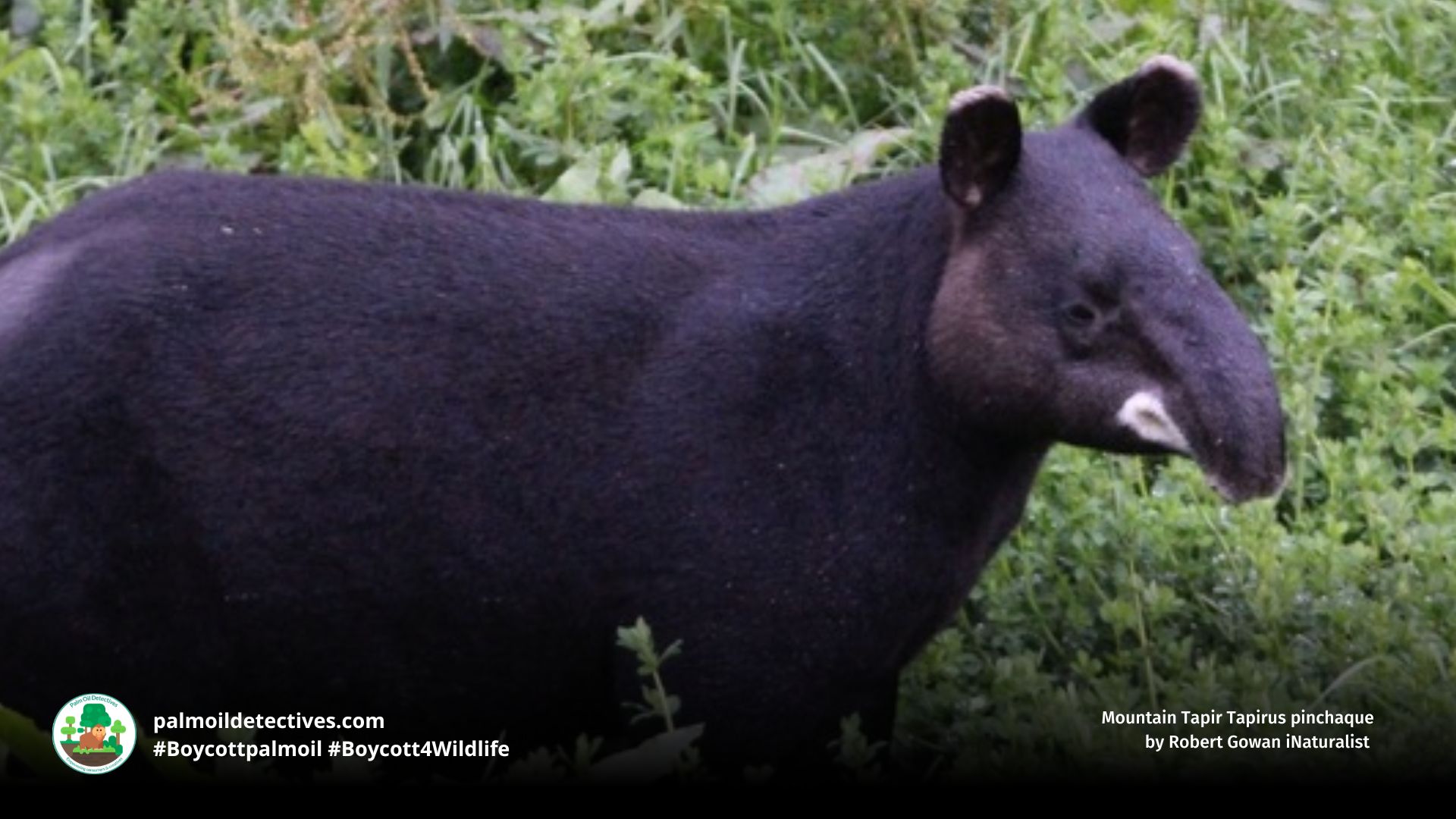
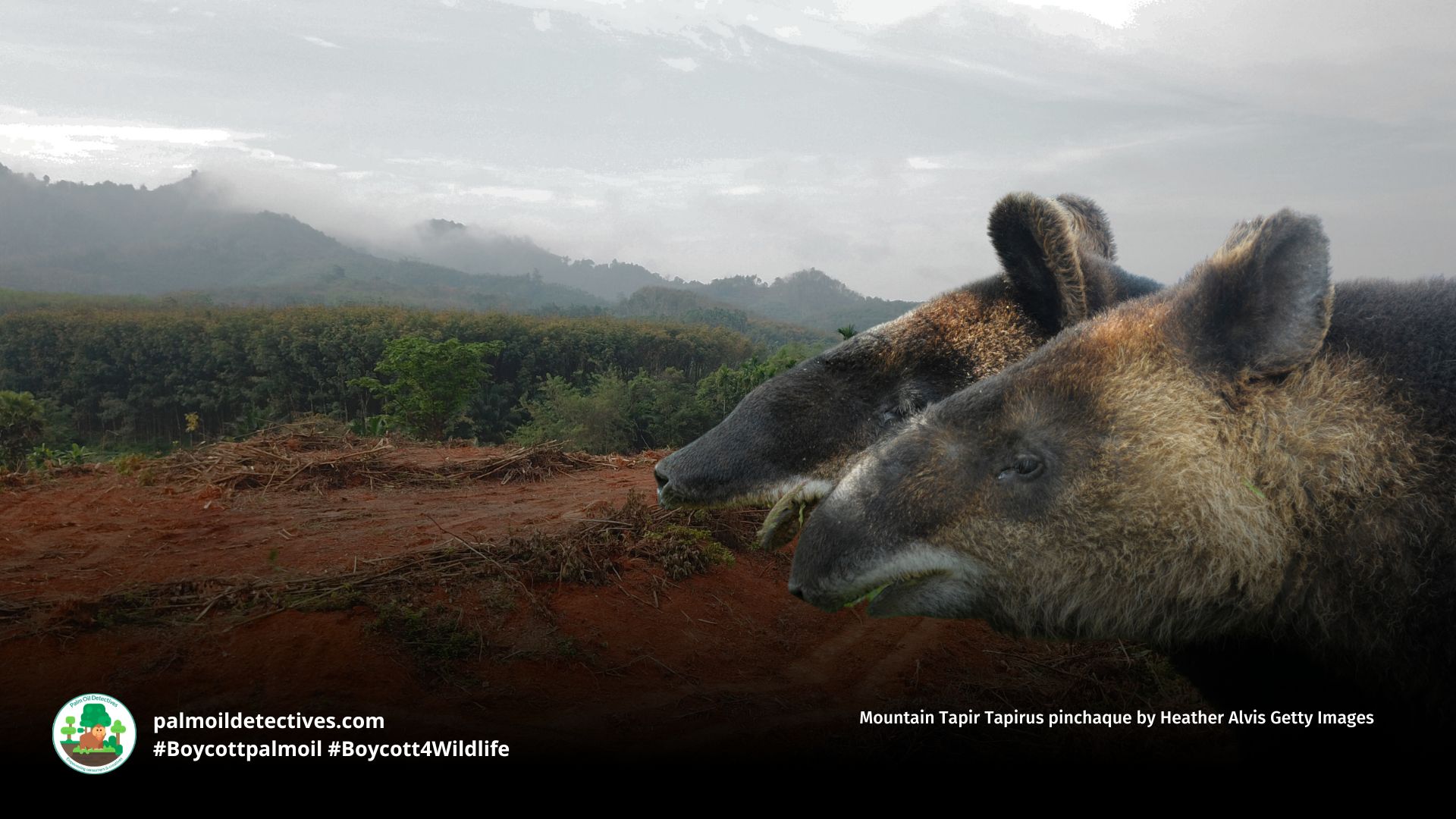
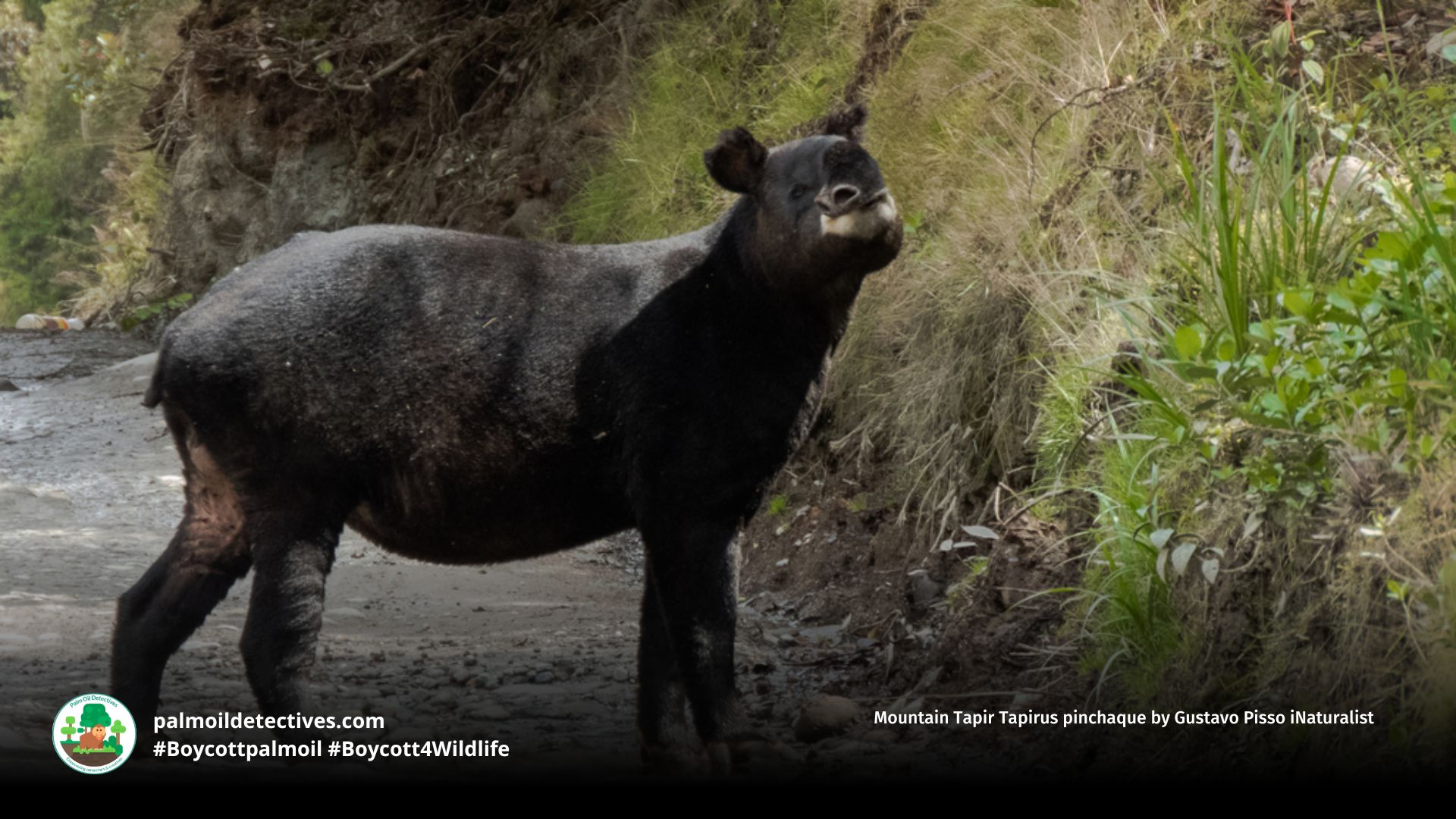
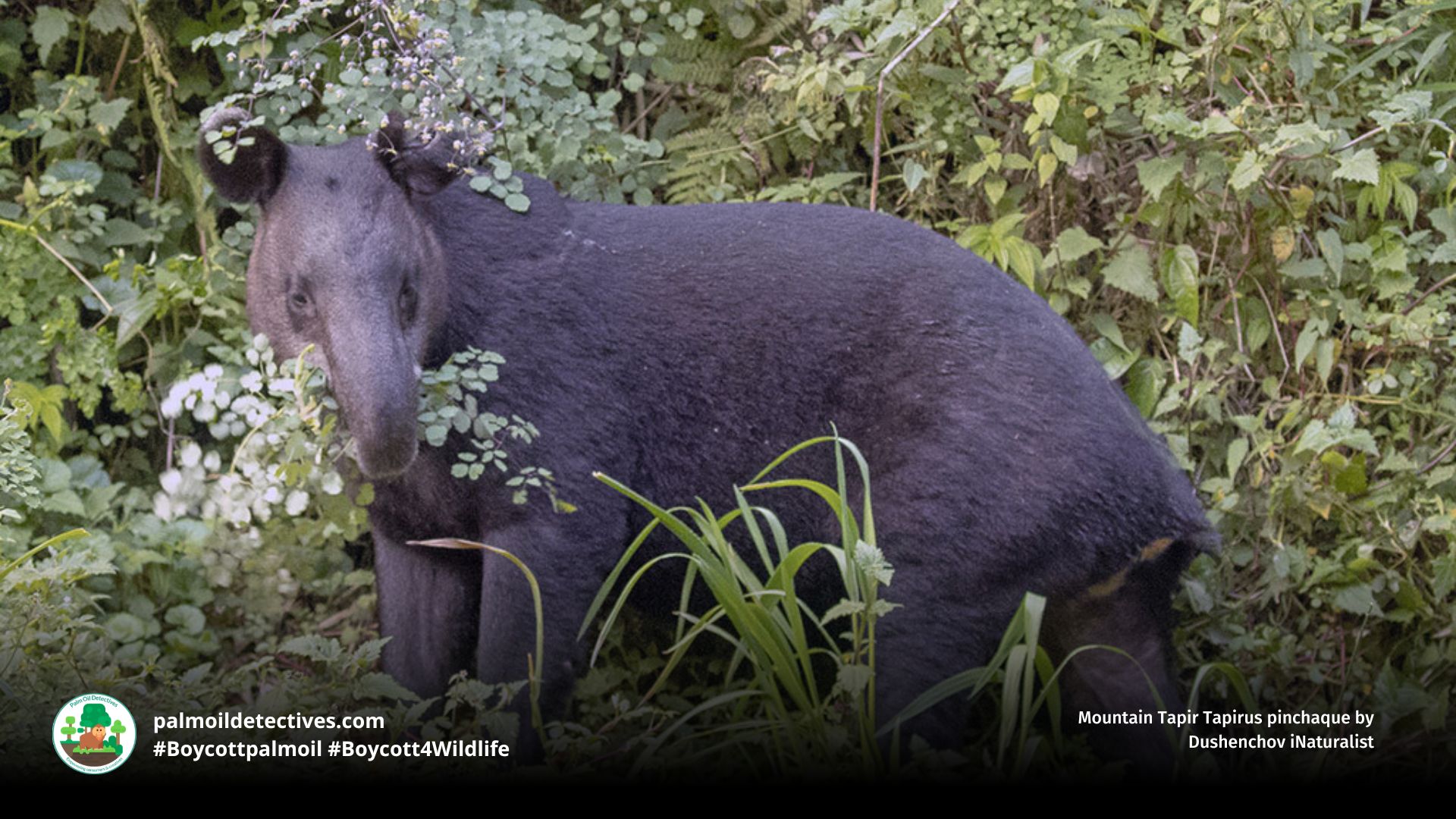
Also known as the woolly tapir for their thick, dark, shaggy coat, Mountain Tapirs are built to survive in the cold, damp cloud forests and páramo grasslands. Their dense fur, white lips, and prehensile snout give them an almost prehistoric appearance. These solitary and elusive mammals are primarily nocturnal and crepuscular, navigating dense foliage with ease. Once thought to be loners, long-term studies in Ecuador have revealed that they form small, close-knit family groups, with calves gradually dispersing over several years (Castellanos et al., 2022).

Threats
Deforestation for palm oil, meat agriculture and illicit opium/coca cultivation
Large swathes of Andean cloud forest and páramo are being cleared to make way for palm oil agricultural expansion, cattle grazing, and opium or coca cultivation. These activities are not only destroying core habitat but also breaking up previously connected populations, leaving tapirs isolated and vulnerable to local extinctions. The introduction of cattle into remote tapir refuges has become increasingly common, even inside designated national parks such as Sangay in Ecuador. This leads to trampling of sensitive vegetation, direct competition for food, and destruction of the unique montane ecosystems that Mountain Tapirs rely on for survival.

Illegal hunting for meat, traditional medicine, and cultural uses
Although hunting pressure has declined slightly in Ecuador due to greater public awareness, it remains severe in Colombia and Peru. Tapirs are killed for their meat, and their skins are used to make traditional tools, horse gear, carpets, and bed covers. Additionally, body parts are sold in local markets or prescribed by shamans for use in traditional medicine. In many remote areas, Mountain Tapirs are still being actively poached, and it is now rare to find populations that are not affected by some form of overhunting.
Gold mining and illegal mining causing deforestation and poisoning of ecosystems
Gold mining projects in the northern Peruvian Andes and central Colombia are rapidly destroying the last cloud forest headwaters and páramo ecosystems where tapirs persist. Both legal and illegal mining operations contaminate streams and watersheds with heavy metals and toxic runoff, which has severe consequences for both tapirs and the human communities downstream. Mining also brings roads, noise, and human settlements into previously inaccessible areas, increasing hunting pressure and reducing available habitat. In some parts of Peru, nearly 30% of the Mountain Tapir’s current range now overlaps with active or planned gold mining concessions (More et al., 2022).
Climate change pushing tapirs further uphill into shrinking habitat
As global temperatures rise, the high-elevation ecosystems where Mountain Tapirs live are shrinking. Suitable climate zones are shifting higher up the mountains, but because mountains have limited space at the top, this forces tapirs into ever smaller areas with fewer food resources. This phenomenon, known as “the escalator to extinction,” is especially dangerous for highland species like the Mountain Tapir, who cannot move downward into warmer zones. Climate change also alters rainfall patterns and vegetation cycles, further straining the species’ delicate habitat requirements.
Road construction and vehicle collisions within protected areas
Infrastructure development is rapidly cutting through mountainous areas, including roads that bisect national parks and reserves. This not only fragments tapir habitat but also leads to direct deaths through vehicle collisions. Once roads are completed, traffic speeds increase and tapirs crossing roads—especially at dawn and dusk—become highly vulnerable. Roads also make previously remote areas more accessible to poachers, settlers, and resource extractors, while local governments often lack sufficient ranger staff to monitor and protect these newly exposed areas.
Fumigation campaigns using toxic chemicals to eradicate drug crops
In Colombia, the government authorises aerial fumigation of coca and poppy fields using glyphosate-based herbicides like Round-Up. These chemicals are sprayed over wide areas, including forests and National Parks, contaminating soil, plants, and water sources. Mountain Tapirs can absorb these toxins through skin contact or ingestion, potentially leading to illness, reproductive failure, or death. Fumigation also destroys native plants that tapirs rely on for food, further decreasing habitat quality in affected areas.
Widespread introduction of cattle and the threat of disease transmission
Domestic cattle are increasingly being introduced into mountain tapir habitat, especially within protected areas where enforcement is weak. These animals not only compete with tapirs for forage but also carry diseases such as bovine tuberculosis and foot-and-mouth disease. Disease outbreaks have already been documented among tapirs in other parts of Latin America and pose a serious threat to small, isolated populations. In the Andes, cattle often form feral herds that reproduce and spread deep into cloud forests, further eroding habitat integrity and increasing the risk of tapir extinction.
Weak enforcement of environmental laws and lack of large protected areas in Peru
Although some Mountain Tapir habitat falls within designated protected areas, law enforcement in Peru is generally under-resourced and poorly coordinated. Rangers are too few to patrol vast mountainous regions effectively, and illegal activities such as mining, logging, and hunting continue within protected boundaries. Furthermore, most reserves are too small or fragmented to support viable tapir populations over the long term. Without stronger policies, larger protected zones, and meaningful binational cooperation with Ecuador and Colombia, tapirs in Peru face an uncertain future.
Low reproductive rate and slow population recovery
Mountain Tapirs have a long gestation period of around 13 months and typically produce only one calf at a time, meaning population growth is inherently slow. When combined with high mortality from hunting, roadkill, and disease, their populations cannot recover quickly from losses. Calves stay with their mothers for extended periods, further limiting reproductive output. This slow life cycle makes the species particularly vulnerable to sudden or sustained threats across their fragmented range.
Geographic Range
This species is found in the high Andes of Colombia, Ecuador, and northernmost Peru. In Colombia, they are present in the Central and Eastern Cordilleras but are absent from the Western Cordillera and Sierra Nevada de Santa Marta. In Ecuador, they range from the central Andes down through Sangay National Park to Podocarpus, with new records emerging from previously unconnected areas in the western Andes. In Peru, they occur north and south of the Huancabamba River in Cajamarca and Lambayeque (More et al., 2022). The total range in Peru is estimated at 183,000 hectares, but mining concessions cover nearly 30% of this habitat.
Diet
Mountain Tapirs are browsers, feeding on a wide variety of vegetation including leaves, shoots, fruits, and bromeliads. Their diet varies depending on the availability of plants within their high-altitude habitats, playing an important role as seed dispersers within these fragile ecosystems.
Mating and Reproduction
Mountain Tapirs have a slow reproductive rate, with a gestation period of approximately 13 months. Females typically give birth to a single calf, which stays with them for several months or even years before dispersing. Calves are born with white stripes and spots that fade as they mature. Their slow breeding cycle makes it difficult for populations to recover from hunting and habitat loss.
FAQs
How many Mountain Tapirs are left in the wild?
Fewer than 2,500 mature individuals remain in the wild, and the population is continuing to decline by at least 20% every two decades due to ongoing threats like habitat destruction, hunting, and climate change (IUCN, 2015).
What is the average lifespan of a Mountain Tapir?
In the wild, Mountain Tapirs may live up to 25 years, though this is significantly affected by environmental threats. Captive individuals can live slightly longer under safe and controlled conditions.
What are the biggest challenges to conserving Mountain Tapirs?
Major challenges include habitat fragmentation due to road construction, agriculture, and mining; the presence of armed conflict zones that hinder research and protection; and the slow reproduction rate of the species, which makes population recovery difficult (Guzmán-Valencia et al., 2024; More et al., 2022).
Do Mountain Tapirs make good pets?
No. Keeping a Mountain Tapir as a pet is unethical and illegal. These intelligent, solitary animals require large, wild habitats to survive. Capturing and trading them causes immense suffering and drives the species further toward extinction. Advocating against the exotic pet trade is vital to their survival.
Take Action!
Boycott palm oil and products linked to Andean deforestation. Support indigenous-led conservation and agroecology initiatives in the Andes. Call for stronger protections against mining and deforestation in Colombia, Ecuador, and Peru. Refuse to buy exotic animal products, including those used in folk medicine. #BoycottPalmOil #Boycott4Wildlife #Vegan #BoycottMeat
Support Mountain Tapirs by going vegan and boycotting palm oil in the supermarket, it’s the #Boycott4Wildlife
Support the conservation of this species
This animal has no protections in place. Read about other forgotten species here. Create art to support this forgotten animal or raise awareness about them by sharing this post and using the #Boycottpalmoil #Boycott4Wildlife hashtags on social media. Also you can boycott palm oil in the supermarket.
Further Information
Castellanos, A., Dadone, L., Ascanta, M., & Pukazhenthi, B. (2022). Andean tapir (Tapirus pinchaque) social groups and calf dispersal patterns in Ecuador. Boletín Técnico, Serie Zoológica, 17, 9–14. Retrieved from https://journal.espe.edu.ec/ojs/index.php/revista-serie-zoologica/article/view/2858
Delborgo Abra, F., Medici, P., Brenes-Mora, E., & Castelhanos, A. (2024). The Impact of Roads and Traffic on Tapir Species. In Tapirs of the World (pp. 157–165). Springer. https://doi.org/10.1007/978-3-031-65311-7_10
Guzmán-Valencia, C., Castrillón, L., Roncancio Duque, N., & Márquez, R. (2024). Co-Occurrence, Occupancy and Habitat Use of the Andean Bear and Mountain Tapir: Insights for Conservation Management in the Colombian Andes. SSRN. https://doi.org/10.2139/ssrn.5061561
Lizcano, D.J., Amanzo, J., Castellanos, A., Tapia, A. & Lopez-Malaga, C.M. 2016. Tapirus pinchaque. The IUCN Red List of Threatened Species 2016: e.T21473A45173922. https://dx.doi.org/10.2305/IUCN.UK.2016-1.RLTS.T21473A45173922.en. Accessed on 06 April 2025.
More, A., Devenish, C., Carrillo-Tavara, K., Piana, R. P., Lopez-Malaga, C., Vega-Guarderas, Z., & Nuñez-Cortez, E. (2022). Distribution and conservation status of the mountain tapir (Tapirus pinchaque) in Peru. Journal for Nature Conservation, 66, 126130. https://doi.org/10.1016/j.jnc.2022.126130

How can I help the #Boycott4Wildlife?
Take Action in Five Ways
1. Join the #Boycott4Wildlife on social media and subscribe to stay in the loop: Share posts from this website to your own network on Twitter, Mastadon, Instagram, Facebook and Youtube using the hashtags #Boycottpalmoil #Boycott4Wildlife.
Enter your email address
Sign Up
Join 3,174 other subscribers2. Contribute stories: Academics, conservationists, scientists, indigenous rights advocates and animal rights advocates working to expose the corruption of the palm oil industry or to save animals can contribute stories to the website.
Wildlife Artist Juanchi Pérez
Mel Lumby: Dedicated Devotee to Borneo’s Living Beings
Anthropologist and Author Dr Sophie Chao
Health Physician Dr Evan Allen
The World’s Most Loved Cup: A Social, Ethical & Environmental History of Coffee by Aviary Doert
How do we stop the world’s ecosystems from going into a death spiral? A #SteadyState Economy
3. Supermarket sleuthing: Next time you’re in the supermarket, take photos of products containing palm oil. Share these to social media along with the hashtags to call out the greenwashing and ecocide of the brands who use palm oil. You can also take photos of palm oil free products and congratulate brands when they go palm oil free.
https://twitter.com/CuriousApe4/status/1526136783557529600?s=20
https://twitter.com/PhillDixon1/status/1749010345555788144?s=20
https://twitter.com/mugabe139/status/1678027567977078784?s=20
4. Take to the streets: Get in touch with Palm Oil Detectives to find out more.
5. Donate: Make a one-off or monthly donation to Palm Oil Detectives as a way of saying thank you and to help pay for ongoing running costs of the website and social media campaigns. Donate here
Pledge your supportLearn about other animals endangered by palm oil and other agriculture
GlobalSouth America S.E. AsiaIndiaAfricaWest Papua & PNGSaola Pseudoryx nghetinhensis
Tucuxi Sotalia fluviatilis

Frill-Necked Lizard Chlamydosaurus kingii

Grey Crowned Crane Balearica regulorum

Ecuadorean Viscacha Lagidium ahuacaense

Southern Pudu Pudu puda
Learn about “sustainable” palm oil greenwashing
Read more about RSPO greenwashing
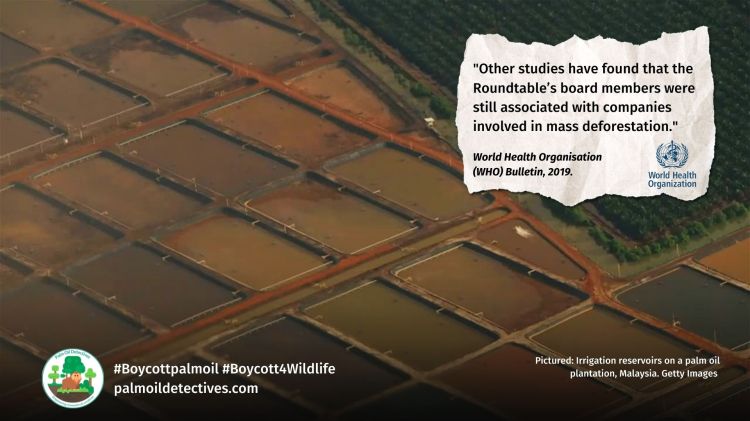
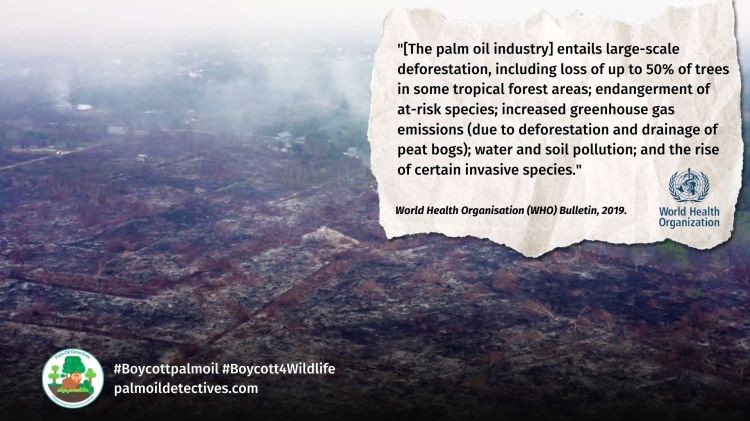
Lying Fake labelsIndigenous Land-grabbingHuman rights abusesDeforestation Human health hazardsA 2019 World Health Organisation (WHO) report into the palm oil industry and RSPO finds extensive greenwashing of palm oil deforestation and the murder of endangered animals (i.e. biodiversity loss)
Read more

#animals #Bantrophyhunting #Boycott4wildlife #BoycottGold #BoycottMeat #BoycottPalmOil #cattle #climateChange #climatechange #Colombia #deforestation #Ecuador #endangered #EndangeredSpecies #ForgottenAnimals #gold #herbivore #herbivores #hunting #infrastructure #lowlandTapir #Mammal #mammals #mining #PalmOil #palmOilDeforestation #palmoil #Peru #poaching #pollution #Tapir #Tapirs #ungulate #ungulates #vegan
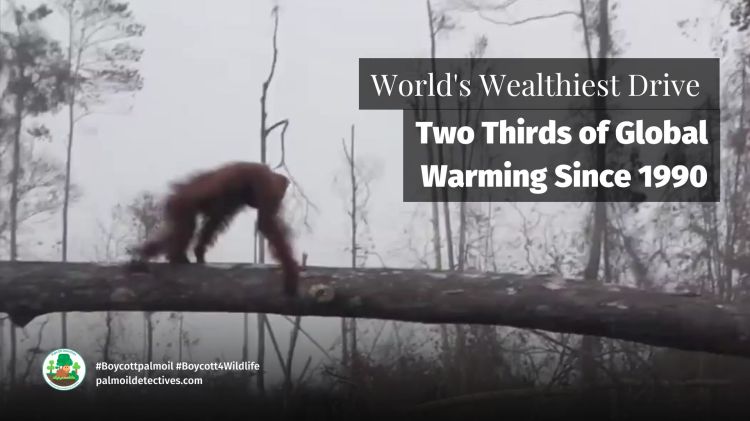
World’s Wealthiest Drive Two Thirds of Global Warming Since 1990
A study examining the wealthiest people in the USA and China reveals that the world’s richest 10% are responsible for two-thirds of global warming since 1990. Their consumption and investments disproportionately fuel climate extremes, especially in vulnerable regions like the Amazon and Southeast Asia. According to the lead author of the study: “If everyone had emitted like the bottom 50% of the global population, the world would have seen minimal additional warming since 1990”. This underscores the urgent need to examine the lifestyle choices and investments of the world’s richest people and for robust climate policies targeting the world’s most powerful in order to achieve true #ClimateJustice #ClimateActionNow
#Study finds top 10% of wealthiest people in #USA and #China cause two thirds of #GHG emissions. Robust #climate policies urgently and a #wealthtax needed to counteract pure #greed 💰🧐🤑 🤮#ClimateActionNow 🏭🛢️ #BoycottPalmOil #Boycott4Wildlife https://palmoildetectives.com/2026/01/07/worlds-wealthiest-have-driven-two-thirds-of-global-warming-since-1990/
Share to BlueSkyShare to TwitterInternational Institute for Applied Systems Analysis. (2025, May 7). The world’s wealthiest 10% caused two thirds of global warming since 1990. ScienceDaily. https://www.sciencedaily.com/releases/2025/05/250507130519.htm
A groundbreaking study published in Nature Climate Change has found that the world’s wealthiest 10% are responsible for two-thirds of global warming since 1990. The research, conducted by the International Institute for Applied Systems Analysis (IIASA), highlights the disproportionate impact of affluent individuals’ consumption and investments on climate change.
The study reveals that the top 1% of earners globally have contributed 26 times more to increases in extreme heat events and 17 times more to Amazon droughts compared to the global average. These findings underscore the significant role that high-income individuals play in driving climate extremes, particularly in vulnerable regions such as the Amazon, Southeast Asia, and southern Africa.
Lead author Sarah Schöngart, associated with ETH Zurich, emphasizes that lifestyle and investment choices linked to wealth are major contributors to climate impacts. “Our study shows that extreme climate impacts are not just the result of abstract global emissions; instead, we can directly link them to our lifestyle and investment choices,” she stated.

The research utilised a novel modeling framework combining economic data and climate simulations to trace emissions from different global income groups. It found that emissions from the wealthiest 10% in countries like the United States and China led to a two- to threefold increase in heat extremes across vulnerable regions.
The researchers were able to trace emissions from different global income groups and assess their contributions to specific climate extremes.
They found that emissions from the wealthiest 10% of individuals in the United States and China alone, each led to a two-to threefold increase in heat extremes across vulnerable regions.
“If everyone had emitted like the bottom 50% of the global population, the world would have seen minimal additional warming since 1990,” says coauthor Carl-Friedrich Schleussner, who leads the Integrated Climate Impacts Research Group at IIASA. “Addressing this imbalance is crucial for fair and effective climate action.”
He advocates for climate policies that address the outsize responsibilities of the wealthiest members of society to effectively reduce future harm.
The study also highlights the importance of targeting emissions embedded in financial investments, not just personal consumption. By focusing on the financial flows and portfolios of high-income individuals, substantial climate benefits can be achieved.
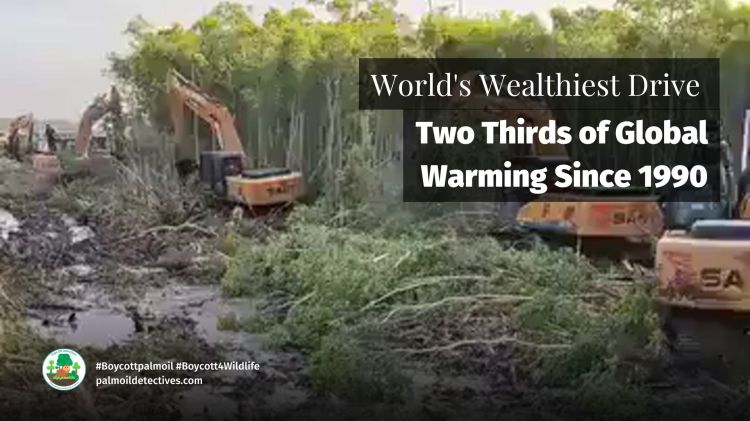
This research provides compelling evidence for the need to implement progressive climate policies that hold the wealthiest accountable for their disproportionate contributions to global warming. Such measures are essential for achieving climate justice and mitigating the impacts of climate change on the most vulnerable populations.
International Institute for Applied Systems Analysis. (2025, May 7). The world’s wealthiest 10% caused two thirds of global warming since 1990. ScienceDaily. https://www.sciencedaily.com/releases/2025/05/250507130519.htm
ENDS
Read more about deforestation and ecocide in the palm oil industry
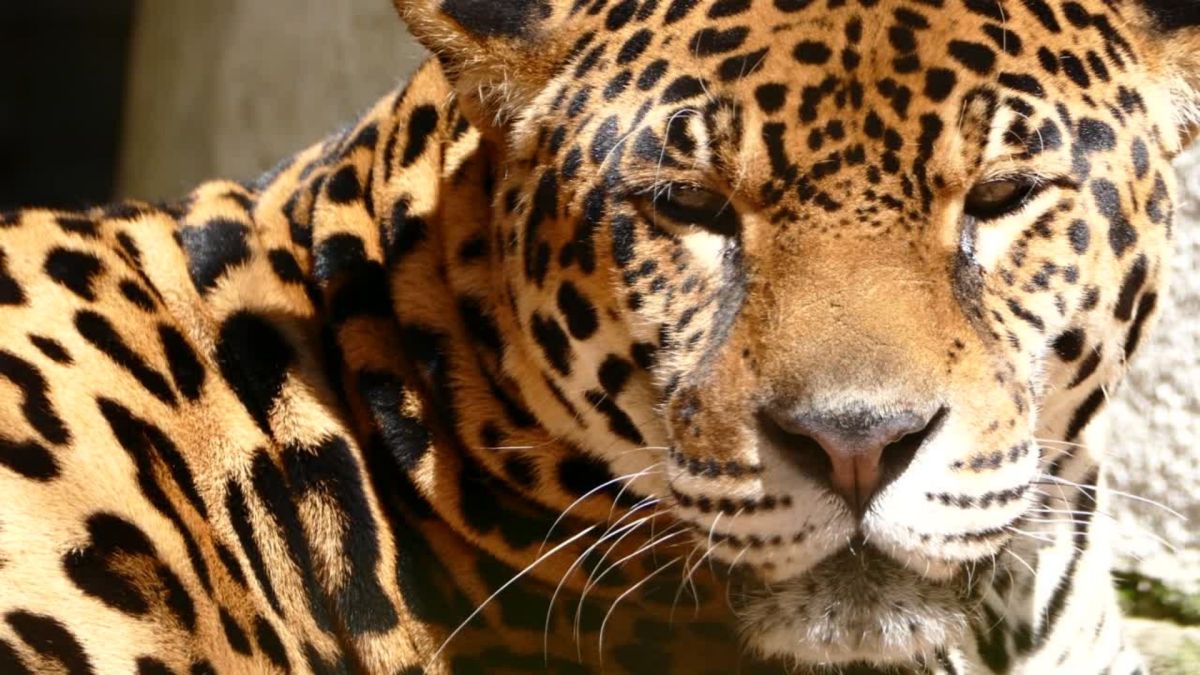
Jaguars and Pumas Eat More Monkeys in Damaged Forests
In fragmented forests of Mexico, big cats find it hard to locate prey ungulates instead seeking tree-dwelling #monkeys – that’s bad news for primates!
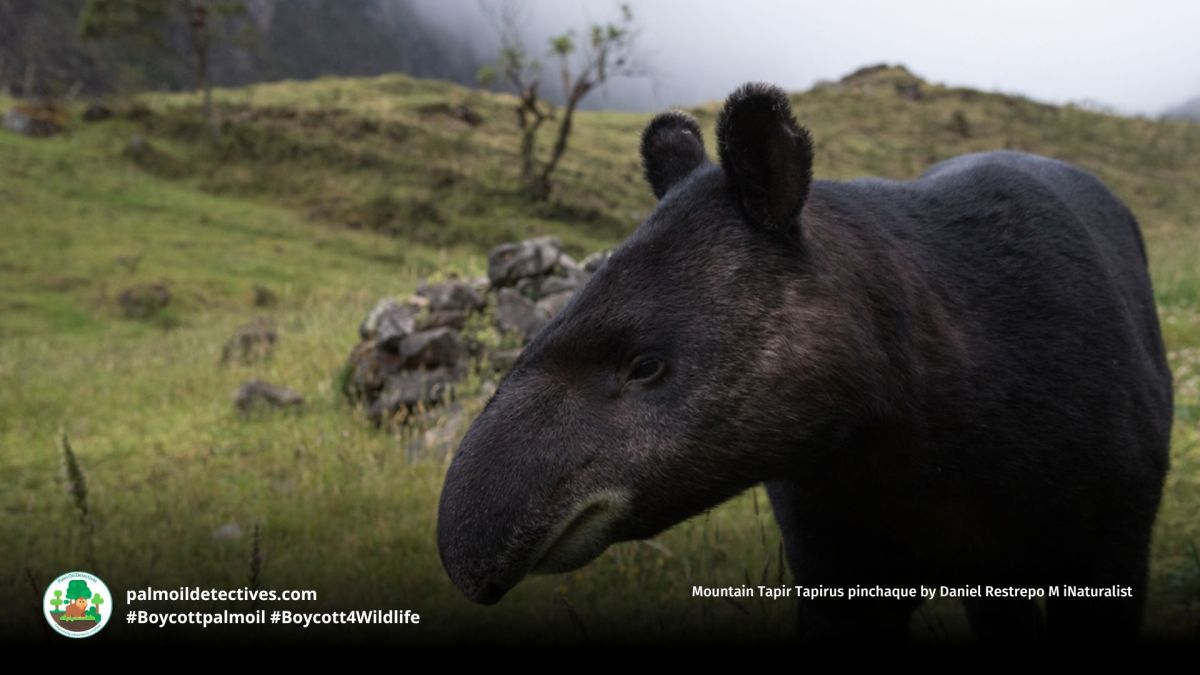
Mountain Tapir Tapirus pinchaque
Mountain Tapirs are the most threatened large mammals of the northern Andes, hunting, climate change and mining are threats, take action and boycott gold!
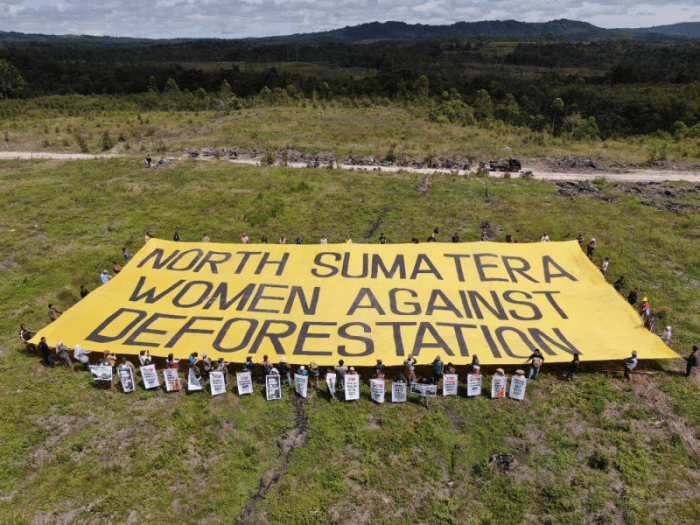
Seeing Forest As Merely A Carbon “Commodity”: Dangerous Greenwashing
Commodifying forests as merely an investment for ‘carbon credits’ has many dangerous loopholes that human rights to indigenous peoples, take action!
Finance giants fuel $8.9 trillion deforestation economy
Forest 500 report shows 150 of the world’s largest financial institutions invested nearly $9 trillion in deforestation-linked industries. Support EUDR!
Saola Pseudoryx nghetinhensis
Saolas are rare and considered Southeast Asia’s ‘unicorns’, this Critically Endangered antelope is facing imminent extinction due to hunting and deforestation
Load more posts
Something went wrong. Please refresh the page and/or try again.
Take Action in Five Ways
1. Join the #Boycott4Wildlife on social media and subscribe to stay in the loop: Share posts from this website to your own network on Twitter, Mastadon, Instagram, Facebook and Youtube using the hashtags #Boycottpalmoil #Boycott4Wildlife.
Enter your email address
Sign Up
Join 3,174 other subscribers2. Contribute stories: Academics, conservationists, scientists, indigenous rights advocates and animal rights advocates working to expose the corruption of the palm oil industry or to save animals can contribute stories to the website.
Wildlife Artist Juanchi Pérez
Mel Lumby: Dedicated Devotee to Borneo’s Living Beings
Anthropologist and Author Dr Sophie Chao
Health Physician Dr Evan Allen
The World’s Most Loved Cup: A Social, Ethical & Environmental History of Coffee by Aviary Doert
How do we stop the world’s ecosystems from going into a death spiral? A #SteadyState Economy
3. Supermarket sleuthing: Next time you’re in the supermarket, take photos of products containing palm oil. Share these to social media along with the hashtags to call out the greenwashing and ecocide of the brands who use palm oil. You can also take photos of palm oil free products and congratulate brands when they go palm oil free.
https://twitter.com/CuriousApe4/status/1526136783557529600?s=20
https://twitter.com/PhillDixon1/status/1749010345555788144?s=20
https://twitter.com/mugabe139/status/1678027567977078784?s=20
4. Take to the streets: Get in touch with Palm Oil Detectives to find out more.
5. Donate: Make a one-off or monthly donation to Palm Oil Detectives as a way of saying thank you and to help pay for ongoing running costs of the website and social media campaigns. Donate here
Pledge your support#BoycottPalmOil #Boycott4wildlife #BoycottGold #BoycottGold4Yanomami #BoycottPalmOil #China #Climate #climateChange #ClimateActionNow #climatecrisis #ClimateEmergency #ClimateJustice #CO2 #consumerRights #corruption #deforestation #ewaste #GHG #gold #greed #investment #News #PalmOil #palmOilBiofuel #palmOilDeforestation #study #USA #wealth #wealthtax
South America: Species Endangered by Palm Oil Deforestation