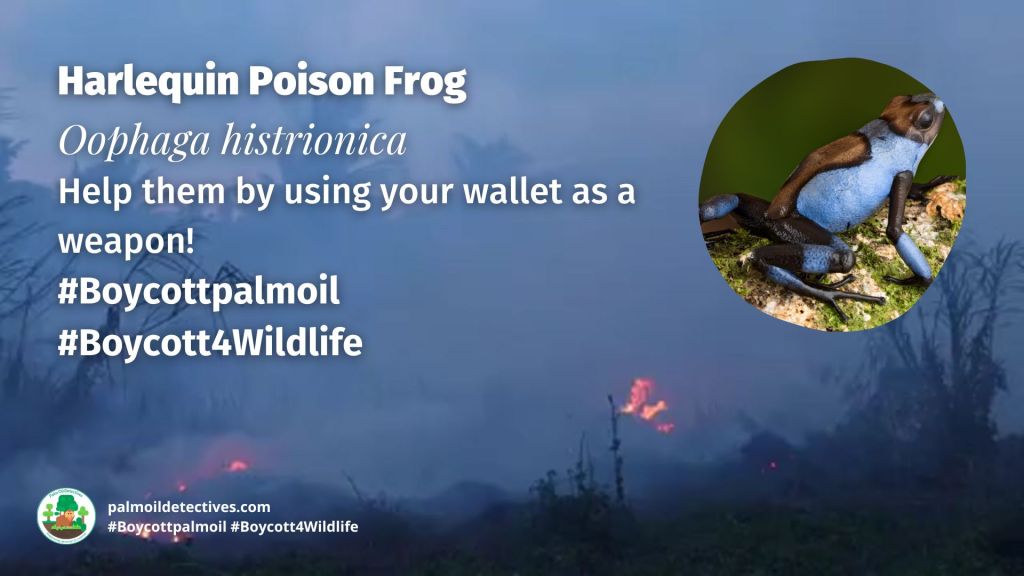
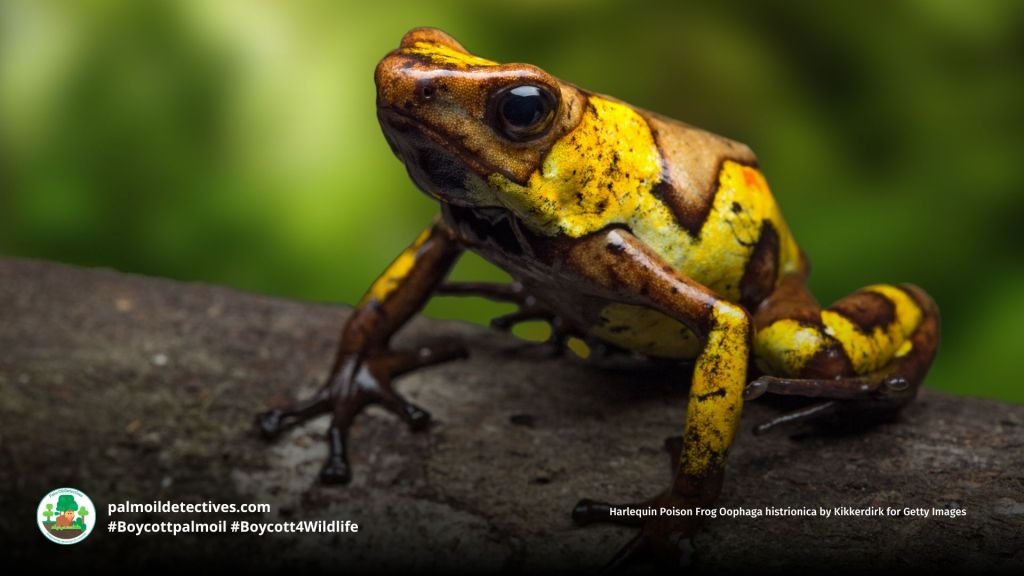
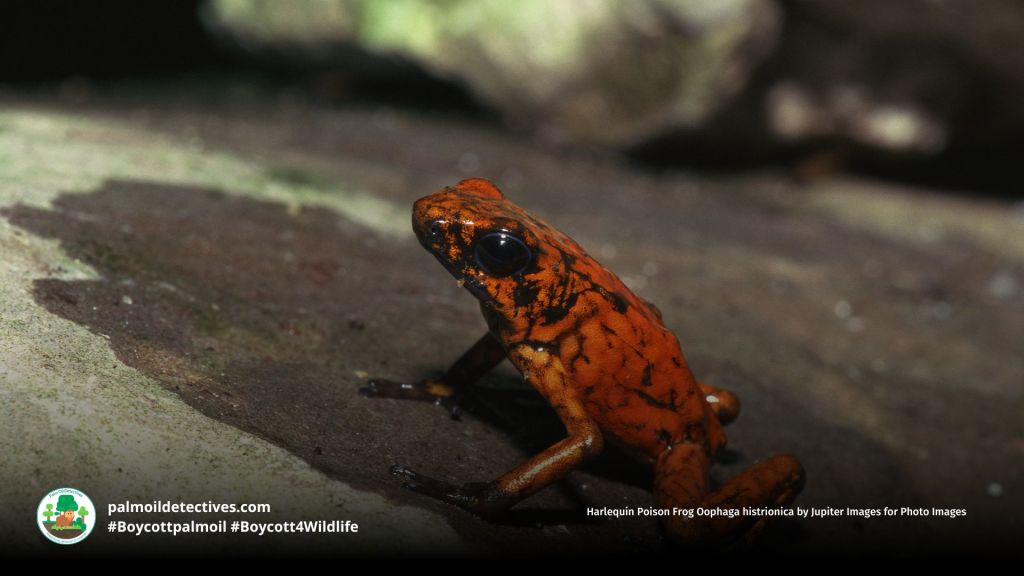
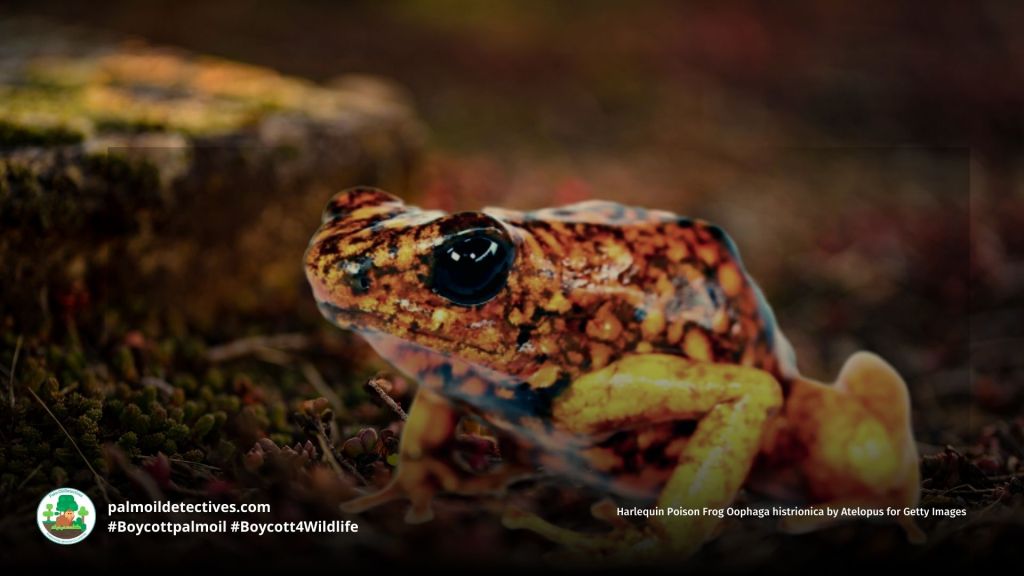
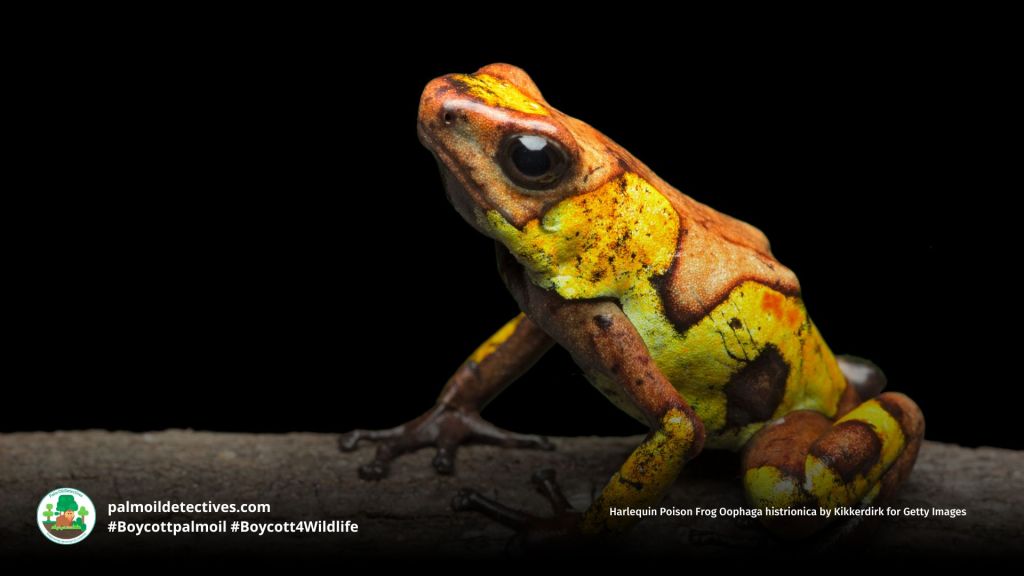
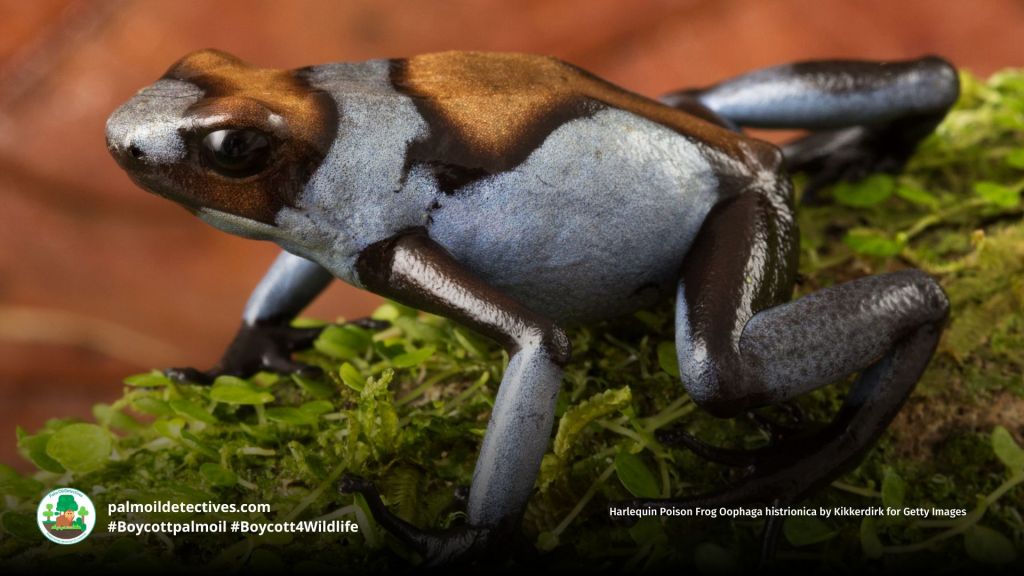
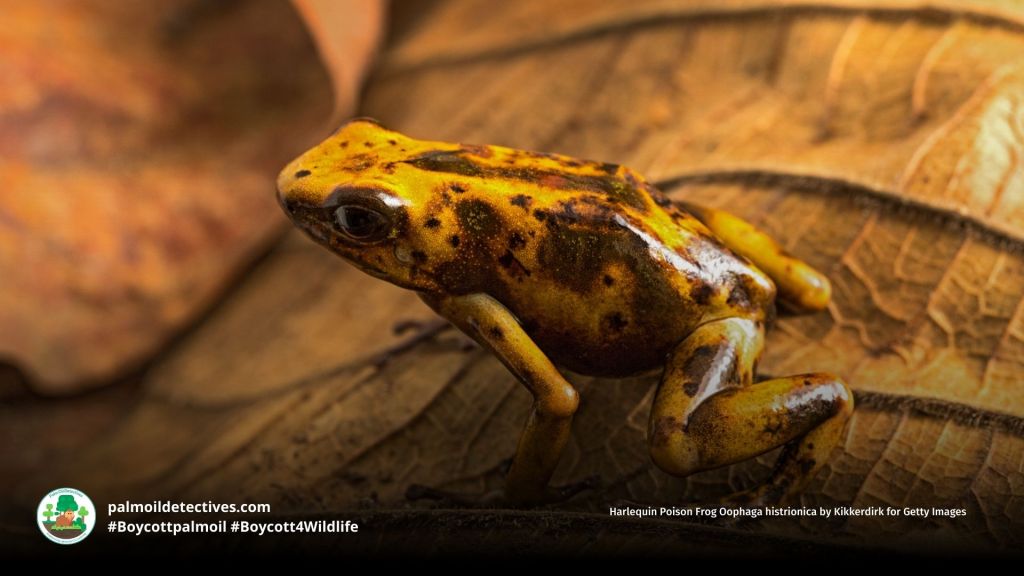
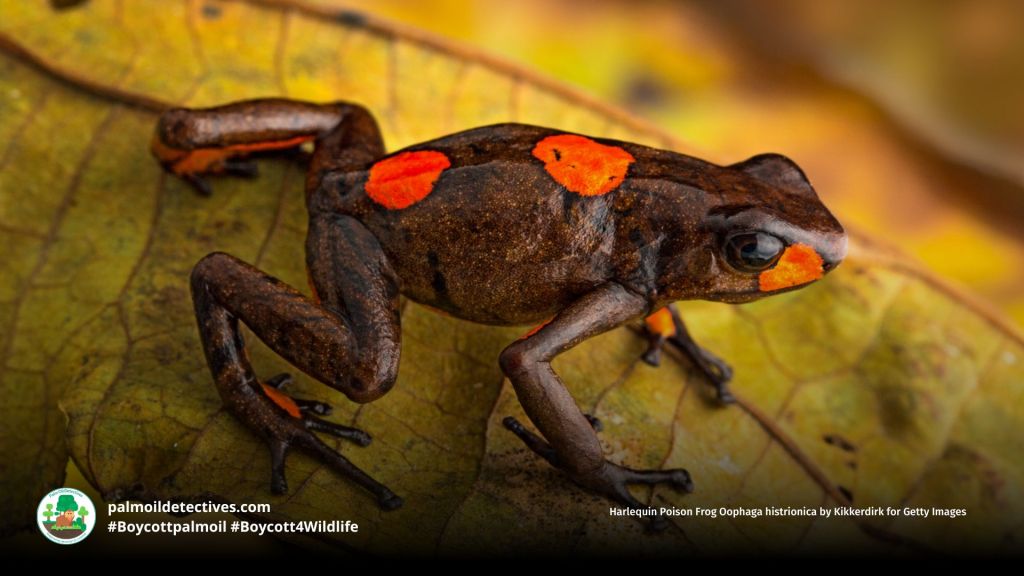
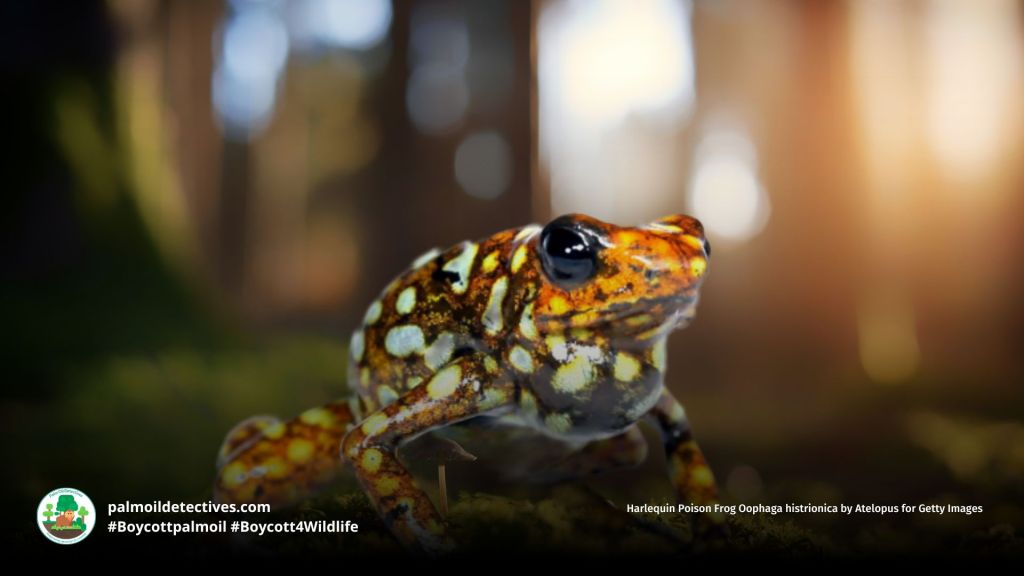
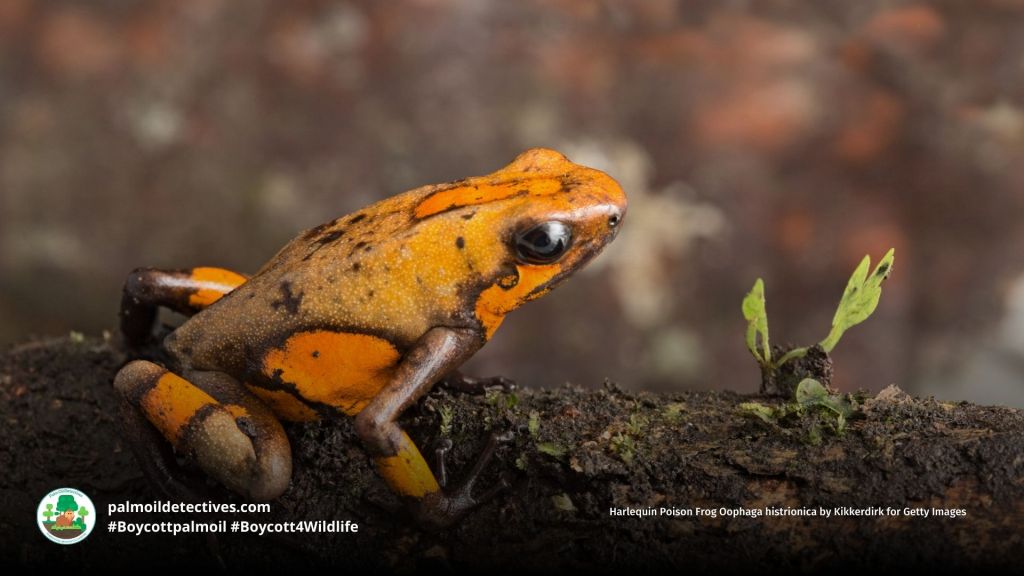
Harlequin Poison Frog Oophaga histrionica

Harlequin Poison Frog Oophaga histrionica

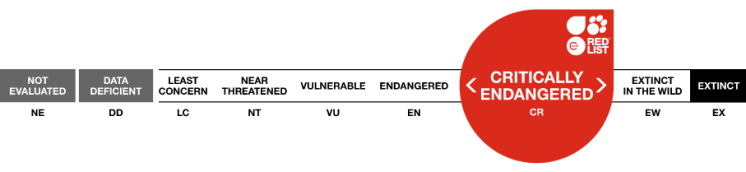
IUCN Status: Critically Endangered (IUCN SSC Amphibian Specialist Group, 2019)

Location: Colombia.
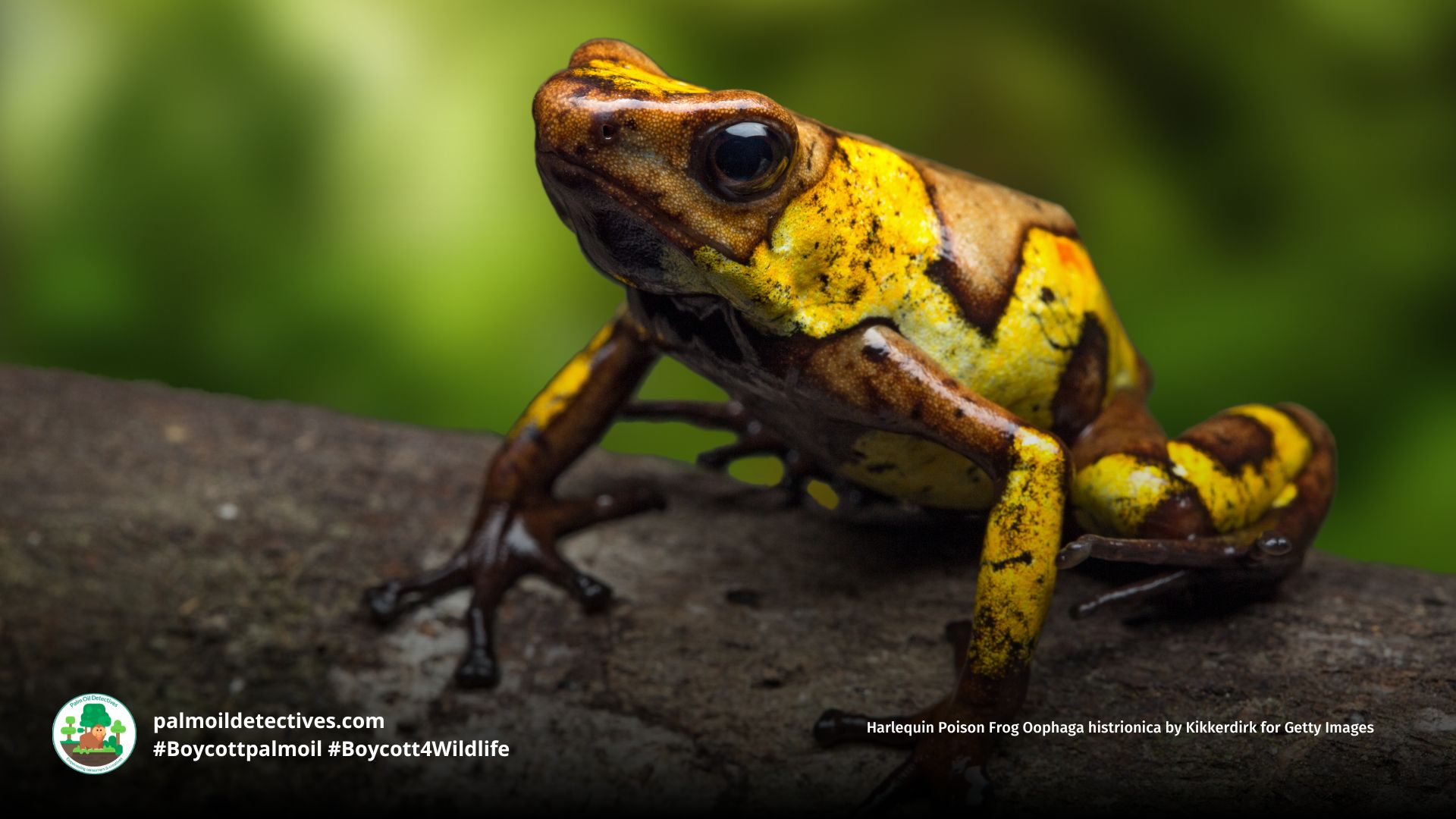
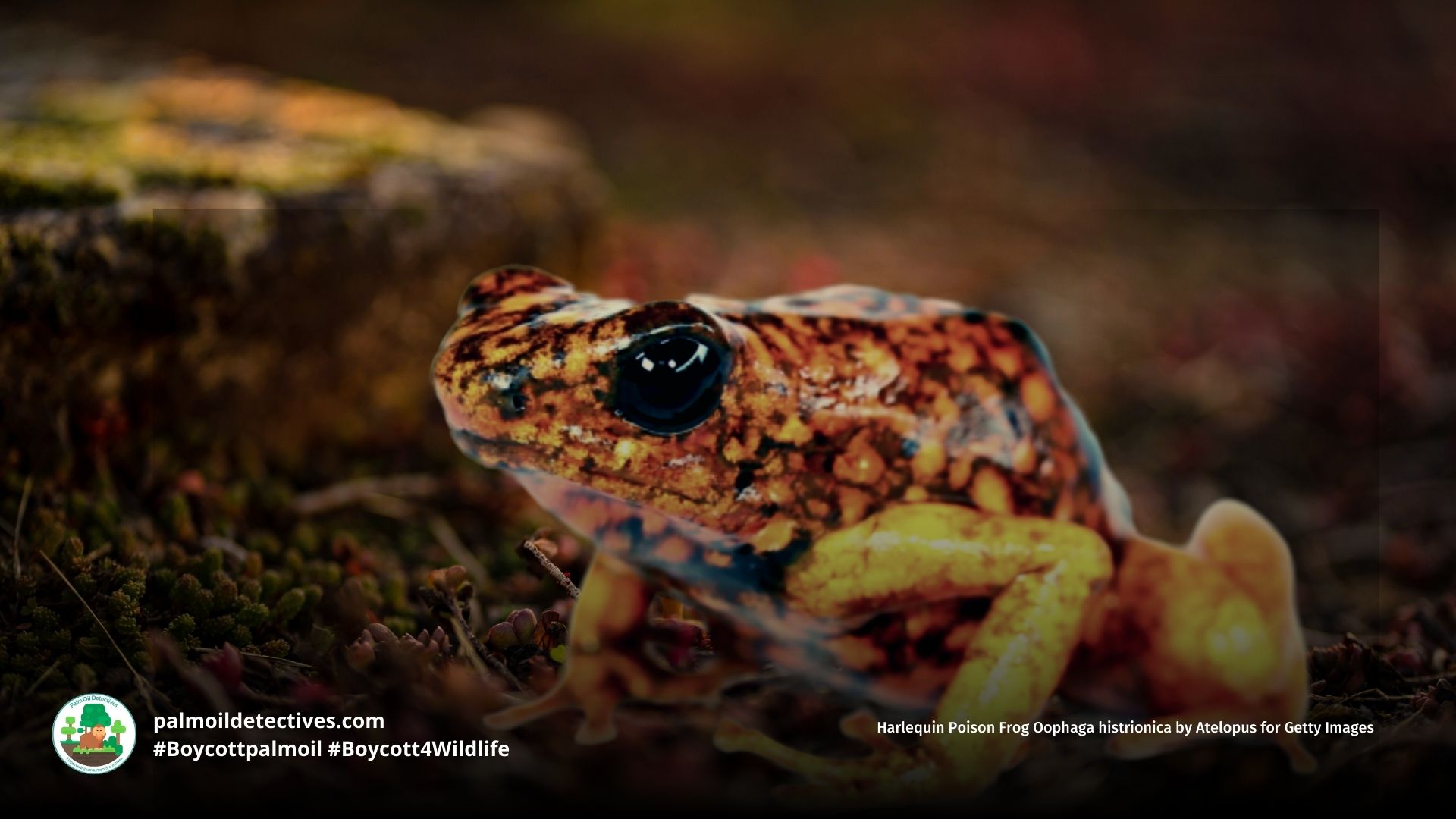
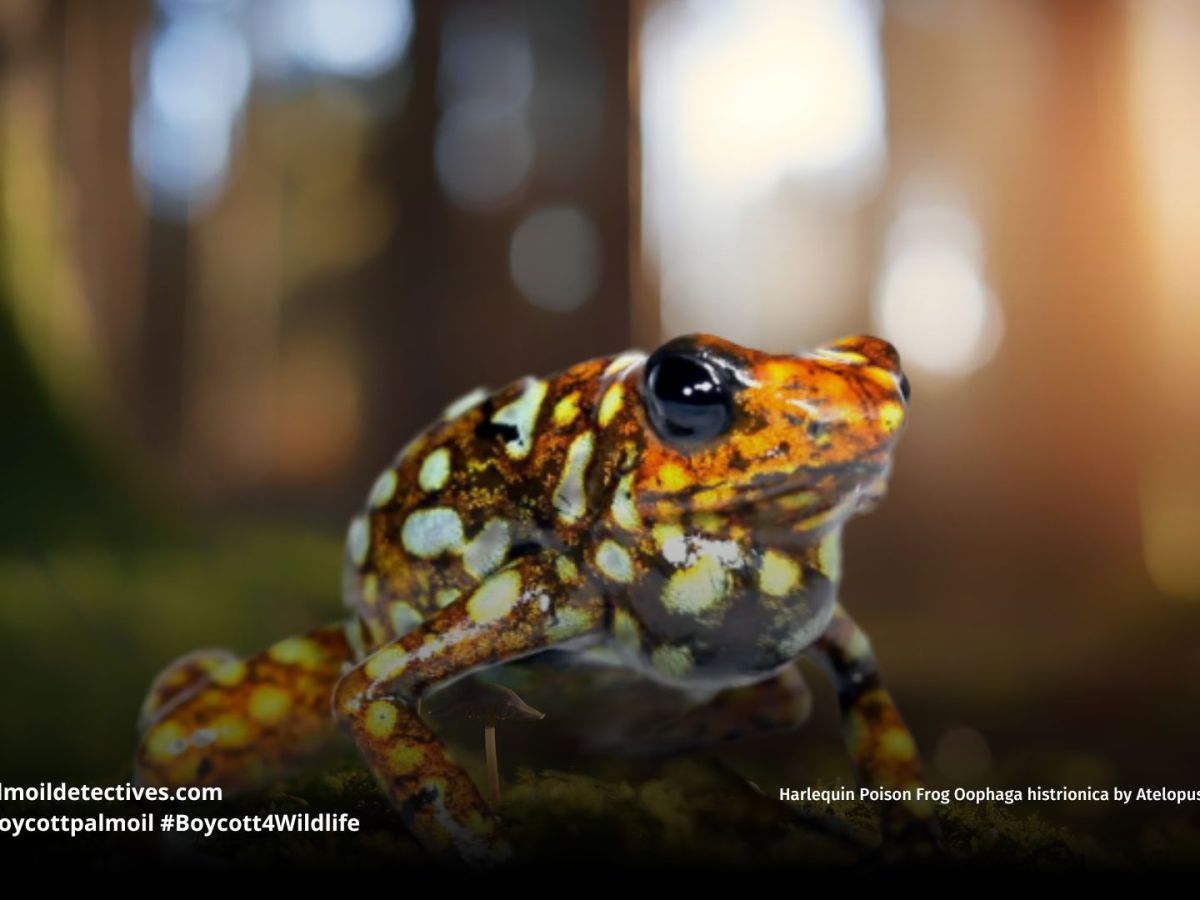
Endemic to the Chocó rainforest of Colombia, the Harlequin Poison Frog (Oophaga histrionica) inhabits humid lowland and foothill forests. These frogs thrive in leaf litter and near small water sources, where they reproduce and communicate using distinct vocalisations.

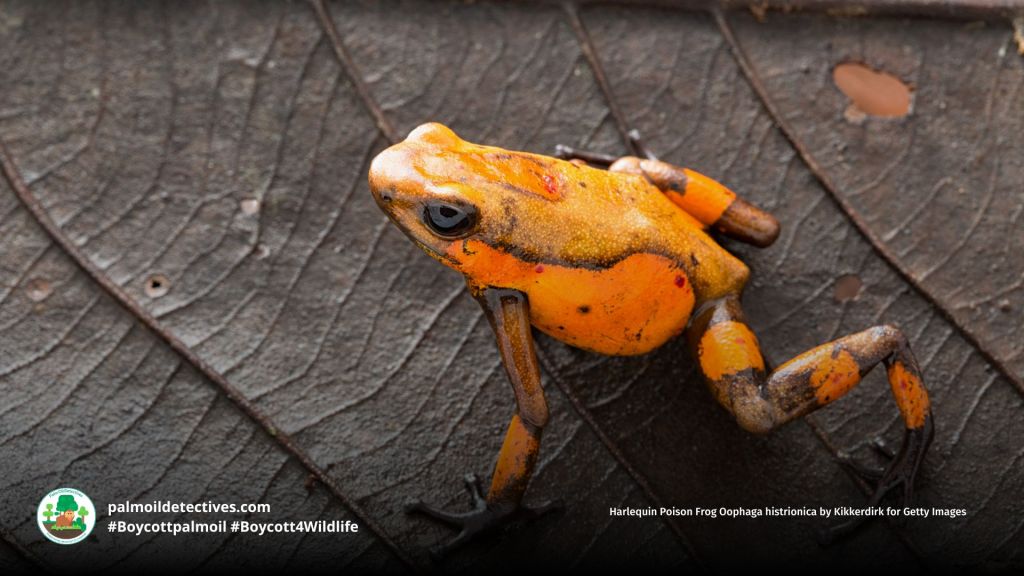
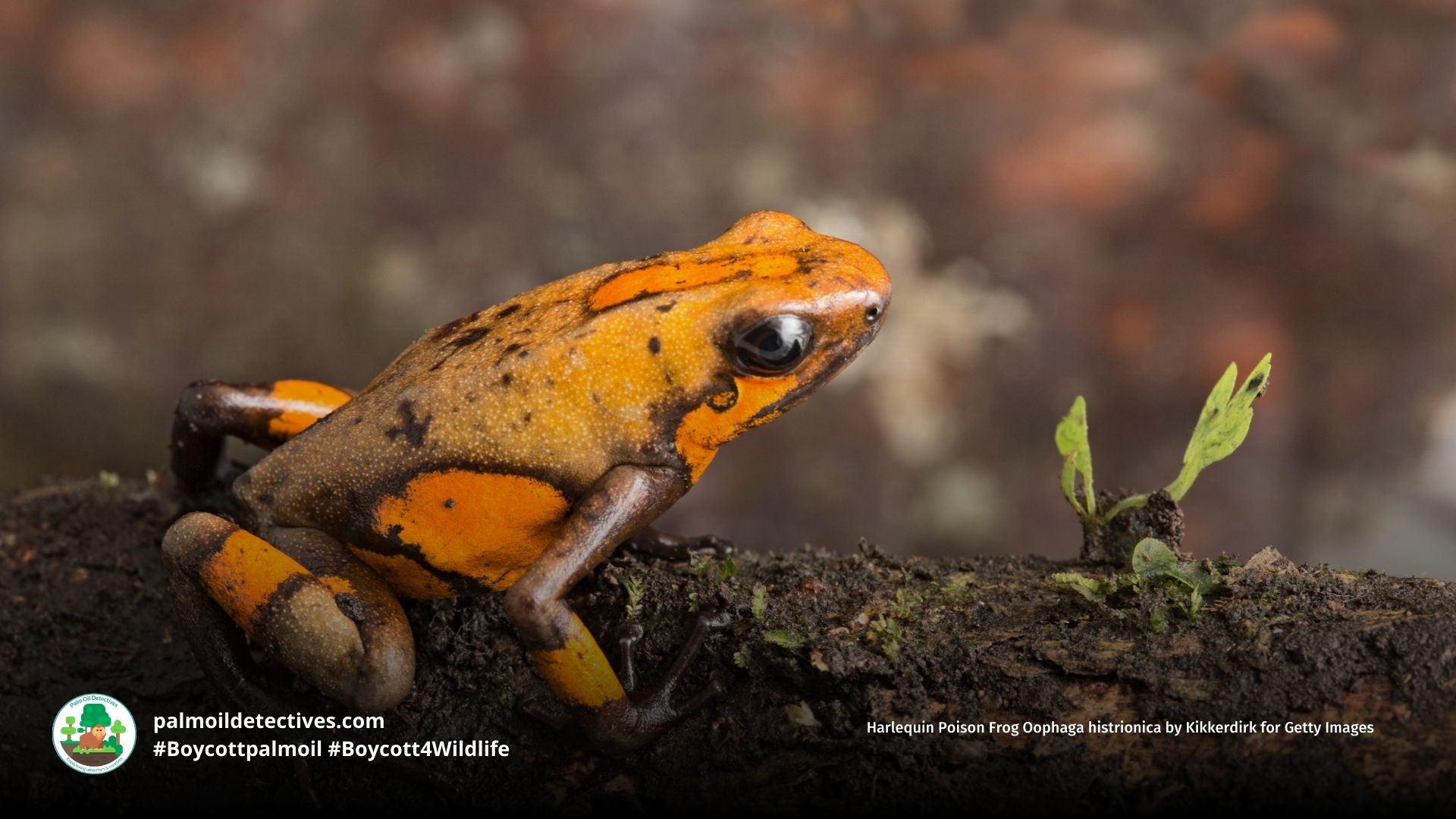
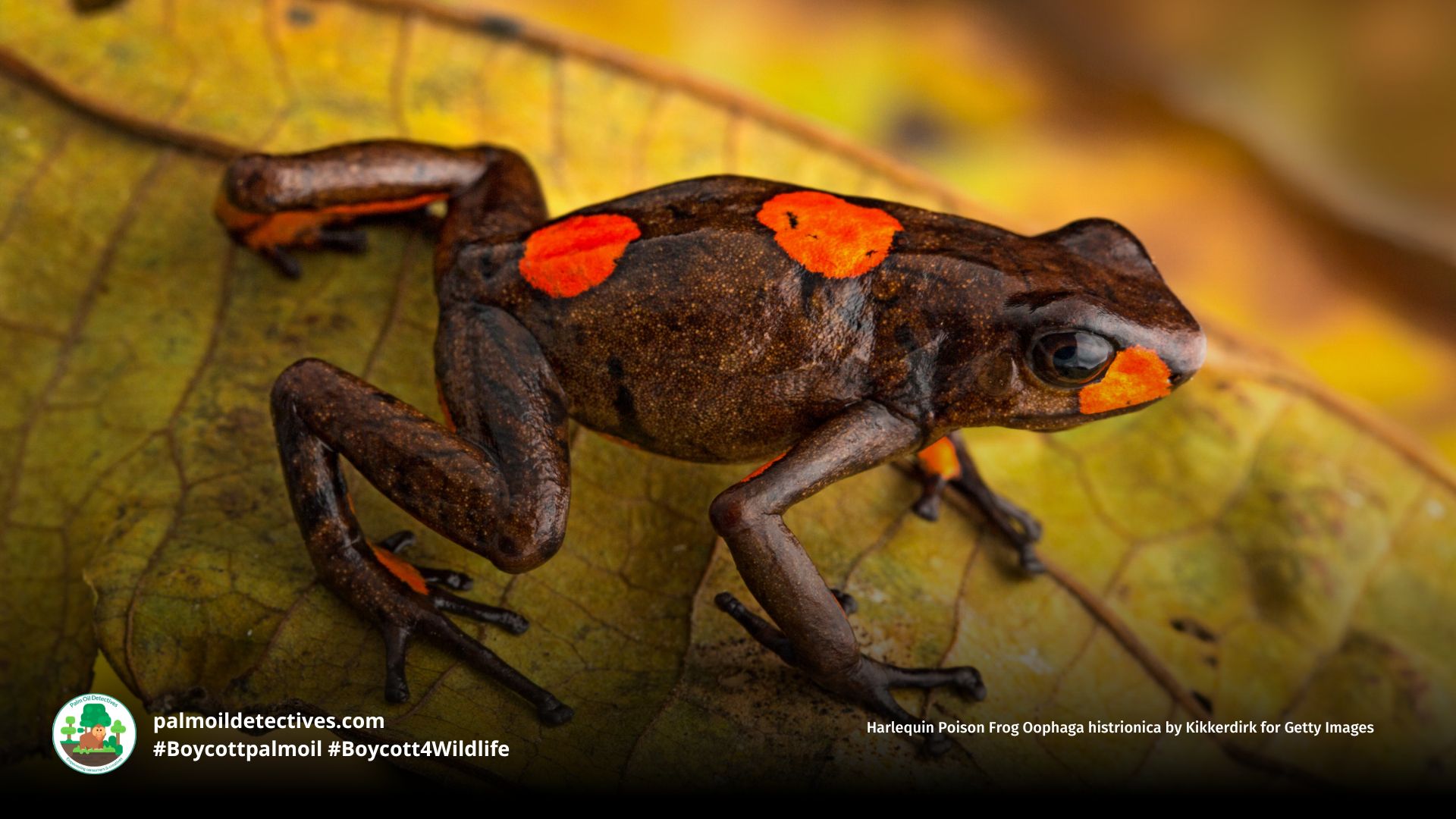
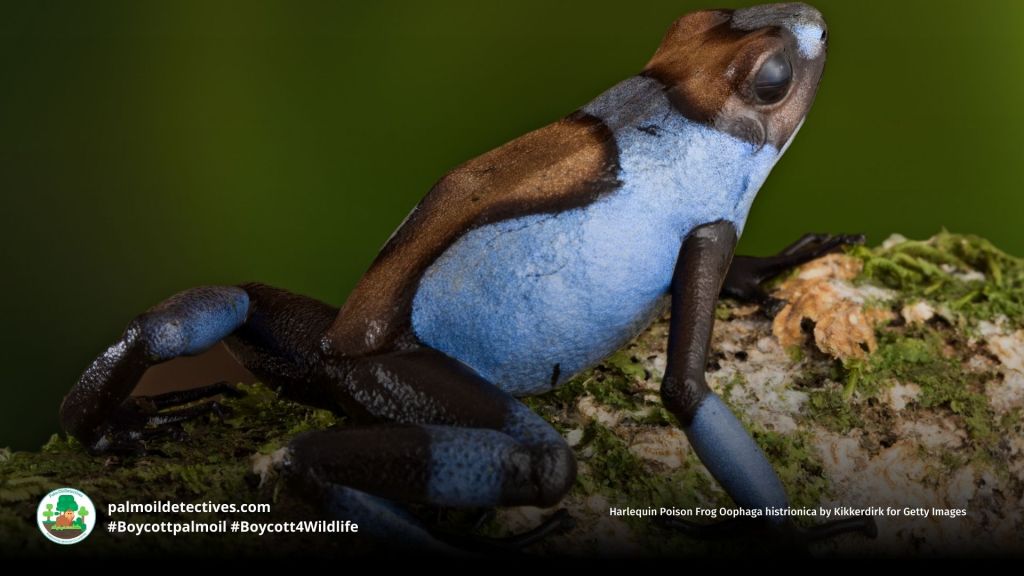
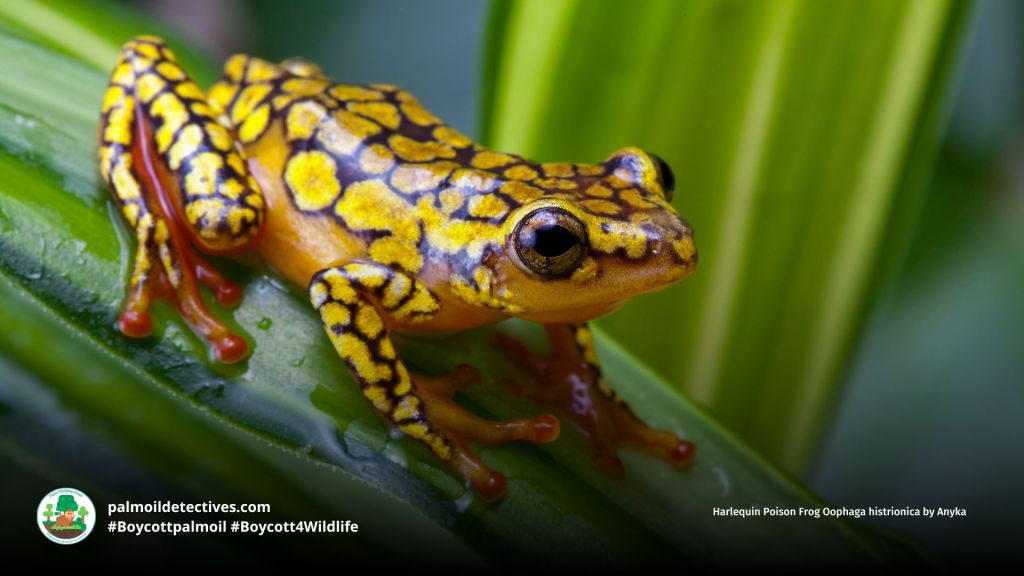
A dazzling splash of colour against the deep greens of Colombia’s Chocó rainforests, the harlequin poison frog is as deadly as it is beautiful. Cloaked in hypnotic shades of orange, yellow, green and black, this tiny amphibian is a master of chemical warfare—their skin is infused with powerful alkaloid toxins that can paralyse or kill predators. But despite their formidable defences, they are completely helpless against human destruction.

Once thriving in the dense, misty forests of western #Colombia, this critically endangered frog is now on the brink of extinction. Illegal mining, rampant deforestation for #palmoil plantations, and the relentless #wildlifetrade have devastated their fragile rainforest home. The same vibrant colours that warn predators away have made them a prime target for #poachers supplying the exotic #pettrade.

This extraordinary species is a vital part of its ecosystem, controlling insect populations and contributing to the rainforest’s delicate balance. But unless urgent action is taken, the harlequin poison frog could vanish forever.

Protect their rainforest home. Say no to palm oil, reject the illegal pet trade, and demand stronger protections for Colombia’s amphibians. #BoycottPalmOil #Boycott4Wildlife

https://youtu.be/fh8TCdrCw-I

Harlequin Poisonous #Frogs 🐸🐸have vivid shades of 💛💚🧡. Unlike other frogs both males and females fiercely guard eggs. #PalmOil #Soy #Meat and #GoldMining are threats in #Colombia. Help them when you #BoycottGold 🥇☠️⛔️ be #vegan #BoycottPalmOil 🌴☠️⛔️https://palmoildetectives.com/2021/03/20/harlequin-poison-frog-oophaga-histrionica/

Share to BlueSkyShare to Twitter

Dazzling Harlequin Poisonous #Frogs 🐸💚 of #Colombia 🇨🇴 are sensitive to noise 🎶📢 Their rainbow colours 🌈 make them #rainforest works of art! ✨🎨Critically Endangered by #mining and #palmoil #BoycottGold 🥇🩸⛔️ #BoycottPalmOil 🌴☠️⛔️ @palmoildetect https://palmoildetectives.com/2021/03/20/harlequin-poison-frog-oophaga-histrionica/

Share to BlueSkyShare to TwitterHarlequin Poison Frog Oophaga histrionicaHarlequin Poison Frog Oophaga histrionicaHarlequin Poison Frog Oophaga histrionicaHarlequin Poison Frog Oophaga histrionicaHarlequin Poison Frog Oophaga histrionicaHarlequin Poison Frog Oophaga histrionicaHarlequin Poison Frog Oophaga histrionicaHarlequin Poison Frog Oophaga histrionicaHarlequin Poison Frog Oophaga histrionica threatsHarlequin Poison Frog Oophaga histrionica boycottHarlequin Poison Frog Oophaga histrionicaHarlequin Poison Frog Oophaga histrionicaHarlequin Poison Frog Oophaga histrionicaHarlequin Poison Frog Oophaga histrionicaHarlequin Poison Frog Oophaga histrionicaHarlequin Poison Frog Oophaga histrionicaHarlequin Poison Frog Oophaga histrionicaHarlequin Poison Frog Oophaga histrionicaHarlequin Poison Frog Oophaga histrionica
Appearance and Behaviour

Few creatures rival the harlequin poison frog in sheer visual spectacle. No two individuals look alike—each frog sports a unique pattern of vivid colours, a living work of rainforest art. These colours serve as a bold warning to predators: “Eat me and regret it.” Unlike other frogs that rely on camouflage, this species flaunts their toxicity in the open.

Growing to just 32.9 mm in length, these frogs are tiny but fiercely territorial. Males perch on fallen logs or leaves, calling loudly to attract mates and defend their domain. Their vocalisations shift depending on their surroundings—frogs near noisy streams produce higher-pitched calls to cut through the background noise.

Unlike most #amphibians, they do not lay their eggs in water. Instead, the female carefully deposits them on the forest floor. Once the tadpoles hatch, she carries them one by one on her back, climbing high into the canopy to deposit them in the tiny water pools inside bromeliads. She returns regularly to feed them unfertilised eggs, ensuring they receive the nutrients needed to grow. Without this dedicated parental care, the tadpoles would not survive (Medina et al., 2013).

Geographic Range

The harlequin poison frog is found only in the Chocó region of western Colombia, a biodiversity hotspot teeming with rare and endemic species. But its habitat is shrinking fast. Once covering vast swathes of rainforest, this species is now confined to small, isolated patches between 300 and 730 metres above sea level. This extreme habitat fragmentation is pushing the species closer to extinction (IUCN SSC Amphibian Specialist Group, 2019).

Diet

Harlequin poison frogs are insectivores, feasting primarily on ants, mites, and termites. Their diet is directly linked to their toxicity—these frogs do not produce their own poison but instead absorb toxic alkaloids from the insects they consume. In captivity, where their diet is different, they lose their toxicity entirely, proving just how essential their rainforest ecosystem is to their survival.

Reproduction and Mating

This species’ reproductive strategy is one of the most fascinating in the animal kingdom. Unlike most frogs that lay hundreds of eggs in water, the harlequin poison frog invests heavily in just a few offspring. The Harlequin Poison Frog demonstrates remarkable parental care.

Males attract females through distinct vocal calls, often influenced by environmental factors such as stream noise. After the female lays her eggs on the forest floor, the male guards them until they hatch. Then, the mother carries each tadpole on her back, one at a time, up into the trees. She carefully places them in separate bromeliads—tiny pools of water trapped in the plant’s leaves. To ensure their survival, she periodically returns to each tadpole and lays unfertilised eggs for them to eat. Without this specialised care, they would not survive (Medina et al., 2013).

This highly specialised reproductive strategy ensures tadpole survival in an ecosystem with limited standing water.

Threats

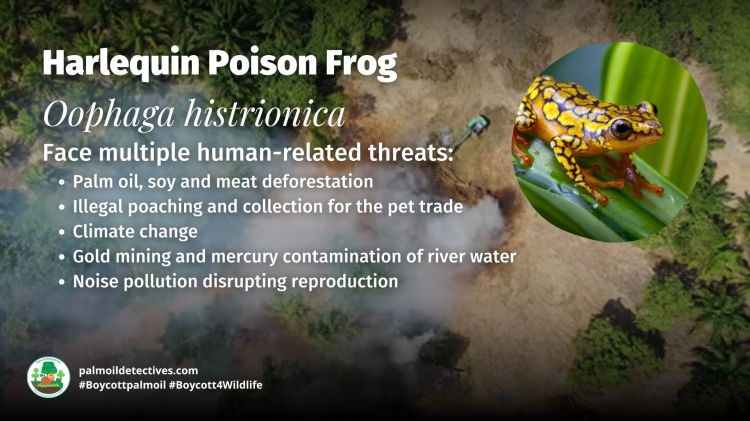
Harlequin Poison Frog Oophaga histrionica threats
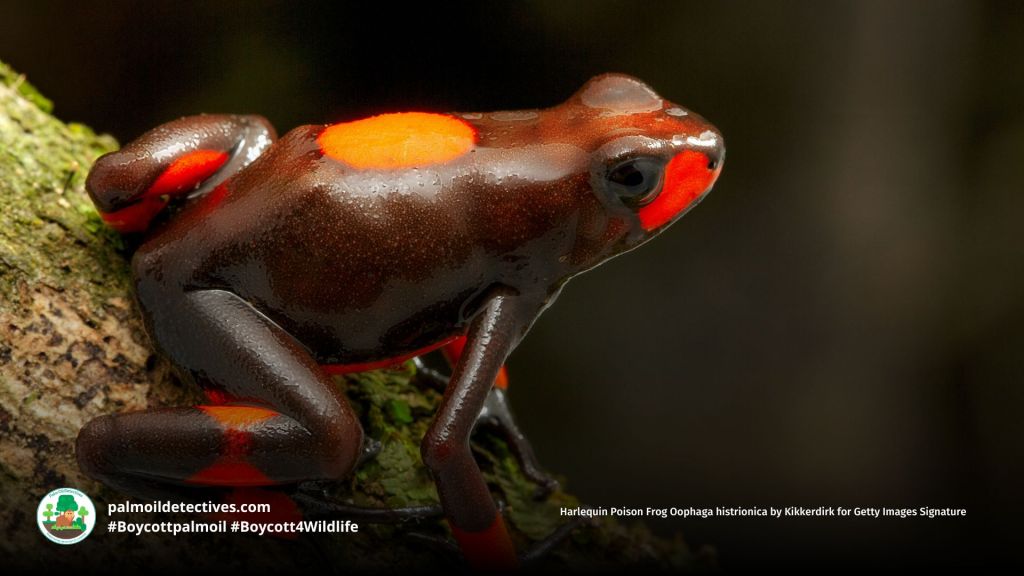
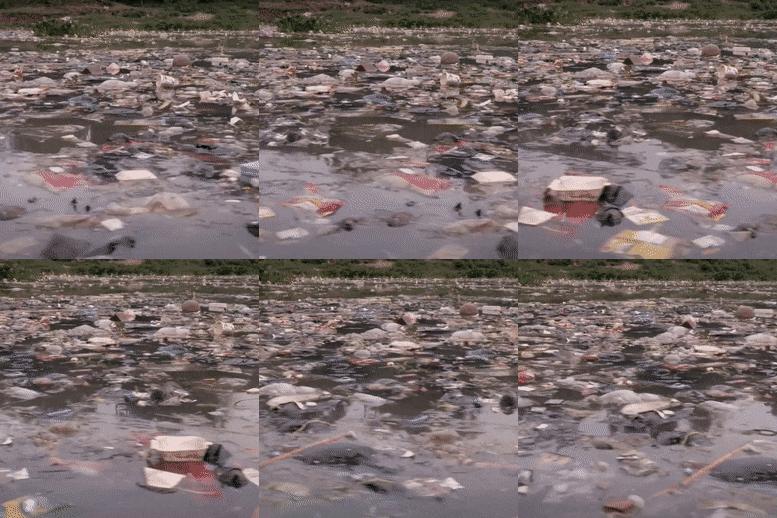
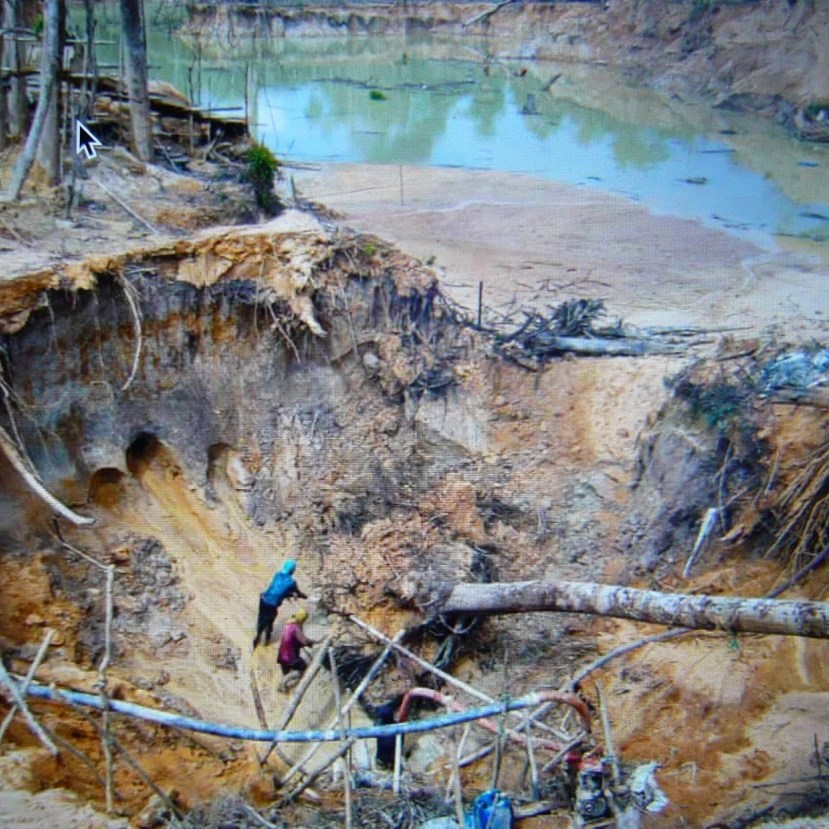
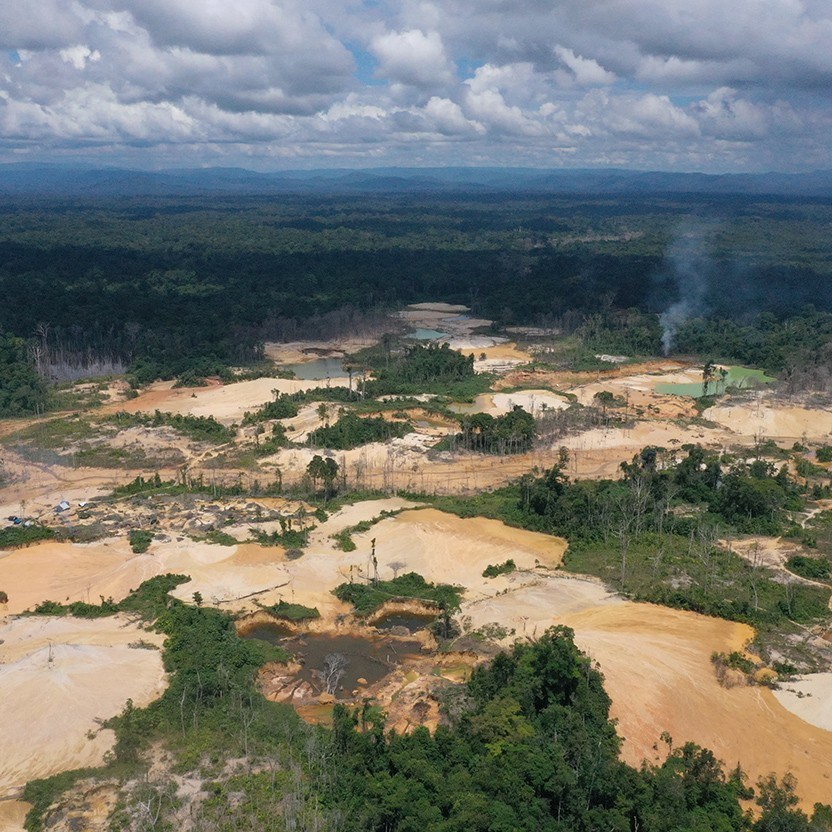
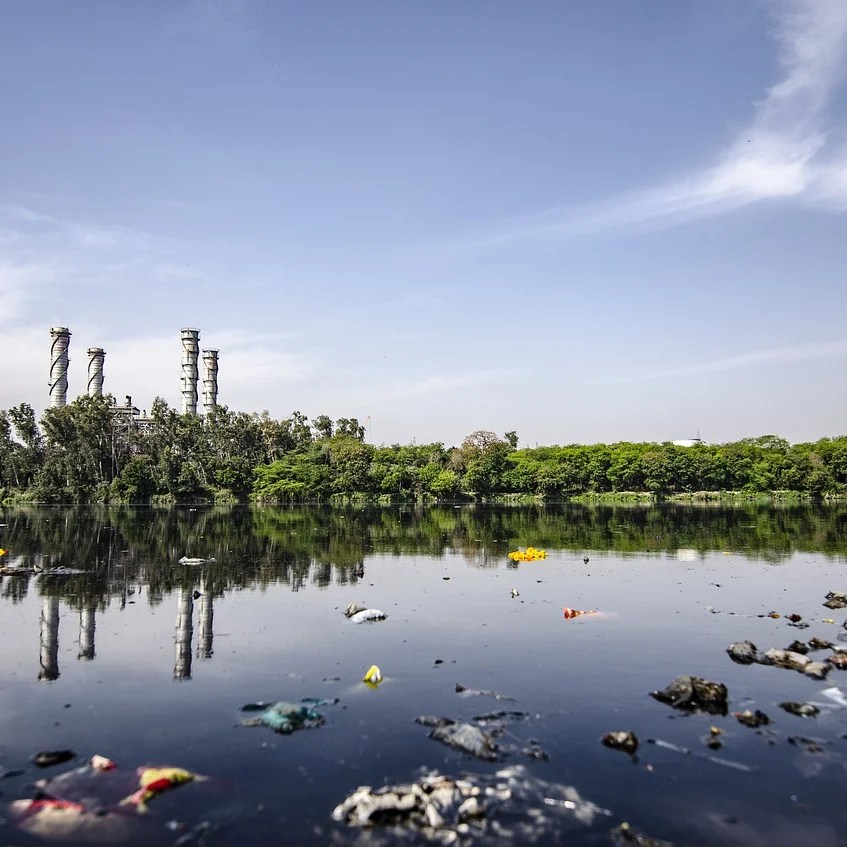
The major threats to the Harlequin Poison Frog are deforestation caused by small-scale agriculture, including livestock, mining activities, and logging, resulting in degraded and fragmented forest at the only known locality (M. Pareja pers. comm. February 2019). However, some patches are still in good condition (M. Pareja pers. comm. February 2019). Pollution associated with mining also represents a threat to the species.

IUCN RED LIST

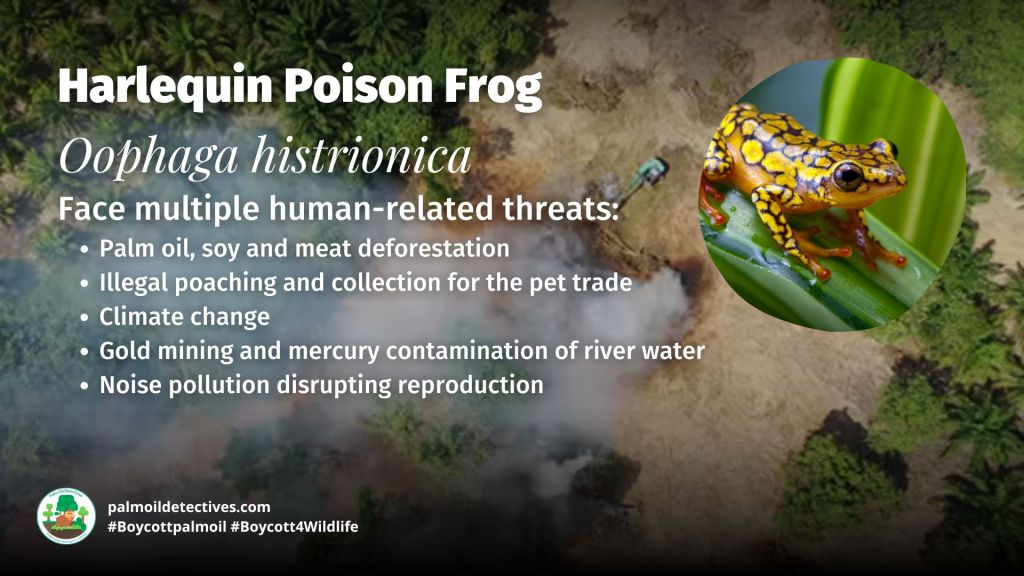
The harlequin poison frog is critically endangered due to a perfect storm of human-driven threats:

Illegal pet trade

These frogs are highly sought after in the exotic pet trade, with many dying in transit or being removed from wild populations at unsustainable rates.

Noise pollution

Increased human activity and deforestation near water sources are affecting their ability to communicate and reproduce.

Deforestation and Palm Oil Expansion

• Colombia’s rainforests are being rapidly cleared for palm oil plantations and cattle ranching. Illegal logging and land conversion have fragmented the frog’s habitat, leaving it nowhere to go.

Illegal Wildlife Trade

This species is highly sought after by collectors in the exotic pet trade. Despite international protections, poachers continue to smuggle these frogs out of Colombia.

Gold Mining and Mercury Contamination

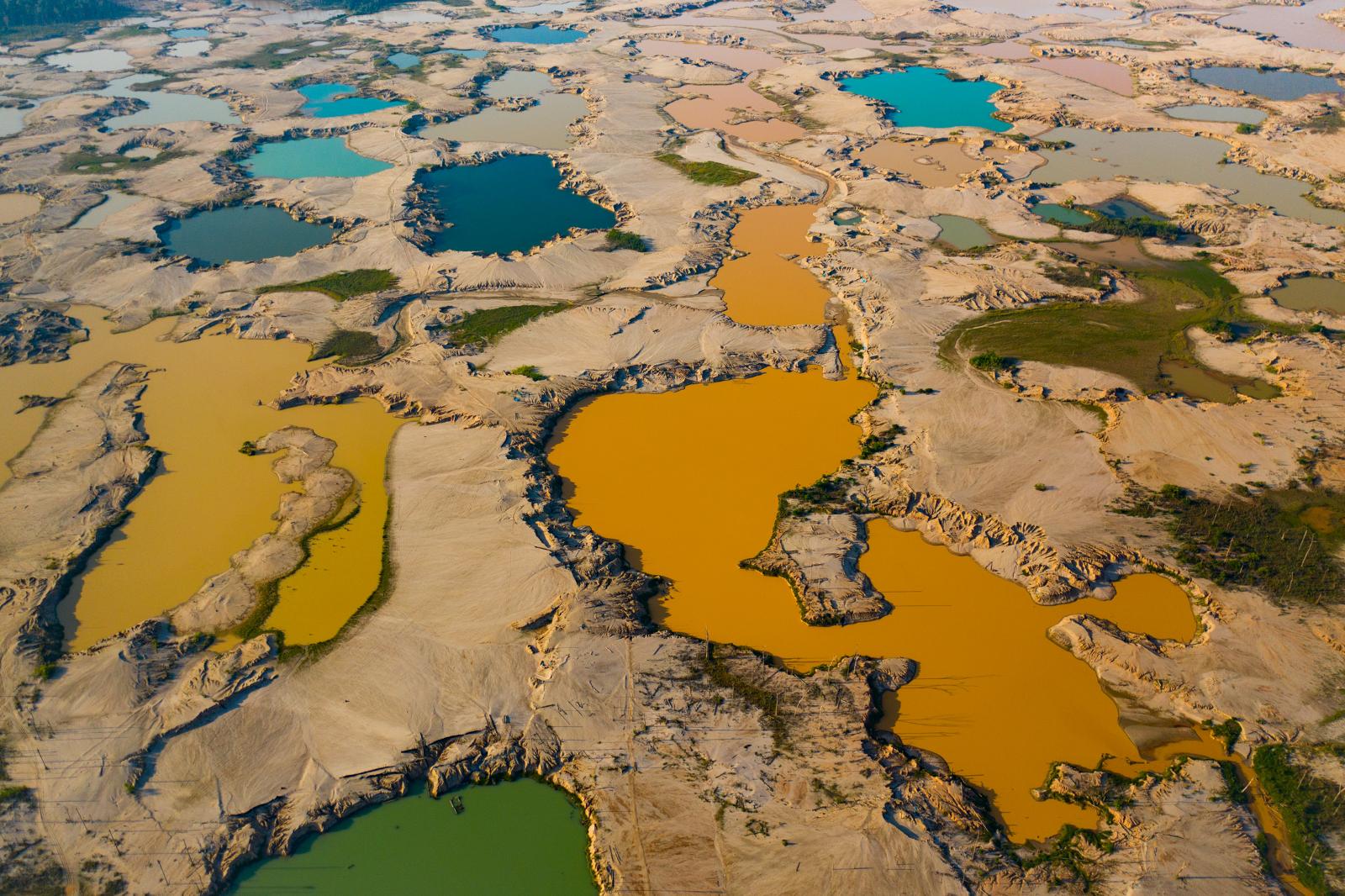
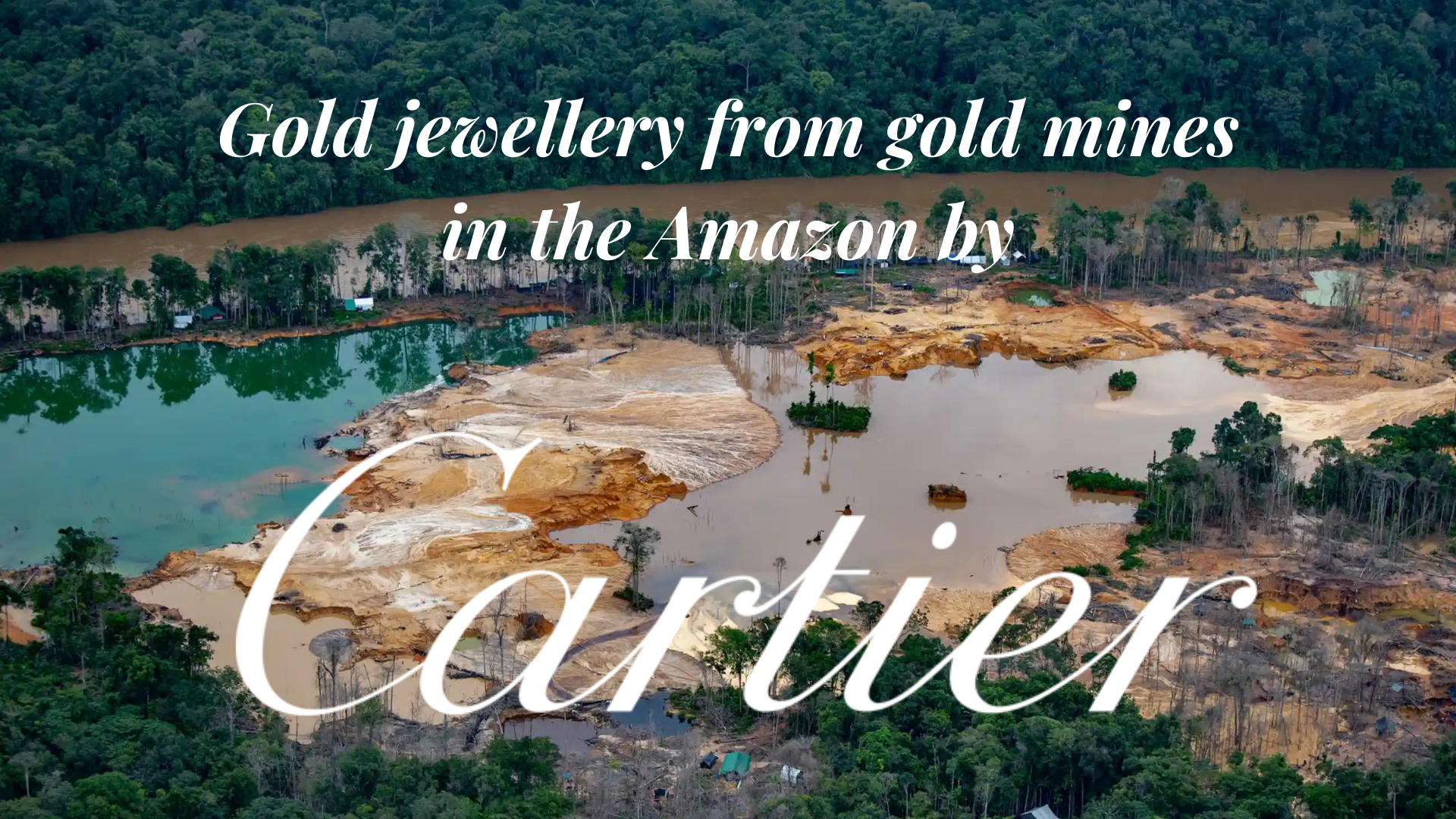
Illegal gold mining pollutes water sources with mercury, poisoning amphibians at all life stages. Deforestation caused by mining activities is wiping out breeding and foraging habitats.

Climate Change

Rising temperatures and shifting rainfall patterns threaten the species’ delicate reproductive cycle. Extreme weather events may impact the availability of bromeliads for tadpole development.

Take Action!

Harlequin Poison Frog Oophaga histrionicaHarlequin Poison Frog Oophaga histrionicaHarlequin Poison Frog Oophaga histrionicaHarlequin Poison Frog Oophaga histrionicaHarlequin Poison Frog Oophaga histrionicaHarlequin Poison Frog Oophaga histrionica

The harlequin poison frog is on the edge of extinction, but there’s still time to help:

  • Boycott palm oil. The destruction of rainforests for palm oil plantations is wiping out amphibian habitats. Choose products that are 100% palm oil-free.
  • Reject the illegal pet trade. Never buy wild-caught poison frogs. Support only reputable captive breeding programs.
  • Support rainforest conservation. Donate to organisations protecting Colombia’s rainforests and wildlife.
  • Demand stronger protections. Contact policymakers to advocate for stricter enforcement against wildlife trafficking and habitat destruction.

Every action counts. Resist and fight back before it’s too late. #BoycottPalmOil #Boycott4Wildlife

FAQs

How toxic is the harlequin poison frog?

The harlequin poison frog produces powerful alkaloid toxins known as histrionicotoxins, which block neural receptors and can cause paralysis or death in predators. The toxins are acquired from their diet—frogs raised in captivity without their natural diet are completely non-toxic (Medina et al., 2013).

What makes Harlequin Poison Frogs toxic?

Their toxicity comes from consuming alkaloid-rich ants and mites. When deprived of this diet, such as in captivity, they lose their poison.

Why do Harlequin Poison Frogs have different calls?

Research by Vargas-Salinas and Amézquita (2013) found that their calls adapt to environmental noise levels. Frogs living near noisy streams produce higher-frequency calls to ensure their signals are heard, while those in quieter areas use lower-frequency calls. This shows how environmental conditions shape evolution in real time.

Why is the harlequin poison frog critically endangered?

Deforestation for palm oil, soy and meat, illegal wildlife trade, gold mining, and habitat fragmentation have driven this species to the brink. With an extremely limited range, any further habitat loss could mean extinction (IUCN SSC Amphibian Specialist Group, 2019).

What is unique about the harlequin poison frog’s reproduction?

This species exhibits exceptional parental care. Unlike most frogs, they do not lay eggs in water. Instead, females transport newly hatched tadpoles on their backs to water-filled bromeliads, where they are fed unfertilised eggs until they mature (Medina et al., 2013).

Do harlequin poison frogs make good pets?

No. While some poison dart frogs are legally bred in captivity, wild-caught harlequin poison frogs are often smuggled illegally, contributing to population decline. Captive frogs also lose their toxicity, making them less vibrant and potentially unhealthy (Zamora et al., 1999).

How many Harlequin Poison Frogs are left in the wild?

Exact numbers remain unknown, but population declines due to habitat loss and illegal trade are well-documented. Their Endangered status indicates a high risk of extinction if conservation efforts are not strengthened.

How long do Harlequin Poison Frogs live?

They typically live 5–8 years in the wild.

Are Harlequin Poison Frogs good pets?

No. Keeping these frogs as pets is a selfish act that contributes to their extinction. Many individuals in the pet trade are illegally captured, harming wild populations and destroying delicate ecosystems. If you care about these animals, advocate for their conservation instead of supporting the illegal pet trade.

How can I help protect Harlequin Poison Frogs?

Avoid and boycott palm oil, support conservation efforts, and speak out against the illegal pet trade. Protecting their rainforest home is the key to their survival.

Support the conservation of this species

Poison Dart Frogs

Manchester Museum captive breeding programme

Further Information

iucn-rating-critically-endangered

IUCN SSC Amphibian Specialist Group. 2019. Oophaga histrionica. The IUCN Red List of Threatened Species 2019: e.T144231367A144443857. https://dx.doi.org/10.2305/IUCN.UK.2019-2.RLTS.T144231367A144443857.en. Downloaded on 16 February 2021.

Vargas-Salinas, F., & Amézquita, A. (2013). Stream noise, hybridization, and uncoupled evolution of call traits in two lineages of poison frogs: Oophaga histrionica and Oophaga lehmanni. PLoS ONE, 8(10), e77545. https://doi.org/10.1371/journal.pone.0077545

Wikipedia contributors. (n.d). Harlequin poison frog. Wikipedia, The Free Encyclopedia. https://en.wikipedia.org/wiki/Harlequin_poison_frog

Harlequin Poison Frog Oophaga histrionica

Contribute to palm oil detectives - black rhino in profile

How can I help the #Boycott4Wildlife?


Take Action in Five Ways

1. Join the #Boycott4Wildlife on social media and subscribe to stay in the loop: Share posts from this website to your own network on Twitter, Mastadon, Instagram, Facebook and Youtube using the hashtags #Boycottpalmoil #Boycott4Wildlife.

Enter your email address

Sign Up

Join 3,179 other subscribers

2. Contribute stories: Academics, conservationists, scientists, indigenous rights advocates and animal rights advocates working to expose the corruption of the palm oil industry or to save animals can contribute stories to the website.
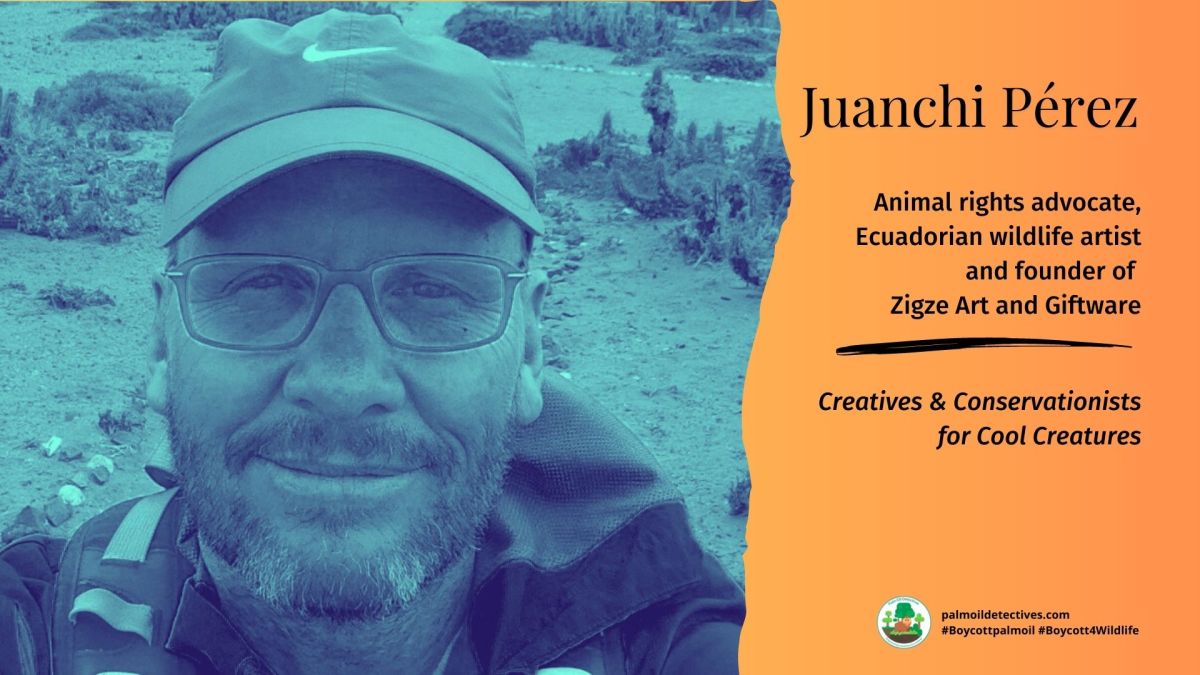
Wildlife Artist Juanchi Pérez

Wildlife Artist Juanchi Pérez

Read more Mel Lumby: Dedicated Devotee to Borneo’s Living Beings
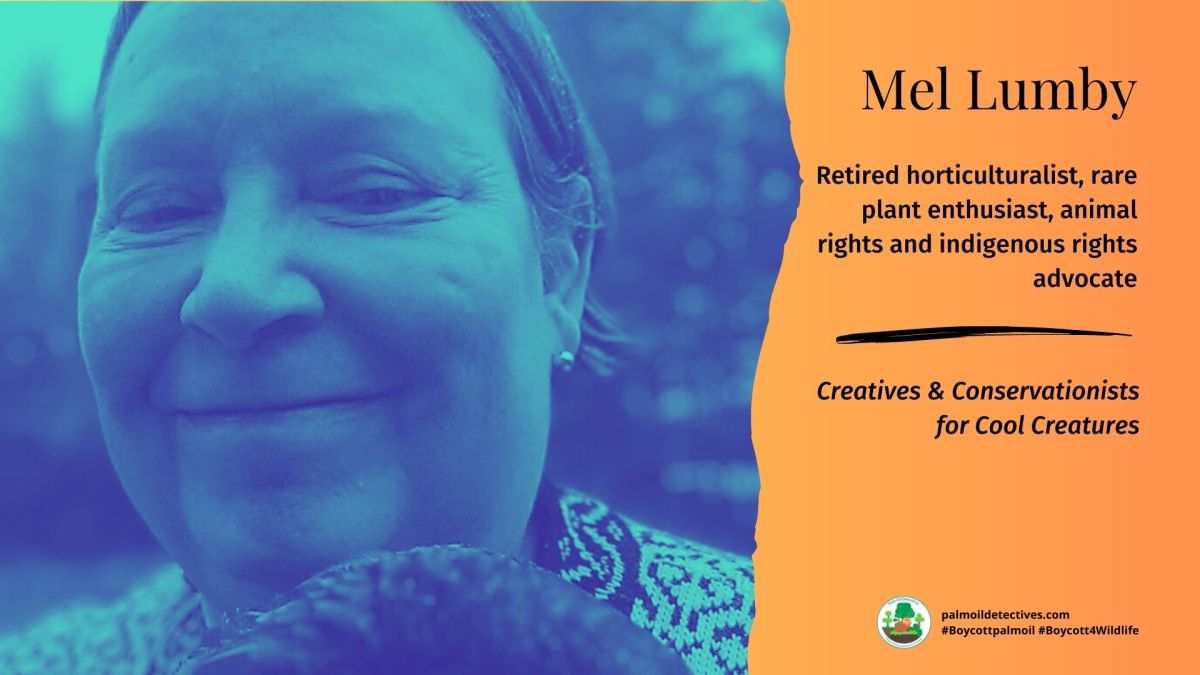
Mel Lumby: Dedicated Devotee to Borneo’s Living Beings

Read more Anthropologist and Author Dr Sophie Chao
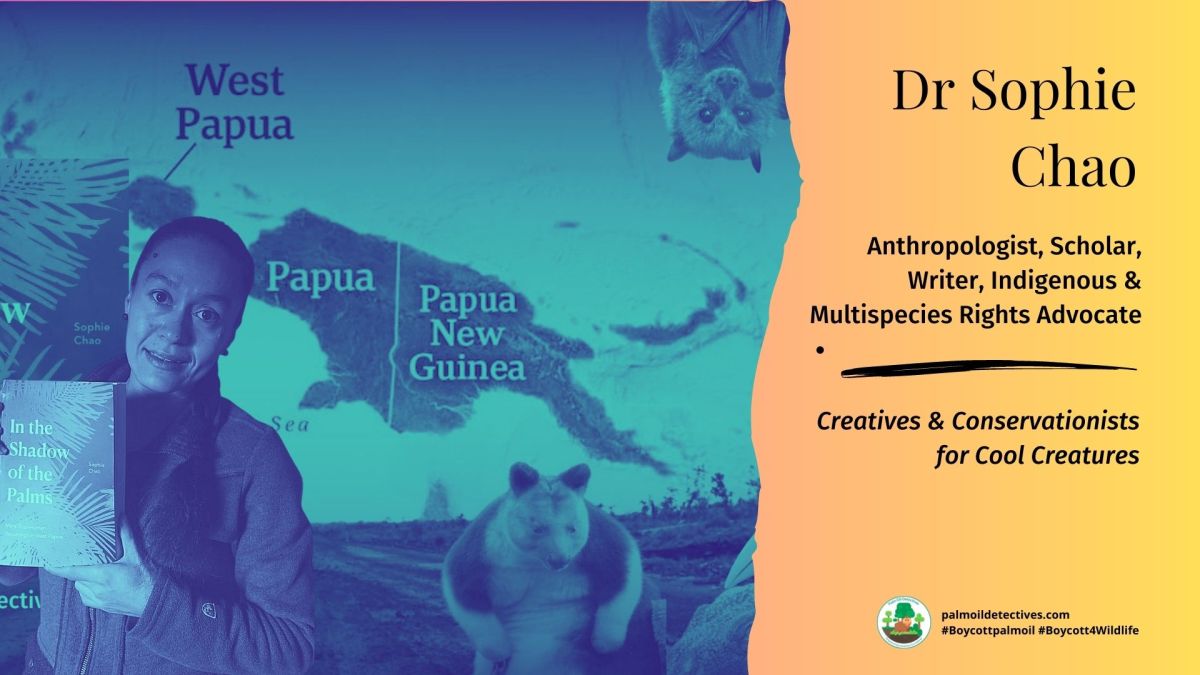
Anthropologist and Author Dr Sophie Chao

Read more Health Physician Dr Evan Allen

Health Physician Dr Evan Allen

Read more The World’s Most Loved Cup: A Social, Ethical & Environmental History of Coffee by Aviary Doert

The World’s Most Loved Cup: A Social, Ethical & Environmental History of Coffee by Aviary Doert

Read more How do we stop the world’s ecosystems from going into a death spiral? A #SteadyState Economy

How do we stop the world’s ecosystems from going into a death spiral? A #SteadyState Economy

Read more

3. Supermarket sleuthing: Next time you’re in the supermarket, take photos of products containing palm oil. Share these to social media along with the hashtags to call out the greenwashing and ecocide of the brands who use palm oil. You can also take photos of palm oil free products and congratulate brands when they go palm oil free.

https://twitter.com/CuriousApe4/status/1526136783557529600?s=20

https://twitter.com/PhillDixon1/status/1749010345555788144?s=20

https://twitter.com/mugabe139/status/1678027567977078784?s=20

4. Take to the streets: Get in touch with Palm Oil Detectives to find out more.

5. Donate: Make a one-off or monthly donation to Palm Oil Detectives as a way of saying thank you and to help pay for ongoing running costs of the website and social media campaigns. Donate here

Pledge your support

#amphibians #Boycott4wildlife #BoycottGold #BoycottPalmOil #climateChange #Colombia #CriticallyEndangeredSpecies #deforestation #Frog #Frogs #goldmining #HarlequinPoisonFrogOophagaHistrionica #herpetology #illegalPetTrade #livestock #meat #mining #PalmOil #palmoil #pettrade #poachers #poaching #rainforest #Reptile #SouthAmericaSpeciesEndangeredByPalmOilDeforestation #SouthAmerica #soy #vegan #waterPollution #wildlifetrade

Tucuxi Sotalia fluviatilis

Tucuxi Sotalia fluviatilis

IUCN Red List Status: Endangered

Location: #Brazil, #Peru, #Colombia, #Ecuador

Found throughout the #Amazon and Solimões River systems, including major tributaries and large lakes. Their range spans lowland rainforest areas of Brazil, southeastern Colombia, eastern Ecuador, and southern Peru.

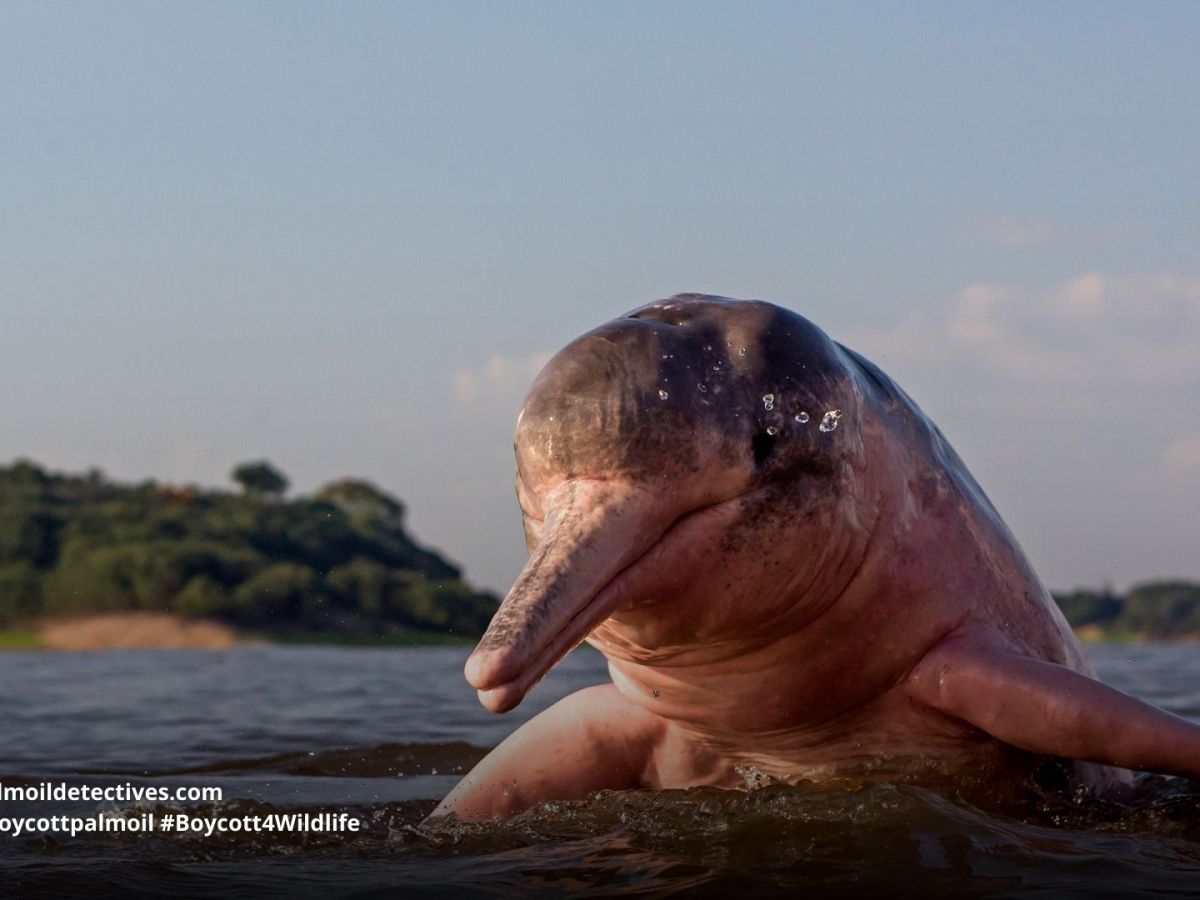
The #Tucuxi, a small freshwater #dolphin of #Peru, #Ecuador, #Colombia and #Brazil now faces a dire future. Once common throughout the Amazon River system, they are now listed as #Endangered due to accelerating population declines. Threats include drowning in fishing nets, deforestation, mercury poisoning from gold mining, #palmoil run-off, oil drilling, and dam construction. A shocking 97% decline was recorded over 23 years in a single Amazon reserve. Without urgent action, this elegant and playful river dolphin could vanish from South America’s waterways. Use your wallet as a weapon against extinction. Choose palm oil-free, and #BoycottGold #BoycottPalmOil #Boycott4Wildlife

https://youtu.be/YYvh0S3ucUI

Playful and intelligent #Tucuxi are small #dolphins 🐬 of #Amazonian rivers in #Peru 🇵🇪 #Brazil 🇧🇷 #Ecuador 🇪🇨 and #Colombia 🇨🇴. #PalmOil and #GoldMining are major threats 😿 Fight for them! #BoycottGold #BoycottPalmOil #Boycott4Wildlife @palmoildetect https://palmoildetectives.com/2025/11/23/tucuxi-sotalia-fluviatilis/

Share to BlueSky Share to Twitter

Clever and joyful #Tucuxi are #dolphins 🐬💙 endangered by #hunting #gold #mining and contamination of the Amazon river 🇧🇷 for #PalmOil #agriculture ☠️ Use your wallet as a weapon and #BoycottGold 🥇🚫 #BoycottPalmOil 🌴🚫 #Boycott4Wildlife @palmoildetect https://palmoildetectives.com/2025/11/23/tucuxi-sotalia-fluviatilis/

Share to BlueSky Share to Twitter

Appearance & Behaviour

Tucuxis are often mistaken for their oceanic dolphin cousins due to their streamlined bodies, short beaks, and smooth, pale-to-dark grey skin. But these freshwater dolphins are wholly unique—adapted to life in winding river systems where water levels rise and fall dramatically with the seasons.

What sets them apart is their remarkable intelligence and tightly knit social groups. Tucuxis are playful and curious by nature. They leap from the water in graceful arcs, sometimes spinning mid-air.

Tucuxi Sotalia fluviatilis boycottTucuxi Sotalia fluviatilis by Axel Antoine iNaturalistTucuxi Sotalia fluviatilis by Instituto Boto Cinza (2)Tucuxi Sotalia fluviatilis by Instituto Boto CinzaTucuxi Sotalia fluviatilis - South AmericaTucuxi Sotalia fluviatilis by Mamiferos de Colombia iNaturalistTucuxi Sotalia fluviatilis threats

The Tucuxi, sometimes called the ‘grey dolphin’ due to their uniform colouring, resembles a smaller oceanic dolphin, with a streamlined body and slender beak. Their colour varies from pale grey on the belly to darker grey or bluish-grey along the back.

They travel in small groups of two to six, displaying coordinated swimming patterns. In rare cases, they may form groups up to 26 individuals, particularly at river confluences. Known for their agility, they leap and spin in the water with a grace that belies their size. Tucuxis are particularly drawn to dynamic habitats like river junctions, where waters mix and fish gather.

Threats

Tucuxi Sotalia fluviatilis threatsTucuxi Sotalia fluviatilis boycott
  • Widespread deforestation from palm oil plantations Palm oil plantations are rapidly expanding across the Amazon, clearing vast tracts of forest that stabilise riverbanks and filter water. This deforestation leads to increased sedimentation in rivers, altering flow patterns and reducing water clarity—conditions that directly disrupt the Tucuxi’s feeding and movement. Run-off from fertilisers and pesticides used in palm oil monocultures also poisons aquatic ecosystems, harming Tucuxis other Amazonian dolphin species and the fish they rely on.
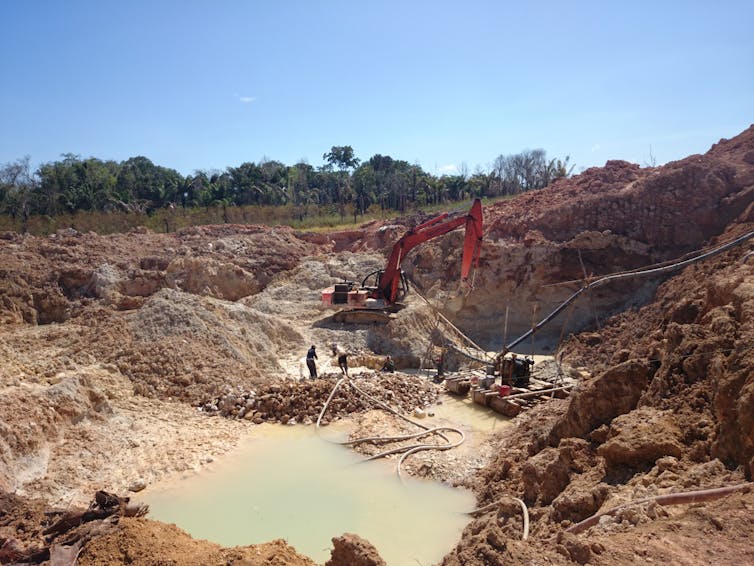
  • Toxic mercury pollution from gold mining Artisanal and illegal gold mining in the Amazon releases massive quantities of mercury into the water, contaminating fish and other aquatic organisms. Tucuxis, as top predators, ingest this mercury through their prey, which accumulates in their tissues and causes neurological damage, weakened immunity, and reproductive failure. Mercury exposure is one of the most insidious threats, as it persists in ecosystems long after mining has ceased.
  • Incidental drowning in fishing nets Tucuxis are frequently caught and killed in gillnets and other fishing gear as bycatch. Tucuxis and other Amazonian dolphins often inhabit the same confluence zones and productive fishing grounds targeted by local communities, making entanglement almost inevitable. Many carcasses are never recovered, having either been discarded by fishers or lost to river currents, meaning actual mortality rates are likely far higher than reported.
  • Deliberate hunting for use as fish bait Though illegal, Tucuxis continue to be targeted and killed in parts of Brazil, especially near the Mamirauá and Amana Reserves, where they are used as bait in the piracatinga (catfish) fishery. This brutal practice involves harpooning or netting dolphins and using their flesh to lure fish, often alongside the killing of Botos. Despite a national ban, weak enforcement and ongoing demand mean this threat persists in remote and lawless regions.
  • Illegal fishing with explosives and toxins In certain areas, particularly in Brazil and Peru, fishers use home-made explosives and poisoned bait to stun or kill fish en masse. These destructive methods harm or kill Tucuxis who are attracted by the sudden appearance of dead or stunned prey. The concussive force of explosions and the ingestion of poisoned prey result in slow, agonising deaths for affected dolphins.
  • Construction of hydroelectric dams Dams fragment Tucuxi populations by blocking their movement along river corridors, reducing access to feeding and breeding grounds. These projects alter seasonal water flow, raise water temperatures, and flood critical habitats—conditions that significantly disrupt dolphin ecology. Brazil alone has 74 operational dams in the Amazon basin, with over 400 more planned, posing a long-term existential threat to freshwater cetaceans.
  • Run-off and contamination from palm oil, soy and meat agriculture In addition to habitat loss, palm oil and soy plantations along with cattle ranching generates enormous volumes of chemical-laden waste, which enters waterways and poisons aquatic life. This pollution affects Tucuxis both directly and indirectly—exposing them to harmful substances and killing off sensitive fish species. As plantations replace biodiverse forests, the ecosystem becomes less resilient, accelerating the decline of species like the Tucuxi.
  • Bioaccumulation of heavy metals and industrial pollutants Tucuxis, like many river dolphins, suffer from exposure to persistent organic pollutants such as PCBs, DDT, and flame retardants, as well as heavy metals like lead and cadmium. These toxins accumulate in dolphin tissues over time, weakening their immune systems, interfering with reproduction, and making them more vulnerable to disease. Contaminants originate from industrial waste, agriculture, and mining, and are now widespread across the Amazon basin.
  • Habitat fragmentation from infrastructure and oil development Roads, oil pipelines, and shipping corridors criss-cross many parts of the Tucuxi’s range, slicing through their habitat and increasing the risk of collisions with boats. These developments also bring noise pollution, which can interfere with echolocation and communication. Fragmentation leads to isolated subpopulations, reducing genetic diversity and making recovery more difficult.

Geographic Range

The Tucuxi inhabits the Amazon River basin, spanning: Brazil, Peru, Colombia, Ecuador These river dolphins occur as far west as southern Peru and eastern Ecuador, and as far north as southeastern Colombia. They are notably absent from Bolivia’s Beni/Mamoré system, the Orinoco basin, and upper reaches above major waterfalls or rapids.

Their range includes wide, deep rivers and lakes, avoiding turbulent rapids and shallow areas. Despite overlapping with the Amazon River Dolphin (Inia geoffrensis), Tucuxis do not enter flooded forest habitats and stay closer to main river channels.

Diet

Tucuxis feed on more than 28 species of small, schooling freshwater fish, including members of the characid, sciaenid, and siluriform families. During the dry season, fish are concentrated in shrinking waterways, making them easier to catch. In contrast, flooding season disperses prey into forested areas, beyond the Tucuxi’s reach. They prefer to feed at river junctions and along confluences, where nutrient-rich waters concentrate fish populations.

Mating and Reproduction

Little is known about their mating behaviours. However, individuals appear to remain within familiar ranges for many years, and females likely give birth to a single calf after a long gestation. Calves are dependent for an extended period, learning complex navigation and foraging skills in rapidly changing river systems. The estimated generation length is 15.6 years.

FAQs

How many Tucuxis are left in the wild?

There is no comprehensive global population estimate. However, surveys from 1994–2017 in Brazil’s Mamirauá Reserve show a 7.4% annual decline—amounting to a 97% drop over three generations (da Silva et al., 2020). If this trend reflects the wider Amazon basin, the species could be on the brink of collapse.

How long do Tucuxis live?

Exact lifespans are unknown, but based on reproductive data and life history modelling, their generation length is around 15.6 years (Taylor et al., 2007), suggesting natural lifespans of 30–40 years.

How are palm oil and gold mining affecting Tucuxis?

Out-of-control palm oil expansion results in massive deforestation and run-off, clogging rivers with sediment and toxic agrochemicals. Gold mining adds mercury into aquatic ecosystems, where it bioaccumulates in fish—Tucuxis’ main food source. These pollutants cause reproductive harm, neurological damage, and immune system failure in dolphins.

Do Tucuxis make good pets and should they be kept in zoos?

Absolutely not. Tucuxis are intelligent, wild animals. Keeping them in captivity is deeply cruel and has no conservation benefit. Wild capture destroys families and can devastate local populations. If you care about these dolphins, say no to the exotic pet trade and the cruel zoo trade.

What habitats do they prefer?

Research in Peru’s Pacaya-Samiria Reserve shows that Tucuxis prefer river confluences and wide channels, particularly during the dry season when fish density is higher (Belanger et al., 2022). Feeding activity is especially concentrated in areas where whitewater rivers meet blackwater tributaries, creating nutrient-rich hotspots.

Take Action!

The Tucuxi is vanishing before our eyes. To protect them:

Boycott palm oil and gold products linked to Amazon destruction.

• Choose fish-free and vegan products to reduce pressure on river ecosystems.

• Support indigenous-led conservation across the Amazon.

• Campaign for a ban on destructive dams, and the end of illegal fishing.

#BoycottPalmOil #Boycott4Wildlife #Vegan #BoycottMeat

Support the Tucuxi by going vegan and boycotting palm oil in the supermarket, it’s the #Boycott4Wildlife

Support the conservation of this species

This animal has no protections in place. Read about other forgotten species here. Create art to support this forgotten animal or raise awareness about them by sharing this post and using the #Boycottpalmoil #Boycott4Wildlife hashtags on social media. Also you can boycott palm oil in the supermarket.

Further Information

Belanger, A., Wright, A., Gomez, C., Shutt, J.D., Chota, K., & Bodmer, R. (2022). River dolphins (Inia geoffrensis and Sotalia fluviatilis) in the Peruvian Amazon: habitat preferences and feeding behaviour. Latin American Journal of Aquatic Mammals, 17(1). https://doi.org/10.5597/lajam00268

da Silva, V., Martin, A., Fettuccia, D., Bivaqua, L. & Trujillo, F. 2020. Sotalia fluviatilisThe IUCN Red List of Threatened Species 2020: e.T190871A50386457. https://dx.doi.org/10.2305/IUCN.UK.2020-3.RLTS.T190871A50386457.en. Accessed on 06 April 2025.

Monteiro-Neto, C., Itavo, R. V., & Moraes, L. E. S. (2003). Concentrations of heavy metals in Sotalia fluviatilis (Cetacea: Delphinidae) off the coast of Ceará, northeast Brazil. Environmental Pollution, 123(2), 319–324. https://doi.org/10.1016/S0269-7491(02)00371-8

Tucuxi Sotalia fluviatilis boycott
Contribute to palm oil detectives - black rhino in profile

How can I help the #Boycott4Wildlife?


Take Action in Five Ways

1. Join the #Boycott4Wildlife on social media and subscribe to stay in the loop: Share posts from this website to your own network on Twitter, Mastadon, Instagram, Facebook and Youtube using the hashtags #Boycottpalmoil #Boycott4Wildlife.

Enter your email address

Sign Up

Join 3,172 other subscribers

2. Contribute stories: Academics, conservationists, scientists, indigenous rights advocates and animal rights advocates working to expose the corruption of the palm oil industry or to save animals can contribute stories to the website.

Wildlife Artist Juanchi Pérez

Wildlife Artist Juanchi Pérez

Read more

Mel Lumby: Dedicated Devotee to Borneo’s Living Beings

Mel Lumby: Dedicated Devotee to Borneo’s Living Beings

Read more

Anthropologist and Author Dr Sophie Chao

Anthropologist and Author Dr Sophie Chao

Read more

Health Physician Dr Evan Allen

Health Physician Dr Evan Allen

Read more

The World’s Most Loved Cup: A Social, Ethical & Environmental History of Coffee by Aviary Doert

The World’s Most Loved Cup: A Social, Ethical & Environmental History of Coffee by Aviary Doert

Read more

How do we stop the world’s ecosystems from going into a death spiral? A #SteadyState Economy

How do we stop the world’s ecosystems from going into a death spiral? A #SteadyState Economy

Read more

3. Supermarket sleuthing: Next time you’re in the supermarket, take photos of products containing palm oil. Share these to social media along with the hashtags to call out the greenwashing and ecocide of the brands who use palm oil. You can also take photos of palm oil free products and congratulate brands when they go palm oil free.

https://twitter.com/CuriousApe4/status/1526136783557529600?s=20

https://twitter.com/PhillDixon1/status/1749010345555788144?s=20

https://twitter.com/mugabe139/status/1678027567977078784?s=20

4. Take to the streets: Get in touch with Palm Oil Detectives to find out more.

5. Donate: Make a one-off or monthly donation to Palm Oil Detectives as a way of saying thank you and to help pay for ongoing running costs of the website and social media campaigns. Donate here

Pledge your support

Learn about other animals endangered by palm oil and other agriculture

GlobalSouth America S.E. AsiaIndiaAfricaWest Papua & PNGFrill-Necked Lizard Chlamydosaurus kingii

Frill-Necked Lizard Chlamydosaurus kingii

Keep reading

Grey Crowned Crane Balearica regulorum

Grey Crowned Crane Balearica regulorum

Keep reading

Ecuadorean Viscacha Lagidium ahuacaense

Ecuadorean Viscacha Lagidium ahuacaense

Keep reading

Southern Pudu Pudu puda

Southern Pudu Pudu puda

Keep reading

Blue-streaked Lory Eos reticulata

Blue-streaked Lory Eos reticulata

Keep reading

Blonde Capuchin Sapajus flavius

Blonde Capuchin Sapajus flavius

Keep reading


Learn about “sustainable” palm oil greenwashing

Read more about RSPO greenwashing

Lying Fake labelsIndigenous Land-grabbingHuman rights abusesDeforestation Human health hazards

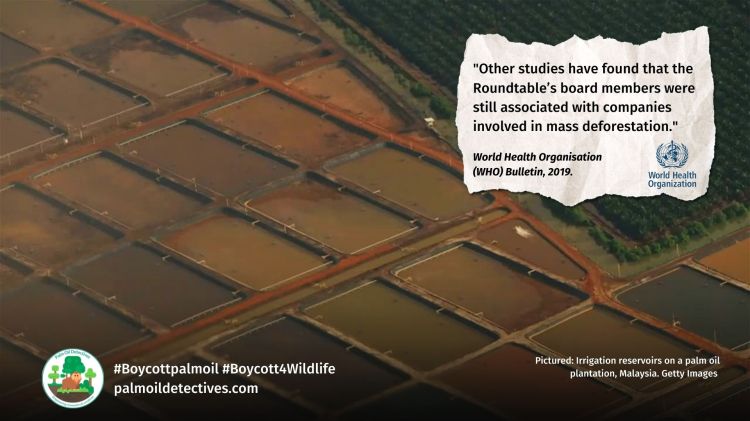
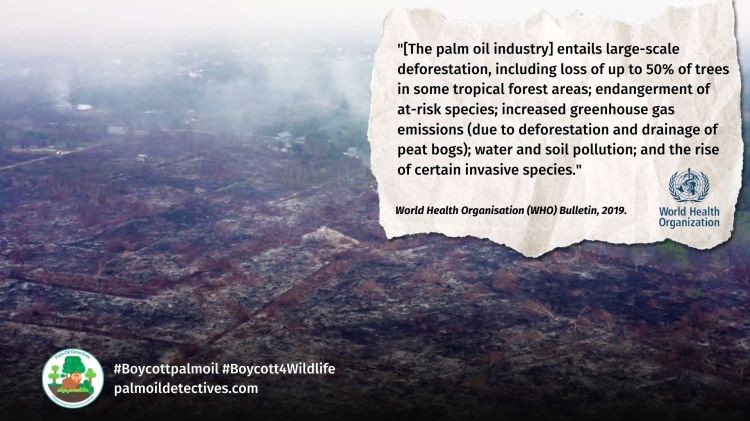
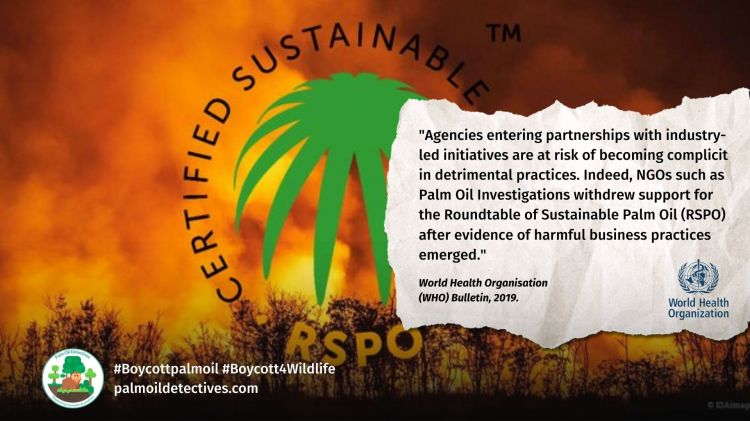
A 2019 World Health Organisation (WHO) report into the palm oil industry and RSPO finds extensive greenwashing of palm oil deforestation and the murder of endangered animals (i.e. biodiversity loss)

Read moreWHO Bulletin on Palm Oil: Deforestation and ExtinctionWHO Bulletin on Palm Oil: Deforestation and ExtinctionWHO Bulletin on Palm Oil: Deforestation and ExtinctionWHO Bulletin on Palm Oil: Air Pollution and Health

#agriculture #amazon #amazonRainforest #amazonia #amazonian #animalCruelty #animals #boycott4wildlife #boycottgold #boycottmeat #boycottpalmoil #brazil #colombia #dams #deforestation #dolphin #dolphins #ecuador #endangered #endangeredSpecies #forgottenAnimals #gold #goldMining #goldmining #humanWildlifeConflict #hunting #hydroelectric #mammal #mining #palmOil #palmOilDeforestation #palmoil #peru #poaching #saynotogold #tucuxi #tucuxiSotaliaFluviatilis #vegan

Indigenous Peoples Fight Climate Change


In the wake of the worst wildfires in living memory in Mexico and Central America in 2024, news outlets were looking for someone to blame. Howler monkeys and many species of parrots perished in the blazes. Slash and burn farming practices by Belize‘s indigenous communities were singled out as a primary cause. Yet this knee-jerk reaction is not evidence based and doesn’t take into account forces like corporate landgrabbing for mining and agribusinesses like meat, soy and palm oil.

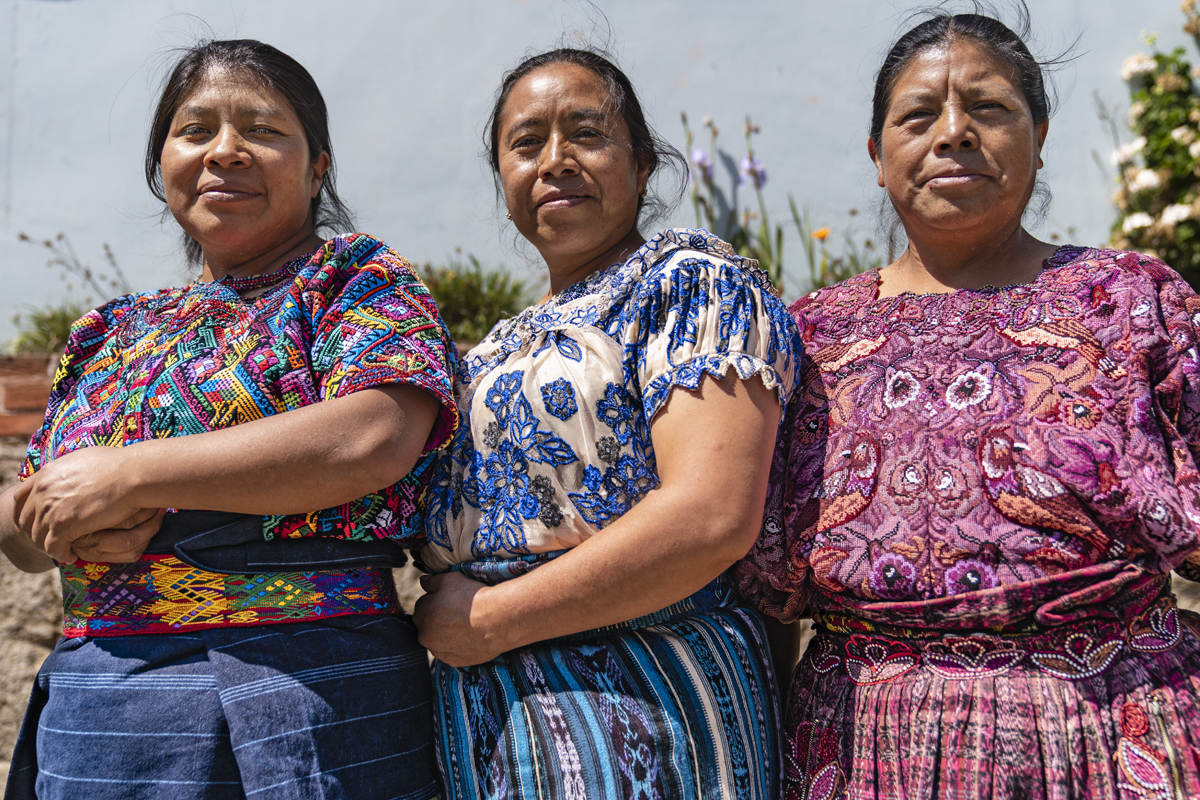
Belize’s indigenous Maya communities are rebuilding stronger based on the collective notion of se’ komonil: reciprocity, solidarity, traditional knowledge, gender equity, togetherness and community.


In the wake of horrific #wildfires in #Belize and #Mexico caused by #climatechange, #indigenous #Maya are rebuilding using the notion of se’ komonil: reciprocity #community and solidarity. #indigenousrights #landrights #BoycottPalmOil @palmoildetect https://wp.me/pcFhgU-924

Share to BlueSky Share to Twitter

Written by James Stinson, Senior Research Associate and Evaluation Specialist, Young Lives Research Lab, Faculty of Education, York University, Canada and Lee Mcloughlin, PhD student, Global Sociocultural Studies, Florida International University This article is republished from The Conversation under a Creative Commons license. Read the original article.


Driven by extreme heat and drought, some of the worst wildfires in living memory raged across Mexico and Central America through April and May 2024.

News agencies reported howler monkeys dropping dead from trees, and parrots and other birds falling from the skies.

In Belize, a state of emergency was declared as wildfires burned tens of thousands of hectares of highly bio-diverse forest. Farmers suffered huge losses as fires destroyed crops and homes, and communities across the country suffered from hazardous air quality and hot, sleepless nights. Many risked their lives to fight off the approaching fires.

As the wildfire crisis subsided with rains in June, public attention shifted toward identifying the causes and allocating blame. Many singled out the “slash and burn” farming practices in Belize’s Indigenous communities as the primary cause. This simple knee-jerk reaction ignores the underlying causes of the climate crisis, are scientifically unfounded and stoke resentment of Indigenous Peoples.

Young Mayan women. Image: wikipediaYoung Mayan women. Image source: Wikipedia

Fanning the flames

On June 5, one of Belize’s major news networks ran a story with the headline “Are Primitive Farming Techniques Responsible for Wildfires?” The story placed blame for Belize’s wildfires on “slash-and-burn farming”, arguing that “there has to be a shift away from this destructive means of agriculture.”

The story was followed by an op-ed published online asserting that “because of the increased amounts of escaped agricultural fires, aided by climate change, global warming and drought, slash and burn has become more of a problem than the solution it once was.” This sentiment was further reinforced by Belize’s prime minister, who declared that “slash аnd burn has to be something of the past.”

While some of the recent fires in Belize were connected to agricultural burning — and poorly managed fire-clearing practices can have negative air-quality impacts — blaming “slash and burn” for the wildfire crisis ignores the larger context and conditions that made it possible, namely global warming.

May 2024 was the hottest and driest month in Belize’s history. This extreme heat is part of a broader global trend, with June 2024 marking the 13th consecutive “hottest month on record” globally.

More fundamentally, these statements confuse other forms of slash-and-burn agriculture with the distinct “milpa” systems employed by Indigenous people in Belize.

Indigenous knowledge undermined

Throughout Belize, Indigenous Maya farmers commonly practise a form of agriculture referred to as milpa in which fire is used to clear fields and fertilize the soil. Within this system, small areas of forest are chopped down, burned, and planted with maize, beans, squash and other crops. After being cultivated for a year or two, the field is then left fallow and allowed to regenerate back to forest cover while the farmers move on to a new area within a cyclical pattern where areas are reused after a regenerative period.

https://youtu.be/ok787HRp_gA

Commonly derided as slash-and-burn farming, milpa has long been perceived as environmentally destructive. This perspective has been perpetuated by long-standing myths and misconceptions that portray the farming practices of non-Europeans, and specifically the use of fire, as wasteful and irrational.

In Belize, this negative view of slash and burn has driven many colonial and post-colonial interventions to modernize Maya farming practices.

Recent research, however, has shown that the lands of Indigenous Peoples around the world have reduced deforestation and degradation rates relative to non-protected areas. The southern Toledo district of Belize, where the majority of Maya communities are located, boasts a forest cover rate of 71 per cent, significantly higher than the national average of 63 per cent.

Further research has found that the species composition of contemporary Mesoamerican forests has been shaped by the agricultural practices of ancient Maya farmers.

In Belize, fire has been found to play a role in promoting ecosystem health and resilience and intermediate levels of forest disturbance caused by milpa can increase species diversity. Well-managed milpa farming can support soil fertility, result in long-term carbon sequestration and enriched woodland vegetation.

Research has also shown that previous studies of deforestation in southern Belize significantly overestimated the rate of deforestation due to milpa agriculture by not accounting for its rotational process.

Many researchers now believe that milpa is a more benign alternative, in terms of environmental effects, than most other permanent farming systems in the humid tropics. Indeed, findings such as these have led to a growing appreciation for the role of Indigenous Peoples in advancing nature-based and life-enhancing climate solutions.

Unfortunately, research in the region has also found that climate change is undermining the ecological sustainability of milpa farming by forcing farmers to abandon traditional practices and adopt counterproductive measures in their struggle to adapt. In some cases, this has resulted in a decrease in the biodiversity and ecological resilience of the milpa system. This issue is compounded by the decreasing participation of young people, resulting in a further generational loss of traditional ecological knowledge.

Together, these issues are serving to alter and undermine a livelihood strategy that has proven sustainable for thousands of years. However, rather than call for Maya farmers to abandon slash and burn, we encourage support for the self-determined efforts of Maya communities to adapt to this changing climate. https://www.youtube.com/embed/ok787HRp_gA?wmode=transparent&start=0 A video documenting the Maya response to the 2024 wildfire crisis.

Planting seeds of collaboration

Since winning a groundbreaking land rights claim in 2015, Maya communities in southern Belize have been working to promote an Indigenous future based on principles of reciprocity, solidarity, traditional knowledge, gender equity and, most significantly, se’ komonil, the Maya notion of togetherness and community.

Led by a collaboration of Maya leaders and non-governmental organizations, work toward this has included efforts to revitalize traditional institutions and governance systems, as well as the development of an Indigenous Forest Caring Strategy and fire-permitting system. In an effort to encourage and support the participation of youth in this process, Maya leaders have collaborated with the Young Lives Research Lab at York University to develop the Partnership for Youth and Planetary Wellbeing.

Building on previous research with Maya youth, the project has produced innovative youth-led research and education on the impacts of climate change, the importance of food sovereignty, traditional ecological knowledge and the struggle to secure Indigenous land rights in Maya communities. This work has been shared with global policymakers at the United Nations and local audiences in Belize.

Rather than fanning the flames of climate blame, we must work together to revitalize Indigenous knowledge systems and plant seeds of climate collaboration and care.

Written by James Stinson, Senior Research Associate and Evaluation Specialist, Young Lives Research Lab, Faculty of Education, York University, Canada and Lee Mcloughlin, PhD student, Global Sociocultural Studies, Florida International University This article is republished from The Conversation under a Creative Commons license. Read the original article.

ENDS


Read more about human rights abuses and child slavery in the palm oil and gold mining industries

SOCFIN’s African Empire of Colonial Oppression: Billionaires Profit from Palm Oil and Rubber Exploitation

SOCFIN’s African Empire of Colonial Oppression: Billionaires Profit from Palm Oil and Rubber Exploitation

Investigation by Bloomberg exposes that despite being RSPO members, #SOCFIN plantations in #WestAfrica are the epicentre of #humanrights abuses, sexual coercion, environmental destruction, and #landgrabbing. Operating in #Liberia, #Ghana, #Nigeria, and beyond, SOCFIN’s…

Read more

Palm Oil Threatens Ancient Noken Weaving in West Papua

Palm Oil Threatens Ancient Noken Weaving in West Papua

Colonial palm oil and sugarcane causing the loss of West Papuans’ cultural identity. Land grabs force communities from forests, threatening Noken weaving

Read more

Family Ties Expose Deforestation and Rights Violations in Indonesian Palm Oil

Family Ties Expose Deforestation and Rights Violations in Indonesian Palm Oil

An explosive report by the Environment Investigation Agency (EIA) details how Indonesia’s Fangiono family, through a wide corporate web, is linked to ongoing #deforestation, #corruption, and #indigenousrights abuses for #palmoil. Calls mount for…

Read more

West Papuan Indigenous Women Fight Land Seizures

West Papuan Indigenous Women Fight Land Seizures

Indigenous Melanesian women in West Papua fight land seizures for palm oil and sugar plantations, protecting their ancestral rights. Join #BoycottPalmOil

Read more

Greasing the Wheels of Colonialism: Palm Oil Industry in West Papua 

Greasing the Wheels of Colonialism: Palm Oil Industry in West Papua 

A landmark study published in Global Studies Quarterly in April 2025 has revealed that the rapid expansion of the #palmoil industry in #WestPapua is not only fuelling #deforestation, #ecocide and environmental destruction but…

Read more

Load more posts

Something went wrong. Please refresh the page and/or try again.


Take Action in Five Ways

1. Join the #Boycott4Wildlife on social media and subscribe to stay in the loop: Share posts from this website to your own network on Twitter, Mastadon, Instagram, Facebook and Youtube using the hashtags #Boycottpalmoil #Boycott4Wildlife.

Enter your email address

Sign Up

Join 3,171 other subscribers

2. Contribute stories: Academics, conservationists, scientists, indigenous rights advocates and animal rights advocates working to expose the corruption of the palm oil industry or to save animals can contribute stories to the website.

Wildlife Artist Juanchi Pérez

Wildlife Artist Juanchi Pérez

Read more

Mel Lumby: Dedicated Devotee to Borneo’s Living Beings

Mel Lumby: Dedicated Devotee to Borneo’s Living Beings

Read more

Anthropologist and Author Dr Sophie Chao

Anthropologist and Author Dr Sophie Chao

Read more

Health Physician Dr Evan Allen

Health Physician Dr Evan Allen

Read more

The World’s Most Loved Cup: A Social, Ethical & Environmental History of Coffee by Aviary Doert

The World’s Most Loved Cup: A Social, Ethical & Environmental History of Coffee by Aviary Doert

Read more

How do we stop the world’s ecosystems from going into a death spiral? A #SteadyState Economy

How do we stop the world’s ecosystems from going into a death spiral? A #SteadyState Economy

Read more

3. Supermarket sleuthing: Next time you’re in the supermarket, take photos of products containing palm oil. Share these to social media along with the hashtags to call out the greenwashing and ecocide of the brands who use palm oil. You can also take photos of palm oil free products and congratulate brands when they go palm oil free.

https://twitter.com/CuriousApe4/status/1526136783557529600?s=20

https://twitter.com/PhillDixon1/status/1749010345555788144?s=20

https://twitter.com/mugabe139/status/1678027567977078784?s=20

4. Take to the streets: Get in touch with Palm Oil Detectives to find out more.

5. Donate: Make a one-off or monthly donation to Palm Oil Detectives as a way of saying thank you and to help pay for ongoing running costs of the website and social media campaigns. Donate here

Pledge your support

#belize #boycottPalmOil #boycottpalmoil #childLabour #childSlavery #climatechange #community #goldMining #humanRights #hunger #indigenous #indigenousActivism #indigenousKnowledge #indigenousRights #indigenousrights #landRights #landgrabbing #landrights #maya #mexico #palmOil #poverty #slavery #wildfires

Western Parotia Parotia sefilata

Western Parotia Parotia sefilata

Location: West Papua (Illegally occupied by Indonesia)

Found exclusively in the montane forests of the Vogelkop Peninsula and Wandammen Mountains in Indonesian-occupied West Papua, this species is confined to isolated pockets of ancient, cloud-draped rainforest.

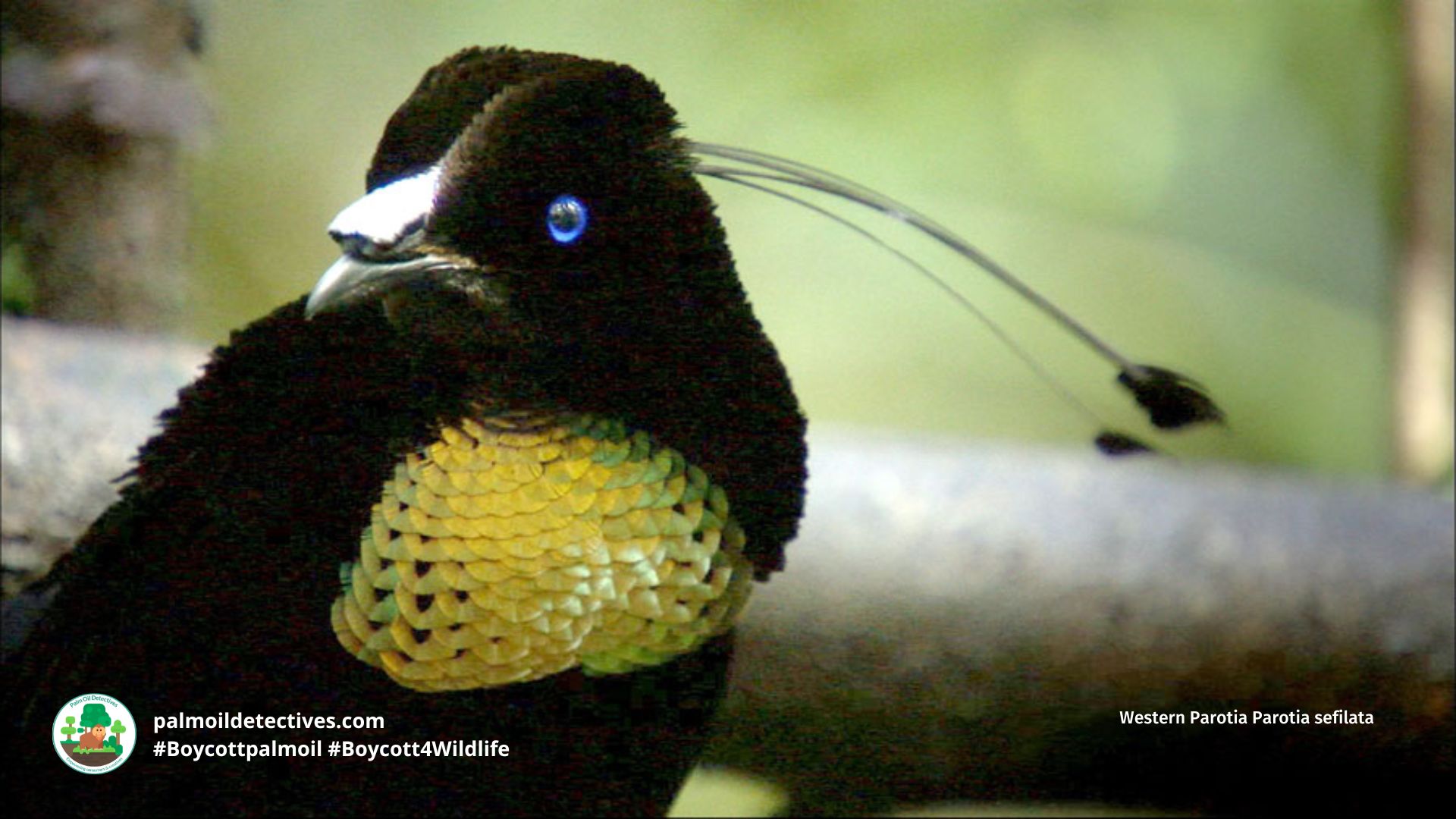
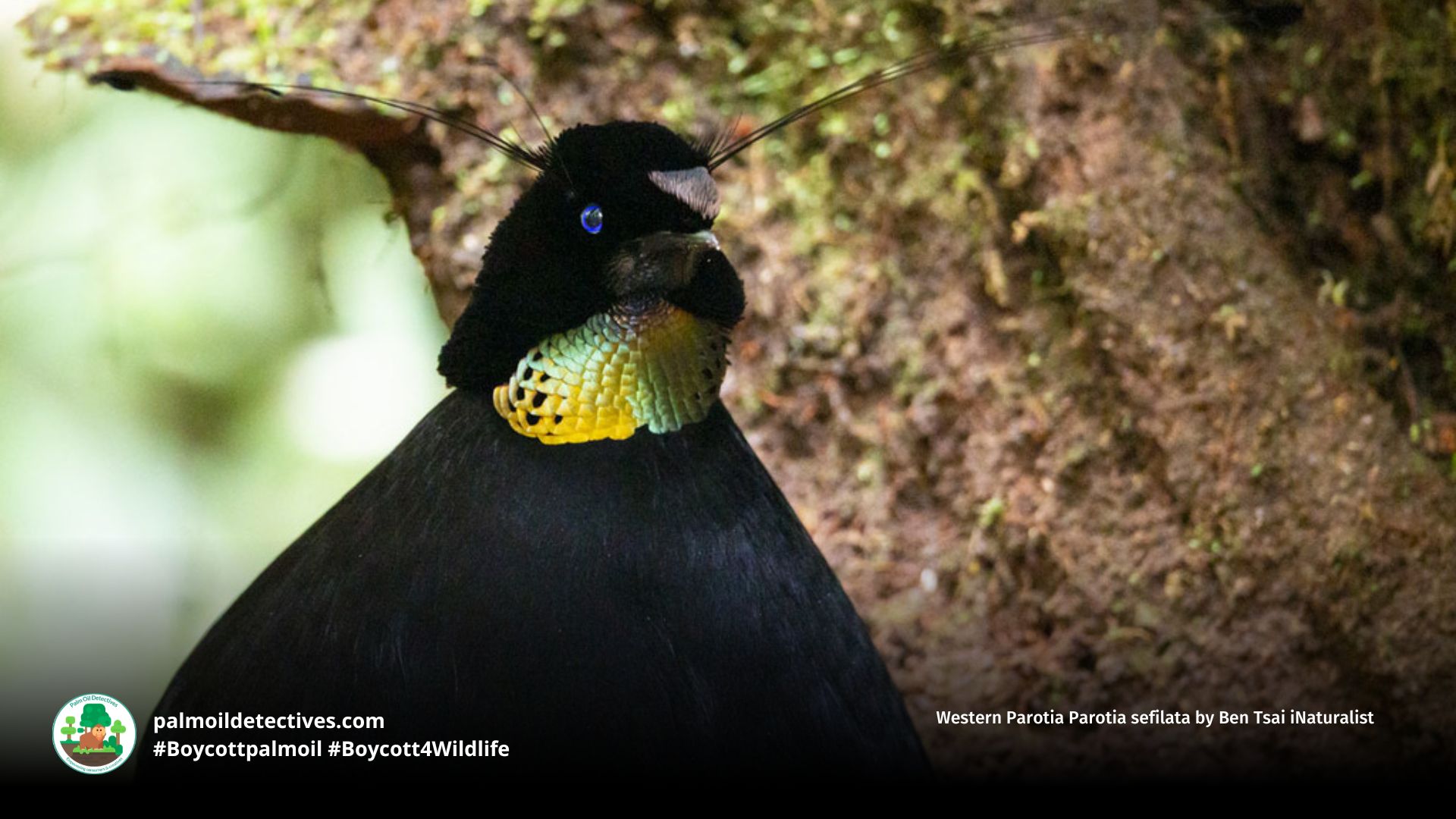
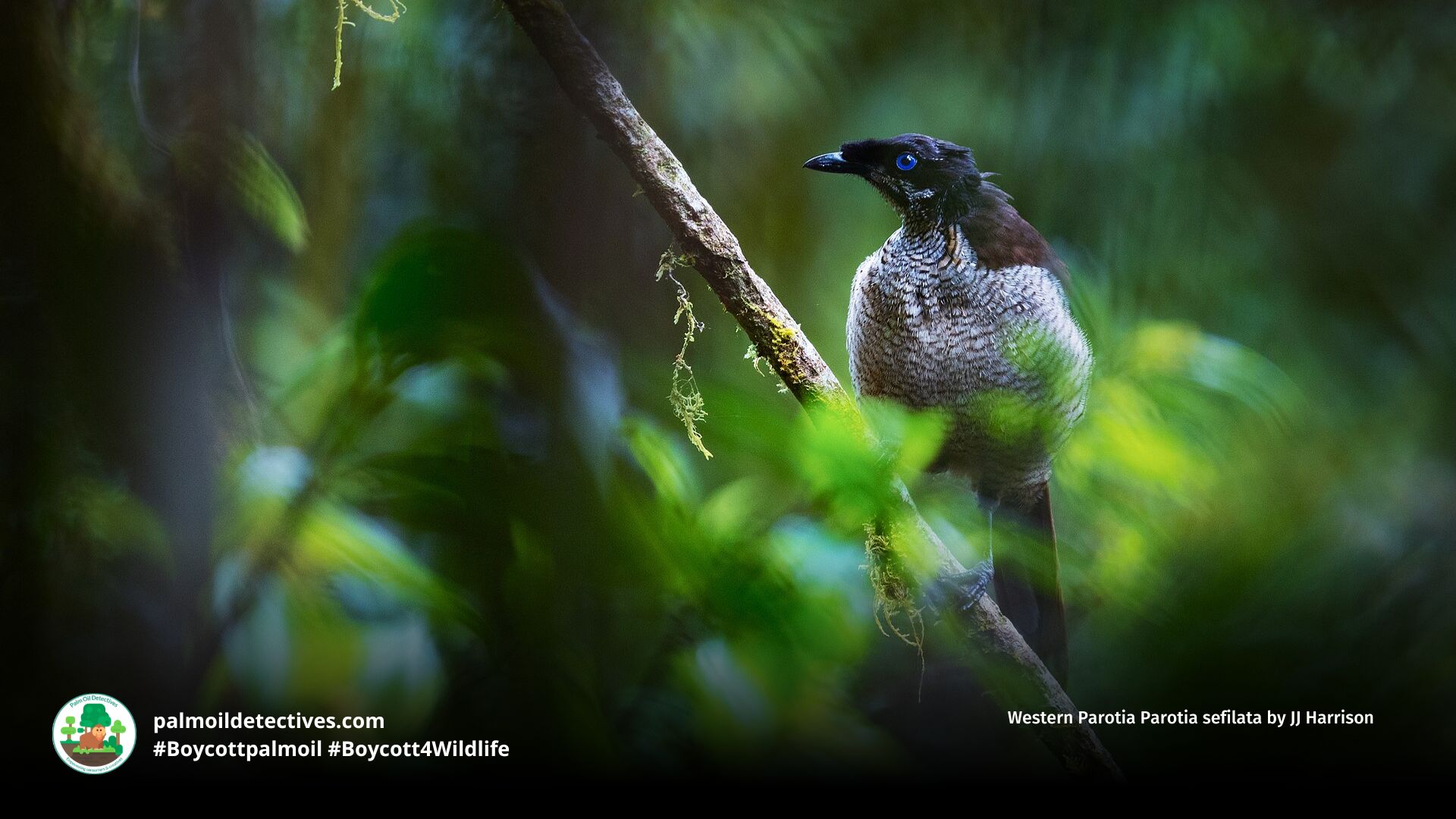
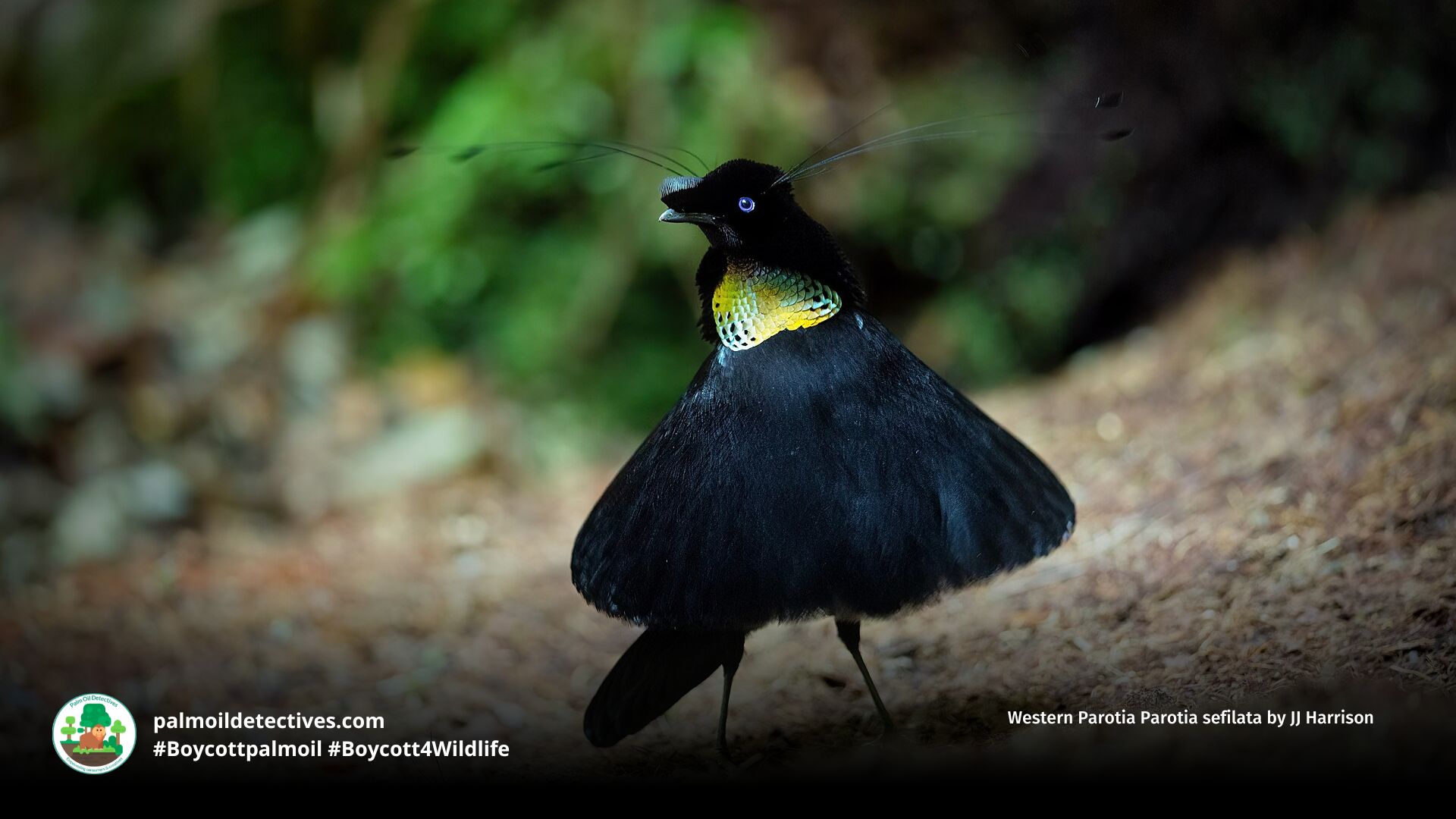
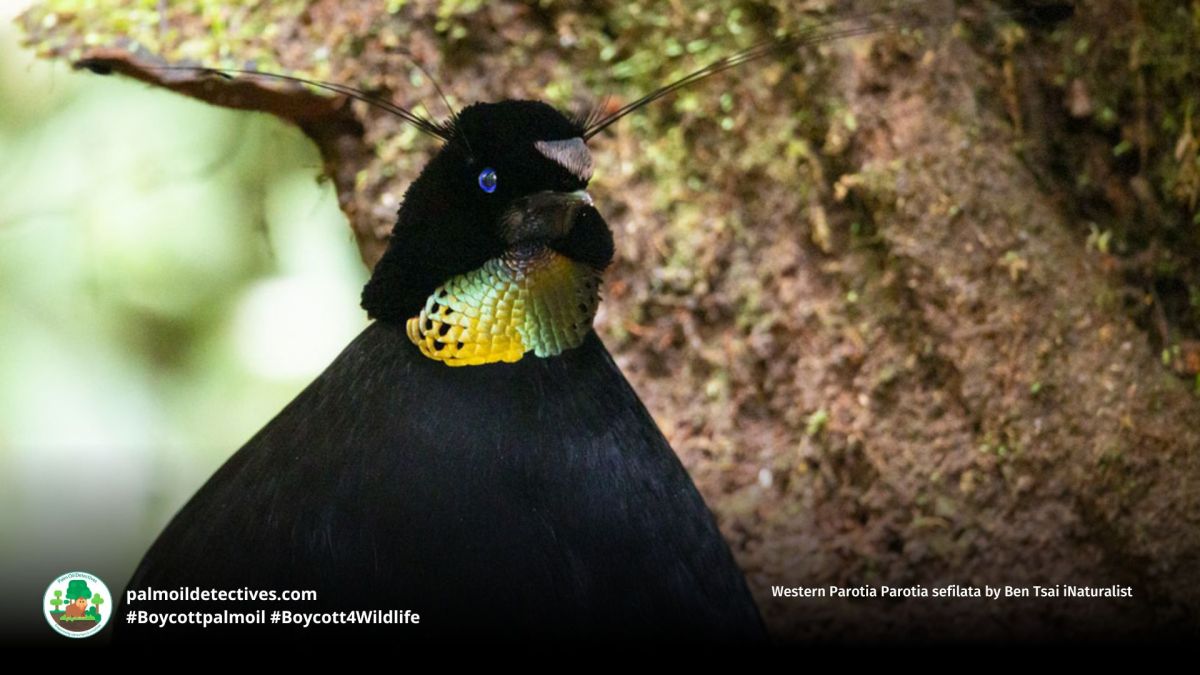
The Western Parotia Parotia sefilata, also called the Arfak Parotia, is a stunning bird-of-paradise of #WestPapua known for their mesmerising, ballerina-like courtship dance. Male #birds fan their iridescent flank plumes into a skirt and dazzle females with precise steps and shimmering throat shields. Although listed as Least Concern in 2016, this designation is dangerously outdated. The forests these rare birds call home have suffered catastrophic #deforestation in recent years due to the explosion of #palmoil plantations. These once-pristine regions are now fragmented and rapidly vanishing. Immediate action is needed to protect the Western Parotia from becoming the next victim of extinction.#BoycottPalmOil #Boycott4Wildlife

https://youtu.be/nNqV1BfSsZY

Unusual behaviours like mounting reveal complexity to the lives of Western #Parotia, thrilling #birds of paradise in #WestPapua. #Palmoil is a major threat. Fight for them and indigenous peoples #Boycottpalmoil #Boycott4Wildlife @palmoildetect https://palmoildetectives.com/2026/01/25/western-parotia-parotia-sefilata/

Share to BlueSky Share to Twitter

With jet black plumage 🖤 and bright green 💚 wattles, male Western Parotia #birds 🐦🦜🦚 of paradise gleam like scaly armour when they dance 🎶 Resist against their #extinction in #WestPapua when you #Boycottpalmoil 🌴🚫 #Boycott4Wildlife @palmoildetect https://palmoildetectives.com/2026/01/25/western-parotia-parotia-sefilata/

Share to BlueSky Share to Twitter

Appearance & Behaviour

Male Western Parotias are instantly recognisable by their jet-black plumage, metallic green wattles that gleam like scaled armour, and three distinctive wire-like head plumes that curl outward from each side of the crown—features that inspired the species name, derived from the Latin sex filum, meaning ‘six threads.’ A dazzling inverted silver triangle on their head flashes during display, perfectly offset by their elegant black flank plumes which form a flared skirt in courtship. Females are more subdued, clad in streaky brown feathers, allowing them to blend into the forest understorey.

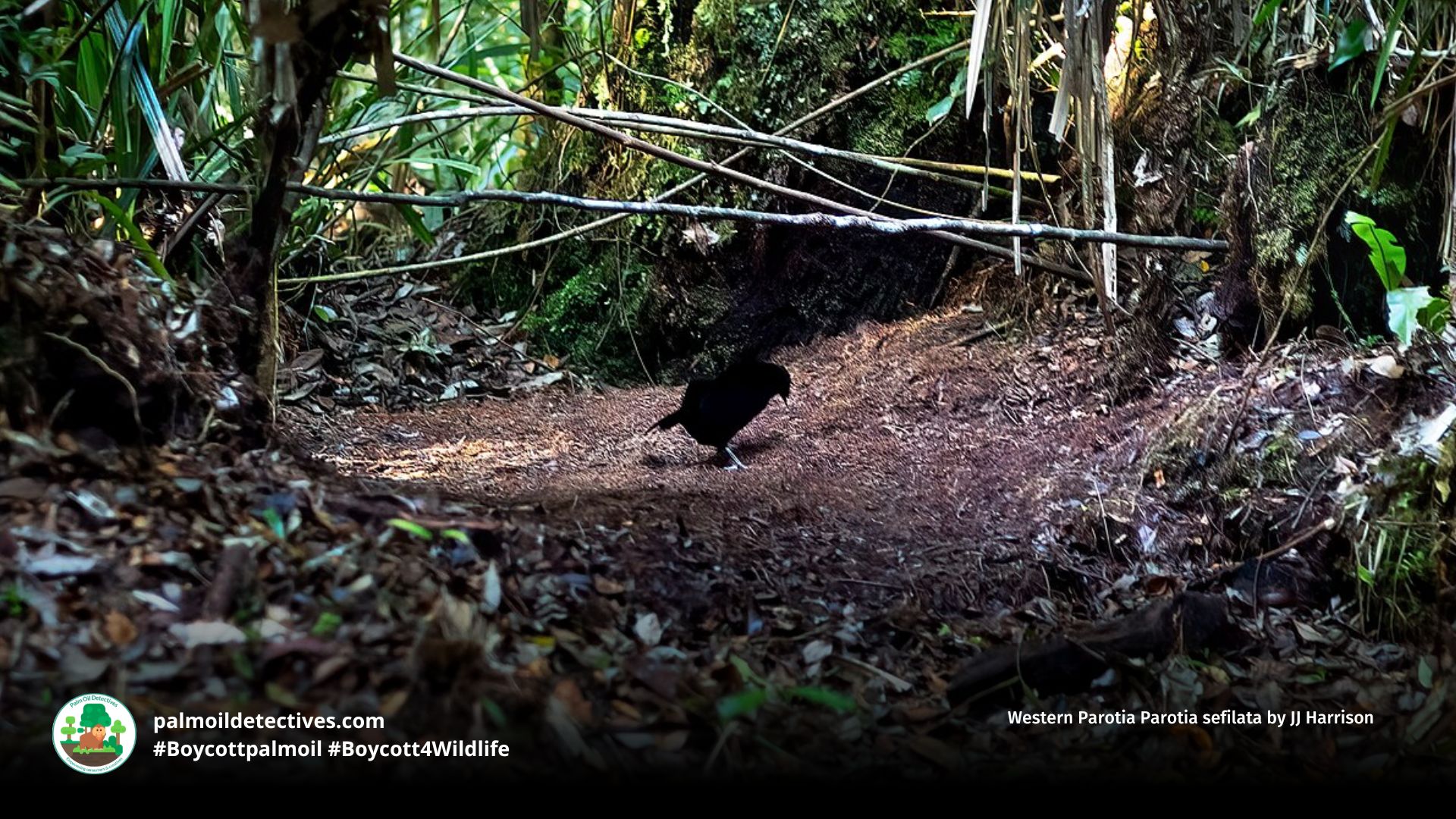
This species of bird-of-paradise is polygynous. Males gather in exploded leks—loosely spaced display grounds—where they clear leaf-littered forest floors to create courts. On these makeshift stages, they perform intricate displays to attract females, combining pirouettes, head bobs, feather shimmers, and rapid shakes. A 2024 behavioural study also observed rare alternative mating tactics, including homosexual mounting and sneak copulation attempts by female-plumaged birds, suggesting untapped behavioural complexity (MacGillavry et al., 2024).

Western Parotia Parotia sefilata boycott palm oilWestern Parotia Parotia sefilata by Ben Tsai iNaturalist (2)Western Parotia Parotia sefilataWestern Parotia Parotia sefilata by Ben Tsai iNaturalistWestern Parotia Parotia sefilata by JJ Harrison (2)Western Parotia Parotia sefilata by JJ Harrison (3)Western Parotia Parotia sefilata by JJ HarrisonWestern Parotia Parotia sefilata threats

Threats

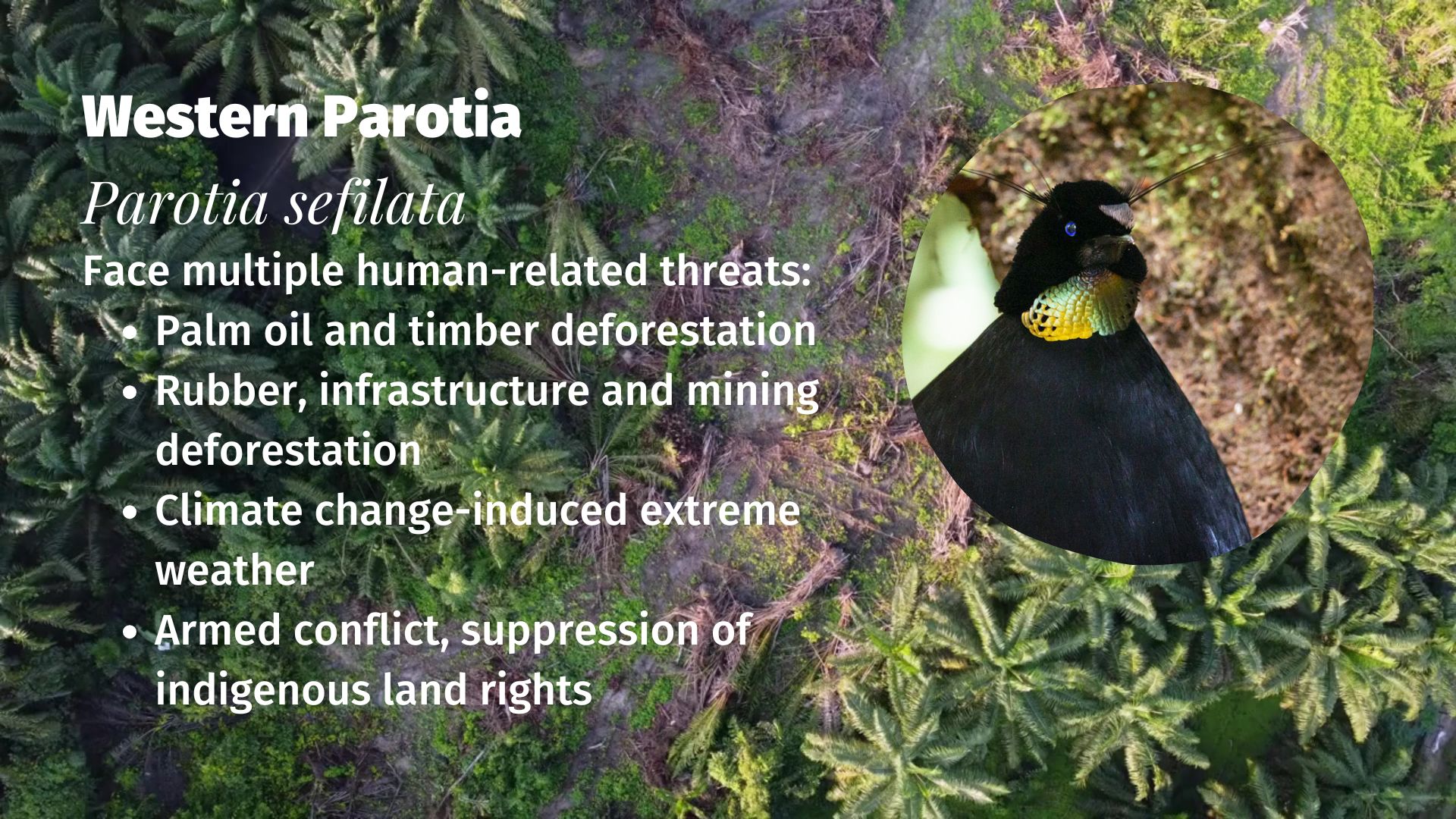
The Western Parotia is officially listed as Least Concern, but this 2016 classification dangerously underrepresents their current reality. Since that assessment, massive deforestation for timber and palm oil has devastated much of their limited range, particularly across the Vogelkop Peninsula and Wandammen Mountains. The threats are mounting and accelerating due to the following drivers:

Western Parotia Parotia sefilata threats

Palm oil deforestation

Large-scale clearing of primary rainforest to make way for industrial palm oil plantations is now rampant across the Bird’s Head (Vogelkop) Peninsula. Even remote montane forests where Western Parotias lek and nest are not safe, as new roads are cut to expand plantation frontiers.

Timber deforestation

Commercial timber extraction is removing centuries-old forest giants that the Western Parotia depends on for fruit, foraging and nesting. Logging roads also fragment habitat, increase fire risk, and provide access to previously undisturbed ecosystems.

Deforestation for mining, rubber and infrastructure projects

Government-backed agribusiness schemes are encouraging monocultures such as oil palm and rubber, which completely erase the forest understory and tree canopy vital for the Parotia’s food and shelter.

Mining concessions in West Papua—often enforced with military support—are rapidly opening up forests in the Wandammen Mountains, overlapping with the Parotia’s habitat. Road construction to access mines and plantations is fragmenting the landscape irreparably.

Climate change-induced extreme weather

The species is restricted to highland forest. As temperatures rise and human pressures encroach from below, their montane habitat may shrink to mountaintop fragments, leaving no room for retreat.

Colonial exploitation, military conflict and suppression of Indigenous land rights:

Indigenous Melanesians have stewarded Papuan forests for millennia. Today, state and corporate projects continue to override Indigenous consent, leading to ecological destruction and social injustice hand-in-hand.

These combined threats pose a serious and immediate danger to the survival of the Western Parotia. Without urgent action to halt deforestation and recognise Indigenous land sovereignty, the species could slide rapidly toward extinction unnoticed.

Geographic Range

Western Parotias are found exclusively in the montane and submontane rainforests of the Vogelkop Peninsula and the Wandammen Mountains in West Papua. They are forest specialists, requiring old-growth rainforest to support their complex courtship behaviour and nesting needs. Since their last assessment in 2016, widespread forest loss has occurred across these regions, particularly from illegal logging and palm oil expansion, putting their long-term survival in serious jeopardy.

Diet

Western Parotias primarily feed on fruits—especially figs—and supplement their diet with arthropods. Their foraging occurs at various forest levels, but they prefer mid-canopy and understorey, where fruiting trees and insect-rich foliage are abundant.

Mating and Reproduction

Courtship and nesting behaviour are marked by sexual division of labour. Only the female builds the nest and raises the chick. Nests are often camouflaged in dense foliage. Although the precise breeding season remains unclear, it is believed to vary by elevation and fruiting cycles. Male courtship is heavily influenced by evolutionary modularity in display traits, which have diverged over time, giving rise to the extravagant variety seen across the Parotia genus (Scholes, 2008).

FAQs

How many Western Parotias are left in the wild?

There are no exact population estimates for the Western Parotia. The IUCN has classified them as Least Concern, but this was based on assessments from 2016. Since then, vast tracts of their habitat have been lost. Without a recent survey, the current population trend is unknown, but it is likely decreasing due to ongoing deforestation (BirdLife International, 2016).

How long do Western Parotias live?

In the wild, birds-of-paradise often live between 5 to 10 years, though lifespan data for this species is limited. In captivity, related species have reached over 15 years, but no long-term studies exist for Parotia sefilata specifically.

What challenges do conservationists face protecting this species?

Conservation of the Western Parotia is complicated by a lack of recent data and the remoteness of their habitat. The Vogelkop and Wandammen regions are undergoing rapid transformation due to illegal logging and palm oil expansion, often facilitated by state-backed infrastructure projects. These forests also fall within contested indigenous lands, and conservation solutions must be rooted in indigenous sovereignty to be effective.

Is the Western Parotia affected by the exotic pet trade?

Unlike parrots and smaller songbirds, Western Parotias are not commonly targeted for the exotic pet trade, likely due to their remote habitat and specialised diet. However, increased accessibility due to road construction could change this. It is essential to remain vigilant and oppose any wildlife trafficking.

Take Action!

Use your wallet as a weapon to stop extinction by boycotting palm oil. Always choose products that are 100% palm oil-free to avoid contributing to the deforestation that is pushing the Western Parotia closer to extinction. Support indigenous-led conservation efforts in West Papua and call for greater transparency around the spread of monoculture plantations. Protect the mesmerising courtship rituals of these remarkable birds by fighting to keep their forests standing. #BoycottPalmOil #Boycott4Wildlife #Vegan #BoycottMeat

Support the Western Parotia by going vegan and boycotting palm oil in the supermarket, it’s the #Boycott4Wildlife

Support the conservation of this species

This animal has no protections in place. Read about other forgotten species here. Create art to support this forgotten animal or raise awareness about them by sharing this post and using the #Boycottpalmoil #Boycott4Wildlife hashtags on social media. Also you can boycott palm oil in the supermarket.

Further Information

BirdLife International. (2016). Parotia sefilata. The IUCN Red List of Threatened Species 2016: e.T22706181A93913206. Retrieved 6 April 2025, from https://www.iucnredlist.org/species/22706181/93913206

MacGillavry, T., Janiczek, C., & Fusani, L. (2024). Video evidence of mountings by female-plumaged birds of paradise (Aves: Paradisaeidae) in the wild: Is there evidence of alternative mating tactics? Ethology. https://doi.org/10.1111/eth.13451

Scholes, E. (2008). Evolution of the courtship phenotype in the bird of paradise genus Parotia (Aves: Paradisaeidae): homology, phylogeny, and modularity. Biological Journal of the Linnean Society, 94(3), 491–504. https://doi.org/10.1111/j.1095-8312.2008.01012.x

Wikipedia contributors. (n.d.). Western parotia. Wikipedia. Retrieved 6 April 2025, from https://en.wikipedia.org/wiki/Western_parotia

Western Parotia Parotia sefilata boycott palm oil
Contribute to palm oil detectives - black rhino in profile

How can I help the #Boycott4Wildlife?


Take Action in Five Ways

1. Join the #Boycott4Wildlife on social media and subscribe to stay in the loop: Share posts from this website to your own network on Twitter, Mastadon, Instagram, Facebook and Youtube using the hashtags #Boycottpalmoil #Boycott4Wildlife.

Enter your email address

Sign Up

Join 3,176 other subscribers

2. Contribute stories: Academics, conservationists, scientists, indigenous rights advocates and animal rights advocates working to expose the corruption of the palm oil industry or to save animals can contribute stories to the website.

Wildlife Artist Juanchi Pérez

Wildlife Artist Juanchi Pérez

Read more

Mel Lumby: Dedicated Devotee to Borneo’s Living Beings

Mel Lumby: Dedicated Devotee to Borneo’s Living Beings

Read more

Anthropologist and Author Dr Sophie Chao

Anthropologist and Author Dr Sophie Chao

Read more

Health Physician Dr Evan Allen

Health Physician Dr Evan Allen

Read more

The World’s Most Loved Cup: A Social, Ethical & Environmental History of Coffee by Aviary Doert

The World’s Most Loved Cup: A Social, Ethical & Environmental History of Coffee by Aviary Doert

Read more

How do we stop the world’s ecosystems from going into a death spiral? A #SteadyState Economy

How do we stop the world’s ecosystems from going into a death spiral? A #SteadyState Economy

Read more

3. Supermarket sleuthing: Next time you’re in the supermarket, take photos of products containing palm oil. Share these to social media along with the hashtags to call out the greenwashing and ecocide of the brands who use palm oil. You can also take photos of palm oil free products and congratulate brands when they go palm oil free.

https://twitter.com/CuriousApe4/status/1526136783557529600?s=20

https://twitter.com/PhillDixon1/status/1749010345555788144?s=20

https://twitter.com/mugabe139/status/1678027567977078784?s=20

4. Take to the streets: Get in touch with Palm Oil Detectives to find out more.

5. Donate: Make a one-off or monthly donation to Palm Oil Detectives as a way of saying thank you and to help pay for ongoing running costs of the website and social media campaigns. Donate here

Pledge your support


Learn about other animals endangered by palm oil and other agriculture

GlobalSouth America S.E. AsiaIndiaAfricaWest Papua & PNGCapped Langur Trachypithecus pileatus

Capped Langur Trachypithecus pileatus

Keep reading

Mountain Tapir Tapirus pinchaque

Mountain Tapir Tapirus pinchaque

Keep reading

Saola Pseudoryx nghetinhensis

Saola Pseudoryx nghetinhensis

Keep reading

Tucuxi Sotalia fluviatilis

Tucuxi Sotalia fluviatilis

Keep reading

Frill-Necked Lizard Chlamydosaurus kingii

Frill-Necked Lizard Chlamydosaurus kingii

Keep reading

Grey Crowned Crane Balearica regulorum

Grey Crowned Crane Balearica regulorum

Keep reading


Learn about “sustainable” palm oil greenwashing

Read more about RSPO greenwashing

Lying Fake labelsIndigenous Land-grabbingHuman rights abusesDeforestation Human health hazards

A 2019 World Health Organisation (WHO) report into the palm oil industry and RSPO finds extensive greenwashing of palm oil deforestation and the murder of endangered animals (i.e. biodiversity loss)

Read moreWHO Bulletin on Palm Oil: Deforestation and ExtinctionWHO Bulletin on Palm Oil: Deforestation and ExtinctionWHO Bulletin on Palm Oil: Deforestation and ExtinctionWHO Bulletin on Palm Oil: Air Pollution and Health

#animals #Bird #birds #Birdsong #Boycott4wildlife #BoycottMeat #BoycottPalmOil #deforestation #EndSongbirdTrade #extinction #ForgottenAnimals #FreeWestPapua #gold #goldMining #hunting #indigenous #military #PalmOil #palmOilDeforestation #palmoil #Parotia #poaching #songbird #songbirds #vegan #vulnerable #VulnerableSpecies #WestPapua #WesternParotiaParotiaSefilata #WestPapua

View (PDF)

Black Bearded Saki Chiropotes satanas

Black Bearded Saki Chiropotes satanas

Red List Status: Endangered

Locations: North-eastern Amazon, Brazil (specifically from the Tocantins River in Pará east to around the Grajaú River in Maranhão)

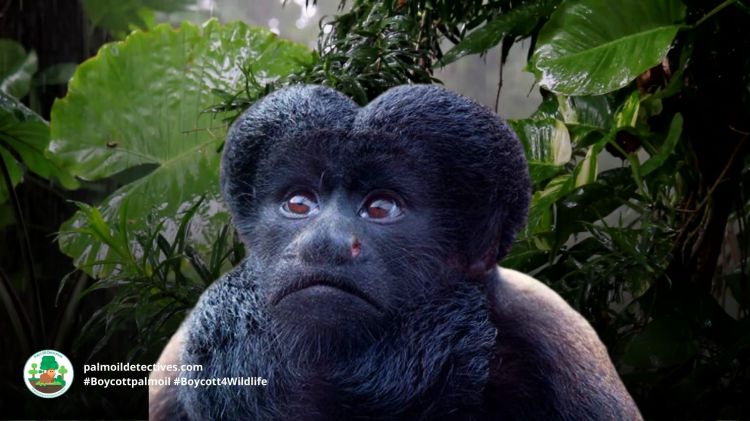
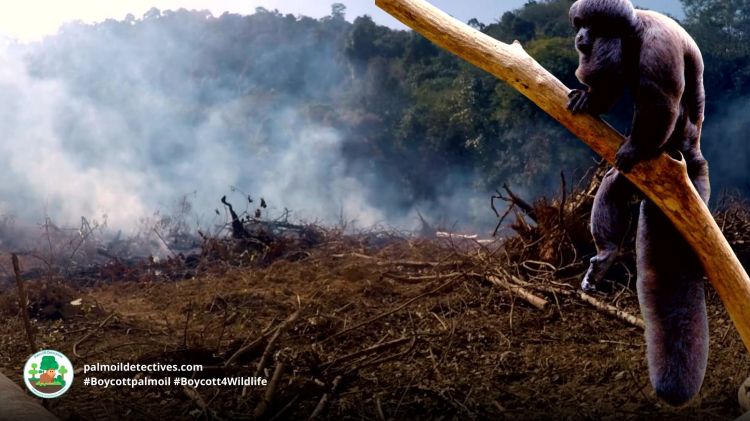
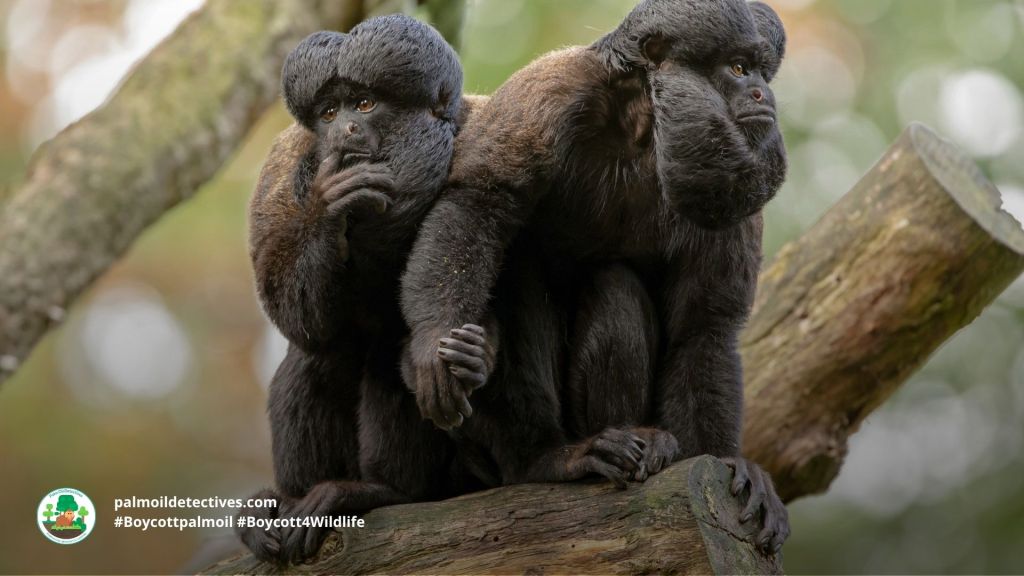
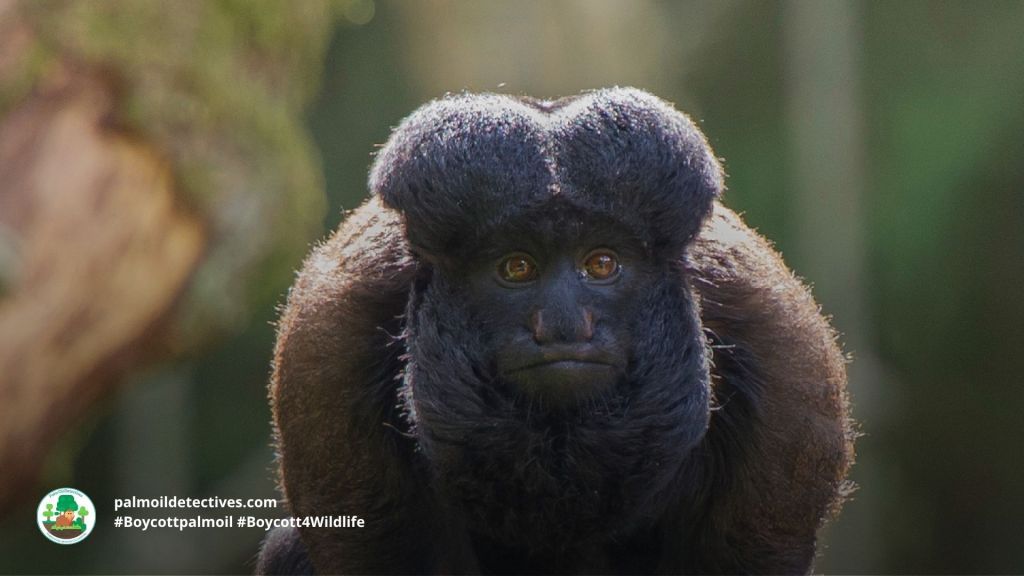
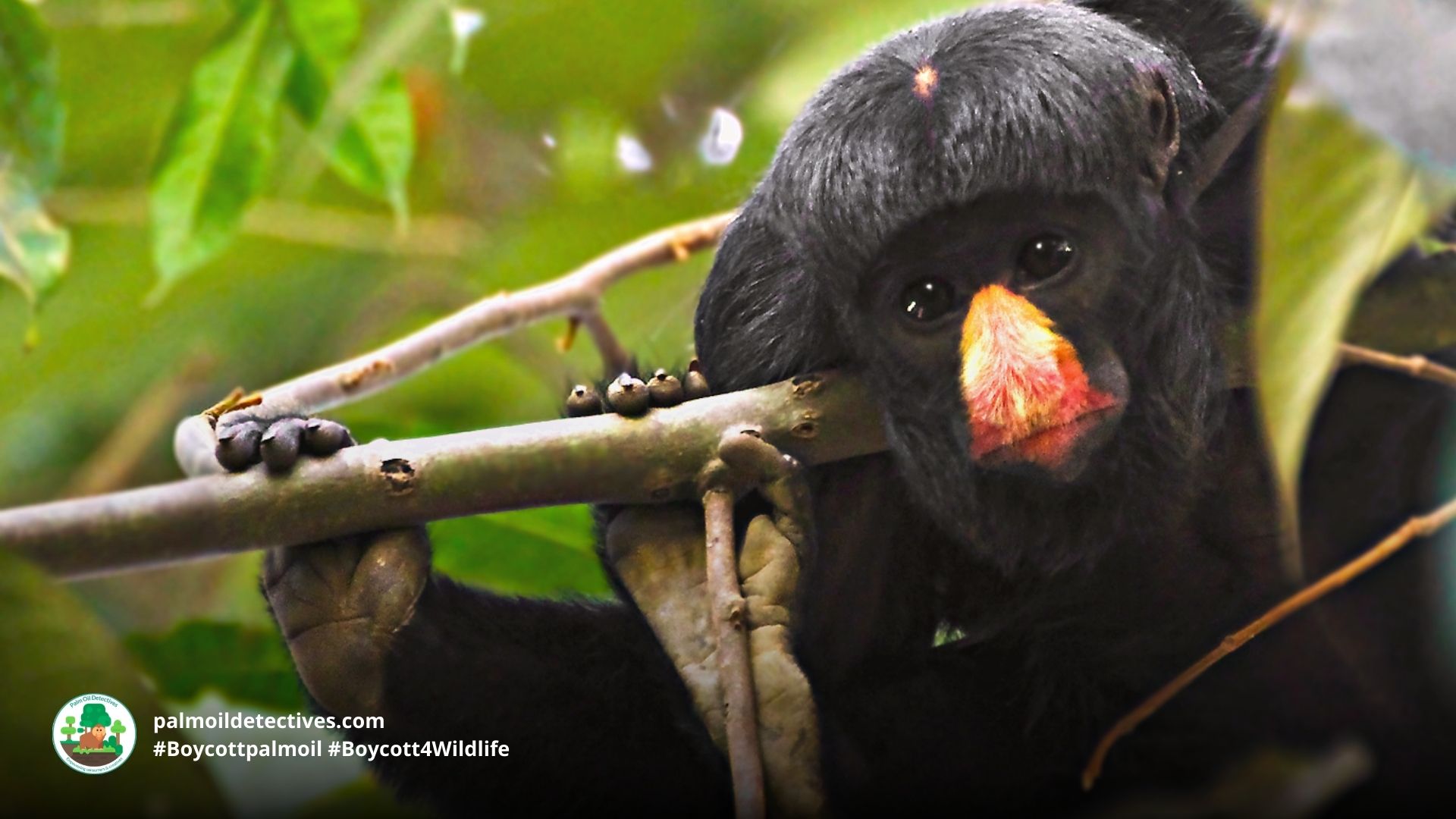
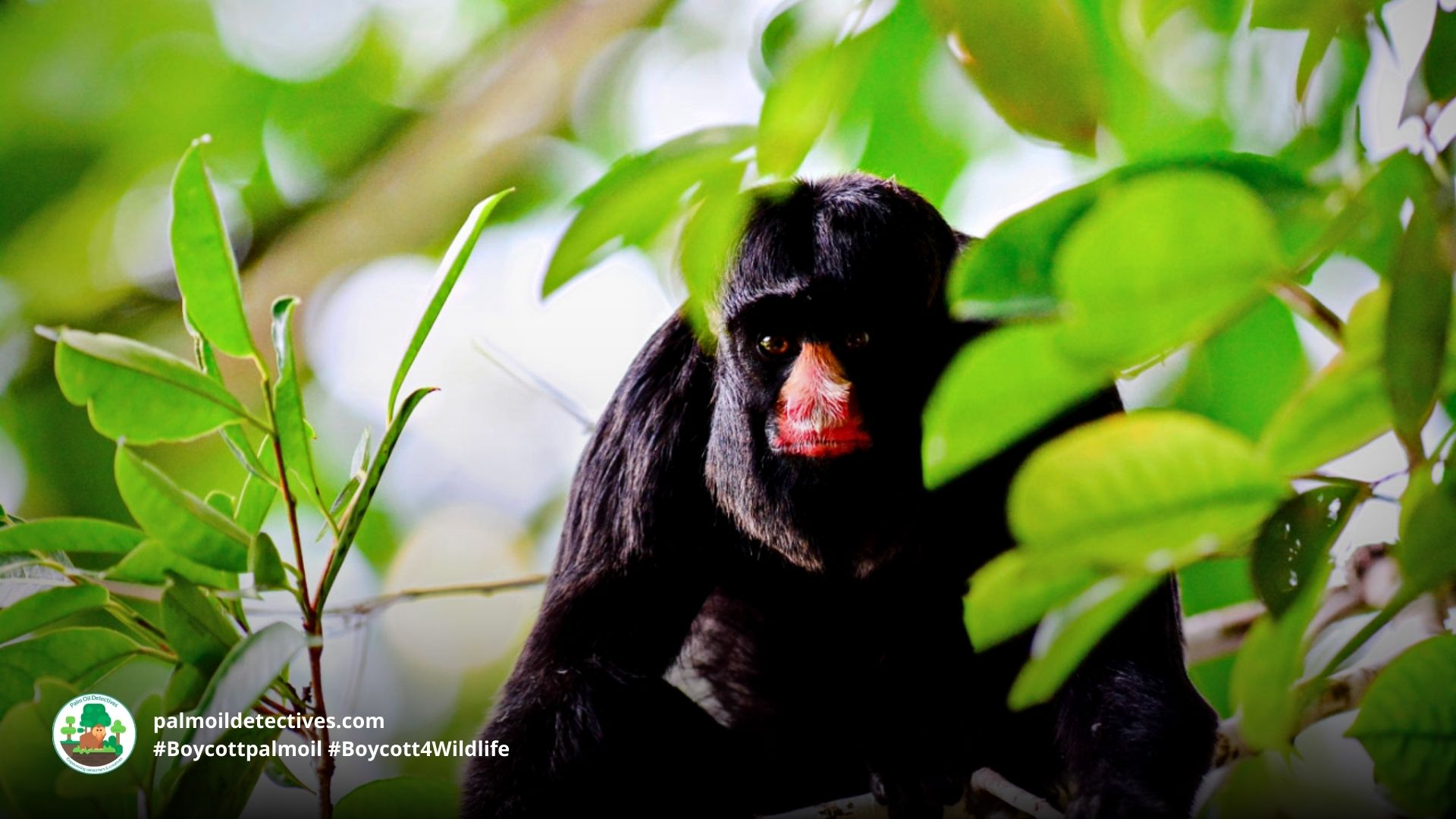
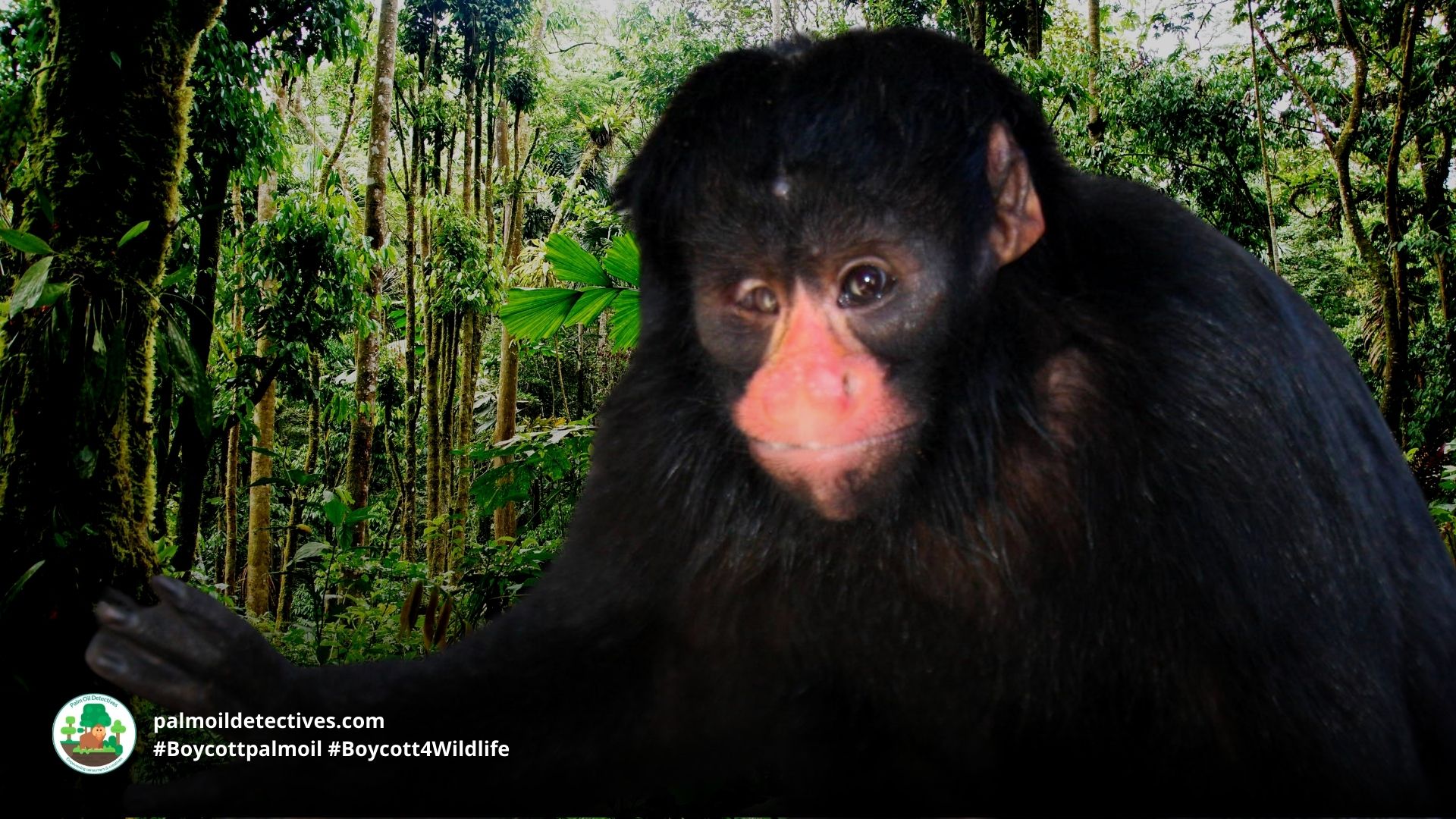
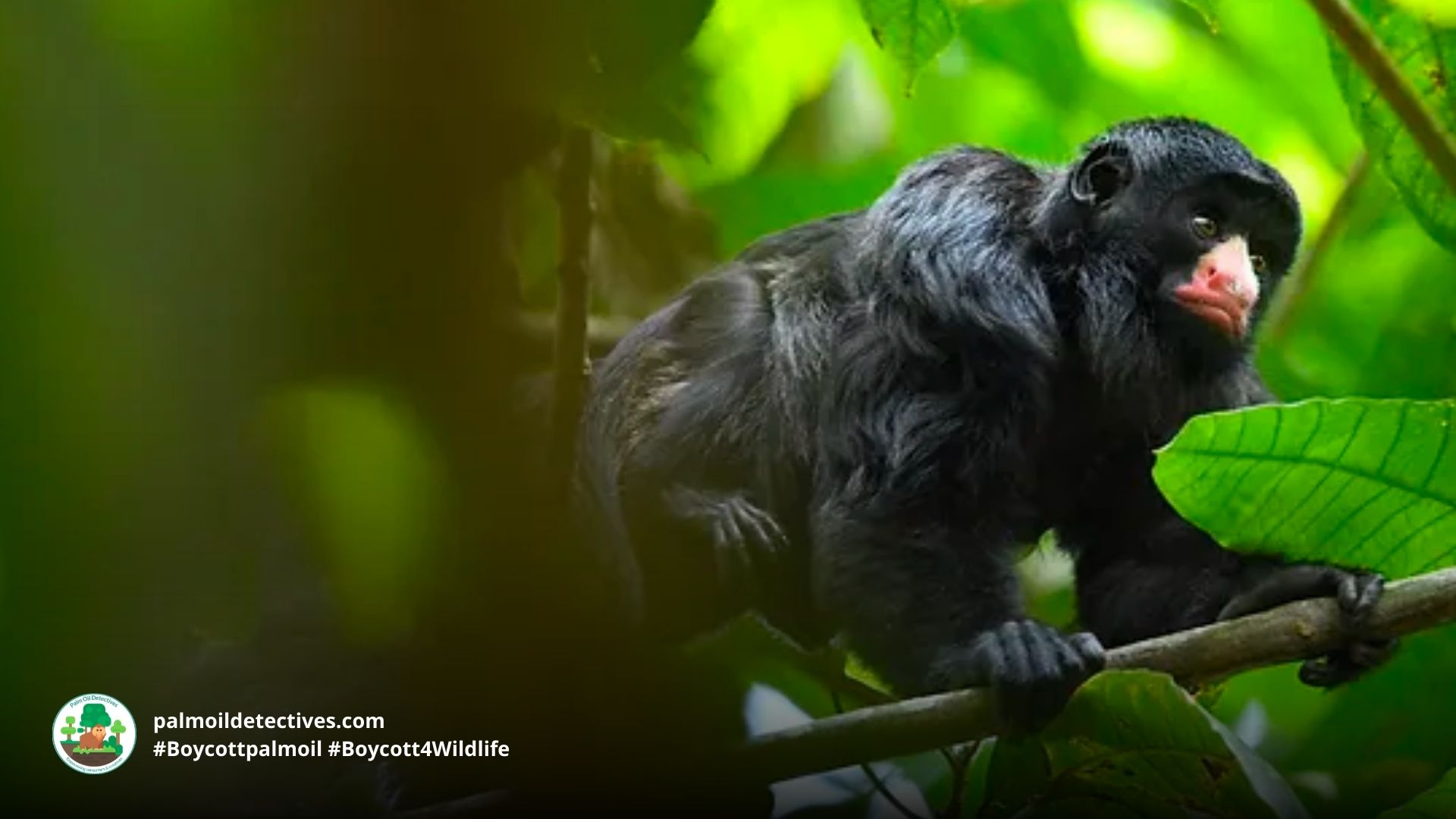
Beneath the towering canopy of the Amazon’s north-eastern forests, the Black Bearded Saki moves with quiet purpose, their distinctive shaggy beard and robust body a testament to their resilience in a world under siege. The air is thick with the scent of damp earth and the distant calls of unseen creatures, but the forest is changing—#roads, #dams, and #agriculture are carving scars across the landscape, fragmenting the Black Bearded Saki’s ancestral home. The black bearded saki’s survival is threatened by relentless deforestation and hunting, their fate bound to the fate of the forest—fight for their survival every time you shop #BoycottPalmOil #Boycott4Wildlife.

https://youtu.be/Cjh19F9Ux9o

Black Bearded #Sakis are #endangered large #monkeys 🐒 endemic to #Brazil 🇧🇷 #SouthAmerica they are #endangered by #timber #palmoil #hydroelectric dam #deforestation. Help save them and #Boycottpalmoil 🌴🩸🔥🙊⛔️ #Boycott4Wildlife @palmoildetect https://palmoildetectives.com/2021/08/28/black-bearded-saki-chiropotes-satanas/

Share to BlueSkyShare to Twitter

Appearance and Behaviour

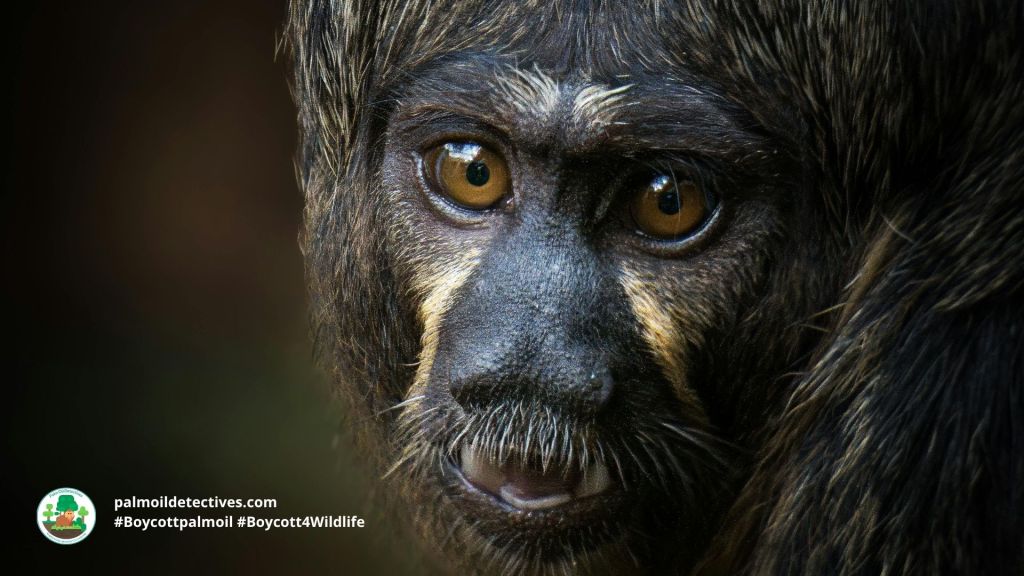
Black bearded sakis are medium-sized primates, their bodies draped in thick, dark fur and their faces framed by a distinctive, flowing beard. Adults typically measure around 50 centimetres in length, with a tail nearly as long as their body, and weigh between 2.5 and 3.5 kilograms. Their robust build and strong limbs allow them to move with surprising agility through the upper canopy, where they spend most of their lives. The black bearded saki’s most remarkable feature is their powerful jaw and specialised teeth, which enable them to crack open the hard shells of unripe fruits to reach the nutritious seeds inside. This adaptation makes them one of the most efficient seed predators and seed dispersers in the Amazon, and their foraging habits play a vital role in shaping the forest ecosystem.

Black bearded sakis live in groups of up to 40 individuals, though smaller groups are more common. They are highly social, with strong bonds between group members, and communicate through a variety of vocalisations, including chirps, whistles, and alarm calls. Their days are spent foraging, resting, and moving through the canopy, rarely descending to the forest floor. The black bearded saki’s presence is often marked by the sound of falling fruit and the rustle of leaves as they leap from branch to branch.

Black Bearded Saki Chiropotes satanasBlack Bearded Saki Chiropotes satanasBlack Bearded Saki Chiropotes satanasBlack Bearded Saki Chiropotes satanasBlack Bearded Saki Chiropotes satanasBlack Bearded Saki Chiropotes satanasBlack Bearded Saki Chiropotes satanas pairBlack Bearded Saki Chiropotes satanas boycott palm oil Black Bearded Saki Chiropotes satanas threats Black Bearded Saki Chiropotes satanasBlack Bearded Saki Chiropotes satanas close-up of faceBlack Bearded Saki Chiropotes satanas close up

Threats

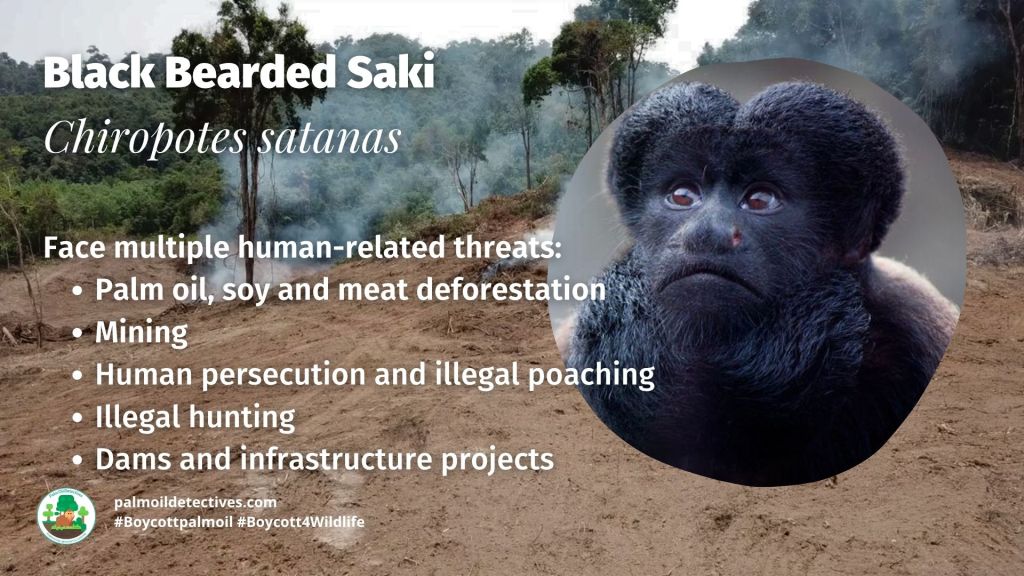
The greatest risks for the future survival of the Black Bearded Saki, also known as the Black Cuxiú are the loss and fragmentation of their habitat and hunting pressure.

IUCN Red list

Palm oil, meat, and soy deforestation

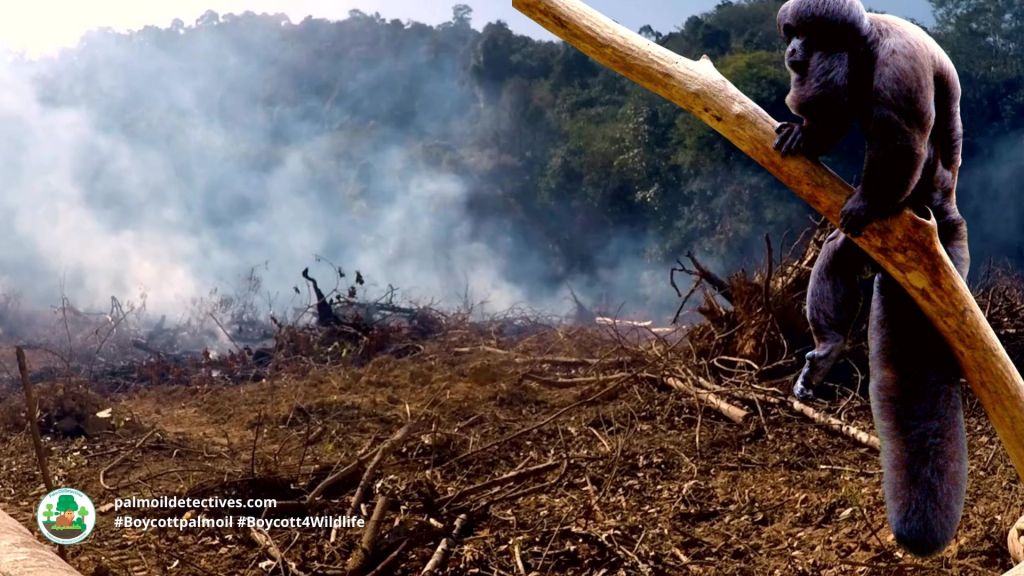
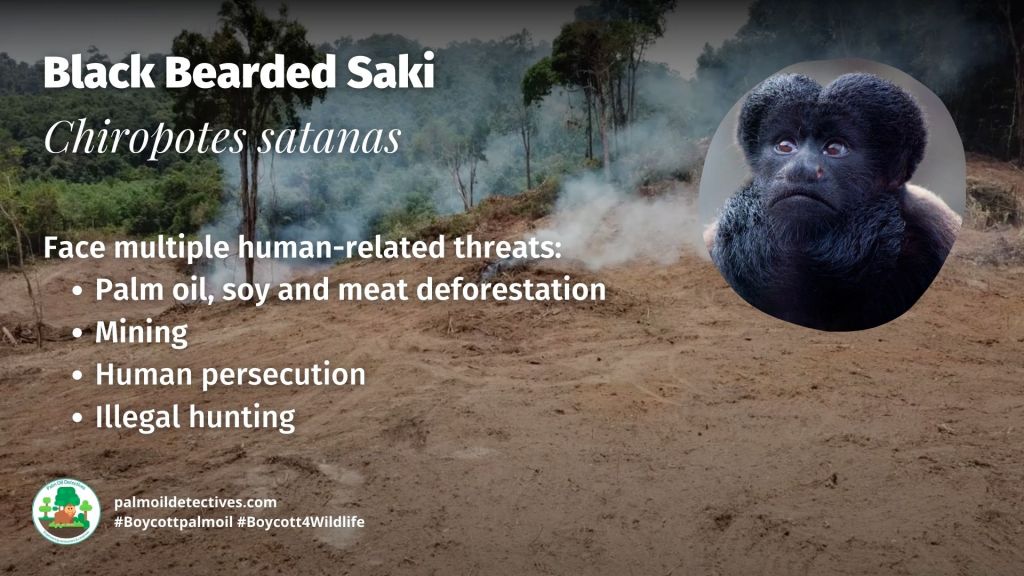
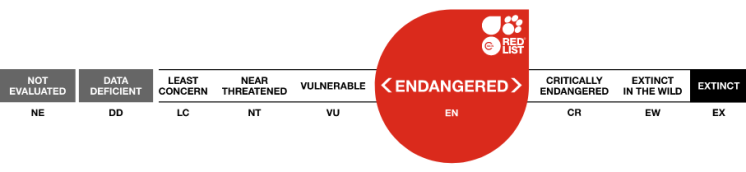
The black bearded saki is classified as Endangered on the Red List, with the loss and fragmentation of their forest habitat the primary threat to their survival. In the north-eastern Amazon, large-scale infrastructure projects—such as highways and the Tucurúi Dam—have destroyed vast tracts of forest, while smaller-scale logging and agriculture continue to fragment the remaining habitat. The forest, once a living, breathing entity, is being replaced by roads, fields, and settlements, leaving only isolated patches where the black bearded saki can survive. This fragmentation isolates populations, reduces genetic diversity, and increases the risk of disease and local extinction. The black bearded saki’s ability to adapt to habitat loss is limited, and their long-term survival depends on the protection and restoration of connected forest landscapes.

Hunting and poaching

Hunting for bushmeat is a persistent threat to the black bearded saki, with individuals targeted for their meat and, in some cases, their tails, which are used as dusters. The influx of people into previously uninhabited areas of the Amazon has increased hunting pressure, and the loss of habitat makes sakis more vulnerable to capture. Hunting disrupts social groups, reduces population numbers, and threatens the genetic health of remaining populations. The black bearded saki is already locally extinct in much of its original range, and continued hunting could push them closer to extinction.

Habitat fragmentation and climate change

The fragmentation of the Amazon’s forests has profound effects on the black bearded saki. Small, isolated forest patches limit the availability of food and mates, and groups living in these fragments often show reduced movement and vocalisation, as well as increased resting. Population densities in small fragments can increase, leading to higher rates of disease and parasite transmission. Climate change adds further pressure, altering rainfall patterns and the availability of key food sources. The black bearded saki’s world is becoming hotter, drier, and less predictable, with the forests they depend on shrinking year by year.

Diet

Black bearded sakis are among the most specialised seed dispersers in the Amazon, with seeds making up the majority of their diet. They spend at least 75% of their feeding time consuming seeds from more than 50 different fruit species, using their powerful jaws and specialised teeth to crack open hard-shelled fruits that few other animals can access. Their diet also includes ripe fruit, flowers, leaf stalks, and arthropods such as caterpillars, termites, and gall wasps. The black bearded saki’s foraging habits are closely tied to the seasonal availability of fruit, with peak feeding activity during the rainy season when many trees are fruiting. Their role as seed predators helps shape the composition of the forest, and their ability to exploit hard-shelled fruits gives them a unique niche in the ecosystem.

Reproduction and Mating

Little is known about the reproductive habits of black bearded sakis in the wild, but observations in captivity and from related species suggest that births occur at the beginning of the rainy season, typically in December or January. Gestation is estimated to last four to five months, and females give birth to a single infant. The mother is the primary caregiver, nursing and carrying her young until the infant is weaned at around three months of age. After weaning, infants remain close to their mothers for protection, and strong social bonds within the group help ensure the survival of young sakis. The reproductive success of black bearded sakis is closely tied to the availability of food and the stability of their forest home.

Geographic Range

The black bearded saki is endemic to the far eastern Amazon in Brazil, with a range restricted to a relatively small region from the Tocantins River in Pará east to around the Grajaú River in Maranhão. They inhabit primary terra firme forests and, occasionally, regenerating forests, rarely descending to the forest floor. The natural home range of a black bearded saki group can vary from 200 to 250 hectares, but habitat loss and fragmentation have reduced the size and connectivity of these ranges. The black bearded saki is already locally extinct in much of its original range, and the remaining populations are increasingly isolated and vulnerable.

FAQs

How many black bearded sakis are left?

Estimates suggest that fewer than 2,500 mature black bearded sakis remain in the wild, with populations continuing to decline due to habitat loss, fragmentation, and hunting. The species is already locally extinct in much of its original range, and the remaining individuals are scattered across increasingly isolated forest fragments.

What are the characteristics of the black bearded saki?

The black bearded saki is a medium-sized primate with thick, dark fur and a distinctive, flowing beard. Adults typically measure around 50 centimetres in length, with a tail nearly as long as their body, and weigh between 2.5 and 3.5 kilograms. They are highly specialised seed predators, with powerful jaws and unique dentition that allow them to crack open hard-shelled fruits. Black bearded sakis live in social groups, communicate through a variety of vocalisations, and spend most of their lives in the upper canopy.

What do black bearded saki eat?

Black bearded sakis are highly specialised seed predators, with seeds making up the vast majority of their diet. They spend at least 75% of their feeding time consuming seeds from more than 50 different fruit species, using their robust jaws and specialised teeth to crack open hard-shelled fruits that many other animals cannot access. Their diet also includes fleshy fruits and, to a lesser extent, insects. They are particularly fond of plants from the Sapotaceae, Lecythidaceae, and Chrysobalanaceae families. This dietary flexibility allows black bearded sakis to adapt to changing forest conditions, but their reliance on certain tree species makes them vulnerable to habitat loss and selective logging.

Is the black bearded saki a monkey?

Yes, the black bearded saki is a monkey—specifically, a New World monkey native to the Amazon rainforest. Unlike apes, monkeys have tails, and the black bearded saki’s long, muscular tail helps them balance as they move through the trees. They are part of the bearded saki group, known for their robust build, thick fur, and specialised feeding habits.

What are the main threats to the survival of the black bearded saki?

The main threats to the survival of the black bearded saki are habitat loss and fragmentation caused by infrastructure projects, logging, and agriculture, as well as hunting for bushmeat. The loss of forest isolates populations, reduces genetic diversity, and increases the risk of disease and local extinction. Hunting further reduces population numbers and disrupts social groups.

How does habitat fragmentation affect the black bearded saki?

Habitat fragmentation isolates black bearded saki groups, reducing the availability of food and mates and increasing the risk of disease. Groups living in small, isolated forest patches often show reduced movement and vocalisation, as well as increased resting. Population densities in small fragments can increase, leading to higher rates of disease and parasite transmission. The black bearded saki’s ability to adapt to habitat loss is limited, and their long-term survival depends on the protection and restoration of connected forest landscapes.

Do black bearded sakis make good pets?

Black bearded sakis do not make good pets. Captivity causes extreme stress, loneliness, and early death for these highly social, intelligent primates. The pet trade and hunting for bushmeat rip families apart and fuel extinction, as infants are stolen from their mothers and forced into unnatural, impoverished conditions. Protecting black bearded sakis means rejecting the illegal pet trade and supporting their right to live wild and free in their forest home.

Where do bearded sakis live?

Bearded sakis, including the black bearded saki, are endemic to the Amazon rainforest in South America. The black bearded saki specifically inhabits a small region in north-eastern Brazil, from the Tocantins River in Pará east to the Grajaú River in Maranhão. They prefer primary tropical rainforests with dense, continuous canopies, which provide safety from predators and abundant food sources. Their natural home ranges can vary from 200 to 250 hectares, but habitat fragmentation has dramatically reduced the size and connectivity of these ranges. Today, black bearded sakis are found only in scattered forest fragments, making their survival increasingly precarious.

What is the lifespan of a black bearded saki?

The lifespan of the black bearded saki is estimated to be up to 18 years in the wild, with sexual maturity typically reached at around 4 years of age. Females usually give birth every two years, and the long interval between births suggests a relatively slow reproductive rate. Closely related bearded saki species have been known to live up to 20 years in the wild, though specific data for the black bearded saki remains limited. Their longevity is closely tied to the quality and continuity of their forest habitat, with threats such as habitat destruction and hunting potentially reducing average lifespans in fragmented environments

Take Action!

Use your wallet as a weapon and #BoycottPalmOil #Boycott4Wildlife. Support indigenous-led conservation and agroecology. Reject products linked to deforestation, mining, and the illegal wildlife trade. Adopt a #vegan lifestyle and #BoycottMeat to protect wild and farmed animals alike. Every choice matters—stand with the black bearded saki and defend the forests of the Amazon.

Black Bearded Saki Chiropotes satanasBlack Bearded Saki Chiropotes satanasBlack Bearded Saki Chiropotes satanasBlack Bearded Saki Chiropotes satanas

You can support this beautiful animal

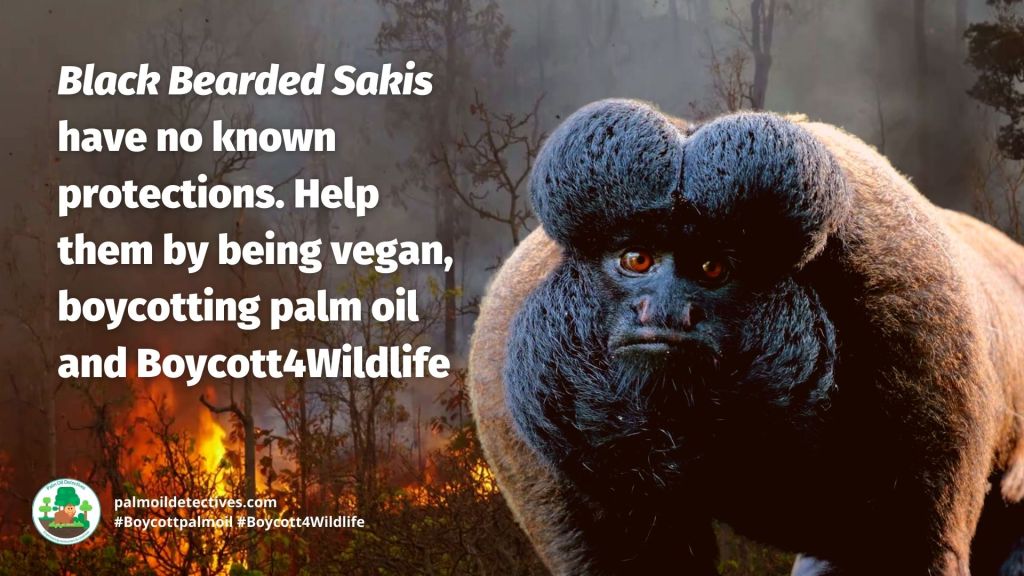
There are no known conservation activities for this animal. Share out this post to social media and join the #BoycottPalmOil #Boycott4Wildlife on social media to raise awareness

Further Information

ICUN endangered logo

Boubli, J. P., de Lima, E. M., Silva, M. N. F., & Silva Júnior, J. S. (2009). Bearded sakis in south-eastern Amazonia—back from the brink? Oryx, 43(2), 283–288. https://www.cambridge.org/core/journals/oryx/article/bearded-sakis-in-southeastern-amazoniaback-from-the-brink/703BC0853B02C2FB8017AD73EDA6BAB8

Neprimateconservancy.org. (n.d.). Black Bearded Saki, Chiropotes satanas. https://neprimateconservancy.org/black-bearded-saki/

Port-Carvalho, M., Muniz, C.C., Fialho, M.S., Alonso, A.C., Jerusalinsky, L. & Veiga, L.M. 2021. Chiropotes satanas (amended version of 2020 assessment). The IUCN Red List of Threatened Species 2021: e.T39956A191704509. https://dx.doi.org/10.2305/IUCN.UK.2021-1.RLTS.T39956A191704509.en. Downloaded on 05 June 2021.

van Roosmalen, M. G. M., Mittermeier, R. A., & Fleagle, J. G. (1988). Diet of the northern bearded saki (Chiropotes satanas chiropotes): A neotropical seed predator. American Journal of Primatology, 14(1), 11–35. https://doi.org/10.1002/ajp.1350140103

Veiga, L. M., & Ferrari, S. F. (2007). Conservation status of the black-bearded saki Chiropotes satanas in Maranhão, Brazil. International Journal of Primatology, 28(2), 347–358. https://doi.org/10.1007/s10764-007-9146-6

Wikipedia. (n.d.). Black bearded saki. https://en.wikipedia.org/wiki/Black_bearded_saki

Black Bearded Saki Chiropotes satanas


Contribute to palm oil detectives - black rhino in profile

How can I help the #Boycott4Wildlife?


Take Action in Five Ways

1. Join the #Boycott4Wildlife on social media and subscribe to stay in the loop: Share posts from this website to your own network on Twitter, Mastadon, Instagram, Facebook and Youtube using the hashtags #Boycottpalmoil #Boycott4Wildlife.

Enter your email address

Sign Up

Join 3,179 other subscribers

2. Contribute stories: Academics, conservationists, scientists, indigenous rights advocates and animal rights advocates working to expose the corruption of the palm oil industry or to save animals can contribute stories to the website.

Wildlife Artist Juanchi Pérez

Wildlife Artist Juanchi Pérez

Read more Mel Lumby: Dedicated Devotee to Borneo’s Living Beings

Mel Lumby: Dedicated Devotee to Borneo’s Living Beings

Read more Anthropologist and Author Dr Sophie Chao

Anthropologist and Author Dr Sophie Chao

Read more Health Physician Dr Evan Allen

Health Physician Dr Evan Allen

Read more The World’s Most Loved Cup: A Social, Ethical & Environmental History of Coffee by Aviary Doert

The World’s Most Loved Cup: A Social, Ethical & Environmental History of Coffee by Aviary Doert

Read more How do we stop the world’s ecosystems from going into a death spiral? A #SteadyState Economy

How do we stop the world’s ecosystems from going into a death spiral? A #SteadyState Economy

Read more

3. Supermarket sleuthing: Next time you’re in the supermarket, take photos of products containing palm oil. Share these to social media along with the hashtags to call out the greenwashing and ecocide of the brands who use palm oil. You can also take photos of palm oil free products and congratulate brands when they go palm oil free.

https://twitter.com/CuriousApe4/status/1526136783557529600?s=20

https://twitter.com/PhillDixon1/status/1749010345555788144?s=20

https://twitter.com/mugabe139/status/1678027567977078784?s=20

4. Take to the streets: Get in touch with Palm Oil Detectives to find out more.

5. Donate: Make a one-off or monthly donation to Palm Oil Detectives as a way of saying thank you and to help pay for ongoing running costs of the website and social media campaigns. Donate here

Pledge your support

#Agriculture #BlackBeardedSakiChiropotesSatanas #Boycott4wildlife #BoycottMeat #BoycottPalmOil #Brazil #bushmeat #dams #deforestation #endangered #EndangeredSpecies #ForgottenAnimals #hunting #hydroelectric #illegalPetTrade #infrastructure #Mammal #monkey #monkeys #palmoil #Primate #primates #roads #Sakis #SeedDispersers #seeddispersal #SouthAmericaSpeciesEndangeredByPalmOilDeforestation #SouthAmerica #timber #vegan

13 Reasons To Boycott Gold for Yanomami

Hunger for Gold in the Global North is fueling a living hell in the Global South. Here are 13 reasons to #BoycottGold4Yanomami. Take action every time you shop! Say no to gold and #BoycottGold!

Hunger for #gold in the Global North is fueling a living hell for #Indigenous people in the Global South. Here’s reasons why you should #BoycottGold4Yanomami #Yanomami #SayNoToGold @barbaranavarro 🥇🧐🔥☠️🚫@palmoildetect https://palmoildetectives.com/2021/12/07/here-are-13-reasons-why-you-should-boycottgold4yanomami/

Share to BlueSkyShare to Twitter

Behind the insatiable appetite for #gold is a dark secret of money laundering, illegal #mining, environmental #ecocide and human misery. Make sure you #BoycottGold4Yanomami when you shop! 🥇☠️🔥🚜🧐❌#Boycott4Wildlife @BarbaraNavarro @palmoildetect https://palmoildetectives.com/2021/12/07/here-are-13-reasons-why-you-should-boycottgold4yanomami/

Share to BlueSkyShare to Twitter

1. Gold mining = greenwashing of crime and corruption

2. Even the world’s biggest gold-importing nations don’t properly monitor the origins of their gold

3. Laundering crimes using gold is easy

4. Gold is a legal version of cocaine

5. Gold mining causes massive deforestation

6. Indigenous people have no rights

7. Brazil’s racist President, Bolsonaro allows land-grabbing to continue

8. Indigenous women and children are forced into sex slavery

9. Violence and murder in gold mining is common

10. Mercury kills ecosystems, people and animals

11. Ecosystems rarely recover from the damage – they are dead

12. Jewellery and electronics companies and criminals are the only ones who benefit from gold

13. Over a million children are forced to work in gold mines

How can I help?

10 Tactics of Sustainable Palm Oil Greenwashing Tactic 1 No Proof

1. Gold mining = greenwashing of crime and corruption

Image: Shutterstock

Back to top ↑


Just like in every other extractive industry in the developing world, palm oil, fossil fuels, gold mining goes hand-in-hand with greenwashing


https://twitter.com/Dragofix/status/1442168669891670017?s=20

https://twitter.com/BarbaraNavarro/status/1465648549371289602?s=20

https://twitter.com/GOLDCOUNCIL/status/1465719200333373448?s=20

https://twitter.com/jobeckerhrw/status/976929269346656257?ref_src=twsrc%5Etfw%7Ctwcamp%5Etweetembed%7Ctwterm%5E976929269346656257%7Ctwgr%5E%7Ctwcon%5Es1_&ref_url=https%3A%2F%2Fpalmoildetectivez.wordpress.com%2F%3Fp%3D12558preview%3Dtrue

2. Even the world’s biggest gold-importing nations don’t properly monitor the origins of their gold

Image: ‘llegal gold that undermines forests and lives in the Amazon’ by Igarapé Institute

Back to top ↑


Switzerland, one of the world’s biggest gold-buying nations has weak and pathetic policies for monitoring the origin of gold


The message is loud and clear: the current system to prevent the importation and refining in Switzerland of illegal gold has been found lacking. The country’s financial watchdog reports that Customs data is not sufficiently transparent to differentiate between mined gold, bank gold and recycled gold, all of which are imported under the same code (HS 710812). This absence of identification means bars of dubious origin can easily slip through the net. The report also pinpoints inadequate legislation, compounded by underwhelming penalties: at worst, a CHF 2,000 fine.

Switzerland bottom of the class for gold due diligence’, Christophe Roulet, FHH Journal

3. Laundering crimes using gold is easy

Image: ‘llegal gold that undermines forests and lives in the Amazon’ by Igarapé Institute

Back to top ↑


Corruption and laundering gold is simple and easy


Since there is no way to measure whether any given land could feasibly produce the reported amount of gold, illegal miners can co-opt owners of illegal permits to ‘wash’ gold for a fee – estimated by the public prosecutor’s office at 10% of the value of the gold transaction

‘Procedural Limitations of Monitoring and Tracking the Illegal Mining Process in the Brazilian Amazon’ (2021)

In 2020, banks flagged $514.9bn suspicious transactions involving gold companies.


FinCEN Files investigations into the gold trade from around the world. Kyra Guerny, International Consortium of Investigative Journalists, 2020.

If there’s a crackdown in Peru, you just smuggle the gold across the border to Chile. Or if there’s a crackdown all across Latin America, then you can simply sell your gold through the Emirates, where there are very few controls. It’s a very difficult industry to completely eliminate the opportunities for money laundering, because it’s so global and you can just keep shifting your business.

‘‘Dirty Gold’ chases ‘three amigos’ from Miami to Peru and beyond’:
International Consortium of Investigative Journalists

Image: ‘llegal gold that undermines forests and lives in the Amazon’ by Igarapé Institute

4. Gold is a legal version of cocaine

Image: ‘llegal gold that undermines forests and lives in the Amazon’ by Igarapé Institute

Back to top ↑


For drug cartels in South America: Gold is just like a legitimate, legal version of cocaine


“Criminal groups make so much more money from gold than from cocaine, and it’s so much easier

Ivan Díaz Corzo, a former member of Colombia’s anti-criminal-mining task force. ‘How drug lords make billions smuggling gold to Miami for your jewelry and phones‘. Miami Herald, 2018.

Drug-cartel associates posing as precious-metals traders buy and mine gold in Latin America. Cocaine profits are their seed money. They sell the metal through front companies — hiding its criminal taint — to refineries in the United States and other major gold-buying nations like Switzerland and the United Arab Emirates.

Once the deal is made, the cocaine kingpins have successfully turned their dirty gold into clean cash. To the outside world, they’re not drug dealers anymore; they’re gold traders. That’s money laundering.

‘How drug lords make billions smuggling gold to Miami for your jewelry and phones‘. Miami Herald, 2018.

5. Gold mining causes massive deforestation

Back to top ↑


Mining in Indigenous territories of the Amazon is responsible for 23% of deforestation, up from 4% in 2017


“Over the past decade, illegal mining incursions — mostly small-scale gold extraction operations — have increased fivefold on Indigenous lands and threefold in other protected areas of Brazil”

‘Illegal mining in the Amazon hits record high amid Indigenous protests’, Jeff Tollerson, Nature 2021.

“The Amazon Rainforest does not burn by itself. Behind every fire that is lit is corporate greed, like agribusiness. And behind them are the largest banks and corporations in the world. They are the ones who profit from this destruction. They profit from every centimeter of land invaded, from every tree cut and burned. In the flames, they see money.”

Sônia Guajajara, executive director of the Association of Brazil’s Indigenous Peoples (APIB).

6. Indigenous Yanomami have no rights to their land

Image: ‘llegal gold that undermines forests and lives in the Amazon’ by Igarapé Institute

Back to top ↑


Venezuela’s illegitimate Maduro regime has rolled back Indigenous rights to stop Yanomami from protesting against gold mining


Venezuela’s constitution recognises its indigenous populations, yet their rights are trampled by the illegitimate Maduro criminal regime. The land is also occupied by armed Colombian groups and others working for the Maduro regime, which seeks to profit from selling the illegally mined minerals.

‘Under Maduro regime, indigenous people suffer’, Noelani Kirschner, Share America, 2020.

Illustration from “Amazon Rainforest Magic – The adventures of Namowë, a Yanomami boy

7. Brazil’s racist President, Bolsonaro allows land-grabbing from indigenous people

Image: Transparency International

Back to top ↑


Far Right president Jair Bolsonaro’s racist policies in Brazil call for an increase in gold mining, palm oil and cattle grazing and the ‘integration’ of Indigenous people


More than 15% of the national territory is demarcated as indigenous land and quilombolas. Less than a million people live in these truly isolated places in Brazil, exploited and manipulated by NGOs. Let’s together integrate these citizens and value all Brazilians.

Jair Bolsonaro

https://twitter.com/jairbolsonaro/status/1080468589298229253?s=20

Sônia Bone Guajajara - Wikipedia

“We are experiencing an emergency to defend indigenous lives and our territories. We need the world to know this, and to do its part. Indigenous land: not an inch less. Indigenous blood: not a single drop more.”

Sônia Guajajara, executive director of the Association of Brazil’s Indigenous Peoples (APIB).

8. Indigenous women and children are forced into sex slavery

Back to top ↑


Sex trafficking is common by women and children, as indigenous people’s traditional means of survival on the land is taken from them


The scale of sex trafficking and paedophilia around illegal gold mines in parts of Latin America is staggering. Thousands of people working there fall prey to labor exploitation by organised crime groups, simply because they have to survive. Girls as young as 12 working in the brothels and bars around illegal gold mines.

Sex trafficking ‘staggering’ in illegal Latin American gold mines: researchers’ By Anastasia Moloney, Thomson Reuters Foundation, 2016.

Image: Barbara Crane NavarroImage: Barbara Crane Navarro

Mining regions in the rainforest have become epicenters of human trafficking, disease and environmental destruction, according to government officials and human rights investigators. Miners are forced into slavery. Prostitutes set up camps near the miners, fueling the spread of sexually transmitted infections. One human rights group found that 2,000 sex workers, 60 percent of them children, were employed in a single mining area in Peru. Meanwhile, strip mining and the indiscriminate use of mercury to ferret out gold are turning swaths of the world’s most biodiverse ecosystems into a nightmarish moonscape. In 2016, Peru declared a temporary state of emergency over widespread mercury poisoning in Madre de Dios, a jungle province rife with illegal mining. Nearly four in five adults in the area’s capital city tested positive for dangerous levels of mercury…”

Barbara Navarro

9. Violence and murder in gold mining is common

Back to top ↑


Gold miners are controlled by fear of having their fingers cut off or of being executed


The illegitimate Maduro regime both controls the illegal gold mining and turns a blind eye to environmental and human rights abuses. Human Rights Watch report collected testimonials from Venezuelan gold miners. The report revealed that miners are kept under tight control by syndicates of armed criminals, such as the guerilla organisation FARC, also known as the Revolutionary Armed Forces of Colombia, and the ELN, also known as the National Liberation Army. If miners or other members of the public are caught stealing they have their fingers publicly cut off or are killed.

‘Venezuela: Violent Abuses in Illegal Gold Mines’, Human Rights Watch, 2020.

10. Mercury used in gold mining kills ecosystems, people and animals

Back to top ↑


Deadly mercury is used to extract gold out of the sludge. This poisons and kills everything in its path


Firstly, water cannons blast away river banks. After this, toxic mercury is used by miners to extract gold from the sediment. After the process, the dumping of mercury contaminates the soil and seeps into the air and water. This permanently destroys the water table, dispersing mercury 100’s of miles away, contaminating fishing stocks, animals and humans. Both people and animals in gold mining regions have high levels of mercury present in their bodies, leading to chronic illnesses and problems with brain function.

‘The New Gold Rush’, Wake Forest University, 2018.

Infographic: Illegal Gold Mining Chain Peru by Insight Crime

Dead fish in river, pollution, deforestation, palm oilPollution, deforestation, palm oilGold mine in Yanomami territory photo João Laet The GuardianAn illegal gold mine in the Uraricoera river region of the Yanomami reserve. Photograph- Christian Braga GreenpeaceIllegal mining operations in Brazil such as the one shown here in the Yanomami Indigenous reserve pollute waterways and soil, and destroy the rainforest. Credit- João Laet:Guardian:eyevinePollution, deforestation, palm oil

11. Ecosystems rarely recover from the damage – they are dead

Back to top ↑

“Gold mining significantly limits the regrowth of Amazonian forests, and greatly reduces their ability to accumulate carbon. Recovery rates on abandoned mining pits and tailing ponds were among the lowest ever recorded for tropical forests, compared to recovery from agriculture and pasture.”

Gold mining leaves deforested Amazon land barren for years, find scientists’ The Conversation, July 1, 2020.

A typical mining site. Even five years after the mine has closed, there is still barely any vegetation. Michelle Kalamandeen, Author providedImage: 'lllegal gold that undermines forests and lives in the Amazon' by Igarapé Institute Boycott Gold

12. Jewellery and electronics companies and criminals are the only ones who benefit from gold

Image: ‘lllegal gold that undermines forests and lives in the Amazon’ by Igarapé Institute

Back to top ↑


Venezuelan gold from Yanomami territories is laundered and ends up in global brands of jewellery and electronics


An investigation of mercury trafficking networks in the Amazon reveals how Venezuelan gold is laundered into legitimate supply chains and could end up in products made by the world’s biggest corporations.

Image: ‘lllegal gold that undermines forests and lives in the Amazon’ by Igarapé Institute

  • Tiffany and Co
  • Cartier

The tainted gold leaves the refineries in glittering bars stamped with their logos, and is sold to international corporations that incorporate the precious metal in our phones, computers, cars, and other technologies.

Mercury: Chasing the Quicksilver by InfoAmazonia

13. More than a million children work in gold mining around the world

Image: Survival

Back to top ↑

There are more than 1 million children working in goldmines around the world. Some of this gold ends up in our mobile telephones. This is the conclusion of the study conducted by SOMO Centre for Research in recent months, which was commissioned by Stop Child Labour.

Every year, the electronics industry uses 279,000 kg of gold with a value of more than 10 billion euros. Making it the third largest buyer of gold after the jewellery industry and the financial sector. Even though nearly all electronics companies state that they do not accept child labour, they are almost doing nothing to actively eradicate child labour in goldmines.

Gold, Child Labour and Electronics

How can I help?

Image: ‘lllegal gold that undermines forests and lives in the Amazon’ by Igarapé Institute

Back to top ↑


Here’s some actions you can take every day to stop the corruption, destruction and human rights abuses associated with gold mining.


1. Raise your voice online for the Yanomami using the hashtag #BoycottGold4Yanomami

Share this article along with many articles by Indigenous Activist Barbara Crane Navarro about this issue on social media using the hashtag #BoycottGold4Yanomami

Yanomami children with achiote face paint reading the Rainforest Magic book Vol. 1 by Barbara Crane Navarro

Image: Barbara Crane Navarro

2. Stop buying gold jewellery and investing in gold

Put your money where your mouth is and don’t support this corrupt and evil industry.

Amazonian gold mine

3. Buy vintage second-hand gold jewellery – don’t buy new gold

This makes a unique and special gift for the one you love. It also does not require more mining to get the gold jewellery. This is the ONLY form of sustainable gold jewellery.

Image: 'lllegal gold that undermines forests and lives in the Amazon' by Igarapé Institute Boycott Gold

Image: ‘lllegal gold that undermines forests and lives in the Amazon’ by Igarapé Institute

4. Don’t fall for the luxury advertising of jewellery brands like Chopard, Tiffany&Co, Cartier, Bvlgari etc.

Don’t be a sucker for luxury. Remember the reality of what gold and diamond mining is doing to the natural world and to Indigenous people.

Image: ‘lllegal gold that undermines forests and lives in the Amazon’ by Igarapé Institute

5. Fix and repair old mobile phones and laptops rather than buying new ones containing gold

This can be hard with the planned obsolescence of a lot of technology (in other words the short lifespan). However all we can do is do our best. Also you can pressure tech brands to make their goods more long-lasting and repairable and cite this as a critical reason why their industry is corrupt, greedy and needs to change.

Image: ‘lllegal gold that undermines forests and lives in the Amazon’ by Igarapé Institute

6. Support Indigenous Rights NGOs that actually stop landgrabbing in the Amazon, Africa and elsewhere like Articulation of Indigenous Peoples of Brazil (APIB)

APIB recently successfully took the Brazilian government and Bolsonaro to court for ecocide and deforestation. Avoid supporting NGO’s that do very little other than virtue-signalling, like Survival.

APIB logoSupport APIB

6. Follow Barbara Crane Navarro on Twitter and WordPress

She has spent decades fighting for the Yanomami people.

Cartier - gold mining in their supply chain is linked to deforestation, ecocide, slavery and death of Indigenous PeoplesBaby spider monkey and Barbara Crane Navarro

Images: Barbara Crane Navarro

Back to top ↑

#Artivism #BarbaraCraneNavarro #BoycottGold #BoycottGold4Yanomami #brandBoycotts #Brazil #collectiveAction #corruption #deforestation #ecocide #extinction #gold #goldMining #indigenous #IndigenousActivism #indigenousRights #mines #mining #SayNoToGold #Venezuela #Yanomami

How We End Gold Mining’s Ecocide For Good


Gold mining is unparalleled in its environmental destruction and human rights toll. Frustratingly, 93% of gold is used for non-essential purposes like jewellery and investments.

A recent study suggests that transitioning to a fully circular gold economy, relying entirely on recycled gold, is achievable. Recycling gold eliminates mercury use, reduces carbon and water footprints, and still supports industries like technology and jewellery. Human rights groups have long called for the end of this destructive industry. To end gold mining, investors should focus on existing reserves. Governments must ensure justice and ‘land back’ for displaced indigenous peoples; along with a just transition for miners. Make sure you #BoycottGold #BoycottGold4Yanomami and demand the end to gold mining right now!


New #study finds that recycling #gold would eliminate the mercury pollution and #deforestation of #goldmining. It would also mean an end to violent #indigenous landgrabbing for #gold in #SouthAmerica #BoycottGold4Yanomami @BarbaraNavarro @palmoildetect https://wp.me/pcFhgU-90d

Share to BlueSkyShare to Twitter

#Gold 🥇🚫 is a controversial commodity because it is unmatched in destruction to #indigenous peoples and #forests. A new study shows how we can end the #ecocide of gold #mining for good! #BoycottGold #BoycottGold4Yanomami @BarbaraNavarro @palmoildetect https://wp.me/pcFhgU-90d

Share to BlueSkyShare to Twitter

https://youtu.be/RLsqyADpgn0?si=0as7dS8JN6v2mWr3

Written by Stephen Lezak, Research Manager at the Smith School of Enterprise and the Environment, University of Oxford. This article is republished from The Conversation under a Creative Commons license. Read the original article.


Two trucks transport gold ore from Barrick Cowal Gold Mine in New South Wales, Australia. Jason Benz Bennee/ShutterstockTwo trucks transport gold ore from Barrick Cowal Gold Mine in New South Wales, Australia. Jason Benz Bennee/Shutterstock

The 16th-century King Ferdinand of Spain sent his subjects abroad with the command: “Get gold, humanely if possible, but at all hazards, get gold.” His statement rings true today. Gold remains one of the world’s most expensive substances, but mining it is one of the most environmentally and socially destructive processes on the planet.

Around 7% of the gold purchased globally each year is used for industry, technology or medicine. The rest winds up in bank vaults and jewellery shops.

Beautiful objects and stable investments are worthwhile things to create and own, and often have significant cultural value. But neither can justify gold mining’s staggering human and ecological toll. In a recent study, my colleagues and I showed how it might be possible to end mining and instead rely entirely on recycled gold.

Despite improvements in gold mining practices over the past century and new regulations designed to limit mining’s impacts, this industry continues to wreak havoc upon landscapes across every continent except Antarctica.

In a given year, gold mines emit more greenhouse gases than all passenger flights between European nations combined. Gold mining also accounts for 38% of annual global mercury emissions, which cause millions of small-scale miners to suffer from chronic mercury poisoning, which can cause debilitating illness, especially in children.

Our research involved modelling hypothetical scenarios in which gold consumption could decline to more sustainable levels. Using current recycling rates, we examined a fully circular gold economy in which the world’s entire supply of gold came from recycled sources.

Even today, nearly one-quarter of annual gold demand is supplied through recycling, making it one of the world’s most recycled materials. The recycling process uses no mercury and has less than 1% of the water and carbon footprint of mined gold.

We found that a global decline in gold mining would not necessarily derail any of gold’s three central functions in jewellery, technology or as an investment.

Towards circularity

Gold stocks and three scenarios of gold flows. Lezak et al. (2022), CC BY-NC-NDGold stocks and three scenarios of gold flows. Lezak et al. (2022), CC BY-NC-ND

Our model showed that the gold used for industrial purposes (mainly in dentistry and smartphones) could be supplied for centuries even if all gold mining stopped tomorrow.

We also found that jewellery could still be produced with recycled gold in a fully circular gold industry. There would just be about 55% less to go around, which would still leave more than enough for essential uses.

In order to make this future a reality, investors would have to limit their trading to existing reserves, without adding newly mined gold to their coffers.

A world with a shrinking supply of gold would likely mean that consumers would pay more for the same 24-karat pure gold ring. But more likely, jewellery purchases would shift to cheaper (and more durable) alloys of gold that are already popular. And in the future, demand for gold may decline as consumers become more concerned with making sustainable choices.

The role that invested gold plays in the global economy would likely continue to function regardless of extraction. Like Renaissance art, gold is valuable precisely because it is scarce. Ending gold mining would not put an end to the buying and selling of gold for bank vaults. Instead, it would make existing stocks of gold more valuable.

Irrespective of whether the world needs gold, our research suggests that the world does not need gold mining.

Private investors and central banks may balk at this idea. The US government, for example, is the world’s single largest owner of gold, holding US$11 (9.1) billion in reserves. But transitions to sustainability are always hard-won and the gold industry is no exception.

Inspired by other transitions

Like gold, the extraction of fossil fuels is also environmentally damaging. But unlike gold, fossil fuels provide warmth and electricity to homes and businesses, power to vehicles and fertiliser to farms. Transitioning away from this resource required decades of research and investment into clean energy technologies.

By contrast, finding substitutes for gold does not require any research. Jewellery can be made more sustainable by blending gold with other metals. Investors can rely on existing gold stocks and diversify to other stable assets. And technology can continue to use recycled gold when appropriate.

Closing gold mines is the first step. But many regions have grown dependent on gold mining, and artisanal mining alone supports as many as 19 million miners and their families worldwide, mostly in developing economies.

These miners deserve a just transition that ensures they do not become collateral damage in the shift to sustainability. Governments must provide a robust safety net for former gold miners and their families. That includes offering low-cost training and reskilling to ensure that miners can find employment in more sustainable industries.

Steps toward sustainability

Responsibly drawing down gold extraction will take time. But several measures are available to begin the transition today.

On the demand side of the industry, major jewellery brands, including Pandora, have already committed to using only recycled gold by 2025. Global technology firm Apple has also recently set a goal to use exclusively recycled materials by 2030.

On the supply side, mining companies should begin retiring mines that extract only gold. Many copper mines produce gold as a byproduct, which will likely continue into the future.

Meanwhile, institutional investors should stop investing in new gold mines. That includes groups like the World Bank, which has invested US$800 (£660) million in gold mines in Africa, Asia, South America and the Pacific Islands since 2010.

Justice-minded fund managers, such as those overseeing endowments, should add gold mining firms alongside coal producers to their divestment lists. And central banks should redirect their future investments toward other stable stores of value, or at least source exclusively recycled gold.

The world is filled with difficult sustainability trade-offs. Gold mining is not one of them. Drawing down this industry stands out as a relatively easy way to reduce humanity’s footprint on a fragile planet.


Written by Stephen Lezak, Research Manager at the Smith School of Enterprise and the Environment, University of Oxford. This article is republished from The Conversation under a Creative Commons license. Read the original article.

ENDS

Gold mining in the Amazon devastates the Yanomami Boycott Gold

Read more about human rights abuses and greenwashing in the gold mining industry. Make sure that you #BoycottGold4Yanomami!

Did you know that gold kills indigenous people and rare animals?

Did you know that gold kills indigenous people and rare animals?

Gold mining kills indigenous peoples throughout the world like the Yanomami people of Brazil and Papuans in West Papua. The bloody, violent and greedy landgrabbing that goes on for gold forces indigenous women…

Read more

Artist and Indigenous Rights Advocate Barbara Crane Navarro

Artist and Indigenous Rights Advocate Barbara Crane Navarro

Artist Barbara Crane Navarro merges art and activism to defend the Amazon and Yanomami from destructive gold mining. Support #BoycottGold4Yanomami.

Read more

13 Reasons To Boycott Gold for Yanomami

13 Reasons To Boycott Gold for Yanomami

Hunger for Gold in the Global North is fueling a living hell in the Global South. Here are 20 reasons why you should #BoycottGold4Yanomami

Read more


Take Action in Five Ways

1. Join the #Boycott4Wildlife on social media and subscribe to stay in the loop: Share posts from this website to your own network on Twitter, Mastadon, Instagram, Facebook and Youtube using the hashtags #Boycottpalmoil #Boycott4Wildlife.

Enter your email address

Sign Up

Join 3,529 other subscribers

2. Contribute stories: Academics, conservationists, scientists, indigenous rights advocates and animal rights advocates working to expose the corruption of the palm oil industry or to save animals can contribute stories to the website.

Wildlife Artist Juanchi Pérez

Wildlife Artist Juanchi Pérez

Read more

Mel Lumby: Dedicated Devotee to Borneo’s Living Beings

Mel Lumby: Dedicated Devotee to Borneo’s Living Beings

Read more

Anthropologist and Author Dr Sophie Chao

Anthropologist and Author Dr Sophie Chao

Read more

Health Physician Dr Evan Allen

Health Physician Dr Evan Allen

Read more

The World’s Most Loved Cup: A Social, Ethical & Environmental History of Coffee by Aviary Doert

The World’s Most Loved Cup: A Social, Ethical & Environmental History of Coffee by Aviary Doert

Read more

How do we stop the world’s ecosystems from going into a death spiral? A #SteadyState Economy

How do we stop the world’s ecosystems from going into a death spiral? A #SteadyState Economy

Read more

3. Supermarket sleuthing: Next time you’re in the supermarket, take photos of products containing palm oil. Share these to social media along with the hashtags to call out the greenwashing and ecocide of the brands who use palm oil. You can also take photos of palm oil free products and congratulate brands when they go palm oil free.

https://twitter.com/CuriousApe4/status/1526136783557529600?s=20

https://twitter.com/PhillDixon1/status/1749010345555788144?s=20

https://twitter.com/mugabe139/status/1678027567977078784?s=20

4. Take to the streets: Get in touch with Palm Oil Detectives to find out more.

5. Donate: Make a one-off or monthly donation to Palm Oil Detectives as a way of saying thank you and to help pay for ongoing running costs of the website and social media campaigns. Donate here

Pledge your support

#BarbaraCraneNavarro #BoycottGold #BoycottGold4Yanomami #corruption #deforestation #ecocide #forests #gold #goldMining #goldmining #humanRights #indigenous #indigenousRights #mining #SouthAmerica #study #workersRights #WorkersRights #Yanomami

Tucuxi Sotalia fluviatilis

Tucuxi Sotalia fluviatilis

IUCN Red List Status: Endangered

Location: #Brazil, #Peru, #Colombia, #Ecuador

Found throughout the #Amazon and Solimões River systems, including major tributaries and large lakes. Their range spans lowland rainforest areas of Brazil, southeastern Colombia, eastern Ecuador, and southern Peru.

The #Tucuxi, a small freshwater #dolphin of #Peru, #Ecuador, #Colombia and #Brazil now faces a dire future. Once common throughout the Amazon River system, they are now listed as #Endangered due to accelerating population declines. Threats include drowning in fishing nets, deforestation, mercury poisoning from gold mining, #palmoil run-off, oil drilling, and dam construction. A shocking 97% decline was recorded over 23 years in a single Amazon reserve. Without urgent action, this elegant and playful river dolphin could vanish from South America’s waterways. Use your wallet as a weapon against extinction. Choose palm oil-free, and #BoycottGold #BoycottPalmOil #Boycott4Wildlife

https://youtu.be/YYvh0S3ucUI

Playful and intelligent #Tucuxi are small #dolphins 🐬 of #Amazonian rivers in #Peru 🇵🇪 #Brazil 🇧🇷 #Ecuador 🇪🇨 and #Colombia 🇨🇴. #PalmOil and #GoldMining are major threats 😿 Fight for them! #BoycottGold #BoycottPalmOil #Boycott4Wildlife @palmoildetect https://palmoildetectives.com/2025/11/23/tucuxi-sotalia-fluviatilis/

Share to BlueSky Share to Twitter

Clever and joyful #Tucuxi are #dolphins 🐬💙 endangered by #hunting #gold #mining and contamination of the Amazon river 🇧🇷 for #PalmOil #agriculture ☠️ Use your wallet as a weapon and #BoycottGold 🥇🚫 #BoycottPalmOil 🌴🚫 #Boycott4Wildlife @palmoildetect https://palmoildetectives.com/2025/11/23/tucuxi-sotalia-fluviatilis/

Share to BlueSky Share to Twitter

Appearance & Behaviour

Tucuxis are often mistaken for their oceanic dolphin cousins due to their streamlined bodies, short beaks, and smooth, pale-to-dark grey skin. But these freshwater dolphins are wholly unique—adapted to life in winding river systems where water levels rise and fall dramatically with the seasons.

What sets them apart is their remarkable intelligence and tightly knit social groups. Tucuxis are playful and curious by nature. They leap from the water in graceful arcs, sometimes spinning mid-air.

Tucuxi Sotalia fluviatilis boycottTucuxi Sotalia fluviatilis by Axel Antoine iNaturalistTucuxi Sotalia fluviatilis by Instituto Boto Cinza (2)Tucuxi Sotalia fluviatilis by Instituto Boto CinzaTucuxi Sotalia fluviatilis - South AmericaTucuxi Sotalia fluviatilis by Mamiferos de Colombia iNaturalistTucuxi Sotalia fluviatilis threats

The Tucuxi, sometimes called the ‘grey dolphin’ due to their uniform colouring, resembles a smaller oceanic dolphin, with a streamlined body and slender beak. Their colour varies from pale grey on the belly to darker grey or bluish-grey along the back.

They travel in small groups of two to six, displaying coordinated swimming patterns. In rare cases, they may form groups up to 26 individuals, particularly at river confluences. Known for their agility, they leap and spin in the water with a grace that belies their size. Tucuxis are particularly drawn to dynamic habitats like river junctions, where waters mix and fish gather.

Threats

Tucuxi Sotalia fluviatilis threatsTucuxi Sotalia fluviatilis boycott
  • Widespread deforestation from palm oil plantations Palm oil plantations are rapidly expanding across the Amazon, clearing vast tracts of forest that stabilise riverbanks and filter water. This deforestation leads to increased sedimentation in rivers, altering flow patterns and reducing water clarity—conditions that directly disrupt the Tucuxi’s feeding and movement. Run-off from fertilisers and pesticides used in palm oil monocultures also poisons aquatic ecosystems, harming Tucuxis other Amazonian dolphin species and the fish they rely on.
  • Toxic mercury pollution from gold mining Artisanal and illegal gold mining in the Amazon releases massive quantities of mercury into the water, contaminating fish and other aquatic organisms. Tucuxis, as top predators, ingest this mercury through their prey, which accumulates in their tissues and causes neurological damage, weakened immunity, and reproductive failure. Mercury exposure is one of the most insidious threats, as it persists in ecosystems long after mining has ceased.
  • Incidental drowning in fishing nets Tucuxis are frequently caught and killed in gillnets and other fishing gear as bycatch. Tucuxis and other Amazonian dolphins often inhabit the same confluence zones and productive fishing grounds targeted by local communities, making entanglement almost inevitable. Many carcasses are never recovered, having either been discarded by fishers or lost to river currents, meaning actual mortality rates are likely far higher than reported.
  • Deliberate hunting for use as fish bait Though illegal, Tucuxis continue to be targeted and killed in parts of Brazil, especially near the Mamirauá and Amana Reserves, where they are used as bait in the piracatinga (catfish) fishery. This brutal practice involves harpooning or netting dolphins and using their flesh to lure fish, often alongside the killing of Botos. Despite a national ban, weak enforcement and ongoing demand mean this threat persists in remote and lawless regions.
  • Illegal fishing with explosives and toxins In certain areas, particularly in Brazil and Peru, fishers use home-made explosives and poisoned bait to stun or kill fish en masse. These destructive methods harm or kill Tucuxis who are attracted by the sudden appearance of dead or stunned prey. The concussive force of explosions and the ingestion of poisoned prey result in slow, agonising deaths for affected dolphins.
  • Construction of hydroelectric dams Dams fragment Tucuxi populations by blocking their movement along river corridors, reducing access to feeding and breeding grounds. These projects alter seasonal water flow, raise water temperatures, and flood critical habitats—conditions that significantly disrupt dolphin ecology. Brazil alone has 74 operational dams in the Amazon basin, with over 400 more planned, posing a long-term existential threat to freshwater cetaceans.
  • Run-off and contamination from palm oil, soy and meat agriculture In addition to habitat loss, palm oil and soy plantations along with cattle ranching generates enormous volumes of chemical-laden waste, which enters waterways and poisons aquatic life. This pollution affects Tucuxis both directly and indirectly—exposing them to harmful substances and killing off sensitive fish species. As plantations replace biodiverse forests, the ecosystem becomes less resilient, accelerating the decline of species like the Tucuxi.
  • Bioaccumulation of heavy metals and industrial pollutants Tucuxis, like many river dolphins, suffer from exposure to persistent organic pollutants such as PCBs, DDT, and flame retardants, as well as heavy metals like lead and cadmium. These toxins accumulate in dolphin tissues over time, weakening their immune systems, interfering with reproduction, and making them more vulnerable to disease. Contaminants originate from industrial waste, agriculture, and mining, and are now widespread across the Amazon basin.
  • Habitat fragmentation from infrastructure and oil development Roads, oil pipelines, and shipping corridors criss-cross many parts of the Tucuxi’s range, slicing through their habitat and increasing the risk of collisions with boats. These developments also bring noise pollution, which can interfere with echolocation and communication. Fragmentation leads to isolated subpopulations, reducing genetic diversity and making recovery more difficult.

Geographic Range

The Tucuxi inhabits the Amazon River basin, spanning: Brazil, Peru, Colombia, Ecuador These river dolphins occur as far west as southern Peru and eastern Ecuador, and as far north as southeastern Colombia. They are notably absent from Bolivia’s Beni/Mamoré system, the Orinoco basin, and upper reaches above major waterfalls or rapids.

Their range includes wide, deep rivers and lakes, avoiding turbulent rapids and shallow areas. Despite overlapping with the Amazon River Dolphin (Inia geoffrensis), Tucuxis do not enter flooded forest habitats and stay closer to main river channels.

Diet

Tucuxis feed on more than 28 species of small, schooling freshwater fish, including members of the characid, sciaenid, and siluriform families. During the dry season, fish are concentrated in shrinking waterways, making them easier to catch. In contrast, flooding season disperses prey into forested areas, beyond the Tucuxi’s reach. They prefer to feed at river junctions and along confluences, where nutrient-rich waters concentrate fish populations.

Mating and Reproduction

Little is known about their mating behaviours. However, individuals appear to remain within familiar ranges for many years, and females likely give birth to a single calf after a long gestation. Calves are dependent for an extended period, learning complex navigation and foraging skills in rapidly changing river systems. The estimated generation length is 15.6 years.

FAQs

How many Tucuxis are left in the wild?

There is no comprehensive global population estimate. However, surveys from 1994–2017 in Brazil’s Mamirauá Reserve show a 7.4% annual decline—amounting to a 97% drop over three generations (da Silva et al., 2020). If this trend reflects the wider Amazon basin, the species could be on the brink of collapse.

How long do Tucuxis live?

Exact lifespans are unknown, but based on reproductive data and life history modelling, their generation length is around 15.6 years (Taylor et al., 2007), suggesting natural lifespans of 30–40 years.

How are palm oil and gold mining affecting Tucuxis?

Out-of-control palm oil expansion results in massive deforestation and run-off, clogging rivers with sediment and toxic agrochemicals. Gold mining adds mercury into aquatic ecosystems, where it bioaccumulates in fish—Tucuxis’ main food source. These pollutants cause reproductive harm, neurological damage, and immune system failure in dolphins.

Do Tucuxis make good pets and should they be kept in zoos?

Absolutely not. Tucuxis are intelligent, wild animals. Keeping them in captivity is deeply cruel and has no conservation benefit. Wild capture destroys families and can devastate local populations. If you care about these dolphins, say no to the exotic pet trade and the cruel zoo trade.

What habitats do they prefer?

Research in Peru’s Pacaya-Samiria Reserve shows that Tucuxis prefer river confluences and wide channels, particularly during the dry season when fish density is higher (Belanger et al., 2022). Feeding activity is especially concentrated in areas where whitewater rivers meet blackwater tributaries, creating nutrient-rich hotspots.

Take Action!

The Tucuxi is vanishing before our eyes. To protect them:

Boycott palm oil and gold products linked to Amazon destruction.

• Choose fish-free and vegan products to reduce pressure on river ecosystems.

• Support indigenous-led conservation across the Amazon.

• Campaign for a ban on destructive dams, and the end of illegal fishing.

#BoycottPalmOil #Boycott4Wildlife #Vegan #BoycottMeat

Support the Tucuxi by going vegan and boycotting palm oil in the supermarket, it’s the #Boycott4Wildlife

Support the conservation of this species

This animal has no protections in place. Read about other forgotten species here. Create art to support this forgotten animal or raise awareness about them by sharing this post and using the #Boycottpalmoil #Boycott4Wildlife hashtags on social media. Also you can boycott palm oil in the supermarket.

Further Information

Belanger, A., Wright, A., Gomez, C., Shutt, J.D., Chota, K., & Bodmer, R. (2022). River dolphins (Inia geoffrensis and Sotalia fluviatilis) in the Peruvian Amazon: habitat preferences and feeding behaviour. Latin American Journal of Aquatic Mammals, 17(1). https://doi.org/10.5597/lajam00268

da Silva, V., Martin, A., Fettuccia, D., Bivaqua, L. & Trujillo, F. 2020. Sotalia fluviatilisThe IUCN Red List of Threatened Species 2020: e.T190871A50386457. https://dx.doi.org/10.2305/IUCN.UK.2020-3.RLTS.T190871A50386457.en. Accessed on 06 April 2025.

Monteiro-Neto, C., Itavo, R. V., & Moraes, L. E. S. (2003). Concentrations of heavy metals in Sotalia fluviatilis (Cetacea: Delphinidae) off the coast of Ceará, northeast Brazil. Environmental Pollution, 123(2), 319–324. https://doi.org/10.1016/S0269-7491(02)00371-8

Tucuxi Sotalia fluviatilis boycott
Contribute to palm oil detectives - black rhino in profile

How can I help the #Boycott4Wildlife?


Take Action in Five Ways

1. Join the #Boycott4Wildlife on social media and subscribe to stay in the loop: Share posts from this website to your own network on Twitter, Mastadon, Instagram, Facebook and Youtube using the hashtags #Boycottpalmoil #Boycott4Wildlife.

Enter your email address

Sign Up

Join 3,172 other subscribers

2. Contribute stories: Academics, conservationists, scientists, indigenous rights advocates and animal rights advocates working to expose the corruption of the palm oil industry or to save animals can contribute stories to the website.

Wildlife Artist Juanchi Pérez

Wildlife Artist Juanchi Pérez

Read more

Mel Lumby: Dedicated Devotee to Borneo’s Living Beings

Mel Lumby: Dedicated Devotee to Borneo’s Living Beings

Read more

Anthropologist and Author Dr Sophie Chao

Anthropologist and Author Dr Sophie Chao

Read more

Health Physician Dr Evan Allen

Health Physician Dr Evan Allen

Read more

The World’s Most Loved Cup: A Social, Ethical & Environmental History of Coffee by Aviary Doert

The World’s Most Loved Cup: A Social, Ethical & Environmental History of Coffee by Aviary Doert

Read more

How do we stop the world’s ecosystems from going into a death spiral? A #SteadyState Economy

How do we stop the world’s ecosystems from going into a death spiral? A #SteadyState Economy

Read more

3. Supermarket sleuthing: Next time you’re in the supermarket, take photos of products containing palm oil. Share these to social media along with the hashtags to call out the greenwashing and ecocide of the brands who use palm oil. You can also take photos of palm oil free products and congratulate brands when they go palm oil free.

https://twitter.com/CuriousApe4/status/1526136783557529600?s=20

https://twitter.com/PhillDixon1/status/1749010345555788144?s=20

https://twitter.com/mugabe139/status/1678027567977078784?s=20

4. Take to the streets: Get in touch with Palm Oil Detectives to find out more.

5. Donate: Make a one-off or monthly donation to Palm Oil Detectives as a way of saying thank you and to help pay for ongoing running costs of the website and social media campaigns. Donate here

Pledge your support

Learn about other animals endangered by palm oil and other agriculture

GlobalSouth America S.E. AsiaIndiaAfricaWest Papua & PNGFrill-Necked Lizard Chlamydosaurus kingii

Frill-Necked Lizard Chlamydosaurus kingii

Keep reading

Grey Crowned Crane Balearica regulorum

Grey Crowned Crane Balearica regulorum

Keep reading

Ecuadorean Viscacha Lagidium ahuacaense

Ecuadorean Viscacha Lagidium ahuacaense

Keep reading

Southern Pudu Pudu puda

Southern Pudu Pudu puda

Keep reading

Blue-streaked Lory Eos reticulata

Blue-streaked Lory Eos reticulata

Keep reading

Blonde Capuchin Sapajus flavius

Blonde Capuchin Sapajus flavius

Keep reading


Learn about “sustainable” palm oil greenwashing

Read more about RSPO greenwashing

Lying Fake labelsIndigenous Land-grabbingHuman rights abusesDeforestation Human health hazards

A 2019 World Health Organisation (WHO) report into the palm oil industry and RSPO finds extensive greenwashing of palm oil deforestation and the murder of endangered animals (i.e. biodiversity loss)

Read moreWHO Bulletin on Palm Oil: Deforestation and ExtinctionWHO Bulletin on Palm Oil: Deforestation and ExtinctionWHO Bulletin on Palm Oil: Deforestation and ExtinctionWHO Bulletin on Palm Oil: Air Pollution and Health

#agriculture #amazon #amazonRainforest #amazonia #amazonian #animalCruelty #animals #boycott4wildlife #boycottgold #boycottmeat #boycottpalmoil #brazil #colombia #dams #deforestation #dolphin #dolphins #ecuador #endangered #endangeredSpecies #forgottenAnimals #gold #goldMining #goldmining #humanWildlifeConflict #hunting #hydroelectric #mammal #mining #palmOil #palmOilDeforestation #palmoil #peru #poaching #saynotogold #tucuxi #tucuxiSotaliaFluviatilis #vegan

Indigenous Peoples Fight Climate Change


In the wake of the worst wildfires in living memory in Mexico and Central America in 2024, news outlets were looking for someone to blame. Howler monkeys and many species of parrots perished in the blazes. Slash and burn farming practices by Belize‘s indigenous communities were singled out as a primary cause. Yet this knee-jerk reaction is not evidence based and doesn’t take into account forces like corporate landgrabbing for mining and agribusinesses like meat, soy and palm oil.

Belize’s indigenous Maya communities are rebuilding stronger based on the collective notion of se’ komonil: reciprocity, solidarity, traditional knowledge, gender equity, togetherness and community.


In the wake of horrific #wildfires in #Belize and #Mexico caused by #climatechange, #indigenous #Maya are rebuilding using the notion of se’ komonil: reciprocity #community and solidarity. #indigenousrights #landrights #BoycottPalmOil @palmoildetect https://wp.me/pcFhgU-924

Share to BlueSky Share to Twitter

Written by James Stinson, Senior Research Associate and Evaluation Specialist, Young Lives Research Lab, Faculty of Education, York University, Canada and Lee Mcloughlin, PhD student, Global Sociocultural Studies, Florida International University This article is republished from The Conversation under a Creative Commons license. Read the original article.


Driven by extreme heat and drought, some of the worst wildfires in living memory raged across Mexico and Central America through April and May 2024.

News agencies reported howler monkeys dropping dead from trees, and parrots and other birds falling from the skies.

In Belize, a state of emergency was declared as wildfires burned tens of thousands of hectares of highly bio-diverse forest. Farmers suffered huge losses as fires destroyed crops and homes, and communities across the country suffered from hazardous air quality and hot, sleepless nights. Many risked their lives to fight off the approaching fires.

As the wildfire crisis subsided with rains in June, public attention shifted toward identifying the causes and allocating blame. Many singled out the “slash and burn” farming practices in Belize’s Indigenous communities as the primary cause. This simple knee-jerk reaction ignores the underlying causes of the climate crisis, are scientifically unfounded and stoke resentment of Indigenous Peoples.

Young Mayan women. Image: wikipediaYoung Mayan women. Image source: Wikipedia

Fanning the flames

On June 5, one of Belize’s major news networks ran a story with the headline “Are Primitive Farming Techniques Responsible for Wildfires?” The story placed blame for Belize’s wildfires on “slash-and-burn farming”, arguing that “there has to be a shift away from this destructive means of agriculture.”

The story was followed by an op-ed published online asserting that “because of the increased amounts of escaped agricultural fires, aided by climate change, global warming and drought, slash and burn has become more of a problem than the solution it once was.” This sentiment was further reinforced by Belize’s prime minister, who declared that “slash аnd burn has to be something of the past.”

While some of the recent fires in Belize were connected to agricultural burning — and poorly managed fire-clearing practices can have negative air-quality impacts — blaming “slash and burn” for the wildfire crisis ignores the larger context and conditions that made it possible, namely global warming.

May 2024 was the hottest and driest month in Belize’s history. This extreme heat is part of a broader global trend, with June 2024 marking the 13th consecutive “hottest month on record” globally.

More fundamentally, these statements confuse other forms of slash-and-burn agriculture with the distinct “milpa” systems employed by Indigenous people in Belize.

Indigenous knowledge undermined

Throughout Belize, Indigenous Maya farmers commonly practise a form of agriculture referred to as milpa in which fire is used to clear fields and fertilize the soil. Within this system, small areas of forest are chopped down, burned, and planted with maize, beans, squash and other crops. After being cultivated for a year or two, the field is then left fallow and allowed to regenerate back to forest cover while the farmers move on to a new area within a cyclical pattern where areas are reused after a regenerative period.

https://youtu.be/ok787HRp_gA

Commonly derided as slash-and-burn farming, milpa has long been perceived as environmentally destructive. This perspective has been perpetuated by long-standing myths and misconceptions that portray the farming practices of non-Europeans, and specifically the use of fire, as wasteful and irrational.

In Belize, this negative view of slash and burn has driven many colonial and post-colonial interventions to modernize Maya farming practices.

Recent research, however, has shown that the lands of Indigenous Peoples around the world have reduced deforestation and degradation rates relative to non-protected areas. The southern Toledo district of Belize, where the majority of Maya communities are located, boasts a forest cover rate of 71 per cent, significantly higher than the national average of 63 per cent.

Further research has found that the species composition of contemporary Mesoamerican forests has been shaped by the agricultural practices of ancient Maya farmers.

In Belize, fire has been found to play a role in promoting ecosystem health and resilience and intermediate levels of forest disturbance caused by milpa can increase species diversity. Well-managed milpa farming can support soil fertility, result in long-term carbon sequestration and enriched woodland vegetation.

Research has also shown that previous studies of deforestation in southern Belize significantly overestimated the rate of deforestation due to milpa agriculture by not accounting for its rotational process.

Many researchers now believe that milpa is a more benign alternative, in terms of environmental effects, than most other permanent farming systems in the humid tropics. Indeed, findings such as these have led to a growing appreciation for the role of Indigenous Peoples in advancing nature-based and life-enhancing climate solutions.

Unfortunately, research in the region has also found that climate change is undermining the ecological sustainability of milpa farming by forcing farmers to abandon traditional practices and adopt counterproductive measures in their struggle to adapt. In some cases, this has resulted in a decrease in the biodiversity and ecological resilience of the milpa system. This issue is compounded by the decreasing participation of young people, resulting in a further generational loss of traditional ecological knowledge.

Together, these issues are serving to alter and undermine a livelihood strategy that has proven sustainable for thousands of years. However, rather than call for Maya farmers to abandon slash and burn, we encourage support for the self-determined efforts of Maya communities to adapt to this changing climate. https://www.youtube.com/embed/ok787HRp_gA?wmode=transparent&start=0 A video documenting the Maya response to the 2024 wildfire crisis.

Planting seeds of collaboration

Since winning a groundbreaking land rights claim in 2015, Maya communities in southern Belize have been working to promote an Indigenous future based on principles of reciprocity, solidarity, traditional knowledge, gender equity and, most significantly, se’ komonil, the Maya notion of togetherness and community.

Led by a collaboration of Maya leaders and non-governmental organizations, work toward this has included efforts to revitalize traditional institutions and governance systems, as well as the development of an Indigenous Forest Caring Strategy and fire-permitting system. In an effort to encourage and support the participation of youth in this process, Maya leaders have collaborated with the Young Lives Research Lab at York University to develop the Partnership for Youth and Planetary Wellbeing.

Building on previous research with Maya youth, the project has produced innovative youth-led research and education on the impacts of climate change, the importance of food sovereignty, traditional ecological knowledge and the struggle to secure Indigenous land rights in Maya communities. This work has been shared with global policymakers at the United Nations and local audiences in Belize.

Rather than fanning the flames of climate blame, we must work together to revitalize Indigenous knowledge systems and plant seeds of climate collaboration and care.

Written by James Stinson, Senior Research Associate and Evaluation Specialist, Young Lives Research Lab, Faculty of Education, York University, Canada and Lee Mcloughlin, PhD student, Global Sociocultural Studies, Florida International University This article is republished from The Conversation under a Creative Commons license. Read the original article.

ENDS


Read more about human rights abuses and child slavery in the palm oil and gold mining industries
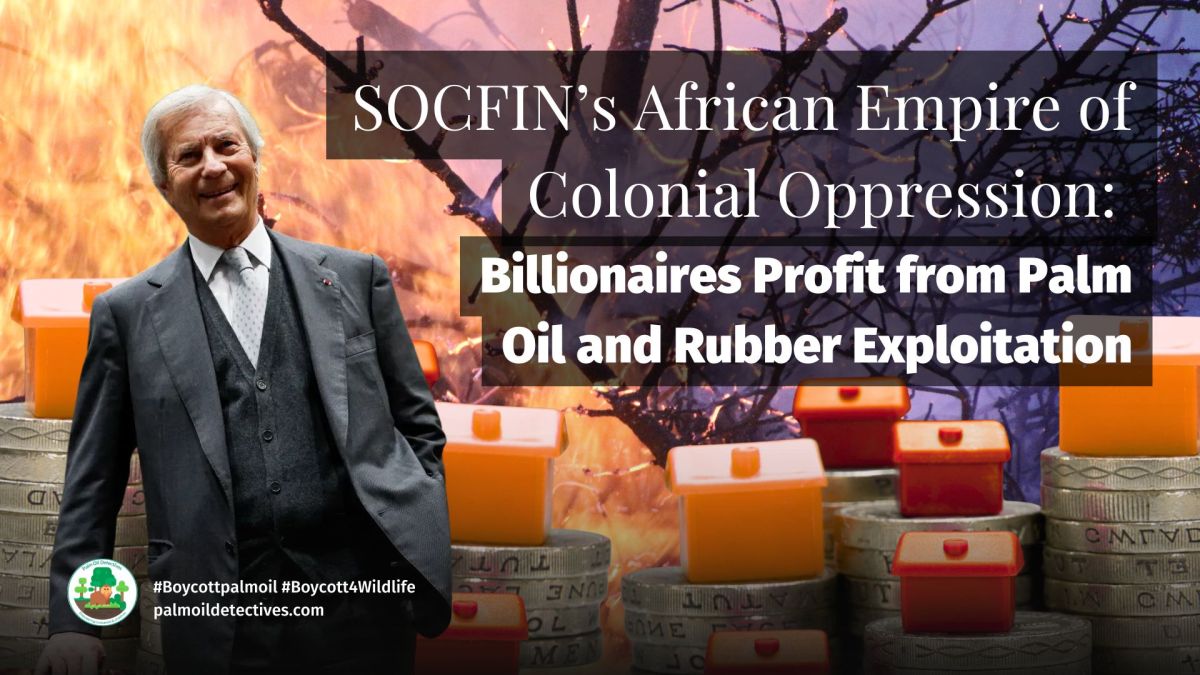
SOCFIN’s African Empire of Colonial Oppression: Billionaires Profit from Palm Oil and Rubber Exploitation

SOCFIN’s African Empire of Colonial Oppression: Billionaires Profit from Palm Oil and Rubber Exploitation

Investigation by Bloomberg exposes that despite being RSPO members, #SOCFIN plantations in #WestAfrica are the epicentre of #humanrights abuses, sexual coercion, environmental destruction, and #landgrabbing. Operating in #Liberia, #Ghana, #Nigeria, and beyond, SOCFIN’s…
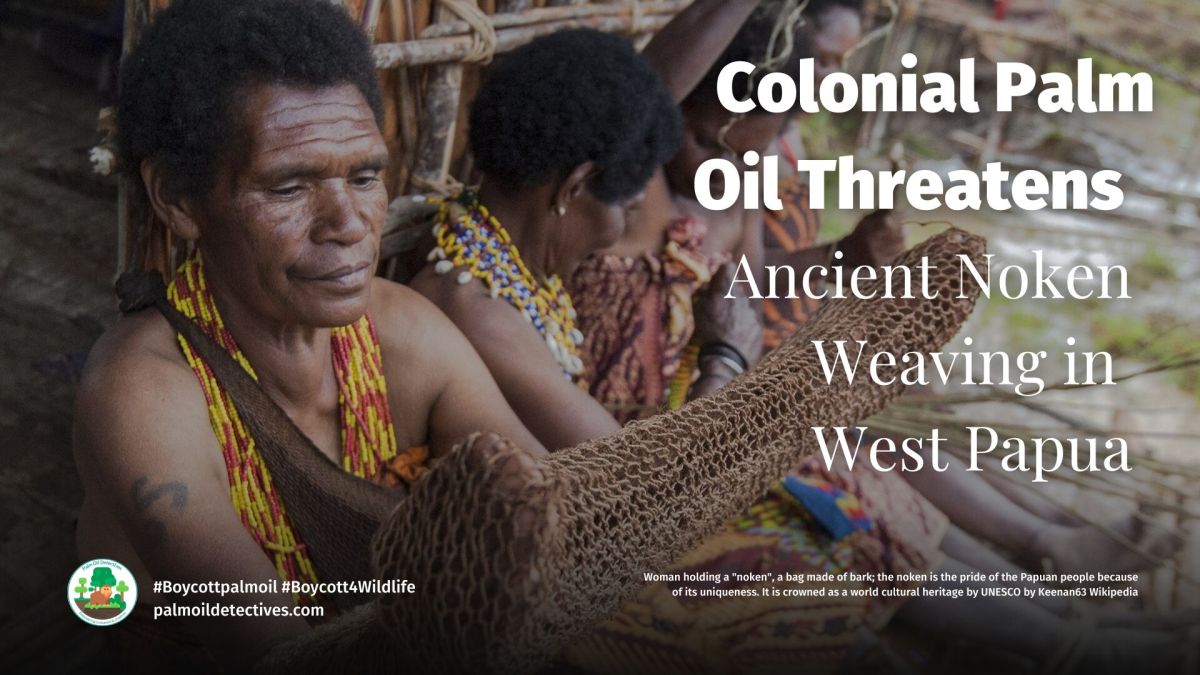
Read more

Palm Oil Threatens Ancient Noken Weaving in West Papua

Palm Oil Threatens Ancient Noken Weaving in West Papua

Colonial palm oil and sugarcane causing the loss of West Papuans’ cultural identity. Land grabs force communities from forests, threatening Noken weaving

Read more

Family Ties Expose Deforestation and Rights Violations in Indonesian Palm Oil

Family Ties Expose Deforestation and Rights Violations in Indonesian Palm Oil

An explosive report by the Environment Investigation Agency (EIA) details how Indonesia’s Fangiono family, through a wide corporate web, is linked to ongoing #deforestation, #corruption, and #indigenousrights abuses for #palmoil. Calls mount for…
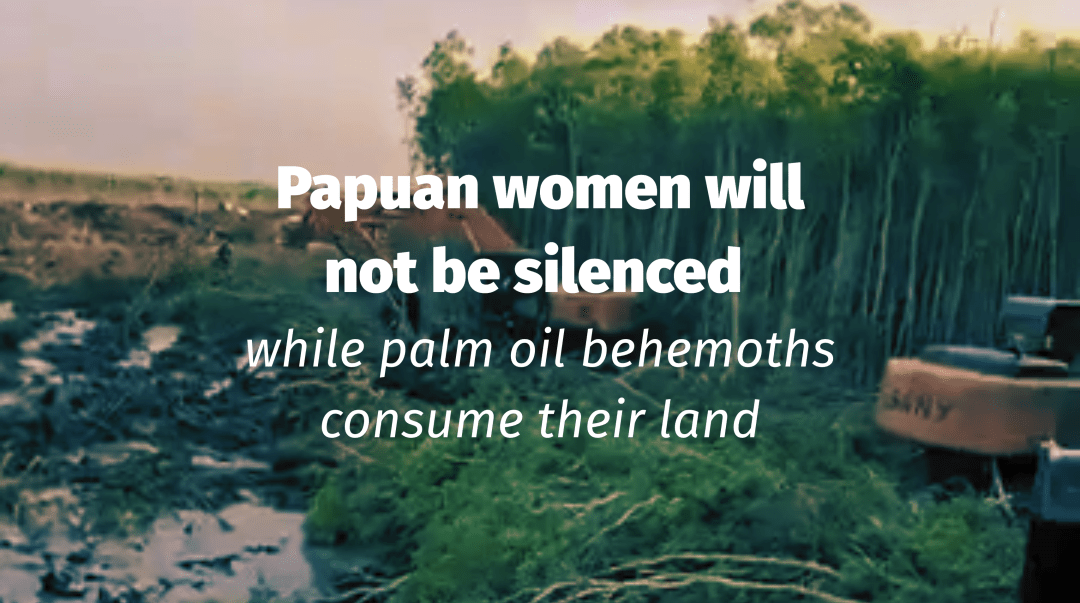
Read more

West Papuan Indigenous Women Fight Land Seizures

West Papuan Indigenous Women Fight Land Seizures

Indigenous Melanesian women in West Papua fight land seizures for palm oil and sugar plantations, protecting their ancestral rights. Join #BoycottPalmOil
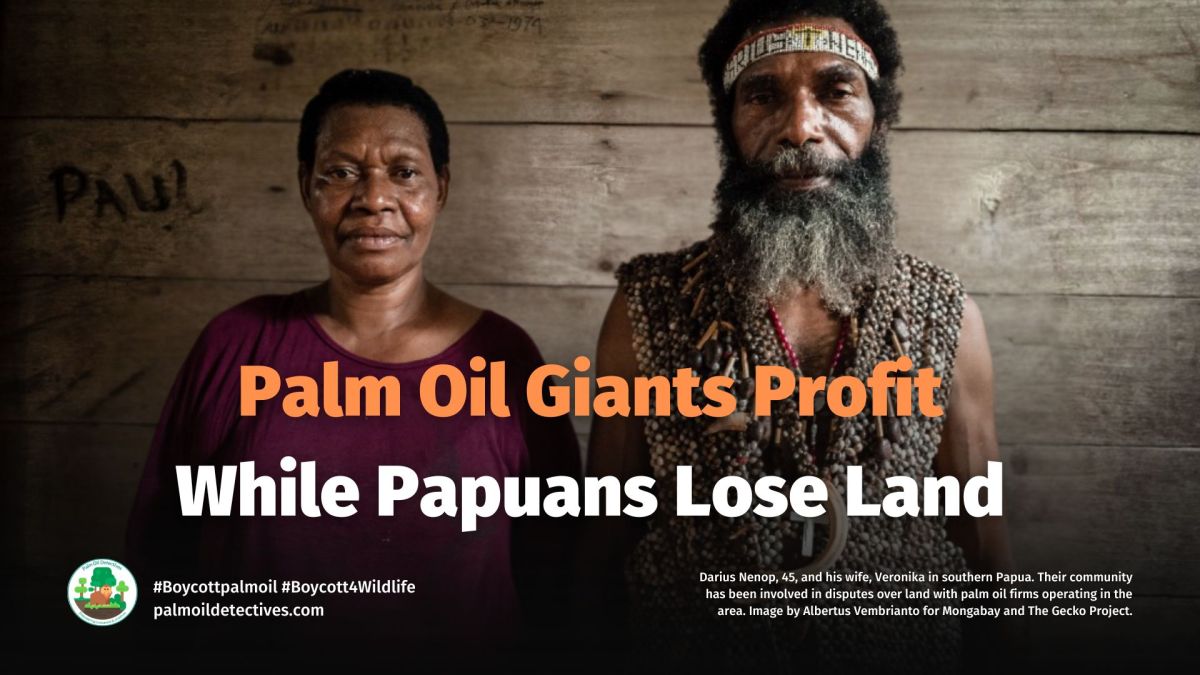
Read more

Greasing the Wheels of Colonialism: Palm Oil Industry in West Papua 

Greasing the Wheels of Colonialism: Palm Oil Industry in West Papua 

A landmark study published in Global Studies Quarterly in April 2025 has revealed that the rapid expansion of the #palmoil industry in #WestPapua is not only fuelling #deforestation, #ecocide and environmental destruction but…

Read more

Load more posts

Something went wrong. Please refresh the page and/or try again.


Take Action in Five Ways

1. Join the #Boycott4Wildlife on social media and subscribe to stay in the loop: Share posts from this website to your own network on Twitter, Mastadon, Instagram, Facebook and Youtube using the hashtags #Boycottpalmoil #Boycott4Wildlife.

Enter your email address

Sign Up

Join 3,171 other subscribers

2. Contribute stories: Academics, conservationists, scientists, indigenous rights advocates and animal rights advocates working to expose the corruption of the palm oil industry or to save animals can contribute stories to the website.

Wildlife Artist Juanchi Pérez

Wildlife Artist Juanchi Pérez

Read more

Mel Lumby: Dedicated Devotee to Borneo’s Living Beings

Mel Lumby: Dedicated Devotee to Borneo’s Living Beings

Read more

Anthropologist and Author Dr Sophie Chao

Anthropologist and Author Dr Sophie Chao

Read more

Health Physician Dr Evan Allen

Health Physician Dr Evan Allen

Read more

The World’s Most Loved Cup: A Social, Ethical & Environmental History of Coffee by Aviary Doert

The World’s Most Loved Cup: A Social, Ethical & Environmental History of Coffee by Aviary Doert

Read more

How do we stop the world’s ecosystems from going into a death spiral? A #SteadyState Economy

How do we stop the world’s ecosystems from going into a death spiral? A #SteadyState Economy

Read more

3. Supermarket sleuthing: Next time you’re in the supermarket, take photos of products containing palm oil. Share these to social media along with the hashtags to call out the greenwashing and ecocide of the brands who use palm oil. You can also take photos of palm oil free products and congratulate brands when they go palm oil free.

https://twitter.com/CuriousApe4/status/1526136783557529600?s=20

https://twitter.com/PhillDixon1/status/1749010345555788144?s=20

https://twitter.com/mugabe139/status/1678027567977078784?s=20

4. Take to the streets: Get in touch with Palm Oil Detectives to find out more.

5. Donate: Make a one-off or monthly donation to Palm Oil Detectives as a way of saying thank you and to help pay for ongoing running costs of the website and social media campaigns. Donate here

Pledge your support

#belize #boycottPalmOil #boycottpalmoil #childLabour #childSlavery #climatechange #community #goldMining #humanRights #hunger #indigenous #indigenousActivism #indigenousKnowledge #indigenousRights #indigenousrights #landRights #landgrabbing #landrights #maya #mexico #palmOil #poverty #slavery #wildfires

Western Parotia Parotia sefilata

Western Parotia Parotia sefilata

Location: West Papua (Illegally occupied by Indonesia)

Found exclusively in the montane forests of the Vogelkop Peninsula and Wandammen Mountains in Indonesian-occupied West Papua, this species is confined to isolated pockets of ancient, cloud-draped rainforest.

The Western Parotia Parotia sefilata, also called the Arfak Parotia, is a stunning bird-of-paradise of #WestPapua known for their mesmerising, ballerina-like courtship dance. Male #birds fan their iridescent flank plumes into a skirt and dazzle females with precise steps and shimmering throat shields. Although listed as Least Concern in 2016, this designation is dangerously outdated. The forests these rare birds call home have suffered catastrophic #deforestation in recent years due to the explosion of #palmoil plantations. These once-pristine regions are now fragmented and rapidly vanishing. Immediate action is needed to protect the Western Parotia from becoming the next victim of extinction.#BoycottPalmOil #Boycott4Wildlife

https://youtu.be/nNqV1BfSsZY

Unusual behaviours like mounting reveal complexity to the lives of Western #Parotia, thrilling #birds of paradise in #WestPapua. #Palmoil is a major threat. Fight for them and indigenous peoples #Boycottpalmoil #Boycott4Wildlife @palmoildetect https://palmoildetectives.com/2026/01/25/western-parotia-parotia-sefilata/

Share to BlueSky Share to Twitter

With jet black plumage 🖤 and bright green 💚 wattles, male Western Parotia #birds 🐦🦜🦚 of paradise gleam like scaly armour when they dance 🎶 Resist against their #extinction in #WestPapua when you #Boycottpalmoil 🌴🚫 #Boycott4Wildlife @palmoildetect https://palmoildetectives.com/2026/01/25/western-parotia-parotia-sefilata/

Share to BlueSky Share to Twitter

Appearance & Behaviour

Male Western Parotias are instantly recognisable by their jet-black plumage, metallic green wattles that gleam like scaled armour, and three distinctive wire-like head plumes that curl outward from each side of the crown—features that inspired the species name, derived from the Latin sex filum, meaning ‘six threads.’ A dazzling inverted silver triangle on their head flashes during display, perfectly offset by their elegant black flank plumes which form a flared skirt in courtship. Females are more subdued, clad in streaky brown feathers, allowing them to blend into the forest understorey.

This species of bird-of-paradise is polygynous. Males gather in exploded leks—loosely spaced display grounds—where they clear leaf-littered forest floors to create courts. On these makeshift stages, they perform intricate displays to attract females, combining pirouettes, head bobs, feather shimmers, and rapid shakes. A 2024 behavioural study also observed rare alternative mating tactics, including homosexual mounting and sneak copulation attempts by female-plumaged birds, suggesting untapped behavioural complexity (MacGillavry et al., 2024).
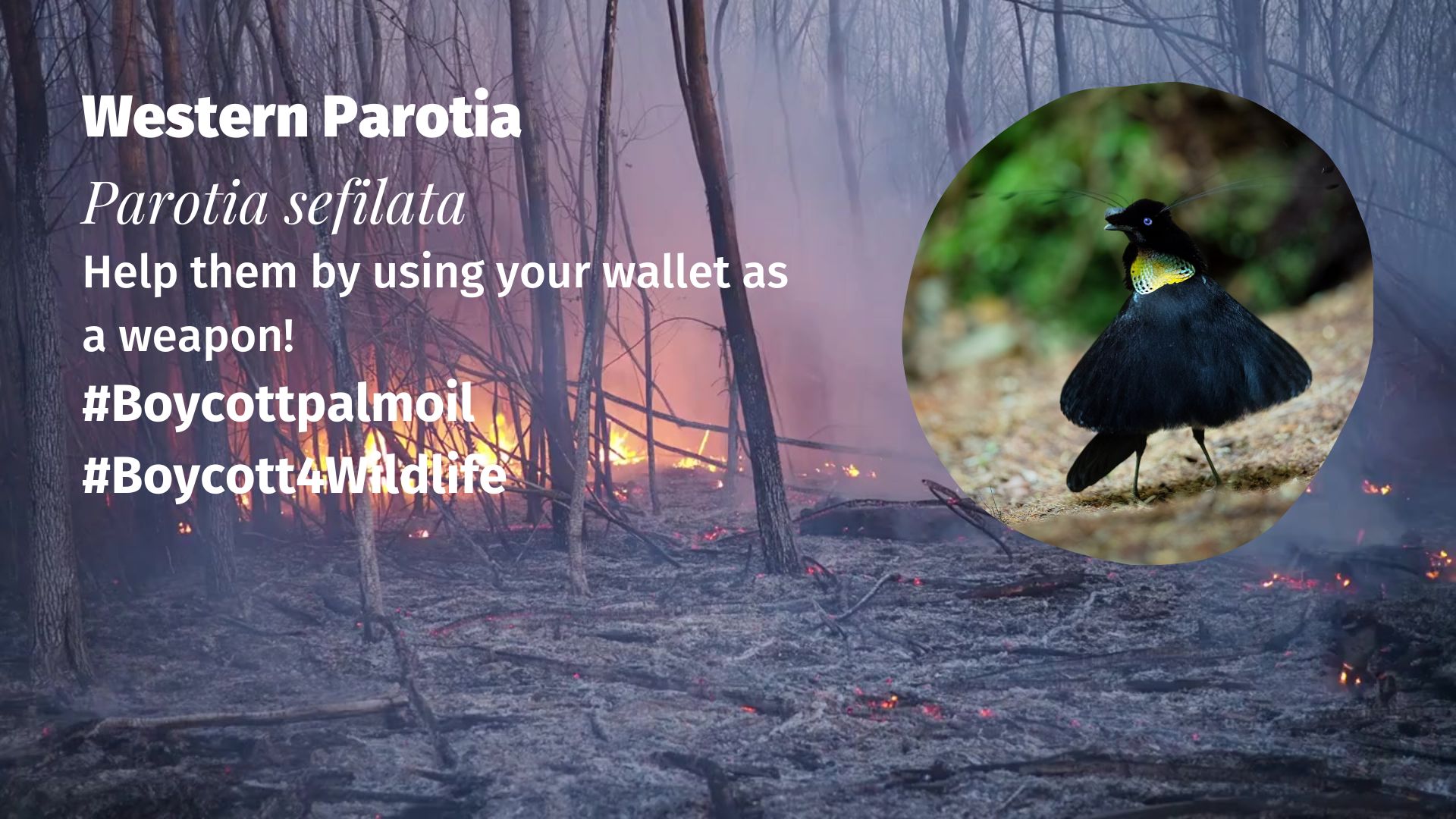
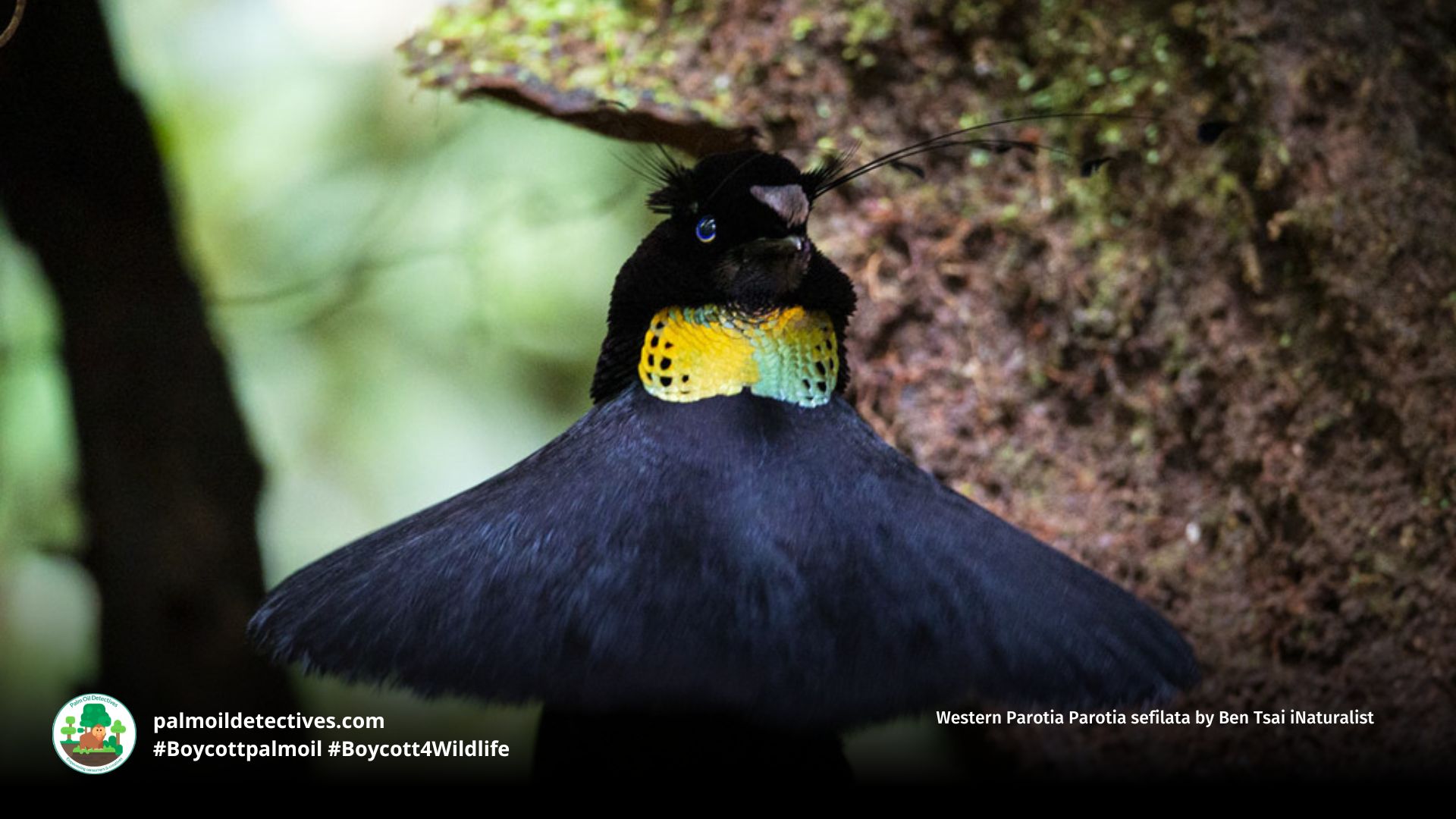
Western Parotia Parotia sefilata boycott palm oilWestern Parotia Parotia sefilata by Ben Tsai iNaturalist (2)Western Parotia Parotia sefilataWestern Parotia Parotia sefilata by Ben Tsai iNaturalistWestern Parotia Parotia sefilata by JJ Harrison (2)Western Parotia Parotia sefilata by JJ Harrison (3)Western Parotia Parotia sefilata by JJ HarrisonWestern Parotia Parotia sefilata threats

Threats

The Western Parotia is officially listed as Least Concern, but this 2016 classification dangerously underrepresents their current reality. Since that assessment, massive deforestation for timber and palm oil has devastated much of their limited range, particularly across the Vogelkop Peninsula and Wandammen Mountains. The threats are mounting and accelerating due to the following drivers:
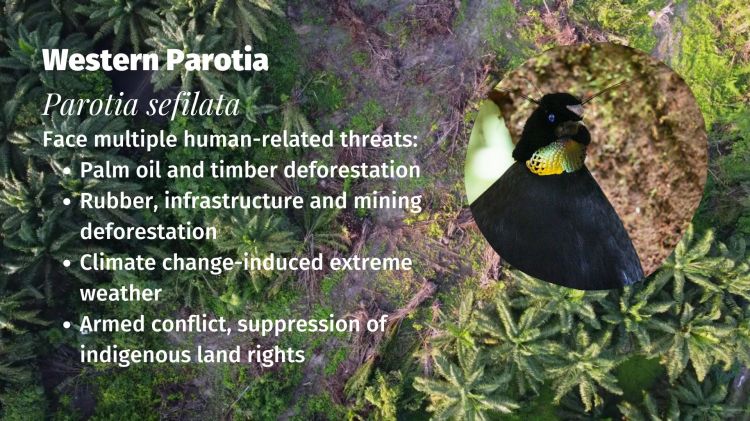
Western Parotia Parotia sefilata threats

Palm oil deforestation

Large-scale clearing of primary rainforest to make way for industrial palm oil plantations is now rampant across the Bird’s Head (Vogelkop) Peninsula. Even remote montane forests where Western Parotias lek and nest are not safe, as new roads are cut to expand plantation frontiers.

Timber deforestation

Commercial timber extraction is removing centuries-old forest giants that the Western Parotia depends on for fruit, foraging and nesting. Logging roads also fragment habitat, increase fire risk, and provide access to previously undisturbed ecosystems.

Deforestation for mining, rubber and infrastructure projects

Government-backed agribusiness schemes are encouraging monocultures such as oil palm and rubber, which completely erase the forest understory and tree canopy vital for the Parotia’s food and shelter.

Mining concessions in West Papua—often enforced with military support—are rapidly opening up forests in the Wandammen Mountains, overlapping with the Parotia’s habitat. Road construction to access mines and plantations is fragmenting the landscape irreparably.

Climate change-induced extreme weather

The species is restricted to highland forest. As temperatures rise and human pressures encroach from below, their montane habitat may shrink to mountaintop fragments, leaving no room for retreat.

Colonial exploitation, military conflict and suppression of Indigenous land rights:

Indigenous Melanesians have stewarded Papuan forests for millennia. Today, state and corporate projects continue to override Indigenous consent, leading to ecological destruction and social injustice hand-in-hand.

These combined threats pose a serious and immediate danger to the survival of the Western Parotia. Without urgent action to halt deforestation and recognise Indigenous land sovereignty, the species could slide rapidly toward extinction unnoticed.

Geographic Range

Western Parotias are found exclusively in the montane and submontane rainforests of the Vogelkop Peninsula and the Wandammen Mountains in West Papua. They are forest specialists, requiring old-growth rainforest to support their complex courtship behaviour and nesting needs. Since their last assessment in 2016, widespread forest loss has occurred across these regions, particularly from illegal logging and palm oil expansion, putting their long-term survival in serious jeopardy.

Diet

Western Parotias primarily feed on fruits—especially figs—and supplement their diet with arthropods. Their foraging occurs at various forest levels, but they prefer mid-canopy and understorey, where fruiting trees and insect-rich foliage are abundant.

Mating and Reproduction

Courtship and nesting behaviour are marked by sexual division of labour. Only the female builds the nest and raises the chick. Nests are often camouflaged in dense foliage. Although the precise breeding season remains unclear, it is believed to vary by elevation and fruiting cycles. Male courtship is heavily influenced by evolutionary modularity in display traits, which have diverged over time, giving rise to the extravagant variety seen across the Parotia genus (Scholes, 2008).

FAQs

How many Western Parotias are left in the wild?

There are no exact population estimates for the Western Parotia. The IUCN has classified them as Least Concern, but this was based on assessments from 2016. Since then, vast tracts of their habitat have been lost. Without a recent survey, the current population trend is unknown, but it is likely decreasing due to ongoing deforestation (BirdLife International, 2016).

How long do Western Parotias live?

In the wild, birds-of-paradise often live between 5 to 10 years, though lifespan data for this species is limited. In captivity, related species have reached over 15 years, but no long-term studies exist for Parotia sefilata specifically.

What challenges do conservationists face protecting this species?

Conservation of the Western Parotia is complicated by a lack of recent data and the remoteness of their habitat. The Vogelkop and Wandammen regions are undergoing rapid transformation due to illegal logging and palm oil expansion, often facilitated by state-backed infrastructure projects. These forests also fall within contested indigenous lands, and conservation solutions must be rooted in indigenous sovereignty to be effective.

Is the Western Parotia affected by the exotic pet trade?

Unlike parrots and smaller songbirds, Western Parotias are not commonly targeted for the exotic pet trade, likely due to their remote habitat and specialised diet. However, increased accessibility due to road construction could change this. It is essential to remain vigilant and oppose any wildlife trafficking.

Take Action!

Use your wallet as a weapon to stop extinction by boycotting palm oil. Always choose products that are 100% palm oil-free to avoid contributing to the deforestation that is pushing the Western Parotia closer to extinction. Support indigenous-led conservation efforts in West Papua and call for greater transparency around the spread of monoculture plantations. Protect the mesmerising courtship rituals of these remarkable birds by fighting to keep their forests standing. #BoycottPalmOil #Boycott4Wildlife #Vegan #BoycottMeat

Support the Western Parotia by going vegan and boycotting palm oil in the supermarket, it’s the #Boycott4Wildlife

Support the conservation of this species

This animal has no protections in place. Read about other forgotten species here. Create art to support this forgotten animal or raise awareness about them by sharing this post and using the #Boycottpalmoil #Boycott4Wildlife hashtags on social media. Also you can boycott palm oil in the supermarket.

Further Information

BirdLife International. (2016). Parotia sefilata. The IUCN Red List of Threatened Species 2016: e.T22706181A93913206. Retrieved 6 April 2025, from https://www.iucnredlist.org/species/22706181/93913206

MacGillavry, T., Janiczek, C., & Fusani, L. (2024). Video evidence of mountings by female-plumaged birds of paradise (Aves: Paradisaeidae) in the wild: Is there evidence of alternative mating tactics? Ethology. https://doi.org/10.1111/eth.13451

Scholes, E. (2008). Evolution of the courtship phenotype in the bird of paradise genus Parotia (Aves: Paradisaeidae): homology, phylogeny, and modularity. Biological Journal of the Linnean Society, 94(3), 491–504. https://doi.org/10.1111/j.1095-8312.2008.01012.x

Wikipedia contributors. (n.d.). Western parotia. Wikipedia. Retrieved 6 April 2025, from https://en.wikipedia.org/wiki/Western_parotia
Western Parotia Parotia sefilata boycott palm oil
Contribute to palm oil detectives - black rhino in profile

How can I help the #Boycott4Wildlife?


Take Action in Five Ways

1. Join the #Boycott4Wildlife on social media and subscribe to stay in the loop: Share posts from this website to your own network on Twitter, Mastadon, Instagram, Facebook and Youtube using the hashtags #Boycottpalmoil #Boycott4Wildlife.

Enter your email address

Sign Up

Join 3,176 other subscribers

2. Contribute stories: Academics, conservationists, scientists, indigenous rights advocates and animal rights advocates working to expose the corruption of the palm oil industry or to save animals can contribute stories to the website.

Wildlife Artist Juanchi Pérez

Wildlife Artist Juanchi Pérez

Read more

Mel Lumby: Dedicated Devotee to Borneo’s Living Beings

Mel Lumby: Dedicated Devotee to Borneo’s Living Beings

Read more

Anthropologist and Author Dr Sophie Chao

Anthropologist and Author Dr Sophie Chao

Read more

Health Physician Dr Evan Allen

Health Physician Dr Evan Allen

Read more

The World’s Most Loved Cup: A Social, Ethical & Environmental History of Coffee by Aviary Doert

The World’s Most Loved Cup: A Social, Ethical & Environmental History of Coffee by Aviary Doert

Read more

How do we stop the world’s ecosystems from going into a death spiral? A #SteadyState Economy

How do we stop the world’s ecosystems from going into a death spiral? A #SteadyState Economy

Read more

3. Supermarket sleuthing: Next time you’re in the supermarket, take photos of products containing palm oil. Share these to social media along with the hashtags to call out the greenwashing and ecocide of the brands who use palm oil. You can also take photos of palm oil free products and congratulate brands when they go palm oil free.

https://twitter.com/CuriousApe4/status/1526136783557529600?s=20

https://twitter.com/PhillDixon1/status/1749010345555788144?s=20

https://twitter.com/mugabe139/status/1678027567977078784?s=20

4. Take to the streets: Get in touch with Palm Oil Detectives to find out more.

5. Donate: Make a one-off or monthly donation to Palm Oil Detectives as a way of saying thank you and to help pay for ongoing running costs of the website and social media campaigns. Donate here

Pledge your support


Learn about other animals endangered by palm oil and other agriculture

GlobalSouth America S.E. AsiaIndiaAfricaWest Papua & PNGCapped Langur Trachypithecus pileatus
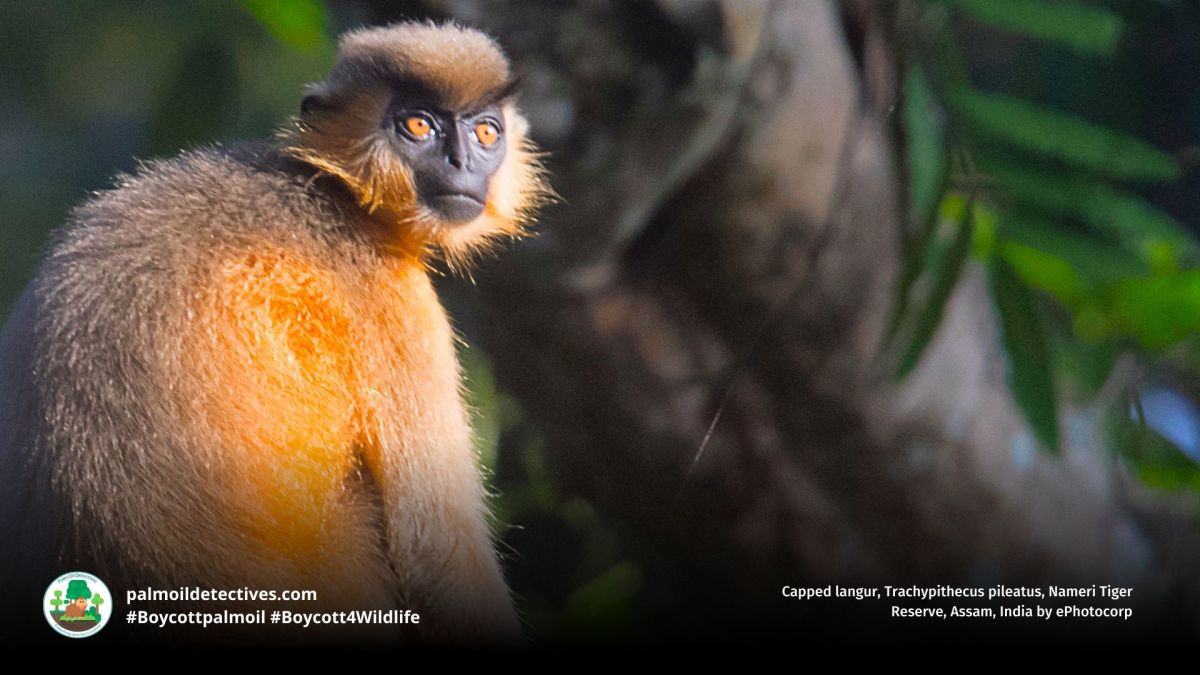
Capped Langur Trachypithecus pileatus

Keep reading

Mountain Tapir Tapirus pinchaque

Mountain Tapir Tapirus pinchaque

Keep reading

Saola Pseudoryx nghetinhensis

Saola Pseudoryx nghetinhensis

Keep reading

Tucuxi Sotalia fluviatilis

Tucuxi Sotalia fluviatilis

Keep reading

Frill-Necked Lizard Chlamydosaurus kingii

Frill-Necked Lizard Chlamydosaurus kingii

Keep reading

Grey Crowned Crane Balearica regulorum

Grey Crowned Crane Balearica regulorum

Keep reading


Learn about “sustainable” palm oil greenwashing

Read more about RSPO greenwashing

Lying Fake labelsIndigenous Land-grabbingHuman rights abusesDeforestation Human health hazards

A 2019 World Health Organisation (WHO) report into the palm oil industry and RSPO finds extensive greenwashing of palm oil deforestation and the murder of endangered animals (i.e. biodiversity loss)

Read moreWHO Bulletin on Palm Oil: Deforestation and ExtinctionWHO Bulletin on Palm Oil: Deforestation and ExtinctionWHO Bulletin on Palm Oil: Deforestation and ExtinctionWHO Bulletin on Palm Oil: Air Pollution and Health

#animals #Bird #birds #Birdsong #Boycott4wildlife #BoycottMeat #BoycottPalmOil #deforestation #EndSongbirdTrade #extinction #ForgottenAnimals #FreeWestPapua #gold #goldMining #hunting #indigenous #military #PalmOil #palmOilDeforestation #palmoil #Parotia #poaching #songbird #songbirds #vegan #vulnerable #VulnerableSpecies #WestPapua #WesternParotiaParotiaSefilata #WestPapua